No other people in Europe knows its beginnings so precisely – or believes it does. The Icelanders have a book that lists hundreds of settlers by name, farm and origin, and a chronicle that names the summer the country became Christian. Both were written two centuries after the events. Since then two witnesses have joined them that do not tell stories but measure: a thin layer of ash in the ground and the genomes of the first dead. They confirm a great deal. On one question they disagree sharply.
It all starts with a priest called Ari Þorgilsson, nicknamed inn fróði, the learned. In the 1120s he wrote a short history of his country, the Íslendingabók, the Book of the Icelanders. The date can be narrowed down: Ari dedicates it to bishops Þorlákr and Ketill, who held office together only between 1122 and 1133. The work is brief, dry and written in the vernacular. It survives only in seventeenth-century copies made by a priest named Jón Erlendsson from an older manuscript.
Ísland byggðist fyrst ór Norvegi á dögum Haralds ins hárfagra, Hálfdanarsonar ins svarta.
"Iceland was first settled from Norway in the days of Harald Fairhair, son of Halfdan the Black."Ari Þorgilsson, Íslendingabók, ch. 1; our translation
Ari works like a historian. He names his informants and hangs his chronology on a date he knew from English sources: the death of King Edmund of East Anglia, which he places in 870. Ívarr, son of Ragnar Lodbrok, had Edmund killed, he writes. So in its very first chapter Icelandic history reaches across to the Great Heathen Army. As the first settler Ari names Ingólfr, who made his home in the south-west, where Reykjavík stands today. The year 874, now attached to Ingólfr, comes from later tradition.
According to Ari the island was not empty. Christian men lived there whom the Norse called papar. They left because they did not want to live alongside heathens:
… ok létu eftir bækr írskar ok bjöllur ok bagla. Af því mátti skilja, at þeir váru menn írskir.
"… and they left behind Irish books, bells and crosiers. From this one could tell that they were Irishmen."Ari Þorgilsson, Íslendingabók, ch. 1; our translation
That sounds like legend, but it has an outside witness. Around 825 the Irish scholar Dicuil, working at the Carolingian court, wrote a book on the measurement of the world. In it he reports that clerics had told him thirty years earlier that they had lived on the island of Thule from February to August, where around midsummer the sun barely set at night. Whether Dicuil's Thule is Iceland cannot be proven, but the description fits. Archaeologically, the papar have still not been securely identified. There are place-names such as Papey and caves with carved crosses of uncertain age. Nothing more.
The most precise clock of the settlement is a volcanic eruption. Late in the ninth century a fissure system opened in the Vatnaöldur area of the highlands and covered much of Iceland with a thin, two-coloured layer of ash. Icelandic archaeologists call it the Landnám tephra. The same ash has been found in the Greenland ice, where it can be dated to the year. For a long time the date was 871, give or take two years. Since a revision of the ice-core timescale, 877 is now usually given; a study by Magdalena Schmid and colleagues works with 877 plus or minus one.
More important than the year is where things lie in relation to it. In Reykjavík, in the street Aðalstræti, a stretch of turf wall was found beneath the tephra, so older than the eruption, while the longhouse beside it was built afterwards. People were there shortly before the ash fell. In 2018 Schmid and colleagues combined more than three hundred reliable radiocarbon dates with the tephra. Their result: before 877 there are only traces of short stays; after it, things move fast. Less than one per cent of tephra-dated sites are older, and nearly half were founded between 877 and the Eldgjá eruption around 939. Within some twenty years the land had been parcelled out in its essentials.
Ari says wise men held that Iceland was fully settled within sixty years. The ash says: roughly right, and it began around 870 to 880. Saga and spade rarely lie this close together.
Beside Ari stands the Landnámabók, the Book of Settlements. It works its way clockwise round Iceland, bay by bay, noting who took land where, where he came from and who descended from him. The numbers are huge: some 430 settlers, women among them, more than three thousand people and around fourteen hundred place- and farm-names.
The original is lost. What survives are versions, each with an editor. Sturlubók is the work of Sturla Þórðarson, written around 1275–80. Hauksbók was compiled by Haukr Erlendsson in the early fourteenth century from Sturla and a lost version by Styrmir Kárason. Of Melabók only two leaves remain. Two seventeenth-century reworkings, Skarðsárbók and Þórðarbók, complete the set. Whether Ari wrote a first version is an open question.
The book secured property and descent, very practical matters in the thirteenth century. An epilogue in one of the later versions says so openly: this is written down to answer foreigners who claim that Icelanders descend from slaves and scoundrels. The settlement here is also a self-portrait. One of the great figures of the book is Aud the Deep-Minded, who came from Scotland, shared out land among her people and set up her freedmen on farms of their own.
The Book of Settlements presents the settlers as free men from Norway, but it does not hide the others. Right at the start stands the story of Hjörleifr, Ingólfr's sworn brother: he was killed by his Irish slaves, who fled to the islands off the south coast and were killed there. The islands have been called Vestmannaeyjar ever since, the islands of the Westmen – the name for the Irish. Whether it happened like that, nobody knows. That there were slaves, the law books confirm. More in our piece on slavery among the Vikings.
Here the genes speak more clearly than the texts. Around 2000 Agnar Helgason and colleagues examined the maternal and paternal lines of present-day Icelanders. About 80 per cent of the Y chromosomes, the paternal lines, are of Scandinavian origin; of the maternal lines only just over 37 per cent are, while the rest, about 62 per cent, derive from the British Isles. In 2018 genomes from 27 early burials were added. They show people of Scandinavian, Gaelic and mixed ancestry; on average the Scandinavian share was around 57 per cent, against about 70 in Icelanders today.
This does not mean every woman from Ireland or Scotland was a slave. Many settlers came by way of the Hebrides, Ireland and Scotland, where Norse people had lived and married locally for decades; Aud is the best example. The studies measure ancestry, not legal status. What is certain is that the Icelanders arose from Norse men and, to a large extent, from women from the west. The trail of genes further west is followed in Indigenous DNA in Iceland.
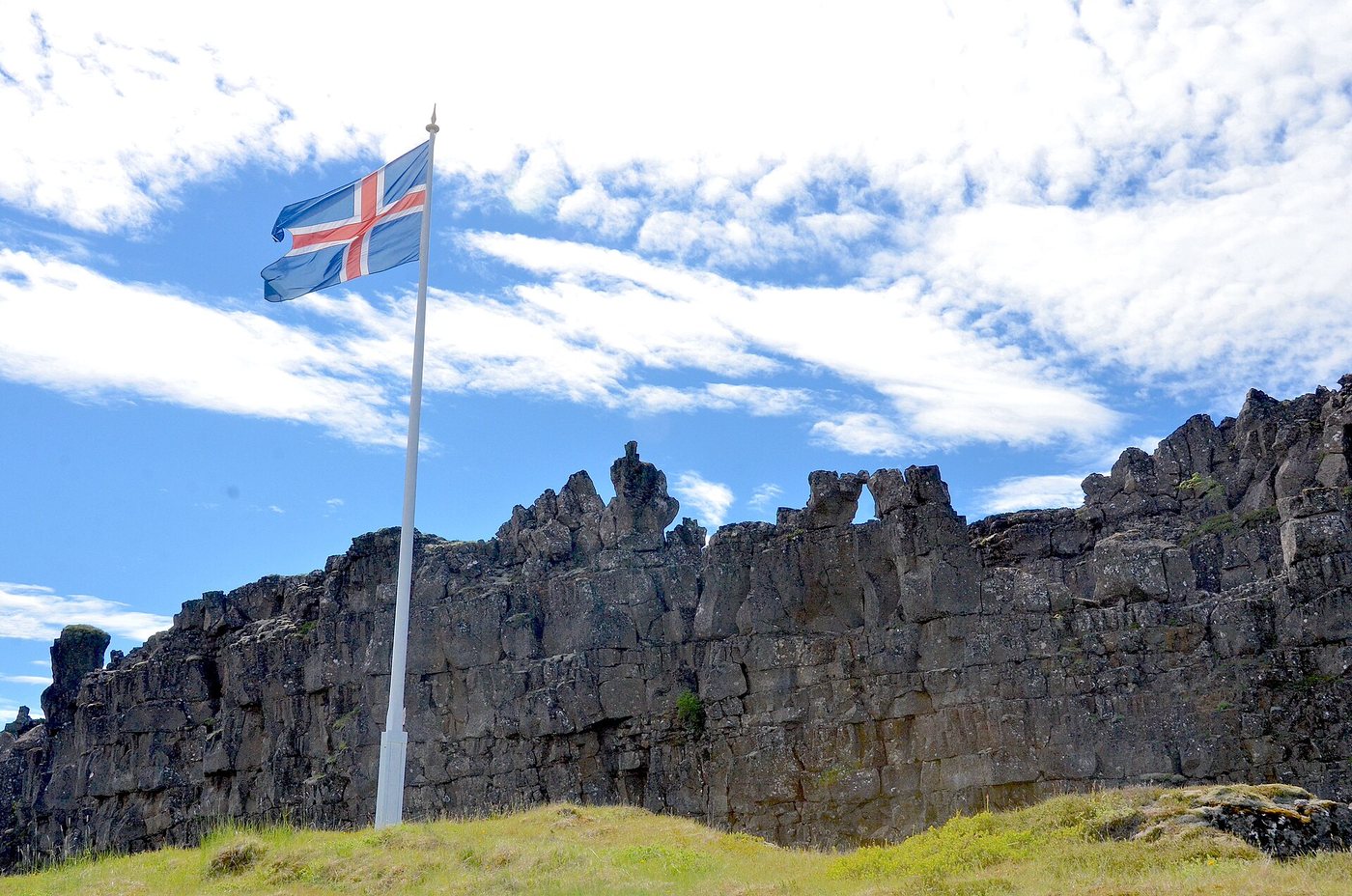
Iceland had no king. It had an assembly. According to Ari a man called Úlfljótr brought laws from Norway, and the Alþingi, the Althing, was established "on the advice of Úlfljótr and of all the people of the land", at the place where it still met in Ari's day: Þingvellir, the assembly plains in a rift valley east of Reykjavík. Ari's figures point to the year 930. Every summer the free men gathered there for about two weeks to argue, trade and marry off their children.
Power lay with the chieftains, the goðar. A chieftain held a goðorð, a chieftaincy. That was not a district but a bundle of rights and followers that could be inherited, shared, given away and sold. Every free farmer had to attach himself to a chieftain, but could change. The word is related to goð, god. Whether the early chieftains also led cult is disputed; the evidence comes almost entirely from sagas.
Around 965, Ari says, the land was divided into quarters, each with three spring assemblies, the north with four. The law books give a total of 39 chieftaincies. So that the northern quarter did not have more votes, the other quarters received extra seats; in the law council, the lögrétta, 48 chieftains sat, each with two advisers. The often-quoted figure of 36 chieftaincies before the reform is a back-calculation, not a recorded number. There were also four quarter courts and, around 1005, a Fifth Court that could decide by simple majority, because the others deadlocked too often.
At first the law was not written. It lived in the head of one man, the lawspeaker, lögsögumaðr. He was chosen for three years and in that time had to recite the entire law from the Law Rock, the Lögberg, one third each summer, and the assembly procedure every year. Ari knew the list of lawspeakers and dates by it. The first after Úlfljótr was Hrafn Hængsson, son of a settler.
In the winter of 1117–18, Ari says, the law was written down at the house of Hafliði Másson. What we now read as the law of the Icelandic Commonwealth is called Grágás, Grey Goose, and survives in two large thirteenth-century manuscripts. It covers everything from manslaughter and inheritance to the question of who owns a stranded whale. A state without army or enforcement that relied on procedure: it lasted until 1262–64, when the Icelanders submitted to the Norwegian king.
The most famous scene in the Íslendingabók takes place at the Althing. King Olaf Tryggvason of Norway was pressing the Icelanders to accept the new faith, missionaries had come, and Christians and heathens stood facing each other on the assembly plain and renounced each other. It was agreed that the lawspeaker Þorgeirr, himself still a heathen, should decide.
… þá lagðist hann niðr Þorgeirr ok breiddi feld sinn á sik ok hvíldi þann dag allan ok nóttina eftir.
"… then Þorgeirr lay down, spread his cloak over himself and lay like that all that day and the following night."Ari Þorgilsson, Íslendingabók, ch. 7; our translation
In the morning he spoke from the Law Rock. If they tore the law apart, they would tear apart the peace as well; all should have "one law and one custom". The Icelanders were to be Christians and be baptised. Yet there were exceptions: the old law on the exposure of infants and the eating of horse meat remained, and anyone who wished could sacrifice in secret. Only if seen would he be punished. A few years later these exceptions were abolished too.
Ari places this in the summer in which Olaf Tryggvason fell, that is 1000; some scholars argue for 999. What happened under the cloak – prayer, brooding or a ritual – has been speculated about for centuries. All that is recorded is the cloak.
Archaeological evidence is the start of permanent settlement shortly before or around the Landnám tephra of about 877, the rapid division of the land within a few decades and a few older traces of short stays. Genetics shows a mixed origin with a marked share from the British Isles, especially among women.
Contemporary sources are almost non-existent. Dicuil's account of around 825 about clerics on Thule is the only text from before the settlement, and it does not name Iceland.
Later tradition is Ari's book of the 1120s, the Book of Settlements in versions of the thirteenth and fourteenth centuries, the law books and the sagas. From them come Ingólfr and the year 874, Úlfljótr, Hjörleifr's death and the scene under the cloak. Ari is close and careful, but he too writes two centuries later.
Modern interpretation covers the role of the papar, the question whether chieftains were priests, and the translation of genetic percentages into life stories.
What remains is a people that wrote itself down, and a soil that proves it right on much of it. How the story went on westward we tell with the Greenlanders and in our overview of the Vikings in the North Atlantic. For courage. For memory. For legends that live on.
Aud the Deep-Minded · The Vikings in the North Atlantic – Iceland, Greenland & Vinland · The Greenlanders · The Faroese · Indigenous DNA in Iceland · Erik the Red.

