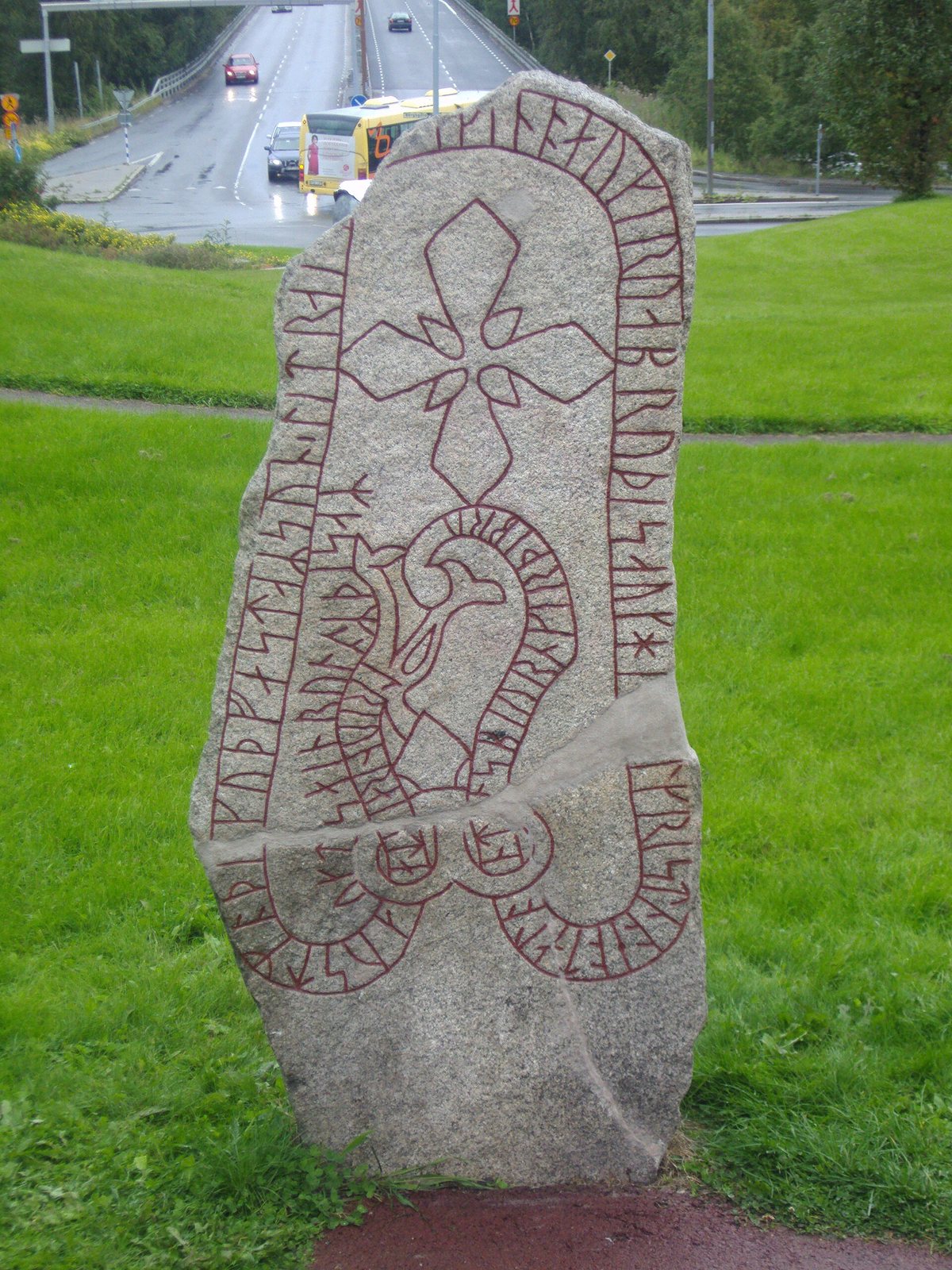
Most runestones say: he had this stone raised in memory of his father. The stone on Frösön says something else. Östman, Gudfast's son, had it raised, had a bridge built – and had Jämtland Christianised. One man, one land, one sentence. A few hundred metres away, beneath the floor of Frösön church, archaeologists found in 1984 the remains of a birch tree, and around it the bones of bears, elk and pigs. Two finds that together tell how a land between the kingdoms changed its faith.
Jämtland lies at the heart of Scandinavia, east of the mountains that now divide Norway and Sweden. To the west the passes lead down into Trøndelag; to the east the rivers run to the Gulf of Bothnia. In the middle lies the great lake Storsjön, and in the lake the island of Frösön. Anyone who wants to understand the history of the Jamts has to keep this position in mind: they could be reached from both sides and for a long time belonged wholly to neither.
The Jamts of the Viking Age were farmers, hunters and traders. Furs, iron from the bog ore of the forests, and antler were sought-after goods. That they were not Vikings in the sense of sea-raiders goes without saying for an inland people. Why "Viking" describes an activity rather than a people anyway, we explain under Danes, Swedes, Norwegians.
The Frösö stone is the northernmost runestone in Sweden and the only one in Jämtland. It originally stood at the eastern tip of Frösön, by Östersund, the narrow strait between the island and the mainland – exactly where people crossed. Today it stands outside the county administration building on Frösön. It is usually dated to around 1030–1050; a closer date is not possible.
The inscription is partly damaged and some runes have been supplied. In normalised form it reads:
Austmaðr, Guðfastar sunr, lét ræisa stæin þenna ok gørva brú þessa, ok hann lét kristna Jamtaland. Ásbjǫrn gørði brú, Trjónn ræist ok Stæinn rúnar þessar.
"Östman, Gudfast's son, had this stone raised and this bridge made, and he had Jämtland Christianised. Åsbjörn made the bridge, Tryn and Sten carved these runes."Runestone J RS1928;66, Frösön; normalised reading based on the Scandinavian Runic-text Database; our translation
The reading calls for caution. The word "stone" survives only in part, and the carvers' names are rendered in different ways. But the key clause, lét kristna Jamtaland, is clearly legible. In this form it is unique: no other runestone claims that someone brought a whole land to Christianity.
The stone does not say. The name Austmaðr literally means "east man". Östman could have a bridge built and employ two rune carvers, so he was wealthy and respected. Whether he was a local chieftain, a king's representative or both cannot be decided. Just as open is how the conversion happened. "He had Christianised" could mean he brought priests into the land, that he pushed through acceptance of the new faith at an assembly, or simply that he saw himself as the man under whom it happened.
The bridge fits the theme. Bridge-building is common on eleventh-century runestones and counts as a Christian work: one did something for the community and for one's own soul. How the change of faith generally took place in the North we show under the Christianisation of the Germanic peoples. Jämtland is a small but rare case, because here the change was carved in stone by someone who claimed it for himself.
The name Frösön is usually explained as "Freyr's island", after the god of fertility and prosperity whom we cover under Freyr and the Vanir. The explanation is widespread but, as with many place-names, not beyond doubt.
More solid is what came to light in 1984 during work in the medieval church of Frösön. Beneath the chancel, in the area of the altar, archaeologists found the stump of a birch tree, and around it a dense layer of animal bones: brown bear, elk, red deer, pig, sheep or goat, cattle and other species. Strikingly many skulls and jaw parts. There were also some human bones.
The osteologists Ola Magnell and Elisabeth Iregren re-examined the material in 2010. Their radiocarbon dates place the site in the late Viking Age. Cut and chop marks show that bears and pigs were butchered and eaten; bones, not whole animals, were deposited. The times of slaughter point to activity in late autumn, in spring and perhaps around midsummer. The human bones they see as remains of disturbed burials rather than sacrifices.
The picture is of an open-air place with a tree, where meals were held and parts of the animals left behind. The word blót for sacrifice and sacrificial feast suggests itself, and Magnell and Iregren use it. What role the bear in particular played is open; some scholars also consider Sámi influence. More on the bear in the Norse world is in The Bear in the North.
That the church was built right over this place is hardly chance. The pattern is known from elsewhere: the new faith took over the site of the old and made it its own. Here we have a find that can be combined with the sentence on the runestone into a story – a pagan cult site in the late tenth or early eleventh century, soon a church above it, and a few hundred metres away a man claiming the conversion of the land.
The story should not be made too neat, though. When exactly the cult site was abandoned and when the first church stood in its place cannot be fixed to the decade. The present church is later, and whether there was a wooden building before it is uncertain. The link between Östman and the site under the church is an obvious guess, not evidence.
The Jamts had an assembly of their own, the Jamtamót. The name is unusual: while almost everywhere else in the North people spoke of the thing, here it is mót, meeting. The meaning is the same, an assembly of free farmers that gave judgement and settled common matters.
How old the Jamtamót is, we do not know. Popular literature often says it arose shortly after the Icelandic Althing of 930. There is no evidence for this; the assembly only becomes tangible in medieval sources. That it met in late winter and was tied to a market comes from later tradition. We therefore treat the Jamtamót as a real institution with an unknown beginning.
What the sagas tell about Jämtland dates from the thirteenth century, above all Snorri's Heimskringla. According to it, a man called Ketil Jamti, son of a jarl from Trøndelag, fled over the mountains from King Eystein, cleared forest and settled the land said to be named after him. That is a foundation legend of the kind many regions acquired; the name Jämtland is surely not derived from a Ketil – if anything, the other way round.
Snorri goes on to say that the Jamts at first belonged to no king. Under Hákon the Good in the tenth century they came west, paid him tribute and received law from him, because they were of Norwegian descent. In the conflict between Olaf the Saint and the Swedish king Olof they then went over to the Swedish king and rejected the Norwegian king's claims. Close ties to Trøndelag, the country of the jarls of Lade, are plausible. Whether the details are right cannot be checked – Snorri wrote two hundred years later and from a Norwegian point of view.
We stand on firmer ground in the late twelfth century. According to Sverris saga, King Sverrir subdued the Jamts around 1178. Politically Jämtland then belonged to Norway until it passed to Sweden in the Treaty of Brömsebro in 1645. In church matters, however, it remained with the archdiocese of Uppsala throughout the Middle Ages. A land that paid taxes to one king and prayed in the church of the other realm: that describes the Jamts' position better than any border line.
Contemporary evidence is the Frösö stone of the eleventh century: Östman, Gudfast's son, a bridge and the Christianisation of Jämtland. There is no more Viking Age writing for Jämtland.
Archaeological evidence is the cult site under Frösön church with its birch stump and animal bones, among them several brown bears, radiocarbon-dated to the late Viking Age.
Later tradition is Ketil Jamti, the tribute to Hákon the Good, the switch to the Swedish king under Olaf the Saint and the subjugation by Sverrir. Much about the Jamtamót belongs here too.
Modern interpretation covers the derivation of Frösön from Freyr, the role of the bear, the link between Östman and the cult site, and the picture of an independent farmers' republic that regional history likes to paint.
What remains is a land between the kingdoms that left its own history in two places: in a sentence on stone and in a layer of bones beneath an altar. For courage. For memory. For legends that live on.
Danes, Swedes, Norwegians · The Christianisation of the Germanic Peoples · The Earls of Lade · The Kvens · Olaf Tryggvason – missionary king and the fall at Svolder · Uppsala.

