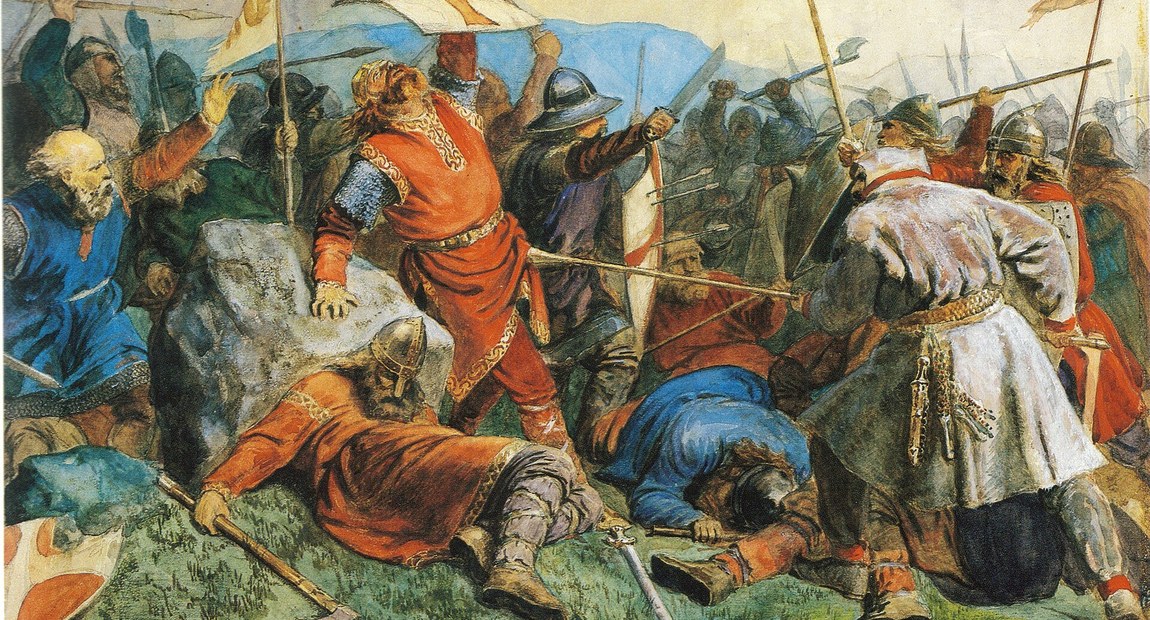
In 1016 Olaf Haraldsson defeated the earls of Lade at Nesjar, ruled Norway for a little over a decade, fled Cnut the Great in 1028, came back and fell at Stiklestad in 1030. A year later he was a saint. This article separates the king from the cult, works through the sources from Sigvatr to Snorri, deals with the disputed date of the battle, and says plainly where there is no attested link to the Rhineland and where there is one to northern Germany.
Olaf Haraldsson, in Old Norse Óláfr Haraldsson, ruled Norway from 1016 to 1028, barely twelve years. He was driven out, came back, and fell in the summer of 1030 against a levy raised by Norwegian magnates. As a dead man he made the bigger career: in 1031 Bishop Grimkell declared him a saint, and for centuries he counted as the true, eternal lord of the country. The sagas call him inn digri, usually rendered "the stout" or "the thick", and later inn helgi, "the holy".
The difficulty with every account is that the two biographies run into each other. Almost everything we know about the king was written or composed by people who already saw him as a saint or lived from his cult. This article therefore proceeds by layers of source material. The battle itself is covered at length in the article on Stiklestad; here the subject is the whole man.
According to the sagas Olaf was born around 995; some scholars think he was older. His mother was Åsta Gudbrandsdatter, his father Harald Grenske, a petty king in south-eastern Norway who is said to have been killed in Sweden before Olaf was born. Olaf grew up with his stepfather Sigurd Syr in Ringerike; his half-brother Harald Sigurdsson, later Harald Hardrada, came from his mother's second marriage. The descent from Harald Fairhair that the sagas claim for Olaf's father cannot be proved.
Closest to the events stand the skalds. A skald is a Norse court poet who performed strophes in a strict form (dróttkvætt) before his lord. Because syllable count, alliteration and internal rhyme fix the wording, such strophes often survived oral transmission better than prose. They were written down only in sagas of the twelfth and thirteenth centuries, though, and a praise poet flatters by trade.
Sigvatr Þórðarson, an Icelander (about 995 to 1045), was Olaf's court poet and, by tradition, his marshal (stallari). About 160 of his strophes survive, more than from any other poet of the period. The Víkingarvísur (about 1014/15) tally Olaf's early campaigns, the Nesjavísur celebrate the sea battle of 1016, and after Olaf's death came the Erfidrápa and a frank admonition to Olaf's son Magnus. His nephew Óttarr svarti ("the Black") served in turn Olof Skötkonung, Olaf, Olof's son Anund Jacob and finally Cnut the Great; his Hǫfuðlausn, the "head-ransom", builds on Sigvatr's strophes about Olaf's Viking expeditions. Þórarinn loftunga composed the Glælognskviða in the early 1030s, the oldest surviving testimony to Olaf's sanctity.
According to Russell Poole, whom I read, it was addressed to Sveinn Knútsson, Cnut's son, who was then governing Norway for his father, and was meant to move him to support the cult of the slain king; Poole refers to Matthew Townend. The veneration thus did not begin only with Olaf's followers but at the court of his opponents. The strophes contain the first "signs": the body lies intact, hair and nails grow, bells ring by themselves, candles burn at the altar. These are motifs already familiar from the East Anglian saint Edmund.
The Anglo-Saxon Chronicle, in the English translation I read in excerpts, reports under 1028 that Cnut went to Norway with fifty ships and drove Olaf from the land, and under 1030 that Olaf returned, the people gathered against him, and he was slain there "by his own people" and afterwards canonised. One manuscript (C) says more briefly, according to Poole, that he was "afterwards holy". When that addition entered the manuscripts cannot be read from the translation.
The sagas and chronicles date from the twelfth and thirteenth centuries: the Historia Norwegiae (second half of the twelfth century), Ágrip (about 1190), the Latin history of the monk Theodoricus (about 1177 to 1188), the Oldest Saga of St Olaf (about 1200, largely lost), the Legendary Saga (early thirteenth century), and Fagrskinna, Morkinskinna and the Heimskringla of Snorri Sturluson (about 1225 to 1230). Then there is the Passio et miracula beati Olavi, a passion and collection of miracles compiled around 1150 to 1160 or shortly after, possibly by Archbishop Eysteinn Erlendsson; the title Acta sancti Olavi belongs to a nineteenth-century edition, not to a separate text. On the genre see the Icelandic sagas.
Adam of Bremen wrote around 1075 from the viewpoint of the archbishopric of Hamburg-Bremen. According to the summaries I read he calls Nidaros a metropolis and knows of the pilgrimage to the shrine; I have not read the Latin text. On his method see Adam of Bremen.
Two witnesses are mute and valuable for that reason. Three coin types of Olaf are known, all modelled on Anglo-Saxon coins; the legend reads ONLAF REX NORMANORUM, "Olaf, king of the Norsemen", and two well-preserved pieces of the earliest type are struck on square blanks. Where they were struck, the Norwegian coin description I read does not say; I leave it open. The Kuli stone from Kuløy in Nordmøre carries a runic inscription on its narrow edge which, in the usual reading, says that Christianity had been "twelve winters in Norway". Reading, dating (about 1034, if the find is tied to a dendrochronologically dated boardwalk) and reference are disputed; some have thought of Olaf's church law of 1022 or 1024, others of the time of Olaf Tryggvason around 995.
Archaeology is silent on the fighting. There are no weapon finds from the Stiklestad battlefield; a ground-penetrating radar survey in 2008 showed traces of large buildings but hardly any sign of combat. A find by the Trondheim archaeologists (NIKU, November 2016) concerns the cult: foundations of a church with a small stone platform at the east end, possibly an altar base, and a small well. The excavators take it to be the first church of St Clement, into which Olaf's body is said to have been moved, and they word it cautiously themselves.
The years before 1015 are the worst attested, and the sagas paint them in the brightest colours. According to Snorri, Olaf first set out at twelve. The Norwegian national encyclopaedia (SNL) reconstructs roughly this sequence: 1007 raids on the Swedish Baltic coast, possibly against Sigtuna, plus tribute on Gotland; 1008 voyages to Saaremaa and Finland; then joining the Jomsviking Thorkell the Tall in Denmark (see Jomsvikings). With his army Olaf reached England in autumn 1009, and scholarship regards it as likely that he took part in the fighting of 1010 and in the capture of Canterbury, in which Archbishop Ælfheah was taken prisoner.
How certain is this? Sigvatr's Víkingarvísur name battles and places without giving an itinerary, and not all the names can be identified. English sources, to my knowledge, do not name Olaf in these years. The same goes for the famous story that Olaf pulled down London Bridge in 1014: a strophe of Óttarr's head-ransom is cited as the basis, the link to the nursery rhyme about London Bridge falling down is regarded in recent literature as unsound, and no English confirmation exists. Whether Olaf helped King Æthelred return in 1014, as the sagas have it, remains a claim of the sagas. For the background see Vikings in England.
In 1012, according to the summaries, Olaf was in the service of Duke Richard II of Normandy and fought at Dol. In autumn 1013 or early 1014 he was baptised at Rouen by Archbishop Robert, the duke's brother. The saga version, that he was baptised as a child with Olaf Tryggvason as godfather, is rated uncertain by the SNL; it visibly places Olaf in the line of the first missionary king. How seriously he took the new faith cannot be read from the baptism.
In 1015 Olaf crossed to Norway with two ships. The timing was good: the earls of Lade, who had ruled the country before, were weakened, and Earl Eiríkr had gone to England to support Cnut the Great. Olaf captured Eiríkr's son Hákon and released him on condition that he leave the country. Five petty kings of the Uplands are said to have backed him.
Better attested is the victory at Nesjar. Sigvatr's Nesjavísur describe it, and the poet says he was there. In stanza 14, in Poole's translation, Olaf's retinue won a hard battle on Palm Sunday, and so the poet had to wait for Easter. Palm Sunday 1016 fell on 25 March. The opponent was Sveinn Hákonarson, earl of Lade and brother of Earl Eiríkr; according to the SNL, Einarr þambarskelfir and Erlingr Skjálgsson also stood on the earls' side. Where Nesjar lay is disputed; the area of Brunlanes and Mølen in Vestfold is named. In the same year, by tradition, Olaf was proclaimed king at the Øreting in Trøndelag. The sources I read give no numbers for Nesjar.
Olaf ruled for about a decade, relatively quietly according to the SNL. He relied on personal bonds: lendmenn (simplified, great landholders who owed the king allegiance and kept power in their region in return) were placed in the districts and watched by royal stewards, the ármenn. He confiscated the estates of opponents and so enlarged the royal holdings. According to the SNL he also claimed overlordship over Orkney and Shetland, probably through alliances with the earls there (see Orkney earls). The system was fragile because it depended on loyalty, not on offices.
With Sweden he made peace, according to the sagas, through the mediation of the lawspeaker Þorgnýr. The planned marriage to Olof Skötkonung's daughter Ingegerd fell through; in 1019 Olaf married her sister Astrid. Ingegerd became the wife of Yaroslav of Kiev, which matters later. Olaf's son Magnus came from a woman of low rank at court; his daughter Wulfhild came from Astrid.
The SNL calls Olaf the first Norwegian king to mint coins to any significant extent and rates the economic yield as small, the symbolic one as large. On silver circulation see Viking trade.
Church policy had the strongest effect. In 1024, according to the SNL, Norway "probably" received a national church order at the Moster assembly in Sunnhordland: churches and priests, a Christian law with baptism, fasting and burial in consecrated ground, first rules on church finance, a ban on other cults, and a ban on exposing infants and on marriage within six degrees of kinship. His English court bishop Grimkell (Grimketel in English) took part. The date varies in accounts between about 1020 and 1024, and it is uncertain whether the Christian law existed in writing in Olaf's time: the surviving manuscripts date from the twelfth century or later. The bishops he brought came mainly from England, according to Wikipedia also from Normandy and Germany. Permanent bishoprics appeared only around 1100.
Snorri makes Olaf a missionary by force: he has pagan cult sites smashed and the stubborn mutilated, blinded or banished. Some of this is probably saga tone. A summary on Wikipedia notes that modern scholars see Olaf's share in the Christianisation as smaller than later tradition made it; the SNL stresses that most people on both sides at Stiklestad were probably already Christians. For the wider picture see the Christianisation of the Germanic peoples.
Once Cnut the Great ruled England and gained Denmark, Norway came into his view (see Cnut the Great and Sweyn Forkbeard). Olaf allied with the Swedish king Anund Jacob. The clash at the Helgeå in Scania, usually put in 1026, went badly for Olaf. The Anglo-Saxon Chronicle has an entry under 1025 about Cnut's voyage to the "Holy River", where Ulf and Eglaf met him with a very large army. The identification is customary but not certain: the passage I read does not name Olaf, and the years differ.
Cnut's most effective weapon was English silver. According to Snorri and the skaldic strophes, many Norwegian magnates let themselves be given presents by Cnut's envoys. Bjarne Fidjestøl, as reported by Poole, reads later strophes of Sigvatr as a Christian interpretation: Cnut appears as Mammon, the defecting magnates as Lucifer or Judas. That is poetry with a purpose, not a court record. At the same time Olaf made it easy for his opponents, having turned the coastal aristocracy against himself with confiscations and stewards. Around the turn of 1027/28 (the SNL gives December 1027) he had Erlingr Skjálgsson killed, the most powerful man in western Norway; Sigvatr wrote a poem about it. After that support largely collapsed.
In summer 1028 Cnut appeared with about fifty ships and was acclaimed at the Øreting. Olaf fled without a major battle across the mountains to Sweden. Cnut's governor Hákon Eiríksson drowned in the Pentland Firth; the Chronicle reports his death still under 1030, the SNL puts it in 1029, and the datings diverge.
From Sweden Olaf's road led to Garðaríki, the realm of the Rus. There ruled Grand Prince Yaroslav the Wise, whose wife Ingegerd was a sister of Olaf's wife Astrid (see Kievan Rus and Varangian routes). How long Olaf stayed, what he did there, and whether in Novgorod or Kiev cannot be established clearly; the SNL speaks only of a stay with Yaroslav.
In late winter 1030 Olaf set out, leaving the small Magnus with Yaroslav according to Snorri, and travelled west through Sweden with Swedes, men from Jämtland, Icelanders and Norwegians; Anund Jacob is said to have given about 400 men. His half-brother Harald Sigurdsson, fifteen according to the sources, was among them.
The fighting took place at Stiklestad in Verdal, north-east of Trondheim, against a levy under Þórir hundr, Kálfr Árnason and Hárekr of Tjøtta, among them former followers of the king. Course, opponents and numbers are described in the article on Stiklestad. The Anglo-Saxon Chronicle says tersely that he was slain "by his own people". Who dealt the fatal blow is not established; later versions distribute the wounds among several men. The army sizes (Snorri: 3,600 on Olaf's side, on the other side 7,000 to 14,400 depending on how one counts) are saga numbers.
The day is a chapter of its own. The Church celebrates Olaf on 29 July. A solar eclipse, which Snorri places in the battle, occurred on 31 August 1030 at about 2 pm, visible in Trøndelag. Whoever takes both seriously must either assume the battle took place only on 31 August, as the astronomer Christopher Hansteen calculated in the nineteenth century, or that the eclipse was later attached to the death. For 29 July there is a church argument: Snorri dates, as I found in summaries, the raising of the bones a year and five days after the death, which leads from 29 July to 3 August 1031, the later translation day. Against it one can object that such a calendar can also be constructed backwards. The year 1030 is covered by the Chronicle, the day remains tradition, the eclipse a narrative motif that also fits biblical models; the question cannot be settled today.
Olaf was buried secretly, says Snorri, in the sand on the bank of the Nidelva, where the Nidaros cathedral later arose. The hiding of the body is a scene one expects of martyrs and cannot be checked.
After Stiklestad, Cnut's son Sweyn and his mother Ælfgifu of Northampton governed the country. Higher levies made them unpopular; the years were later remembered as "Álfífa's time". The magnates who had stood against Olaf were no freer under the new regime than under the old. In this situation Bishop Grimkell, so tradition says, had the grave opened. In the English version of the Heimskringla that I read, the witnesses noticed that hair and nails had grown; an assembly resolved that Olaf should count as truly holy, and the body was moved into St Clement's church near the high altar.
"The men who had seen King Olaf when he fell remarked, also, that his hair and nails had grown as much as if he had lived on the earth all the time that had passed since his fall. ... it was determined that King Olaf should be considered a man truly holy."Heimskringla, Saga of Olaf Haraldson, section 258 in the numbering of wisdomlib.org ("King Olaf The Saint's Remains Disinterred"); English wording read there (translator not named, probably Laing 1844, public domain); the two sentences do not stand directly next to each other in the original
The passage does not say that a pope canonised Olaf. In the eleventh century there was no regulated papal procedure; a saint was "made" regionally: by the bishop, a resolution of the assembly and the veneration of the people. The translation of the bones into a shrine (translatio) made this visible and is celebrated on 3 August. Grimkell later returned to England, became bishop of Selsey and died in 1047. Miracle reports, disappointment with Cnut's governors and the Church's interest in a martyr king helped; Olaf's son Magnus returned from the Rus in 1034/35 and became king with the support of Kálfr Árnason and Einarr þambarskelfir. Russell Poole also sees English influence: Olaf's portrayal as a saint resembles English hagiography.
The title Rex perpetuus Norvegiae, "eternal king of Norway", is later. According to the summary I found, perpetuus rex Norvegiae first appears in the Historia Norwegiae of the second half of the twelfth century. Magnus Erlingsson, crowned in 1163, promised according to the SNL to be Olaf's knight and defender; the idea that the ruler was only Olaf's deputy thereby became a state idea. The archbishopric of Nidaros arose in 1152/53 under a papal legate, the later Adrian IV. A confirmation of the veneration by Alexander III in 1164 is often mentioned; I could not check it.
The Nidaros cathedral arose over the grave, begun under Olaf Kyrre and later extended in Gothic style. The Olsok on 29 July drew people "from all the nations of the northern seas"; the SNL describes a feast lasting until 5 August, with a procession of the shrine and a special mass chant, the Olavssekvensen. At the Reformation the shrine was taken to Copenhagen and melted down; the bones were buried in the cathedral and the place was forgotten. In Novgorod stood a church of the Varangians that later counted as St Olaf's; the chronicle first names it in 1152. That it goes back to Olaf's exile is not attested.
For the Rhine, the Eifel or the Aachen region I know of no attested link to Olaf and I will not construct one. For northern Germany there are two points. The first is the Church: the archbishopric of Hamburg-Bremen claimed the North as a mission field. That Olaf also brought bishops from Germany is stated in a summary on Wikipedia; I could not check names. Adam of Bremen, according to the SNL, called Nidaros a metropolis in the 1070s; the cult was thus known in Bremen.
The second is a marriage: Olaf's daughter Wulfhild married in 1042 Ordulf, duke of Saxony of the house of the Billungs. According to the summary on Ordulf this strengthened his alliance with Denmark against the Wends; the source given is Adam of Bremen, whom I did not read for it. Her son Magnus succeeded Ordulf as duke. The setting is explained by Saxons, Obodrites and Nordalbingia. For the North Sea and Baltic coasts: Olaf's early voyages led to Saaremaa, Finland and Gotland (Baltic); places on the German coast are, to my knowledge, not securely attested.
Olaf became the patron saint of Norway. The axe in the hand of the heraldic lion is held to be his axe and a sign of his martyrdom; the earliest known example is a seal of Eric II from 1285. At Stiklestad the Olav play has been staged every summer since 1954. The Olsok remains a feast and pilgrimage day, and on the Faroe Islands it is the national holiday Ólavsøka. The Order of St Olav was founded in 1847 by Oscar I. Folk tradition makes Olaf a conqueror of trolls, folklore without a historical core. The line of kings is shown in Nordic kings; Harald Hardrada, who fought at Stiklestad at fifteen, later shaped Norway himself (Miklagard and the Varangians).
Open are the year of his birth, the course of the Viking years, the day of death (29 July or 31 August), the army sizes, the exact battle site and the extent of his church legislation. The motives of the magnates also remain disputed: silver from England, wounded pride, resistance to a king who confiscated land, or loyalty to the old earls. The sagas offer answers, but their authors knew the outcome. The saint is a product of cult and politics, the king a product of the sources; Sigvatr, Óttarr and Þórarinn stand closest to the events, but they sang for different lords.
When and where did Olaf the Saint die? In 1030 at Stiklestad in Verdal, fighting a levy of Norwegian magnates. The day is given as 29 July; a solar eclipse of 31 August has raised doubts that cannot be resolved.
Why did Olaf Haraldsson become a saint? His veneration began immediately after his death, carried by miracle reports, the raising of the bones by Bishop Grimkell in 1031, the politics after the fall of Cnut's governors and the interest of the Church. There was no papal procedure in 1031.
Did Olaf Christianise Norway? He promoted church and Christian law, probably in 1024 at Moster. How far this reached is uncertain; scholarship sees his share partly as smaller than tradition does.
Where is Olaf's grave? Nobody knows. He was buried on the bank of the Nidelva, later laid in St Clement's church and in the Nidaros cathedral; since the Reformation the place has been forgotten.
What does "Rex perpetuus Norvegiae" mean? "Eternal king of Norway". The title dates from the twelfth century and makes Olaf the true ruler whose successors served as his deputies.
Family, opponents and setting: Stiklestad, Cnut the Great, Olaf Tryggvason, Harald Hardrada, Nordic Kings, The Earls of Lade, Harald Fairhair, Sweyn Forkbeard, Adam of Bremen and Snorri Sturluson.

Stiklestad – the fall of Saint Olav · Cnut the Great · Olaf Tryggvason – missionary king and the fall at Svolder · Harald Hardrada · Norse Kings.
All History & Finds articles →
Olaf the White is the Viking leader the Irish annals call Amlaíb: in 853 he arrived in Ireland as the "son of the king …
Read more →Olaf Tryggvason ruled Norway for only about five years – yet he became one of the loudest figures of the Viking Age. A …
Read more →In the late 10th century an island in the middle of Opole carried a stronghold with a timber-and-earth rampart, and its …
Read more →The Ordovices were a Celtic mountain people in north Wales. Together with the Silures they were among Rome's most …
Read more →