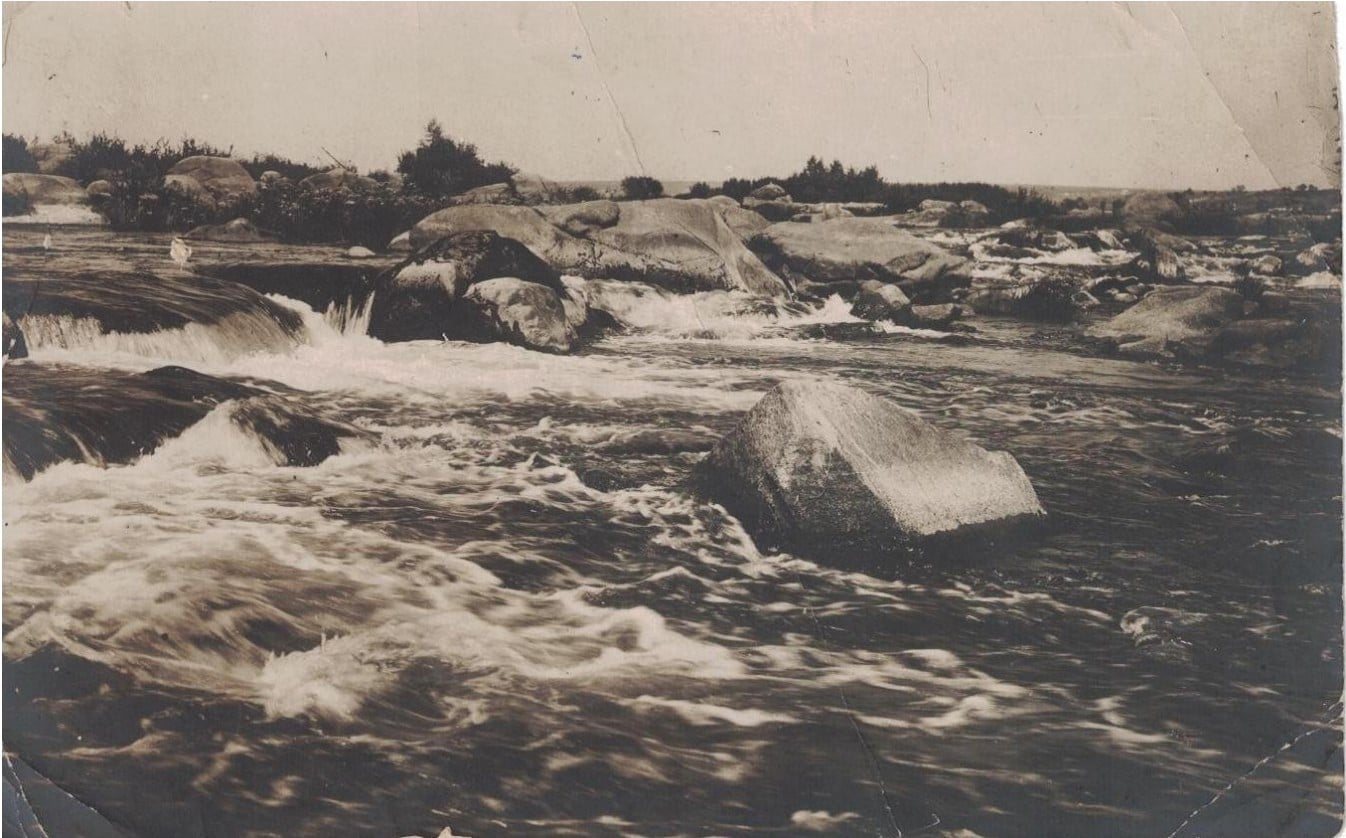
 While some Vikings sailed west, others were drawn east — up and down the rivers, all the way to the walls of Constantinople. The “Road from the Varangians to the Greeks” was trade artery, war path and cultural bridge at once. We follow it rapid by rapid.
When we hear “Viking,” we picture dragon ships off the English coast. Yet a large part of Norse expansion ran eastward, across a network of rivers and land bridges that linked the Baltic with the Black and Caspian Seas. The Old Russian Primary Chronicle calls this route the “Road from the Varangians to the Greeks” — from the Scandinavian Varangians (Old Norse Væringjar) to the “Greeks,” the Byzantines.
The goal bore a resounding name: Miklagarðr, the “great city” — Constantinople, the richest metropolis of the age. For a trader from the North it was a place of longing made of gold, silk and wine. Yet the way there was anything but easy. It ran not across the open sea but through the interior of Eastern Europe, on rivers that were not navigable everywhere, through the lands of foreign peoples and over rapids that had already shattered many a ship.
For this the travellers used smaller, nimble boats rather than the great seagoing ships — craft that could, if need be, be carried or dragged over land. Travel here meant rowing, poling, hauling and, again and again, unloading.
One should not imagine this as a single heroic voyage but as a yearly rhythm. Constantine VII describes how the Rus gathered tribute and goods from the hinterland in winter and, in spring when the ice broke, assembled their fleet at Kiev to set off downstream in convoy. The journey was an enterprise against the clock: come too late and you risked low water at the rapids; range too far ahead and you found yourself alone among the horse peoples of the steppe.
The entry lay in the north: across the Gulf of Finland to Lake Ladoga and the early trading settlement of Aldeigjuborg (Staraya Ladoga), whose timber buildings are dated by dendrochronology back to the 8th century. From there it continued to Holmgarðr (Novgorod) and, via a system of rivers and short overland stretches, to the upper Dnieper. The Dnieper became the main artery of the southern route: it carried the boats down to the Black Sea, along whose coast one finally reached Constantinople.
The most dangerous stretch lay in the lower Dnieper: a chain of rapids where the water raged over ledges of rock. And here we have one of the most fascinating sources of the whole Viking Age. The Byzantine emperor Constantine VII Porphyrogenitus, in his work De administrando imperio (around 950), describes seven of these rapids — and gives most of them two names: a “Slavonic” one and a “Rhosic” one, that is, Old Norse.
They come to the fourth rapid, the great one, called in Rhosic Aeifor and in Slavonic Neasit, because the pelicans nest in the rocks of the rapid.Constantine VII Porphyrogenitus, De administrando imperio, ch. 9 (c. 950, public domain)
This pairing is a linguistic fingerprint. The “Rhosic” names — such as Ulvorsi, Gelandri (“the roaring one”), Aeifor, Varuforos — can be convincingly interpreted from Old Norse. They are among the strongest pieces of evidence that the Rus of this route had a Scandinavian component. At the worst point the boats had to be taken out of the water; armed men went ashore and guarded against raids by the Pechenegs while others dragged the ships.
Where a river became impassable, or no continuous waterway existed at all, only one thing helped: carrying the ship over land. These land crossings are called volok (drag-place) in Old East Slavic — a word preserved to this day in place names like Vyshny Volochyok. Boats were unloaded, dragged on rollers or logs over paths and watersheds, and launched again at the next river. This is why light boats mattered so much: a heavy sea-sailer would have been dead weight on this route.
The portages were also the most vulnerable points of the whole journey. Heave your ship on rollers over a watershed and you have neither cover nor escape route. It was exactly at such bottlenecks that robbers and steppe riders lay in wait. Trade and war lay less than a boat’s length apart here: the same men who haggled with silver as merchants might have to swing the axe the next morning to keep both cargo and life.
What drove people to struggle through this bottleneck? Silver. The North craved the coined silver of the Orient — the dirhams of the Caliphate — while Byzantium offered silk, wine, spices and luxury goods. In return the North supplied what the South lacked: furs (especially squirrel and marten), beeswax, honey, amber, weapons — and people. The slave trade was a bitter but central part of this economy; the word slave and the medieval Latin sclavus are linguistically bound up with the enslaved peoples of the East. Honesty demands we do not gloss over it: the Eastern route was trade artery and slave road at once.
No text shows how powerful this stream from the south was as vividly as the silver itself. In the soil of Gotland and all Scandinavia lie, to this day, vast hoards of Arab dirhams — tens of thousands of coins, struck in Samarkand, Baghdad and Bukhara, buried thousands of kilometres from their origin. Often they are chopped up: for the North it was not the face value that counted but the weight of the precious metal. Silver was weighed on small folding scales and tested with fine nicks. This weight-based bullion economy is the silent, irrefutable proof of how deeply the East shaped the wealth of the North.
Not everyone who reached Miklagard came to trade. Many came to serve. The Byzantine emperors raised an elite guard of Norse and later Anglo-Saxon warriors — the famous Varangian Guard. It was reckoned loyal (because foreign and not tangled in court intrigue) and terrifying in battle with the axe. The most famous Varangian was probably Harald Hardrada, later king of Norway, who as a young man spent years in imperial service before returning rich to the North. Runestones in Sweden — the so-called Greece stones — commemorate men who journeyed “to Greece” and sometimes did not return.
A greeting from these men is still visible today in one of the most famous places in the world: into the marble balustrade of the Hagia Sophia in Constantinople one of them scratched his name — “Halfdan” — probably out of boredom during an endless service. A second runic graffito is found nearby. No heroic epic, no treasure hoard, just a name in stone — and precisely for that reason a touchingly human testimony to how far the paths of these Northmen reached.
The Dnieper was not the only Eastern route. Further east the Volga led to the Caspian Sea and thus into reach of the Islamic Caliphate. Here belongs one of the most famous eyewitness accounts of all: the Arab envoy Ibn Fadlan encountered a group of Rus on the Volga around 922 and described their appearance, their trade and an elaborate ship burial with unsettling precision. Along the Volga, Arab silver flowed into the North — the vast dirham hoards of Scandinavia are the silent proof of this trade.
Ibn Fadlan’s account is so valuable because it comes from outside: an educated Muslim who neither romanticises nor demonises the Rus but describes what he sees — their stature and tattoos, their weapons, but also, in his eyes, their lack of cleanliness. Famous is his description of the ship burial of a chieftain, with sacrifice, intoxication and flames. One must read this source carefully — Ibn Fadlan did not understand the language and, as an outsider, misread some things — yet as a snapshot of Norse traders far in the East it is irreplaceable. The Hollywood film “The 13th Warrior” turned it into an adventure story; the original is soberer and, precisely for that, more precious.
And so to the touchiest question: who were these Rus? The Primary Chronicle tells that Slavic and Finnic tribes summoned the Varangian Rus to bring order — above all the prince Rurik. The so-called Normanists see in this clear proof that the Rus were Scandinavians, pointing to the Norse rapid names, the envoy names in the Byzantine treaties and the finds. The other side stresses the Slavic component and warns against too tidy a derivation.
The honest position: the Rus were neither “pure” Scandinavians nor a purely Slavic people, but a mixed population in which Norse traders and warriors initially played a formative role and quickly merged with their Slavic surroundings. What remains is a fascinating image: people from the far North dragging their boats over watersheds to trade before the gates of the richest city in the world.
Constantine VII records Slavonic AND Norse names for the Dnieper rapids — interpretable from Old Norse. Byzantine treaties with the Rus (911/944) list Scandinavian envoy names. Ibn Fadlan described the Rus on the Volga around 922. Staraya Ladoga is dated by dendrochronology to the 8th century. The Greece stones and vast dirham hoards attest to long-distance trade and mercenary service.
“The Rus were clearly Scandinavians” is the Normanist position and remains disputed: there were Norse AND Slavic components that quickly merged. The route was trade and violence, not a merchant’s idyll. And “the Vikings founded Russia” is a crude shortcut that turns a complex entanglement into a simple foundation story.
The Rus (Kiev) · Miklagard and the Varangians · Hacksilver – silver as currency · Birka – the trading hub · Ibn Fadlan & the Rus.
All History & Finds articles →
Vikings and Aachen? Sounds like two worlds with nothing to do with one another. Yet in the winter of 881/882 the …
Read more →The axe is the most honest tool of the Viking Age. It split firewood, built ships, cut paths through the forest - and …
Read more →