The axe is the most honest tool of the Viking Age. It split firewood, built ships, cut paths through the forest - and, when it had to, it decided a battle. Not some hero-steel out of a saga, but the weapon almost anyone could afford. That is exactly what makes it so interesting.
Most Vikings owned no weapon in the modern sense. They owned an axe - and it was leaning against the wall anyway. Splitting wood, driving fence posts, jointing meat, building boats: the axe was the north's multi-tool. That the same edge could also shear a shield or split a helmet in an emergency was no accident but a welcome side effect. Whoever reached for a weapon usually reached for what was already there.
That is precisely the charm of the Viking axe: it was democratic. A good sword cost a small fortune - a serviceable axe cost iron and a few hours at the forge. The free farmer, the fisherman, the craftsman: they could all wield an axe, and many did. That fundamentally changes our picture of the Viking. The gleaming blade was not the norm; the plain, hard tool was.
A Viking-Age axe was a masterpiece of thrift. The head was mostly plain wrought iron - soft, tough, cheap. Only at the cutting edge did smiths set in a narrow strip of hard, carbon-rich steel: forge-welded in, drawn out, hardened. That gave a blade that held an edge without wasting expensive steel on the whole head. A crack in the soft body could be re-welded; the precious edge stayed where it belonged.
The eye - the hole for the haft - was usually formed from the folded iron, often with small "lugs" that gripped the wooden shaft at the sides and steadied the blade. The haft itself almost never survives archaeologically, because wood decays; we know length and shape mainly from pictures and a few waterlogged finds. The key point is this: Viking axes were light. A one-handed axe head often weighed only a few hundred grams. The heavy, clumsy executioner's cleavers of fantasy films have nothing to do with the record - such a lump would have been far too slow in a fight.
That lightness was worth a tactical price: reach and speed. An axe on a long haft swung out farther than a sword and, through leverage, delivered enormous force onto a small point of the edge. That is exactly why it was feared against shield and helmet - where a sword blow glanced off, an axe could catch the rim and break through. At the same time the head stayed small enough to be pulled back and re-aimed quickly in a crush.
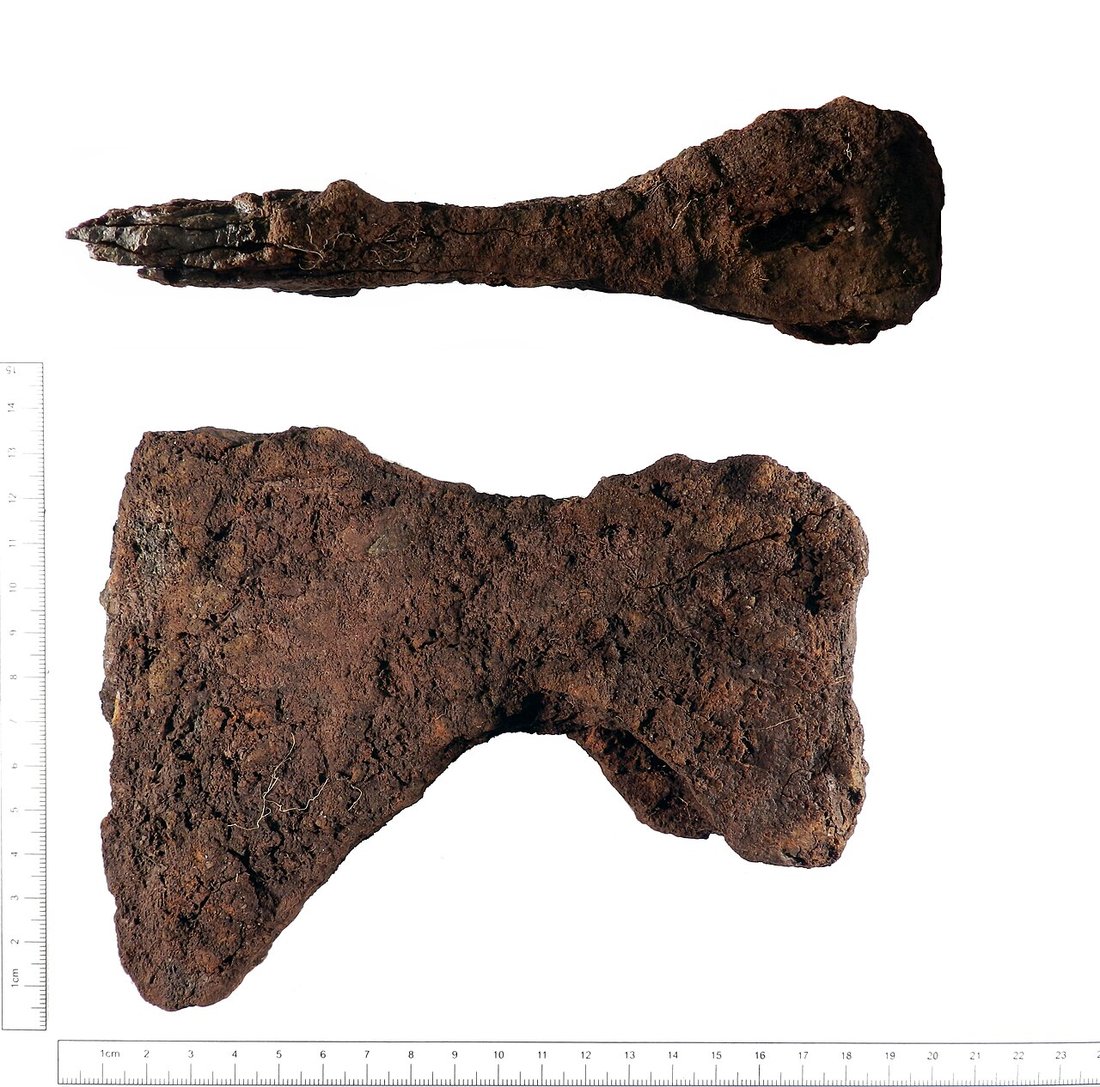
The Viking-Age classic is the bearded axe, Old Norse skeggox. Its name comes from the "beard": the lower corner of the edge is drawn downwards, extending the blade asymmetrically. It looks decorative but is above all functional. The beard enlarges the cutting surface without making the head heavier. With the hook you could pull down an enemy's shield rim or catch a leg. And because a gap remains between beard and shaft, you could place your hand right behind the head and use the axe for fine work like a drawknife - tool and weapon in one piece.
Bearded axes come in many sizes, from a handy hatchet to a full-grown war axe. This range is typical: there was no single "Viking axe" but a whole family of forms that shifted across centuries and regions.
In the grave the axe often lay beside spear and shield - the typical kit of a free man. That axes turn up so often in warrior graves is one reason we know their forms so well: where a sword was lacking, the dead were given the weapon they had really wielded in life.
From around the middle of the 10th century a new, spectacular type appears: the great broad axe, Old Norse breidox, later famous in English sources as the "Dane axe". Its head is sweepingly wide, the edge often 20 to 30 centimetres across, and the haft measures a good metre or more. This is a pure two-handed weapon - anyone wielding it had no hand free for a shield.
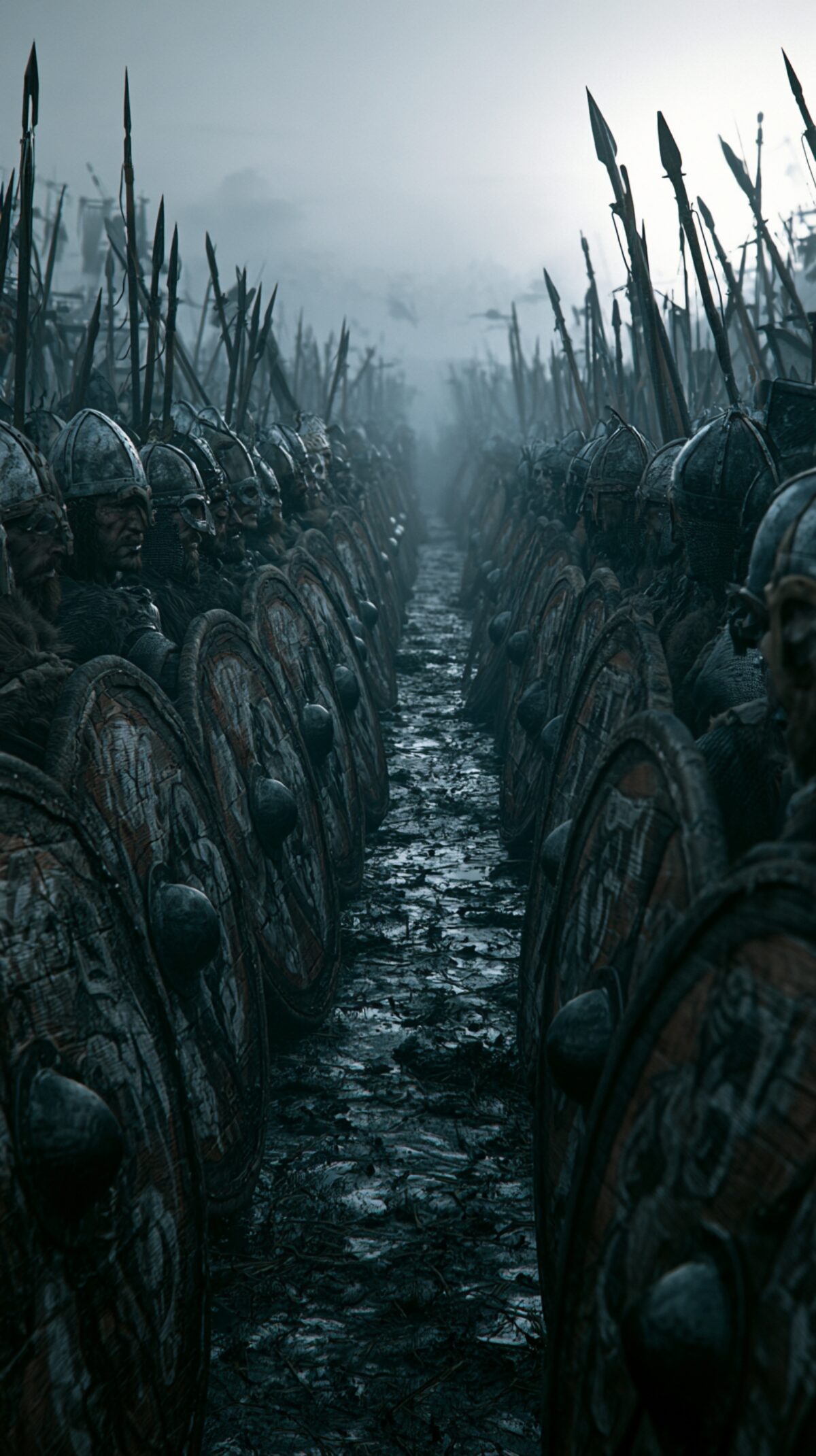
Despite its size the broad axe stayed surprisingly light, because the blade was forged thin. It was no clumsy club but a fast, far-reaching battlefield tool. In formation the axe-fighter usually stood in the second rank or on an open flank - he needed room to swing and the protection of the shield-bearers beside him. The broad axe became so popular that it spread from England into the Rus lands and remained in use into the 13th century - for instance among the famous bodyguard of the Byzantine emperors.
With that guard, the Varangians, the great axe became almost a trademark: contemporary Byzantine sources simply call the northern mercenaries the "axe-bearing barbarians". A northern tool had thus become the status symbol of an imperial elite unit at the far end of the known world - a fine image of how far the Vikings and their kit travelled.
Anyone who studies Viking weapons trips over one name: Jan Petersen. In 1919 the Norwegian archaeologist laid, with his work on Norwegian Viking weapons, the foundation on which research still builds today. Petersen sorted the axe heads by head shape into types and labelled them simply with letters - roughly A to M.
The bearded axes fall mainly into types B to E; in type C the beard is drawn out especially far. The great broad axes are the late types L and M. Type M, common from about 950, is the classic "Dane axe" with its broad, more symmetrical blade. These letters are no idle game: because the forms can be arranged in time, a find can be roughly dated by its axe type. Petersen's typology is thus less a catalogue than a calendar.
That an axe could be not only a tool but also a showpiece is proved by the most spectacular single find: the axe from the grave at Bjerringhoej near Mammen in Denmark, laid down around 970. Its iron head is inlaid all over with silver wire - threads of silver set into fine tendrils that form a whole picture programme: a tree, a bird, interlaced foliage in the style named after this very find (Mammen style).
Such an axe never saw firewood. It was a status object that displayed its owner's rank - a sceptre in the shape of a weapon. It reminds us that in the Viking Age the line between tool, weapon and jewellery was fluid. Whoever could afford it had even the most everyday things adorned.
At the peak of its impact we see the great axe in the year 1066. It begins at Stamford Bridge, where the army of the Norwegian king Harald Hardrada was defeated - tradition here knows the lone axeman holding the bridge, even if that scene is heavily embroidered. A few weeks later, at Hastings, the Anglo-Saxon huscarls met William's cavalry with exactly that broad axe. The Bayeux Tapestry shows it frame by frame: warriors hauling the two-handed axe over their heads, shields and horses alike in view.
Just how brutally effective an axe was in a practised hand is recorded by the Icelandic sagas. In Njals saga, Skarphedinn wields his axe with the telling name "Battle-ogress". Sliding across the ice, he strikes the unsuspecting Thrain on the head:
...and now Skarphedinn bore down on them, and hews at Thrain with his axe, "the ogress of war," and smote him on the head, and clove him down to the teeth, so that his jaw-teeth fell out on the ice.Njals saga (The Story of Burnt Njal), trans. George W. Dasent, 1861, public domain
The saga is literature, not a police report - but it shows the respect the axe commanded and how naturally it belonged to the image of the warrior.
Axes are among the most common weapon finds of the Viking Age; almost always only the iron heads survive. The construction of a soft iron body with a forge-welded steel edge is metallurgically attested. Petersen's 1919 typology (types A to M) still orders the heads today; the great broad axe (type M) is traceable from about 950. The silver-inlaid Mammen axe from Bjerringhoej (about 970) attests the axe as a prestige object. Pictorial sources such as the Bayeux Tapestry show the two-handed axe in use.
"Dane axe" is not a Viking self-designation but a later Anglo-Latin outside name for the great broad axe. Huge, clumsy cleavers from film and fantasy have nothing to do with the finds - real axe heads were light and thin-walled, or they would have been useless in a fight. And the axe was precisely not a weapon of a proud elite: it was the weapon of the common man, cheaper and more common than any sword. The dual-axe warrior, finally, is pure invention - fighting was one-handed with a shield, or two-handed with the broad axe, never with two axes at once.
Before the Norse bearded axe rose to fame, a very different axe ranked among the most feared weapons of the Germanic west: the francisca, the small throwing axe of the Franks. It is so closely tied to that people that some scholars even wanted to derive the tribal name from the weapon - the reverse is more likely, yet the link shows how thoroughly the axe became a badge of identity. Its hallmark is a boldly sweeping, S-shaped back edge and a comparatively short haft; examples from Merovingian-era row graves rarely weigh more than a good kilogram.
Its power lay in the throwing technique. Hurled from perhaps ten to twelve paces, the francisca tumbled through a predictable arc and struck with the force of a heavy, spinning blade - enough to split or shatter a wooden shield before the real melee even began. A whole battle line threw at once, then drew sword or spear. The chronicler Gregory of Tours preserves two famous scenes in his Historia Francorum: the episode of the vase of Soissons (II,27), in which a warrior raises his axe and smashes a precious vessel, and Clovis's act of revenge (II,40), when he hurls the axe into that same man's head.
"And he raised his axe and split the man's head, saying: This is what you did to that vase at Soissons." Gregory of Tours, Historia Francorum II,27; our own faithful rendering of the Latin text
By the late 7th and into the 8th century the francisca vanishes from the graves. As denser shield walls and longer close-combat weapons came into use, the single-use throwing axe lost its value - you no longer threw away what you badly needed in the press of battle. The axe itself remained, but it became a hewing weapon. Out of this centuries-old west-Germanic tradition grew, in the end, the very tool we know today as the Viking axe.
In 1919 the Norwegian archaeologist Jan Petersen, in his standard work, classified axe finds by the shape of the blade and the form of the neck. He assigned letters from A to M - leaving out J, because in Norwegian it is too easily confused with the I. This sequence remains the backbone of the specialist vocabulary to this day, even though later researchers have refined it and added regional sub-groups.
Honesty matters here: the types blend into one another, the dates are approximations, and no smith ever worked from a list of letters. The overview below is a signpost, not a rulebook.
| Type | Dating | Feature |
|---|---|---|
| A | c. 700-800 | early, narrow form, small blade, out of the Merovingian tradition |
| B | c. 750-850 | narrow blade, straight back, everyday and combat form |
| C | c. 800-900 | bearded form (skeggøx), edge extended downward |
| D | c. 800-950 | richly decorated socket, often with silver inlay |
| E | c. 850-950 | most common bearded working axe of the Viking Age |
| F | c. 850-950 | symmetrical blade, medium-broad, sturdy field form |
| G | c. 900-950 | transitional form with a broadened neck |
| H | c. 900-975 | broad-necked transitional axe, forerunner of the great broad axe |
| I | c. 900-975 | broad-necked, akin to H, often heavier |
| K | c. 950-1000 | early broad form, thin, boldly flaring blade |
| L | c. 1000-1050 | great broad axe (breiðøx), long sweeping edge |
| M | c. 1000-1100 | largest broad axe, very wide blade, the classic two-handed war axe |
The early types A and B are still narrow and close to the Carolingian everyday axe; with C and E the characteristic "beard" emerges; H and I form the broad-necked bridge, and with L and M the great broad axe reaches its full shape from around the middle of the 10th century. So anyone dating a Viking axe reads not just the blade, but above all the neck.
The honest answer: there is no sharp line. The overwhelming majority of Viking-Age axes were tools that, in an emergency, also served as weapons - and the other way round. The famous tool chest from Mästermyr on Gotland, sunk in a bog around the year 1000, contained, alongside tongs, files and hammers, several axes plainly made for woodwork. No one would have called them war axes, and yet they would have struck fatally in a scuffle.
The specialist distinguishes less by "tool or weapon" than by the task of the blade. The narrow carpenter's axe sits firmly on a short haft and is guided, not swung. The adze has its edge set crosswise to the haft and serves for hollowing and smoothing - in boatbuilding, for instance, where a plank was split from a trunk and shaped with the adze. T-shaped edges and side-axe forms belonged wholly in the workshop.
What made an axe a weapon of war was less the form than the measure: a longer haft, a thinly forged, far-reaching blade for maximum cutting force at low weight. Yet even these great broad axes stood at one end of a smooth continuum, at whose other end sat the humble house axe by the hearth. Between the two lay a whole field of in-between sizes - and that is exactly why nearly every larger man's grave of the Viking Age holds an axe.
This dual nature also explains why the axe was so ever-present in the Viking world. A sword cost the value of many cattle and stayed the preserve of the wealthy warrior; an axe, though, was owned by practically every farmer, every carpenter, every fisherman. It split firewood, felled trees, mended fences and slaughtered the autumn stock - and when quarrel or raid threatened, it was instantly to hand. No other iron implement accompanied the Norseman so closely, from daily life all the way into battle.
The heart of every axe is the eye - the hole through which the haft runs. It was not drilled but forged: the glowing bar was hammered around a mandrel and the two ends welded together to form the blade and the neck. In many forms the smith drew narrow extensions down and up from the eye to embrace the haft - the so-called lugs or langets. They spread the load of the blow and keep the blade from working loose in use.
The haft was fitted from below and spread at the top, on the edge side, with a wooden or iron wedge, so that it pressed tightly into the eye. For the wood the north used whatever was good, tough and springy: ash above all, and also birch, oak or maple. The hickory beloved of modern toolmakers did not grow in Europe - it is an American wood and has nothing to do with the Vikings.
For the cutting edge soft iron was not enough. The smith welded a narrow strip of high-carbon steel into the edge, hardened it by rapid quenching, then tempered it under control - so the edge stayed keen while the softer axe body absorbed blows without breaking. The reason we almost never find the hafts themselves is simply the wood: it rots in the ground while the iron survives. Nearly everything we know about hafting we owe to the rare waterlogged and bog finds.
The Vikings did not invent the axe - they stood at the end of a very long northern smithing tradition. As far back as the Celtic La Tène period there were two fundamentally different constructions: the socketed axe, in which the blade sits in a cast or forged socket on the end of the haft, and the shaft-hole axe, in which the haft runs, as later, through an eye in the blade. The shaft-hole method won out in the iron north and became the ancestor of every Viking-Age form.
Among the Germanic peoples of the Roman Iron Age the axe appears both in daily life and in the weapon offerings of the bogs - at the great army-sacrifice sites such as Illerup or Nydam, axes belong to the deposited gear. Out of this world the Germanic west developed the francisca, while the north shaped its own bearded and broad-axe forms.
Seen this way, the Viking axe is no sudden stroke of genius but the ripe fruit of centuries: Celtic smithing, Germanic ironwork and the throwing axe of the Franks flowed together into a tool that felled timber, smoothed planks and broke shield walls alike. Anyone who has an axe engraved carries with it a piece of this unbroken northern history of craft.
The great two-handed axe was a weapon for fighters with nerve. Whoever wielded it gave up the shield - both hands lay on the long haft. That is why the axe fighter often stood not in the very front line but a rank behind it or on its flank: reaching out over the shoulders of the shield bearers while the front rank covered him. A single blow of a broad edge could shear through a helmet rim, a shield rim or a leg.
The curved edge was good not only for striking but for hooking. You could lay the lower beard over an enemy's shield rim and drag it down to open his guard - or pull a rider from the saddle. And there lay the danger for the wielder himself: between two blows he was uncovered, and a quick opponent with shield and short weapon could thrust into that gap. Reach and force were paid for with vulnerability.
In single combat too, the holmgang, the axe appears in the sagas. These tales should be read with caution: they were written down centuries after the Viking Age and love to embellish - a hero who mows down a whole shield rank belongs to poetry, not the battlefield. But the core rings true: the axe was cheaper than a sword, it stood in every house, and in a practised hand it was, in open combat, as feared as it was respected.
How deeply the great axe stamped itself on the imagination is clear when we look beyond the end of the Viking Age. Long after the Norman descendants of the Northmen fought on horseback and with the lance, axe-bearing bodyguards held on for generations in England and Scandinavia. The weapon had become an emblem: of the man who stood close at his lord's side and struck with both hands, without hiding behind a shield. In that image the Viking axe lives on to this day - half tool, half guardian.
The axe was more than a piece of iron. Small axe-shaped pendants of bronze, silver or iron are among the finds of the Viking Age and were probably worn as ornament or as a token of belonging - status symbol, tool miniature and amulet all at once. Among the neighbouring West Slavs the axe was even associated with the thunder god Perun, and there too small axe amulets are known. This is a parallel, not proof of a shared cult - but a hint of how deeply the axe was rooted across northern and eastern Europe.
A word of caution belongs here: there was no "axe cult of Thor". Thor's weapon is and remains the hammer Mjöllnir - and the famous Thor's-hammer pendants are hammers, not axes. Anyone who mixes up axe and hammer is following a modern misunderstanding, not the sources. Some objects do carry a consecration in the style of "Þórr vígi" (may Thor hallow this), yet that is a blessing formula, not evidence of a hallowed axe as a god's weapon.
Perhaps the finest embodiment of this double nature is the Mammen axe from a Danish high-status grave of the late 10th century, its blade inlaid with silver. Its ornament unites animal-style interlace with motifs that can be read as both pagan and Christian - a piece from that age of upheaval in which the old and the new images still lived side by side. In later folk tradition, finally, the axe lost its edge and kept its power: laid beneath the threshold as a sign of blessing or against lightning, it remained a scrap of protection made of iron.
The Ulfberht sword · The shield wall · The Mästermyr tool chest.
Sources: Jan Petersen, De norske vikingesverd (1919); Njals saga in the translation by George W. Dasent, The Story of Burnt Njal (1861, public domain); National Museum of Denmark on the Mammen axe from Bjerringhoej; Medievalists.net, "The Viking Axe" (2022); the Bayeux Tapestry as a pictorial source for Hastings 1066. Image credit: bearded axe head (find) - Portable Antiquities Scheme / York Museums Trust (R. Griffiths), CC BY-SA 2.0, via Wikimedia Commons.
All History & Finds articles →
The Vikings came, raided – and stayed. Over the winter, at least. Instead of sailing home after every raid, they …
Read more →Sword and axe get the glory, yet the most common kit of the Viking warrior was round, wooden and surprisingly light …
Read more →