The core Viking-Age customs were rituals of community: the sacrificial feast called blót, toasts to gods and the dead, oaths sworn on a ring, the sacred duty of hospitality, naming a newborn with water, the funeral ale that made an heir, marriage as a contract between two kindreds, the thing assembly, fosterage and blood brotherhood. Most of what we know comes from texts written in the 12th and 13th centuries, some of it from archaeology. For every custom we show you where the knowledge comes from – and how far you can trust it.
Picture a hall in Trøndelag in the mid-10th century. Fires run down the floor, cauldrons hang above them, and the air is thick with smoke, blood and horse meat. The farmers have brought their own ale. On the high seat an earl raises the first horn. And somewhere in the middle of all this sits a young king who happens to be a Christian – and who knows that these people are about to ask him some very awkward questions.
The scene comes from Hákonar saga góða, the saga of Hákon the Good, and it is the keyhole through which we usually peer at Viking ritual. A keyhole, not an open door: Snorri Sturluson wrote it around 1230, some 280 years after the events, as a Christian with his own agenda. That is why every custom below comes with a note on its source type. We distinguish archaeological evidence, contemporary written sources (rune stones, skaldic verse, outsiders' reports), later tradition (Eddic poems, sagas and law books of the 12th and 13th centuries) and modern interpretation. The festivals of the year have their own in-depth guide in our article on Germanic feasts, so we will not repeat them here.
Old Norse blót simply means "sacrifice"; the verb blóta means to worship with offerings. A blót was above all a big communal meal: the animal was slaughtered, the meat boiled and shared by everyone. The gods got the blood, the people got dinner.
The fullest description sits in Hákonar saga góða (chapter 14 in the standard Icelandic edition; chapter 16 in Samuel Laing's 1844 English translation). Snorri tells us that Earl Sigurðr of Hlaðir near Trondheim hosted the sacrificial feasts. Every farmer was to come to the temple and bring ale. Small livestock and horses were slaughtered. The blood was called hlaut, the bowls that caught it hlautbollar, and with hlautteinar – twigs used like an aspergillum – it was sprinkled on the pedestals of the god images, on the walls and on the people. The meat boiled in cauldrons over the long fires. Then the cups were blessed and passed round: first Odin's cup, for victory and power to the king, then the cups of Njörðr and Freyr, til árs ok friðar – "for a good year and peace". (Laing's translation has "Freyja" here; the Old Norse text names Freyr.)
The saga then turns into a political drama. King Hákon, raised a Christian at the court of King Æthelstan of England, has to attend these feasts because the farmers will not tolerate a king who refuses. He makes the sign of the cross over his horn; Earl Sigurðr smooths things over by claiming the king had made the sign of Thor's hammer. At the next feast at Mære the farmers push harder, and in the end Hákon eats a few bites of horse liver and drains the cups without crossing them. Whether it happened like that, we cannot know. But a blót was clearly a political duty, not private piety. Whoever led the community had to eat with it.
In Ynglinga saga (chapter 8) Snorri also gives a yearly framework: one sacrifice at the start of winter for a good year, one at midwinter for growth, one at the start of summer for victory. How these dates map onto Yule, the Winter Nights and the dísablót is covered in our guides to Germanic feasts and Yule. Where such feasts were held is the subject of Blót sites: hörgr, hof and cult hall.
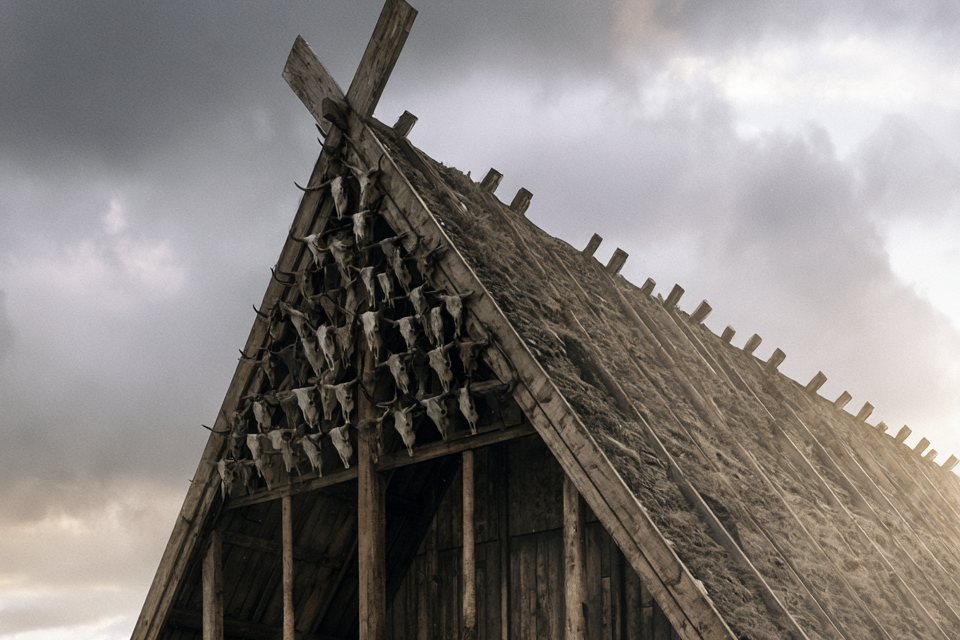
Is there anything in the ground to back this up? Yes. At Hofstaðir in north Iceland, archaeologists excavating a large 10th-century hall found the skulls of at least 23 cattle. In 2007 Gavin Lucas and Thomas McGovern showed that the animals were stunned with a blow between the eyes and then decapitated and that the skulls seem to have been displayed for a long time – slaughter, blood, a great meal and a visible reminder, much as in the saga.
After the food came the drinking. Old Norse sumbl (Old English symbel, a word you may know from Beowulf) means a feast or drinking party. No old source describes a fixed liturgy with three rounds, as many modern heathen groups practise it; that is a modern reconstruction. How it is done today is explained in How do heathens celebrate today?
What is attested is the minni, the memorial toast. In Hákon's saga, the cups for the gods are followed by a toast to dead kinsmen who lay in their burial mounds. The church did not abolish the custom but rebranded it: people drank the minni to Christ, Mary or the Archangel Michael, and the German "Johannesminne", blessed wine on St John's Day (27 December), survives in places today. What was actually in the horn is the topic of our article on mead – spoiler: not always mead.
The bragafull (also bragarfull) was the most solemn cup of all. The name is usually read as "cup of the foremost, of the chieftain"; a link with the god Bragi is sometimes proposed, and both readings are debated. Whoever raised it made a public vow. In Ynglinga saga (chapter 36) the young king Ingjaldr, at the funeral ale for his father, vows to enlarge his realm by half in every direction – and makes a start that same night by burning six kings in the hall. In the prose of the Eddic poem Helgakviða Hjörvarðssonar, Heðinn swears over the bragafull on Yule Eve to win his own brother's bride, and regrets it at once. A word spoken over the horn could not be taken back.
Binding oaths were sworn on a ring. Landnámabók, the Icelandic Book of Settlements, preserves a legal rule: in every chief temple a ring weighing at least two ounces was to lie on the pedestal. The goði – a chieftain with both religious and legal duties – wore it on his arm at every assembly he led. Anyone giving evidence named his witnesses and then declared that he swore an oath on the ring: hjálpi mér svá Freyr ok Njörðr ok inn almáttki áss, "so help me Freyr and Njörðr and the almighty god". Who that "almighty god" is – Thor, Odin, or already the Christian God – is still argued over.
The Anglo-Saxon Chronicle reports for the year 876 that the Danes at Wareham swore oaths to King Alfred on the "holy ring" (halgan beage) – something, the chronicler notes pointedly, they had never before done for any nation. They broke the oath anyway. But this contemporary source, written by the other side, shows that the ring oath was known and taken seriously. Finds, forms and interpretations are discussed in our article on oath rings.
Where roads are long and winters brutal, hospitality is a matter of survival. So the Eddic poem Hávamál, the "Sayings of the High One", opens not with divine wisdom but with house rules. In our own paraphrase: hail to the hosts, a guest has come – where shall he sit? Fire is needed by the one who comes in with frozen knees; food and dry clothes by the one who has crossed the mountains. Water, a towel and a kind word, too.
The poem sees both sides. A guest should be attentive, not boast, not drink too much – and know when to leave. A guest who stays too long, says stanza 35 in substance, turns friendship into weariness. Hospitality was a contract with obligations on both sides.
How seriously it was taken shows in Egils saga. Egill Skallagrímsson stops in Värmland at the farm of a man called Ármóðr. The host lies that he has no ale and serves skyr, then brings out strong ale after all to make a fool of his guest. Egill's revenge is drastic: next morning he cuts off Ármóðr's beard and gouges out one of his eyes. The saga presents it as an answer to violated hospitality.
A newborn was not automatically part of the family: according to sagas and law books, the father decided whether it would be raised. The flip side was exposure, Old Norse útburðr: a child that was not accepted was left outside to die. How common this was can be seen in Íslendingabók by Ari Þorgilsson (c. 1125). When Iceland accepted Christianity around the year 1000, the heathens negotiated that exposure of infants and the eating of horse meat would remain allowed for the time being. A few years later both were dropped.
Acceptance came with a water rite: ausa vatni, "to sprinkle with water". In the Eddic poem Rígsþula, at every birth the child is sprinkled with water and given a name. In Hávamál stanza 158 Odin boasts of a charm: if he sprinkles water on a young warrior, that man will not fall in battle.
But was this a heathen custom or an imitation of baptism? Scholars disagree. In favour of an old custom: the texts clearly distinguish it from Christian baptism (skírn). Against: every single source dates from Christian times. There is no secure answer.
A name often came with a gift, the nafnfesti, the "name-fastening". Whoever gave a name – including a new nickname for an adult – added something valuable: a ring, a sword, land. More on how names were built in Viking names.
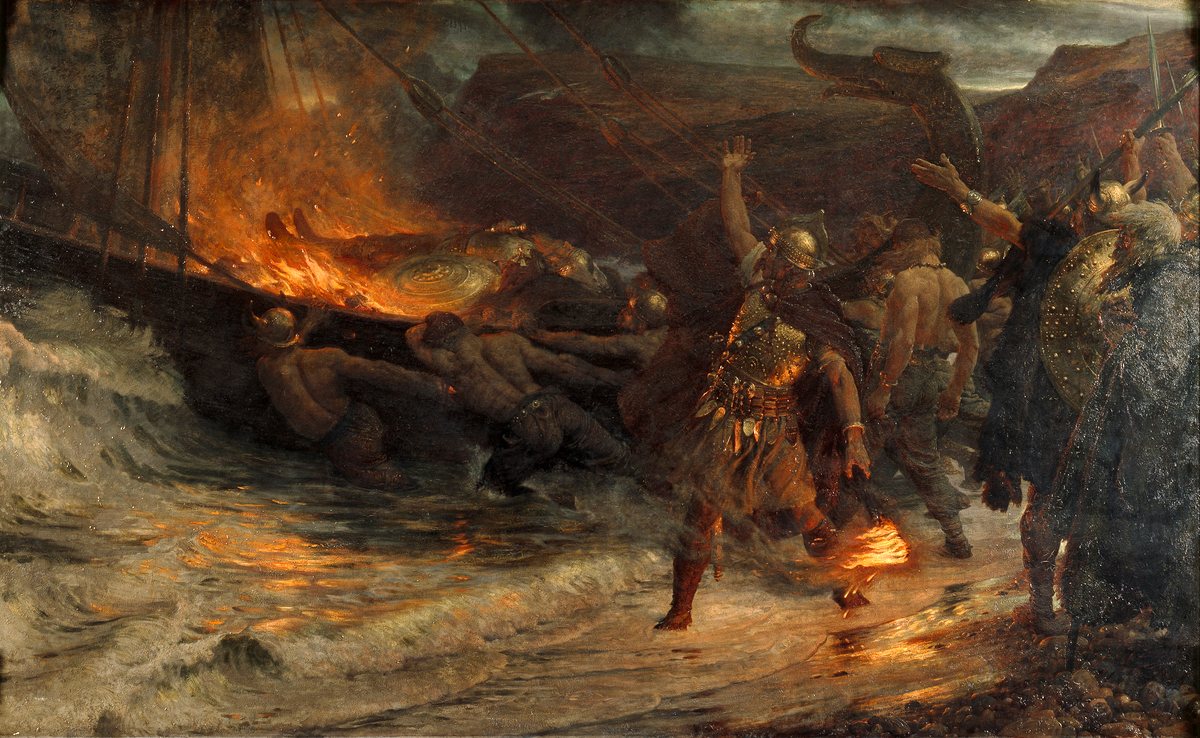
After a death came first the burial, then the feast. Erfi or erfiöl literally means "inheritance ale": the feast at which the heir took up his inheritance. According to Snorri in Ynglinga saga, the heir could not take his father's high seat until this feast. He sat on a step in front of the high seat until the bragafull was carried in. Then he stood up, spoke his vow, drained the cup and took the dead man's place. The guests were the witnesses.
At the funeral ale King Sveinn of Denmark held for his father, the Jomsvikings – according to the kings' sagas – made such boastful vows over the bragafull, including driving Earl Hákon out of Norway, that the battle of Hjörungavágr followed.
Here, at last, we have contemporary evidence. Many rune stones speak to exactly this situation: a son, a widow or a brother raises a stone for the dead and thereby writes their own position as heir into the landscape. The Hillersjö stone in Uppland even records an entire chain of inheritance across several marriages and deaths, ending with a woman named Geirlaug holding the property. How the dead themselves were buried – mounds, boats, grave goods – is covered in detail in Death and the afterlife in the North.
The Old Norse word for wedding was brúðlaup, roughly "bride-run". Whether it originally meant the bride's procession to the groom's house is uncertain. What is certain: marriage was an agreement between two families. It began with a betrothal (festar) before witnesses, sealed by a handshake between the men of both kindreds. The Icelandic law book Grágás and the sagas name three kinds of property: the mundr paid by the groom, the heimanfylgja or dowry from the bride's home, and the morgingjöf, the morning gift after the wedding night.
Was the mundr a "bride purchase"? Older scholarship said so; today the picture is more nuanced: in practice the mundr usually became part of the property the wife could control, and it secured her position. According to Grágás a marriage was only fully valid with a mundr of a set minimum – important above all for the children's right to inherit. The bride was not merchandise, though her say in the choice was often limited. Women could, however, divorce according to the sagas, and take their property with them. More in Women in the Viking Age.
The wedding feast itself is thinly documented. The only Eddic wedding consecration is a joke: in Þrymskviða, Thor sits disguised as a bride with the giant Þrymr, who calls for the hammer to be laid in the bride's lap and for the couple to be hallowed by the hand of the goddess Vár. In Snorri, Vár is the goddess of oaths and agreements – a neat fit. Whether a hammer in the lap was real custom or the poet's punchline, we cannot say. The brúðlaup itself was a feast, often lasting several days, centred on the bridal ale.
The thing was the assembly of free men, where law was declared, disputes settled and politics made. It was also a ritual: the site stood under a special peace, the þinghelgi. In Iceland the Althing met at Þingvellir from around 930; the lawspeaker (lögsögumaðr) recited the law from the Law Rock, one part each year, the whole law over three years.
Around AD 98 Tacitus wrote in his Germania that the Germanic peoples signalled agreement at assemblies by clashing their weapons. The Old Norse word for this "weapon-taking" is vápnatak, and in the English Danelaw it became the wapentake – an administrative district whose name survived in the English Midlands and north into the 20th century. Not proof of an unbroken tradition, but a striking echo.
Many thing sites lay near burial mounds, rune stones or cult places; law and cult were not neatly separated. Examples are shown in Bällsta & Anundshög – thing and cult sites; the legal system itself, with feud, compensation and outlawry, is explained in Viking law and the thing.
Children often grew up not with their parents but with foster parents – Old Norse fóstr. Those raised together called each other fóstbræðr, foster-brothers. The bond was often as strong as blood kinship.
Whoever raised another's child usually placed himself below the child's father. Snorri tells an anecdote about this in the saga of Harald Fairhair: an envoy of King Haraldr of Norway sets Haraldr's son Hákon on the knee of King Æthelstan of England, and because Æthelstan is now in effect fostering the boy, the proverb makes him the lesser man – "he is the lesser who fosters another's child". The scene itself may be invented. But that Hákon was brought up at the English court is considered credible, and his byname Aðalsteinsfóstri, "Æthelstan's foster-son", is firmly established in the kings' sagas. The wider web of kinship is explained in Kin and family.
Fóstbræðralag first means "foster-brotherhood". In some sagas, though, it describes a bond between adults sealed by ritual – what we call blood brotherhood. The most striking account is in Gísla saga Súrssonar, probably written in the 13th century and set in the 10th.
Gísli, his brother Þorkell, their brother-in-law Þorgrímr and Gísli's brother-in-law Vésteinn decide to become sworn brothers after a wise man has foretold strife among them. They cut a long strip of turf so that both ends stay attached to the ground and prop it up with an inlaid spear, high enough for a man to stand beneath. All four step under the arch, let their blood run into the earth and mix it with the soil. Then they kneel and swear to avenge one another like brothers, calling all the gods as witnesses. It is often read as a rebirth from the earth – a modern but plausible interpretation.
Then, at the handshake, Þorgrímr pulls back: he will not bind himself to Vésteinn. So Gísli refuses to bind himself to Þorgrímr. The pact fails – and the saga unfolds into a tragedy of murder, revenge and outlawry. The ritual has no archaeological confirmation.
The gods know blood brotherhood too. In Lokasenna, Loki reminds Odin that in the early days they mixed their blood, and Odin promised never to drink ale unless it was brought for both of them. Loki uses that to force his way into the feast. Fóstbræðra saga, by contrast, tells of a bond that holds – between the warrior Þorgeirr and the skald Þormóðr.
Almost every one of these customs makes something public that would otherwise stay invisible: the favour of the gods at the blót, remembrance of the dead in the minni, a promise over the bragafull, truth in court with the ring oath, the acceptance of a child with water, the inheritance at the erfi, new kinship through marriage, fosterage and blood brotherhood. In a world almost without writing, the ritual was the document and the guests were the notaries.
And it nearly always happened at the table, by the horn, beside the fire – cosier than it was, because a wrong word over the horn could still cost lives decades later. Anyone today who has a ring or a slate plaque engraved follows, at a respectful distance, the same logic: a promise is made visible so that it lasts. For an overview of cult and cult places, see our ritual hub.
What was a Viking blót? A blót was a sacrificial feast: animals were slaughtered, their blood dedicated to the gods, and the meat eaten together by the community. Snorri describes it around 1230, and bone finds such as those at Hofstaðir in Iceland support the picture.
What is the difference between sumbl and bragafull? Sumbl is the drinking feast in general. The bragafull was a particularly solemn cup within it, over which a public vow was made – for example at the funeral ale for a dead father.
Did Vikings swear oaths on rings? Yes. Icelandic sources describe a temple ring used for oaths in court, and the Anglo-Saxon Chronicle reports that in 876 the Danes swore oaths to King Alfred on their holy ring.
How did Vikings get married? Marriage was a contract between two families, with a betrothal before witnesses, a payment from the groom, a dowry and a morning gift, followed by a feast that could last several days.
Did Vikings have blood brothers? In the sagas, yes, as fóstbræðralag. Gísla saga describes a ritual beneath a raised strip of turf in which the sworn brothers' blood flowed into the earth – but there is no archaeological evidence for it.
Did Vikings baptise their children? They sprinkled newborns with water and named them (ausa vatni). Whether this was a heathen custom or influenced by Christian baptism remains disputed.
For courage. For remembrance. For legends that live on.
Germanic feasts (lead article) · Blót & sumbel · Blót calendar · Naming, marriage & farewell.
All History & Finds articles →
Without their ships the Vikings would never have become Vikings. The longship was the high technology of its time …
Read more →