A thing site was the fixed place where the free men of a district met in assembly: in the open air, often by a mound, a lake or old graves, clearly marked off and reachable for everyone. The most famous are Þingvellir in Iceland, where the Althing met from 930, and Tynwald Hill on the Isle of Man, where the laws are still proclaimed every year. Add Gulating and Frostating in Norway, Anundshög and Old Uppsala in Sweden – and a trail of Thingwall place-names running right across Britain.
Go looking for the Viking parliament building and you will come back empty-handed. No columns, no benches, no chamber. What you find instead is a meadow by a river, a low mound, a rock wall, a tiny island in a loch. That is the point. The thing – the assembly of free men where law was spoken, cases fought, leaders chosen and decisions made – needed a place everyone knew, everyone could reach and nobody owned outright. How the thing worked as an institution, who could speak and how a lawsuit ran, we cover in a separate article. This one is about the sites themselves: where they were, what they looked like and what is left of them.
The Old Norse word is þingvǫllr, literally "thing field" or "assembly plain". It survives in Þingvellir in Iceland, Tingvoll in Norway and Tingvalla in Sweden – and, as we will see, in Tynwald, Tingwall, Dingwall and Thingwall across the British Isles. Wherever Scandinavians settled, they took the word with them. Often a name on the map is all that remains of an assembly. Sometimes the mound still stands. And in a few places, people still meet there.
"Með lǫgum skal land byggja." – "With law shall the land be built."Njáls saga; similar wording in Nordic law codes such as the Jutland Law of 1241 (our translation)
No thing site is better known than Þingvellir, some 40 kilometres north-east of Reykjavík. According to Icelandic tradition the Althing, the assembly for the whole island, first met here around 930. The settlers had been in the country only a few decades – the story is told in our piece on the Icelanders, their chieftains and the Althing. From then on, every early summer, the goðar – chieftains with both political and religious roles – rode here with their followers for about two weeks. They lived in booths (búðir) with turf and stone walls roofed with cloth; remains of such walls, many of them later, are still visible.
The heart of it all was the Lögberg, the Law Rock. From here the lawspeaker (lögsögumaðr) spoke – the only elected office of the Icelandic Commonwealth. He was chosen for three years and in that time had to recite the entire body of law, a third each summer, from memory. According to Ari's Íslendingabók, the laws were first written down in the winter of 1117–18. Where exactly the Law Rock stood is not certain. A flagpole on the edge of the Almannagjá gorge marks the most likely spot today, but scholars have proposed others.
Alongside it sat the Lögrétta, the law council, which made new law and settled disputes about what the law was. From around 965 there were also four Quarter Courts, one for each quarter of the country, and around 1005 a "Fifth Court" was added as a court of appeal. The great lawsuits of the Sagas of Icelanders play out right here. Njáls saga turns the case after the burning of Njáll into a courtroom thriller at the Althing that finally breaks into open battle on the assembly field. The saga dates from the late thirteenth century and is no court record, but it shows how Icelanders imagined their assembly.
Around the year 1000 Þingvellir saw the most far-reaching decision in Iceland's history. The pagan and Christian factions were so hostile that the country threatened to split in two. According to Ari the Learned, the lawspeaker Þorgeirr – himself still a pagan – lay under his cloak for a day and a night, then announced: all Icelanders shall be Christian, though private pagan sacrifice would be tolerated for the time being.
The Althing met at Þingvellir until 1798. It was then dissolved and re-established in Reykjavík in 1845. Þingvellir became Iceland's first national park in 1930, for the Althing's millennium, and was inscribed on the UNESCO World Heritage List as a cultural landscape in 2004. Then there is the geology. The valley lies in the rift of the Mid-Atlantic Ridge, where the North American and Eurasian plates are pulling apart. The Almannagjá, the great rock wall beside the assembly, is the western edge of the rift. Nobody in 930 chose the spot because the earth was splitting open there; they cared about water, grazing and access. But the rock wall gives the place a force it has never lost.
If Þingvellir is the most famous thing site, Tynwald Hill at St John's on the Isle of Man is the most alive. The name comes from the same Old Norse þingvǫllr. Norse settlers arrived on the island in the ninth century, and for centuries it belonged to the Norse-dominated Kingdom of Mann and the Isles – more on that in our article on the Norse on the Isle of Man.
The mound itself is surprisingly modest: about 3.7 metres high, built in four circular tiers that shrink towards the top. Tradition says it contains soil from all 17 of the island's ancient parishes. That cannot be proved – but it is a lovely idea.
Every year on Tynwald Day, usually 5 July, the island's parliament assembles here in the open air. The original date was Midsummer, 24 June; when Britain adopted the Gregorian calendar in 1753, the old day was kept, and it now falls on 5 July. From the hill, summaries of the laws passed in the previous year are read out in English and in Manx, the island's Gaelic language. This is more than pageantry: an Act that is not promulgated on the hill within 18 months of Royal Assent ceases to have effect. It is a remnant of the old idea that law only becomes law when it has been spoken aloud before the people.
In Norway, local things grew into large regional assemblies, the lagting. The two oldest and most important were the Gulating on the west coast and the Frostating in Trøndelag. According to Snorri Sturluson, King Hákon the Good (who reigned c. 935–961) set down the laws of both – the Gulathing law with the advice of Þorleifr the Wise, the Frostathing law with Earl Sigurd of Lade. But Snorri wrote some 270 years later; the assemblies themselves are probably older than any royal law credited to them.
The Gulating met in what is now Gulen Municipality, north of Bergen at the mouth of the Sognefjord. Delegates came from several districts – first Sogn, Hordaland and the Fjords, later Rogaland, Agder and Sunnmøre as well. So the Gulating was not a gathering of every farmer in the west but, early on, a representative assembly: each district sent a fixed number of thingmen. Where exactly the site lay is still being researched; candidates include spots on and near the island of Guløy and near Eivindvik, where a monument has commemorated the Gulating since 2005.
What such a court looked like is described in a famous scene in Egils saga (ch. 56). Egill Skallagrímsson is suing for an inheritance at the Gulating. The court sits on a level piece of ground, ringed by hazel poles with ropes strung around the outside – the vébǫnd, the "sacred bands". Inside sit twelve judges from the Fjords, twelve from Sogn and twelve from Hordaland (paraphrasing the saga). Vé means "holy, inviolable": whoever cut the bands or used violence inside the ring broke the peace of the court. In the saga, that is exactly what happens: the other side slashes the ropes. Whether the scene is historical, nobody knows.
The Gulating produced the oldest surviving Norwegian law, the Gulaþingslǫg, preserved in manuscripts of the twelfth and thirteenth centuries. It deals with inheritance, wergild, wreck rights, whaling and church duties – and it bans pagan sacrifice. The Frostating had its own law, the Frostuþingslǫg. Its assembly met on the Frosta peninsula in the Trondheimsfjord, at the mound called Tinghaugen near the medieval church of Logtun; a standing stone marks the place today. Eight districts of Trøndelag belonged to it, later Hålogaland in the north as well. Both laws were absorbed in 1274 into the Landslov, the national law code of King Magnus the Lawmender – Norway's first law for the whole kingdom. The old sites lost their importance, but the names lived on: Gulating and Frostating are still the names of two of Norway's courts of appeal today.
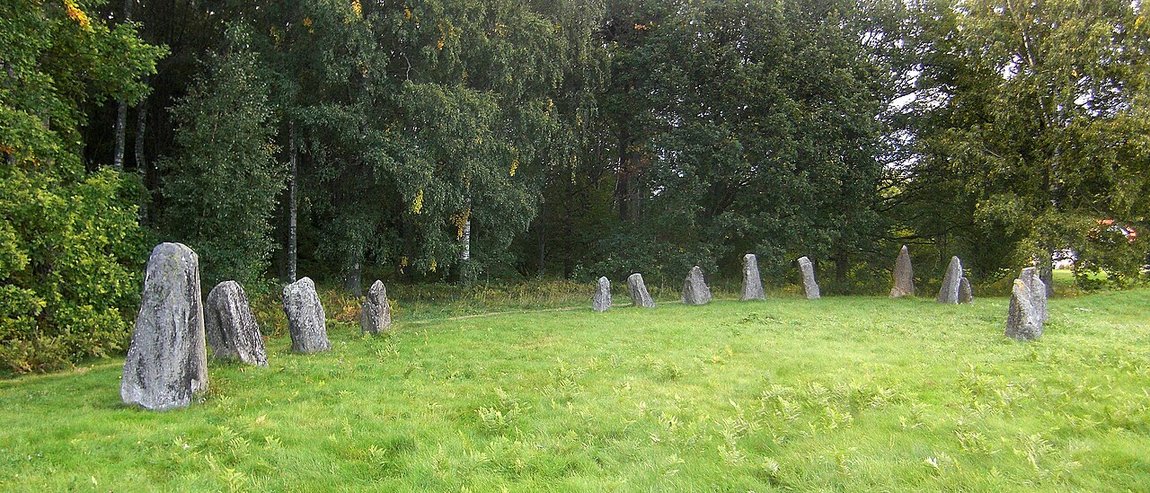
A Swedish thing site looks very different. Near Västerås in Västmanland, in the parish of Badelunda, lies Anundshög, the largest burial mound in Sweden: about 60 metres across and some 9 metres high. At its foot lie two large stone ships – ship-shaped settings of upright stones – placed end to end, one about 51 and the other about 54 metres long. There are smaller ship settings too, and a row of 15 standing stones that were re-erected in the 1960s.
One of them is a runestone, Vs 13. Its inscription says, in essence: "Folkviðr raised all these stones in memory of Heðinn, his son, Önundr's brother. Vrað carved the runes." The runestone dates from the eleventh century. The row of stones seems to mark an old road, possibly a stretch of the Eriksgata, the ride a newly elected Swedish king had to make through the provinces to be acknowledged by each provincial assembly.
How old is the mound itself? Beneath it lay a hearth that has been radiocarbon dated to between roughly AD 210 and 540. So the mound is younger than that hearth – but how much younger is open. Estimates in the literature range widely, from the Bronze Age to the late Iron Age. Nobody knows who is buried inside. The name "Anund's mound" points to a legendary King Anund, but that is folk tradition, not a finding.
Why call it a thing site? Because the layout, the location and long research tradition indicate that the district assembly met here – well supported, though details remain open – at a place where people quite literally stood on their ancestors' graves. Alexandra Sanmark and others have shown that this was the rule rather than the exception in Scandinavia: assemblies met remarkably often at old burial mounds. Whoever spoke there spoke in the presence of those who had worked the land before him.
At Bällsta in Vallentuna, north of Stockholm, there is something rare: a thing site that names itself. Known as Arkils tingstad, it is a rectangular stone setting with two runestones, U 225 and U 226. Both were carved by the same rune-master, Gunnar, and the text runs across both stones. Style and wording place them in the early eleventh century, around the 1010s.
The inscription names the sons of a man called Ulfr – Ulfkell, Arnkell and Gýi – who "made a thing-place here" (þingstaðr). No memorial, it says, shall be greater than the one Ulfr's sons made for their father. And then a line that hits hard: Gyríðr, the widow, loved her husband; he will long be remembered in grief. Whether grati means "in tears" or "in a lament" is debated. Gyríðr may have composed a mourning poem herself that ended up on the stone. Scholars call the family behind the stones the Skålhamra clan, after a farm; they also raised runestones on the far side of the lake.
Close by, at Vallentuna church, stands a stone of the famous Jarlabanki, U 212. On it he boasts that he "made this thing-place" and alone owned the whole hundred. The thing was a stage for great families, too.
Sweden's best-known assembly met at Old Uppsala, beside the great royal mounds: the "thing of all Swedes" (allsherjarþing). According to Snorri's Óláfs saga helga, in pagan times a great sacrifice was held there in the month of Gói, late February or early March; the thing met at the same time, and there was a market that lasted a week. After the conversion, Snorri says, the market was moved to Candlemas and cut to three days. The name Disting is usually read as "the thing of the dísir", linked to the dísablót, a sacrifice to female guardian powers.
The market is still alive: Distingen is held every year in early February in Uppsala. It was officially abolished in 1895 and simply carried on regardless. Laws and gods change; the market stays.
On Shetland the chief assembly, the Lawting, met at Tingwall – once again Old Norse þingvǫllr. The actual meeting place was the Law Ting Holm, a small promontory at the north end of the Loch of Tingwall. Originally it was an islet reached by a stone causeway; only when the water level was lowered in the 1850s did it take on its present shape. For more on the Norse in Shetland, see our article on Jarlshof and the Shetlanders.
On the Faroe Islands the Løgting met at Tinganes, the rocky headland in Tórshavn harbour – literally "thing headland". Water keeps turning up at these sites, and that is no accident: in the island North people travelled by boat. A thing site on the shore was reachable for everyone, and an island or promontory was easy to mark off and protect.
On mainland Britain, most thing sites survive only as names. But the names give a lot away, and some can be pinned down well:
Thynghowe lies within the Danelaw, the Scandinavian-ruled east of England. There the districts were called wapentakes, from Old Norse vápnatak, "weapon-touching" – probably after the custom of showing assent at an assembly by brandishing or clashing weapons. The archaeologists Sarah Semple and Alexis Tudor Skinner studied such assembly mounds in Yorkshire and found that existing, older mounds were frequently reused.
Between 2010 and 2013 the international Assembly Project ("Meeting-places in Northern Europe AD 400–1500"), funded by the European HERA research network and led by Frode Iversen (University of Oslo), with Sarah Semple (Durham), Alexandra Sanmark (University of the Highlands and Islands) and Natascha Mehler (Vienna), studied assembly sites in Norway, Sweden, Denmark, Iceland, the Faroes, Scotland and England. Its results appeared in 2020 as the open-access book Negotiating the North. In 2017 Alexandra Sanmark also published an overview of Scandinavian assembly sites and their rituals, Viking Law and Order.
A fairly clear picture emerges from this work. Thing sites share typical features – not every one at every site, but strikingly often:
That makes life hard for archaeologists: an assembly leaves very little rubbish behind. So the very absence of settlement traces at a prominent mound can be a clue – as at Dingwall, where diggers found hardly any domestic remains but an artificial mound and a few sherds. Thing research is half detective work with what is not there. For the legal order as a whole, read our article on Viking law and the thing.
Slate is a piece of stone itself, like the runestones that marked assembly sites. A few ideas from our workshop in Alsdorf: "Með lǫgum skal land byggja" in Younger Futhark runes or Latin letters, with a translation beneath – for a law firm, say, or a gift for passing the bar. A stylised stone circle with a mound as a family emblem: the place where a family comes together. Or a ship setting modelled on Anundshög as a memorial plaque, with name and date – just as Folkviðr did for his son. All of it fits on an engraved slate plaque.
What we love most about these places is this: they tell of a society that made its own order – out of voices, out of memory and out of stone. That is the same wish that sits inside every good engraving: to hold on to something important so that it lasts.
What is a thing site? A thing site is the fixed meeting place of a thing, the assembly and court of free men in the Germanic and Norse world. It lay in the open air, often by a mound, water or old graves.
What is the most famous Viking thing site? Þingvellir in Iceland, where the Althing met from around 930. It is a national park and has been a UNESCO World Heritage Site since 2004.
Are thing assemblies still held today? Yes: on Tynwald Hill on the Isle of Man, the laws are proclaimed in the open air every year on Tynwald Day (usually 5 July). The parliaments of Iceland (Alþingi), Norway (Storting) and the Faroes (Løgting) still carry the word thing in their names.
What does Thingwall mean? Thingwall, Tingwall, Dingwall and Tynwald all go back to Old Norse þingvǫllr, "thing field" or "assembly plain". They mark places where Scandinavian settlers held their assemblies.
For courage. For remembrance. For legends that live on.
The Thing · Runes · Burial · Picture Stones.
All Festivals & Belief articles →
In the middle of January, when the wind scours Iceland and the days have only just begun to lengthen again, Icelanders …
Read more →Through the long winters of Iceland's farmsteads ran a fear that had nothing to do with trolls or giants and everything …
Read more →When the nights are longest and the fire in the house is warmest, the departed draw nearer. Yule, the midwinter feast …
Read more →For our ancestors the year was no sheet on the wall but hard, beautiful work: to sow, to tend, to harvest, to store …
Read more →