A stone ship, or ship setting, is a grave or memorial made of upright stones arranged in the outline of a ship – pointed at both ends, swelling amidships, with the tallest stones standing at stem and stern. People around the Baltic built them for almost two thousand years: the first in the later Bronze Age, above all on Gotland, the largest only in the Viking Age. Here is what archaeology actually knows about Ales stenar, Lindholm Høje, Jelling and the rest – and where interpretation takes over.
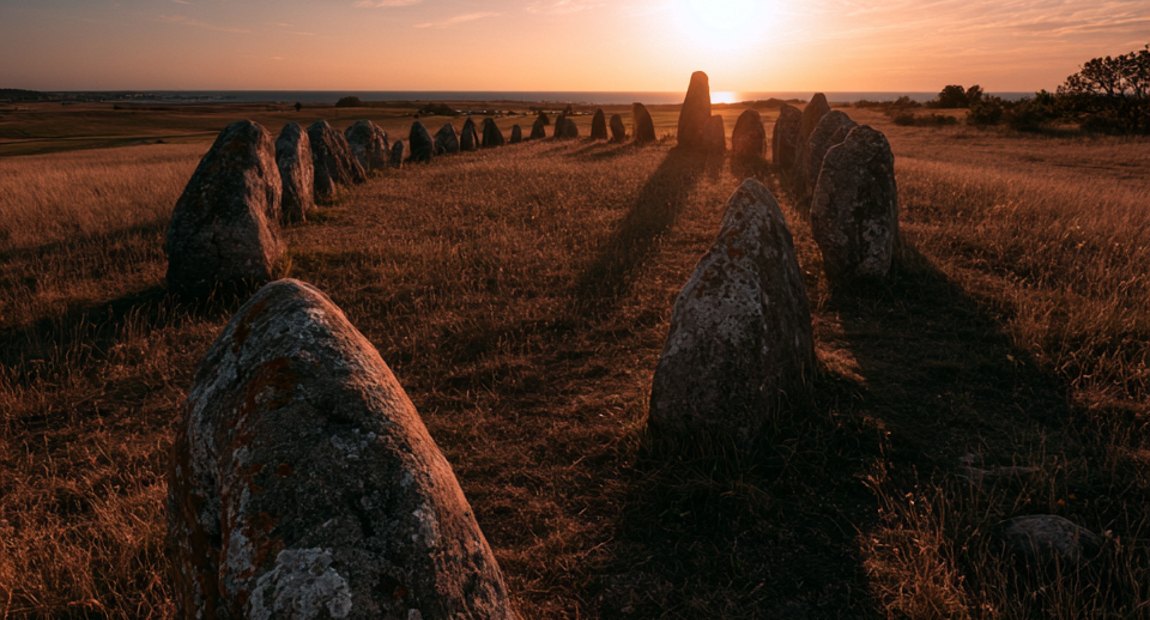
Picture a blustery afternoon on the cliffs above Kåseberga in Skåne, southern Sweden. The Baltic glitters below, pasture rolls away behind you, and in front of you stand 59 boulders in a long, graceful line. Take a few steps back and the picture flips: this is a ship. A ship of stone almost seventy metres long, its bow and stern swept upwards, laid down on the clifftop as if on a slipway. It will never be launched. That is precisely the point.
Archaeologists call these monuments ship settings (Swedish skeppssättning, Danish skibssætning, Norwegian skipssetning); in English they are just as often called stone ships. A ship setting is a deliberate arrangement of stones whose outline traces a boat or ship. Two rows of upright stones form the sides. They converge at each end, where the largest and tallest stones usually stand – the stem stones. Many settings rise in height towards the ends, mimicking the curving prow and stern of a real hull. Some also have a stone in the middle that people like to read as a mast or steering position. That is an interpretation, not a finding.
The range is huge. Some stone ships are only a few metres long, hardly bigger than a rowing boat; others run to more than 300 metres. Some lie alone on a ridge, others form whole fleets across a cemetery. And they do not all belong to one period. If you hear "stone ship" and think "Vikings", you are only partly right – which is the first and most important point of this article.
Ship settings were built over roughly two thousand years, from about 1000 BC to around AD 1000. But those centuries are not evenly filled. There are two clear peaks.
The first falls in the later Nordic Bronze Age, roughly 1100 to 500 BC. Most of the stone ships on Gotland and Bornholm date from this time, as do groups along Sweden's east coast and in the eastern Baltic. They have nothing to do with Vikings: a good fifteen centuries separate these graves from the raid on Lindisfarne in 793. Their builders knew neither runes nor iron, but they did know bronze, amber and long-distance contact across the sea – the same world that produced the Trundholm sun chariot. On the rock carvings of the period, the ship is one of the most common motifs of all.
The second peak falls in the late Iron Age: the end of the Migration Period, the Vendel Period and the Viking Age, roughly the 5th to the 11th century AD. This is when the great monuments of Skåne, Denmark and central Sweden were raised – Ales stenar, Lindholm Høje, Glavendrup, Anundshög and Jelling among them. Whether an unbroken tradition linked the two peaks, or whether Iron Age people consciously revived an ancient form, cannot be said for certain. Ship settings are clearly much rarer in the early Iron Age.
Nowhere has as many stone ships as Gotland. The County Administrative Board of Gotland counts more than 300 ship settings on the island. Most date from the later Bronze Age, and as a rule each ship held only one person – often a cremation placed in a small stone cist.
The best-known example is Tjelvar's Grave near Boge: about 18 metres long and 5 metres wide, its edge stones tallest at the ends and lower towards the middle. An investigation in the 1930s found a cist that had already been looted, containing burnt bone and a few potsherds. The name, however, is far younger than the grave. It comes from the Guta saga, an account of Gotland's early history written down in the 13th century. In it, Tjelvar is the first man on Gotland: he brought fire to the island, which until then had sunk beneath the sea every night. That medieval islanders identified a Bronze Age stone ship as his grave tells you a lot about how these monuments were seen in later centuries – as traces of the oldest ancestors.
Another popular site is the ship setting at Gannarve in Fröjel parish on the west coast. If you visit, bear in mind that it is largely a reconstruction: when it was excavated in the late 1950s only the stem stones were still standing. The other stones were set back in place according to the traces found in the ground. Gannarve illustrates a problem shared by all the big stone ships: what you see is often the result of modern restoration. That does not make the monuments fake, but it is a reason for caution whenever someone draws sweeping conclusions from the exact position of individual stones.
In his 2013 doctoral thesis at the University of Gothenburg, archaeologist Joakim Wehlin studied the Bronze Age stone ships of the Baltic. At some sites he found hearths, post holes and flint debris, and suggested that these places were meeting points as well as graves – perhaps connected with departure rituals or landing places on old waterways. A stimulating idea, but still an idea.
Ship settings are not exclusively Scandinavian. In northern Courland in Latvia, especially in the Talsi area, there is a group of Bronze Age stone ships known locally as Velna laivas, "devil's boats". They are dated to around 950–750 BC; only a few are still visible, and several have been destroyed. Ship settings are also known on the Estonian island of Saaremaa and on Åland. The resemblance to Gotland is so striking that many scholars assume contact, perhaps even migration, across the Baltic. What exactly those links looked like remains open. What is clear is that in the Bronze Age the Baltic connected people more than it divided them.
Back to Kåseberga, about ten kilometres south-east of Ystad. Ales stenar ("Ale's Stones") is around 67 metres long and roughly 19 metres wide – the largest surviving ship setting in Sweden. It consists of 59 large sandstone boulders, the heaviest weighing up to five tonnes. The stem stones at either end are noticeably larger than the rest.
That the ship looks so complete today is partly thanks to heritage work. In the early 20th century only 16 of the 59 stones were still securely upright; the others were re-erected in 1916. How accurately their original positions were recovered is unknown.
The first scientific excavation took place in 1989 under the Lund archaeologist Märta Strömberg, who published her results in 1997. Inside the monument a decorated clay pot was found containing burnt human bone, probably from a funeral pyre. There are seven radiocarbon dates in all. Six cluster around AD 600 – including birch charcoal directly beneath a stone that appears never to have been moved, and a charred food crust inside the pot. One date is wildly different: around 3500 BC, taken from soot-blackened stones that probably belonged to a much older hearth on the site. The Swedish National Heritage Board (Riksantikvarieämbetet) regards construction around AD 600 as most likely – at the turn from the Vendel Period to the Viking Age, not in the Bronze Age.
Few stone ships have caused as much argument. For decades the amateur researcher Bob Lind has argued that Ales stenar is a Bronze Age solar calendar: at midsummer the sun sets over one stem stone, at midwinter it rises over the other, and the stones in between mark the months. It is an elegant idea, and it earned the site its nickname, "Sweden's Stonehenge".
Most specialists see it differently. In 2002 the astronomer Curt Roslund and the archaeologist Jonathan Lindström examined Lind's arguments in detail in the Swedish sceptics' journal Folkvett. Their criticism: the supposed calendar periods range from 3 to 30 days; sometimes the sun counts when it stands over a stone, sometimes when it stands beside one; there is no error analysis – and since most stones were reset in 1916, deviations of a few centimetres prove nothing anyway. Then there is the dating: six of seven samples point to around AD 600, none to the Bronze Age.
A fair summary looks like this. Nobody disputes that the long axis is roughly aligned on the solstice points. Such an alignment can be intended in a funerary monument too – the course of the sun and the cult of the dead are not mutually exclusive. What remains unproven is a precise Bronze Age calendar. Some researchers still argue for an older origin of the site, but the available dates do not support it so far.
If Ales stenar is the lone flagship, Lindholm Høje is the harbour. On a hill north of the Limfjord, looking across to Aalborg, lies Denmark's largest cemetery of the late Iron Age and Viking Age. Around 700 graves were uncovered here, the vast majority cremations. Archaeologist Thorkild Ramskou excavated the site between 1952 and 1958.
What makes it special is that no other burial ground in Scandinavia has so many surviving ship settings. That is down to a disaster. After the land was cleared, drifting sand blew over the hill, in places metres deep, and buried graves and village alike. Beneath that blanket the stone settings survived, while elsewhere ploughs and stone-breakers cleared entire fields.
Lindholm Høje also shows how grave forms changed. The oldest graves, from around AD 500 or a little earlier, are marked by triangular, square or round stone settings. From the 8th century oval settings become more common, and in the Viking Age ship settings dominate. Many of them are small, only a few metres long. Here, then, the stone ship was not a privilege of a few chieftains but a widespread way of marking the dead of an ordinary community. The settlement included houses, a smithy and a road with timber paving, and the museum at the foot of the hill tells the story in more detail.
The mightiest stone ship of all can barely be seen today – which is exactly what makes it so fascinating. At Jelling in Jutland, where King Gorm the Old and his son Harald Bluetooth raised their runestones, a gigantic ship setting was part of the royal monument. The North Mound sits at its centre; the South Mound covers its southern end.
Its estimated size has changed several times as research progressed. Older reference works give figures of around 150 to 170 metres. Only the investigations by the National Museum of Denmark and Vejle Museum between 2006 and 2013 produced today's picture: the National Museum gives the length as about 356 metres, other accounts as 354 metres. The small difference comes down to measurement and reconstruction; what matters is the scale. That makes Jelling by far the largest known ship setting anywhere. The same excavations revealed a lozenge-shaped palisade about 1,440 metres long enclosing the whole site. Today white concrete markers and posts trace the outline of ship and palisade.
On dating: the burial chamber in the North Mound has been dated by dendrochronology – tree-ring analysis – to 958/959. The monuments as a whole were built between about 950 and 970. Whether the ship setting came before or after the mounds, and whom it first commemorated, is debated. On his small runestone Gorm names his wife Thyra, and some scholars suggest the stone ship was originally her memorial. That is not proven.
The political message is remarkable. A pagan burial symbol on a colossal scale, combined with Harald Bluetooth's runestone boasting that he made the Danes Christian: Jelling is a place of transition. Many of the stones were later removed, some perhaps built into the church and nearby farms. That the monument could still be reconstructed is a stroke of archaeological luck.
In Denmark there is a group of Viking-Age ship settings where ship and script belong together. The best known is Glavendrup on north Funen. The ship setting was originally about 60 metres long and was laid out around a Bronze Age burial mound – another case of deliberately reusing an ancient place. At its western end stands the Glavendrup stone with the longest runic inscription in Denmark. Ragnhildr raised it for Alli, a goði – a man with both religious and political standing – and it ends with a dedication to Thor and a curse on anyone who damages the stone. The inscription is usually dated to the early 10th century. An excavation in 1958 found traces of burning inside the setting, but no grave.
At Bække in southern Jutland (about 45 metres) a runestone itself serves as a stem stone, and at Lejre on Zealand the Tingstenene ("assembly stones") once formed one or more ship settings of roughly 80 metres – among the largest in the North. The pairing of runestone and stone ship shows that the two were conceived together: the ship as form, the inscription as voice.
Near Västerås in central Sweden lies Anundshög, about 60 metres across and some 9 metres high – Sweden's largest burial mound. A hearth beneath it has been radiocarbon dated to AD 210–540. At the foot of the mound lie five ship settings, a number found nowhere else in Sweden. The two largest lie end to end, each just over 50 metres long; according to the site itself, the biggest measures 53 by 16 metres. Four of the five have been restored after their stones were toppled as Christianity took hold. Nearby stands a row of standing stones including runestone Vs 13, raised by a man called Folkvid for his son Heden.
Anundshög is regarded as an old thing site, an assembly place where law was spoken – more on that in our article on Bällsta and Anundshög. Whether the stone ships there are graves, memorials or part of the assembly setting has not been settled, and the settings themselves lack a secure date.
In the far west of Sweden, near Strömstad in Bohuslän, stands the ship setting of Blomsholm: 41 metres long, 9 metres wide, made of 49 stones, the stem stones nearly 4 metres high, the stones amidships around a metre. In the middle stands a memorial stone from the 1660s – a nice example of later centuries continuing to use such places. The legend that soldiers from Charles XII's campaign of 1718 lie buried there is unconfirmed. Close by are a stone circle of ten stones, several Iron Age cemeteries and the large mound of Grönehög.
The obvious answer is the right one, but not the whole one. Most ship settings are grave markers. Beneath or within them lie burials, usually cremations with bone in urns or stone cists. That holds for the Bronze Age ships of Gotland as much as for the many small settings at Lindholm Høje. For the bigger picture of burial customs, see our overview Death and the afterlife in the North.
Yet not every setting contains a grave. At Glavendrup only traces of burning were found; at Ales stenar a pot of bone but no conventional grave; and some Gotland ships were empty. That is why researchers allow for other functions:
These functions are not mutually exclusive. One place could be a grave and at the same time the spot where a community met regularly.
That leaves the big question: why a ship, of all things? The Viking Age also had real ship graves. At Oseberg, Gokstad and Ladby the dead lay in complete ships; in Sweden there are the boat graves of Vendel and Valsgärde; and Ibn Fadlan describes a Rus chieftain being burned in his ship on the Volga (read it with us: Ibn Fadlan). There is more on these finds in our articles on boat burial and the Gokstad ship.
A popular interpretation sees the ship setting as a "substitute ship": if you could not – or would not – put a real vessel in the grave, you gave the dead one made of stone. That sounds plausible, and at cemeteries like Lindholm Høje, where hundreds of ordinary people were buried, a stone outline was certainly more affordable than a boat. But beware of tidy arithmetic. The Bronze Age has stone ships but hardly any real boat graves – there the stone ship was not a substitute for anything; it was the form itself. And at Jelling the stone ship was anything but the cheap option.
The stones do not tell us directly what beliefs lay behind the ship. Written sources help only so much, because they are centuries younger. The best known is Snorri's account of Baldr's funeral in Gylfaginning (Prose Edda, c. 1220). Rendered freely in our own words:
The gods took Baldr's body and carried it down to the sea. Hringhorni was the name of Baldr's ship, the greatest of all ships; on it they meant to build his pyre. Snorri Sturluson, Gylfaginning 49 – our own rendering
That does not mean the builders of Ales stenar were thinking of Baldr. But it shows that in Norse imagination the ship stayed bound up with death and passage – right down to Hringhorni and the ships on the Gotland picture stones. Some scholars also point to Freyja's realm of the dead, Fólkvangr, and her hall Sessrúmnir, whose name can be read as "seat-room" – an idea that plays with the image of a ship in a field (more on the realms of the dead: Valhalla, Hel, Fólkvangr). That is a modern hypothesis, not a statement from the sources.
Most of the big sites are freely accessible and stunningly placed. You reach Ales stenar from Kåseberga by a short climb; on Midsummer Eve it is often crowded. Lindholm Høje has its own museum, Jelling a visitor centre, and on Gotland you can drive round several stone ships in a single day. For a list of worthwhile places, see our guide Experiencing the Vikings. One request: please don't climb on the stones. Many are standing only because someone painstakingly put them back up in the 20th century.
What moves us about ship settings is the way they join departure and permanence. A wooden ship rots; a stone ship remains. That is the very thought behind every engraving in stone. In our workshop in Alsdorf the motif often takes this form: a ship setting seen from above as a simple line of dots that grow larger towards the ends, with a name and two years beneath – or the outline of Ales stenar with the coastline. On natural slate it looks almost like an aerial view of an ancient cemetery. As a memorial plaque, for a remembrance corner in the garden, or simply for anyone who has stood on the windy cliff at Kåseberga.
Honesty matters to us here. We engrave a symbol that people chose for their dead over thousands of years. No invented "Viking signs", no fantasy runes – just a form that genuinely stands in the landscape.
What is a stone ship? An arrangement of upright stones in the outline of a ship, usually with tall stem stones at both ends. Most mark graves; some were probably memorials or meeting places.
How old are stone ships? They were built from about 1000 BC to around AD 1000. The stone ships of Gotland are mostly later Bronze Age; the large Danish and Scanian monuments date from the late Iron Age and Viking Age.
How old is Ales stenar? Six of seven radiocarbon dates point to around AD 600, which the Swedish National Heritage Board considers the most likely construction date. A Bronze Age origin is not supported by evidence.
Is Ales stenar a solar calendar? The monument is roughly aligned on the solstices, but the theory of a precise calendar is regarded as unproven. Most stones were also re-erected in 1916.
What is the largest stone ship? The one at Jelling in Denmark, about 354–356 metres long according to excavations between 2006 and 2013. The largest intact example in Sweden is Ales stenar at around 67 metres.
Where are the most stone ships? On Gotland, which has more than 300 known ship settings. The greatest concentration of well-preserved stone ships in a single cemetery is at Lindholm Høje near Aalborg.
For courage. For remembrance. For legends that live on.
Boat burial – the burning ship · The longships · The Skuldelev ships · How the Germanic peoples honoured their dead · Hringhorni – Baldr's funeral ship.
All Ships & Seafaring articles →
There is an Old Norse word for the quietest terror of seafaring: hafvilla, the “sea-bewilderment.” It does not mean the …
Read more →Some graves are so rich that they still take our breath away. The Oseberg grave near Tønsberg in Norway is one such: a …
Read more →Around the year 1070 the people of Roskilde deliberately sank several old ships in a narrow channel of their fjord – as …
Read more →