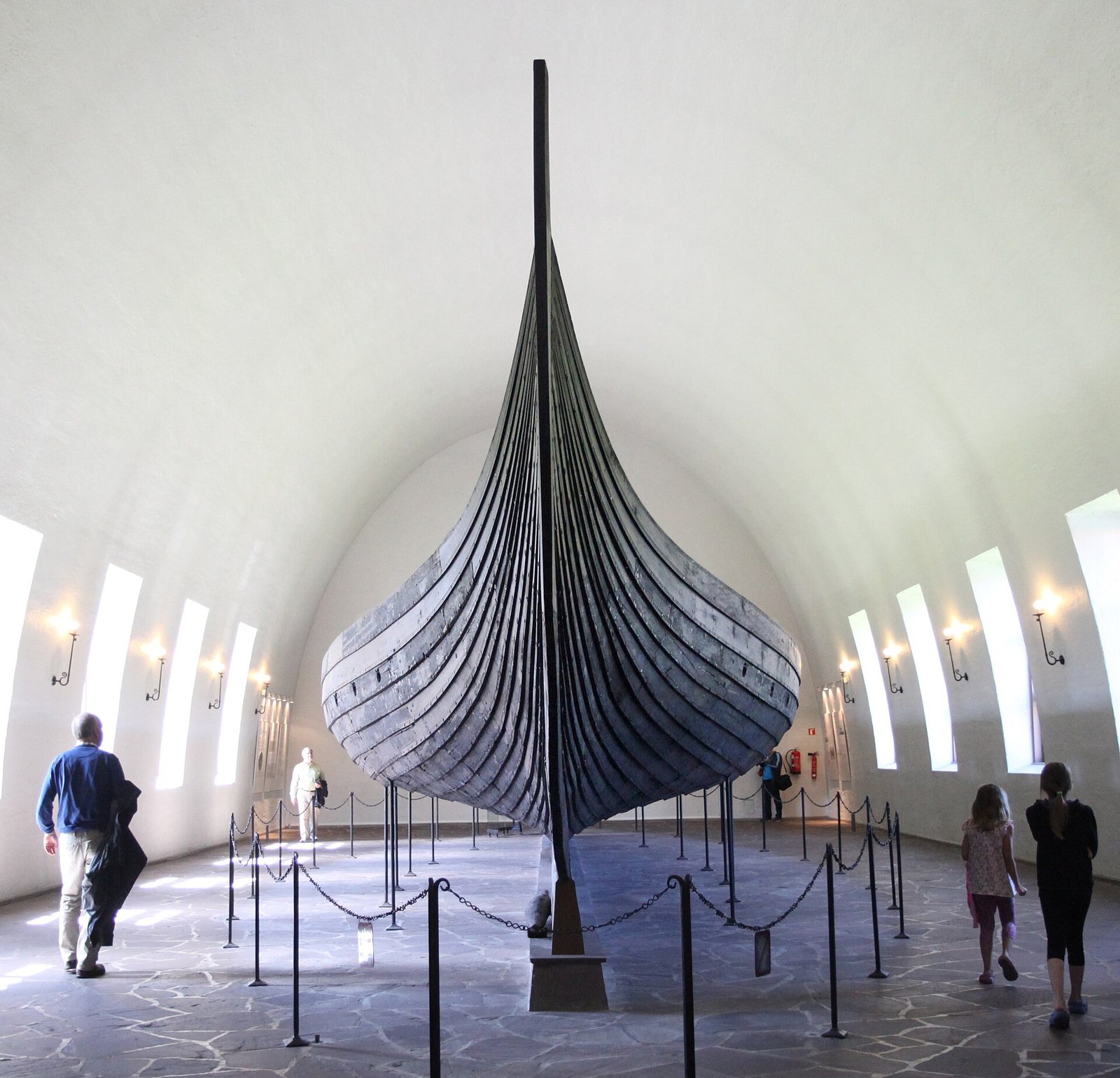
The Gokstad ship is the largest surviving Viking ship in Norway: a roughly 23-metre oak vessel built around 890, buried around 900 as the grave of a powerful man in a mound near Sandefjord, and excavated by Nicolay Nicolaysen in 1880. It had 32 oar ports, carried a sail, and went into the ground with 64 yellow and black shields, horses, dogs, peacocks and three small boats. Here is what the find really tells us, why a replica crossed the Atlantic in 1893, and where you will be able to see the original again from 2027.
On the Gokstad farm, a few kilometres north of Sandefjord in Vestfold, rose a large burial mound the locals called Kongshaugen – the King's Mound. Stories about a king inside it had circulated for generations, and hardly anyone took them seriously. In the winter of 1879/80, two sons of the farm started digging on their own. The ground was frozen and their hopes of gold were high. What they hit instead was timber: the stem of a ship.
Word reached Nicolay Nicolaysen, head of the Society for the Preservation of Ancient Norwegian Monuments and later the country's first State Antiquary. He stopped the amateur digging and in spring 1880 led a proper excavation. It took about ten weeks, and according to the Norwegian encyclopaedia Store norske leksikon some 25,000 visitors came to watch. The mound then measured around 50 metres across and, after centuries of ploughing, still stood about five metres high. Nicolaysen dug in from the side rather than from the top.
Gokstad owes its survival to what lay beneath it. The ship rested in a pit that had filled with water and blue clay. That dense, airless clay kept rot away and preserved oak, textile scraps and animal bones for more than a thousand years. Nicolaysen published the find as early as 1882 in a lavish bilingual volume, Langskibet fra Gokstad ved Sandefjord – a scientific sensation at the time. Until then the only comparable find was the poorly preserved Tune ship, discovered in 1867. The Oseberg ship did not come to light until 1904.
A mound like this was never a quiet grave. It was a statement of power in the landscape: visible from afar, close to the water, raised with an enormous amount of labour. Anyone passing by saw the claim of a family. For the wider setting – the trading town of Kaupang, the mounds at Borre and the politics on the western shore of the Oslofjord – read our piece on the people of Vestfold.
For a long time, dates for Gokstad wandered. Many older writers placed the grave in the mid-ninth century, often because of a saga king we will meet shortly. Since the 1990s there have been hard numbers. In 1993, Niels Bonde and Arne Emil Christensen dated the timbers of the three great ship burials on the Oslofjord – Oseberg, Gokstad and Tune – using dendrochronology. That is tree-ring dating: a tree adds one ring per year, wide in good years and narrow in bad ones. Compare the pattern with regional reference curves and, if the outermost ring under the bark survives, you can often pin down the felling year exactly.
For Gokstad the result is clear. The ship's timber was felled around 890, so the ship was built in the 890s, probably somewhere around the Oslofjord. The younger timbers of the burial chamber point to a funeral around 900 to 905. You will find slightly different ranges in different sources – 895 to 903, or 900 to 905 – but the essential point holds: the ship was about ten years old when it was buried. Not a vessel built for the grave, but a used ship with a working life behind it.
That places Gokstad in the very decades when, according to much later tradition, Harald Fairhair was bringing Norway under his rule. Whether the dead man had anything to do with that struggle, we simply do not know. The timing does help explain why a man in Vestfold needed such a display of rank: power was being reshuffled. More on that in our portrait of Harald Fairhair.
The Gokstad ship measures roughly 23.2 to 23.8 metres in length and a little over 5 metres in the beam – published figures differ slightly depending on where and how it was measured. It is built almost entirely of oak, with some pine. It is clinker-built: the planks overlap like roof tiles and are fastened with iron rivets, with the seams caulked using tarred wool or animal hair.
Each side has 16 strakes – rows of planking – running from keel to gunwale. The planks were not sawn but split from logs, so the grain follows the natural growth of the tree, and even thin boards stay tough. The lower strakes are only about 2.5 centimetres thick, the upper ones heavier. The clever part: the lower planks are not rigidly nailed to the frames but lashed to them through cleats left standing on the inside of each plank. The hull could flex. Captain Magnus Andersen, who sailed the 1893 replica, reported that the bottom rose and fell by up to 18 millimetres in heavy seas and the gunwale twisted up to 15 centimetres out of line – without the ship leaking.
That flexibility is the secret of Viking shipbuilding. A Viking ship was not a stiff box but a springy shell that yielded to the waves instead of fighting them. Add a shallow draught, usually given as just under a metre, and you have a ship that could run up river mouths, cross sandbanks and be beached on any gently shelving shore. For the whole craft, from splitting oak to setting rivets, see our guide to Viking shipbuilding.
Amidships sits a heavy oak block shaped like a fish – fittingly called the mast fish. It held the mast and allowed the crew to lower it and raise it again, which is handy when rowing upriver, passing under obstacles or heading into the wind.
Cut into the upper planking are 16 oar ports on each side, 32 oars in all. The oars themselves were about 5.3 to 5.9 metres long. The detail everyone remembers: each port could be closed with a small swivelling shutter, so that when the ship heeled under sail no water came in through the holes.
Little of the sail survives. Remains of white woollen cloth with sewn-on red strips, found in the bow, are interpreted as fragments of it. Reconstructions suggest a square sail of around 110 square metres. The oars were for calms, rivers and manoeuvring in harbour; out at sea, the sail did the work.
Steering was by a large side rudder on the right-hand side near the stern. It was mounted on a wooden block fixed to the hull and could be lifted quickly in shallow water. That side is where the word starboard comes from – the steering board side.
How many people were aboard is a sum with unknowns. Thirty-two rowers plus a helmsman and a lookout is the minimum for rowing. The 64 shields are often read as a hint at two crews taking turns at the oars, but no specific crew size is documented. How such crews found their way across open water without a compass is the subject of how the Vikings navigated.
When the ship was excavated, 64 round shields lined the gunwale, 32 on each side, painted alternately yellow and black. They were tied to a shield rack by a cord threaded through their grips, overlapping so that they formed a band of yellow and black half-moons. That image has shaped almost every picture of a Viking ship since.
For a long time the standard view was that this was funerary and parade decoration. And one argument stands: a row of shields hung over the oar ports would have got in the way of rowing, so ships hardly travelled like that. But when it comes to the shields themselves, research has moved on.
Archaeologist Rolf Fabricius Warming re-examined the surviving Gokstad shields from 2019 and published a reassessment in the journal Arms & Armour in 2023. His findings: the boards are sharply chamfered towards the rim, and small perforations along the edge suggest that rawhide was stretched over them. A thin rawhide covering would let the paint show through while making the shield much harder to split. Notches on some shield bosses might come from fighting – though those have not yet been analysed systematically. Warming's conclusion is that these were not flimsy grave props but serviceable battle shields.
How a Viking-age round shield was built – wood, boss, size and grip – is covered in our Viking shield fact check.
Few finds were put to the test so quickly. In 1892/93 a full-size replica, the Viking, was built at the Rødsverven yard in Sandefjord under Christen Christensen. The driving force was Captain Magnus Andersen, who wanted to prove that such a ship could cross the Atlantic – far from accepted at the time. The occasion was the World's Columbian Exposition in Chicago, marking 400 years since Columbus. There was a pointed message in that: Norse seafarers had reached America some five centuries earlier, as the sites of Vinland show.
In spring 1893 the Viking set out from Bergen with Andersen and a crew of eleven. After just under four weeks she reached Newfoundland, then continued to New York, up the Hudson, through the Erie Canal and across the Great Lakes to Chicago, where she moored at the fairground in Jackson Park in July 1893. Speeds of around 10 to 11 knots were recorded along the way. Andersen was full of praise for how she handled heavy weather. The Viking delivered what no scholar at a desk could: practical proof that the Gokstad design was a true ocean-goer.
The ship stayed in America. After the fair she wintered in New Orleans, spent decades in Chicago's Lincoln Park, and in 1994 was moved to Geneva, Illinois, where she now stands under a canopy in Good Templar Park, cared for by the Friends of the Viking Ship.
Gokstad became probably the most copied Viking ship of all, precisely because it survives so completely. A few examples:
These voyages are experimental archaeology: building and testing historical technology produces data on speed, handling and stress that no fragment of timber can provide. Every replica also contains modern choices, especially in the rigging, that the find itself does not document.
Behind the mast, in the after part of the ship, a tent-shaped timber burial chamber had been built with sloping walls of heavy planks. Inside stood a bed, and on that bed lay a man. Remains of costly clothing survived: wool and silk, partly worked with gold thread. The skeleton was incomplete – more on that when we get to the robbers.
Who was he? We do not know his name. His bones were reburied in a lead coffin in the restored mound in 1928 and recovered by University of Oslo researchers in 2007, because moisture inside the coffin threatened to destroy them. The anatomist Per Holck re-examined them, and his results changed the picture considerably:
Holck's verdict, in essence: this man died a violent death. The wounds fit a fight in which his legs were deliberately targeted. Attempts to extract DNA have so far failed.
Nicolaysen himself spotted a parallel. The skaldic poem Ynglingatal, which Snorri Sturluson worked into his Ynglinga saga in the thirteenth century, mentions a King Olaf who died of a foot ailment and was buried at Geirstaðir. The sagas make him a king in Vestfold and half-brother of Halfdan the Black. After his death people were said to have sacrificed to him in his mound – hence his byname Geirstaðaálfr, "the elf of Geirstaðir".
Søren A. Sørensen (1902) and Anton Wilhelm Brøgger (1916) championed the identification, and it became popular. The catch: in the traditional saga chronology Olaf died around the middle of the ninth century, while the Gokstad grave was made around 900. And the injuries Holck found are not gout or a "foot disease" but battle wounds. Archaeologists have therefore largely abandoned the identification.
How Snorri built his royal history out of older poems and oral tradition – and why we treat his dates with caution – is explained in our portrait of Snorri Sturluson. How naturally he linked mounds and lordship shows in the preface to his Heimskringla, here in Samuel Laing's public-domain translation:
But after Frey was buried under a cairn at Upsala, many chiefs raised cairns, as commonly as stones …Snorri Sturluson, Heimskringla, Preface, trans. Samuel Laing (1844)
Outside the ship lay the skeletons of twelve horses and at least seven, probably eight dogs. Behind the burial chamber the excavators found two peacocks, two goshawks and a duck or goose. Some summaries give different figures – a single peacock and six dogs.
The peacocks are the sensation of that list. Native to South Asia, they reached the North along far-flung trade routes – living luxury goods, expensive and exotic. The goshawks point to falconry, hunting with trained birds of prey. Horses, hounds and hawks together sketch a man who hunted on horseback with dogs and birds – an aristocratic pastime. For more on the role of horses, see the horses of the Vikings.
There was plenty of equipment too:
The gaming board is double-sided. One face carries a grid suited to hnefatafl, the strategy game in which a king and his defenders try to break out against a larger force. The other face is laid out for nine men's morris. How hnefatafl worked and which rules can be reconstructed is explained in Hnefatafl – Viking chess.
What is missing is just as striking: weapons, jewellery, precious metal. For a man of this rank, that is almost unthinkable. The explanation lies in the mound itself.
The dead man was given what a lord needed to travel, hunt, camp and host. Whether this was meant for a journey into the afterlife or mainly to display the standing of those he left behind is debated – the two are not mutually exclusive. For the bigger picture, from a simple boat in a flat grave to a royal ship under a mound, see our article on boat burial, and for Norse ideas about what came after death, death and the afterlife in the North.
The farm boys of 1879/80 were not the first to dig into Gokstad. In the second half of the tenth century, two or three generations after the funeral, unknown people cut a trench about 14 metres long into the mound, broke into the chamber, removed valuables and weapons and scattered the dead man's bones. They left their tools behind: wooden spades, eleven of them.
Those spades became the key. In 2012 Jan Bill and Aoife Daly dated them by dendrochronology and compared the evidence with the robbing of Oseberg. Both break-ins fall into the same phase of the tenth century. And neither was secret: large open trenches, many hands, a lot of time. People who work like that want to be seen.
Bill and Daly suggested linking the robberies to the Danish king Harald Bluetooth's claim to power over eastern Norway. Breaking open the mounds would have devalued the ancestors of local ruling families – symbolically, publicly and irreversibly. Researchers also discuss other motives: seizing objects of power, fear of the dead walking again, or even moving the dead to Christian ground. The political reading is plausible and well argued, but it remains an interpretation.
What was heavy stayed – ship, boats, sledge, animals. What was valuable and portable vanished. The gap itself is evidence.
The Gokstad ship is often presented as the typical Viking warship. That does not quite fit. It is broader and fuller than the slim warships of later finds and, as far as it survives, carried no carved dragon head. Scholars usually classify it as a karve (Old Norse karfi), a medium-sized all-purpose ship for travel, display, transport and occasionally war – the vessel of a wealthy lord, not a fleet unit.
Truly long, lean warships are known mainly from the eleventh century, for example from Roskilde. The five wrecks from Skuldelev show nicely how specialised ship types became later: cargo ships, coastal vessels, warships. More in the Skuldelev ships and in our overview of Viking ship types. Where the image of the dragon-headed prow comes from, and how much of it is backed by evidence, we sort out in dragon ships.
From 1932 the Gokstad ship stood in the Viking Ship Museum (Vikingskipshuset) on the Bygdøy peninsula in Oslo, alongside Oseberg and Tune. After years of debate about relocating the ships, the government decided in 2012 to keep them on Bygdøy. The old building has been closed since 2021, however: it is being rebuilt and extended with a large new wing to become the University of Oslo's Museum of the Viking Age (Vikingtidsmuseet).
For the ships that meant one last, very short voyage. On 10 September 2025 the Oseberg ship was rolled in a steel cradle into the new exhibition hall. On 29 October 2025 the Gokstad ship followed, about 100 metres at a snail's pace. It was considered the trickier move: Gokstad is more than a tonne heavier than Oseberg and rests on fewer supports. According to the museum, the move went without problems.
The new museum is scheduled to open in 2027. As of autumn 2026 no exact opening date has been announced, and Norwegian media report that funding for running the museum is not yet fully secured. Check the museum's own website before planning a trip. Until then, the replica Gaia in Sandefjord and the restored mound at Gokstad itself are worth a visit. For more destinations on the trail of the Norse, see our guide Viking museums and sites.
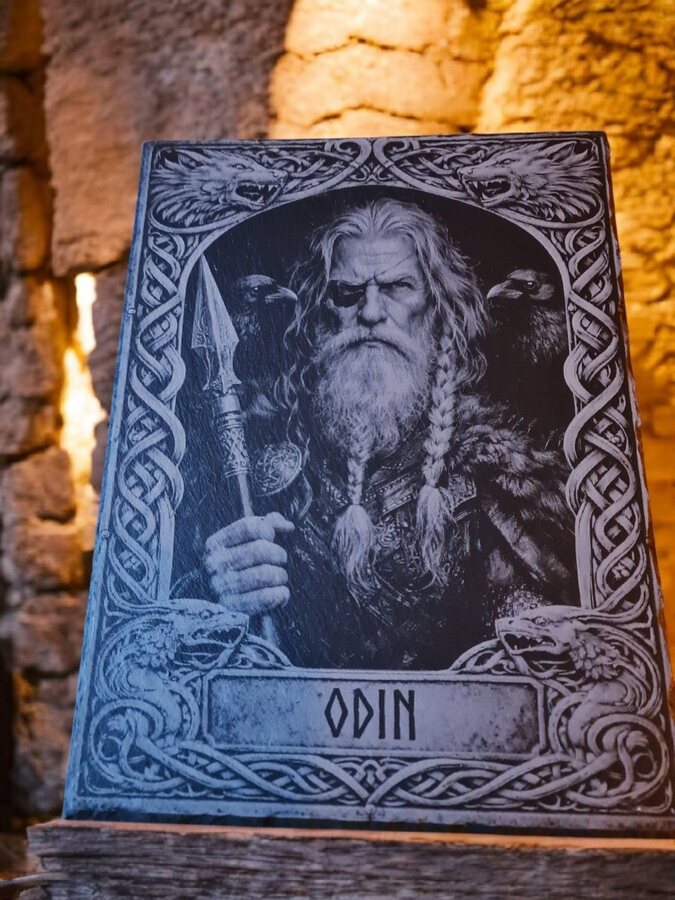
When we engrave a Viking ship on slate in our Alsdorf workshop, we almost always end up at Gokstad. Not because it is the most spectacular ship – Oseberg is far more richly decorated – but because it is so honest. Every plank, every port, every rivet is documented. What you see is not a film fantasy but the tool of people who knew the sea and understood wood.
And you see a man in his forties who fell in a fight, was buried with horses, hounds and peacocks, and whose grave was deliberately violated two generations later. That is the Viking Age without a soft-focus lens: skill and splendour, violence and politics, side by side.
How old is the Gokstad ship? Tree-ring dating shows the ship was built in the 890s from timber felled around 890. The burial took place around 900 to 905.
How big is the Gokstad ship? It is about 23 to almost 24 metres long and a little over 5 metres wide, with 16 strakes per side and 32 oar ports. That makes it the largest surviving Viking ship in Norway.
Who was buried in the Gokstad ship? A tall, powerfully built man in his forties who died of battle wounds. His name is unknown; the identification with King Olaf Geirstaðaálfr is an old hypothesis that has largely been abandoned.
Where is the Gokstad ship now? On Bygdøy in Oslo. It was moved into the new Museum of the Viking Age on 29 October 2025; the museum is scheduled to open in 2027, and until then the ship is not on public view.
Was the Gokstad ship seaworthy? Yes. The replica Viking sailed from Bergen across the Atlantic and on to Chicago in 1893, reaching speeds of around 10 knots. Later replicas have confirmed it.
Were the Gokstad shields real? Yes – 64 original round shields were found, painted yellow and black. A 2023 re-examination considers them fit for battle, although hanging them along the rail was part of the funeral staging.
For courage. For remembrance. For legends that live on.
The Oseberg ship & the two women · The longships · The Skuldelev ships · Birka – the trading hub · Hedeby.
All Ships & Seafaring articles →
There is an Old Norse word for the quietest terror of seafaring: hafvilla, the “sea-bewilderment.” It does not mean the …
Read more →Some graves are so rich that they still take our breath away. The Oseberg grave near Tønsberg in Norway is one such: a …
Read more →Around the year 1070 the people of Roskilde deliberately sank several old ships in a narrow channel of their fjord – as …
Read more →Sometimes a ship stands in the middle of a wide landscape – only it is not made of wood, but of upright boulders …
Read more →