Birka was the most important trading town of Viking Age Sweden: a harbour settlement on the island of Björkö in Lake Mälaren, about 30 kilometres west of modern Stockholm, founded around 750 and abandoned around 975. Northern furs met Arab silver and eastern silk here, the missionary Ansgar preached here, and here lies grave Bj 581, whose "warrior woman" is still hotly debated. This guide separates what the finds and texts actually show from what is interpretation, and tells you how to visit Birka today.
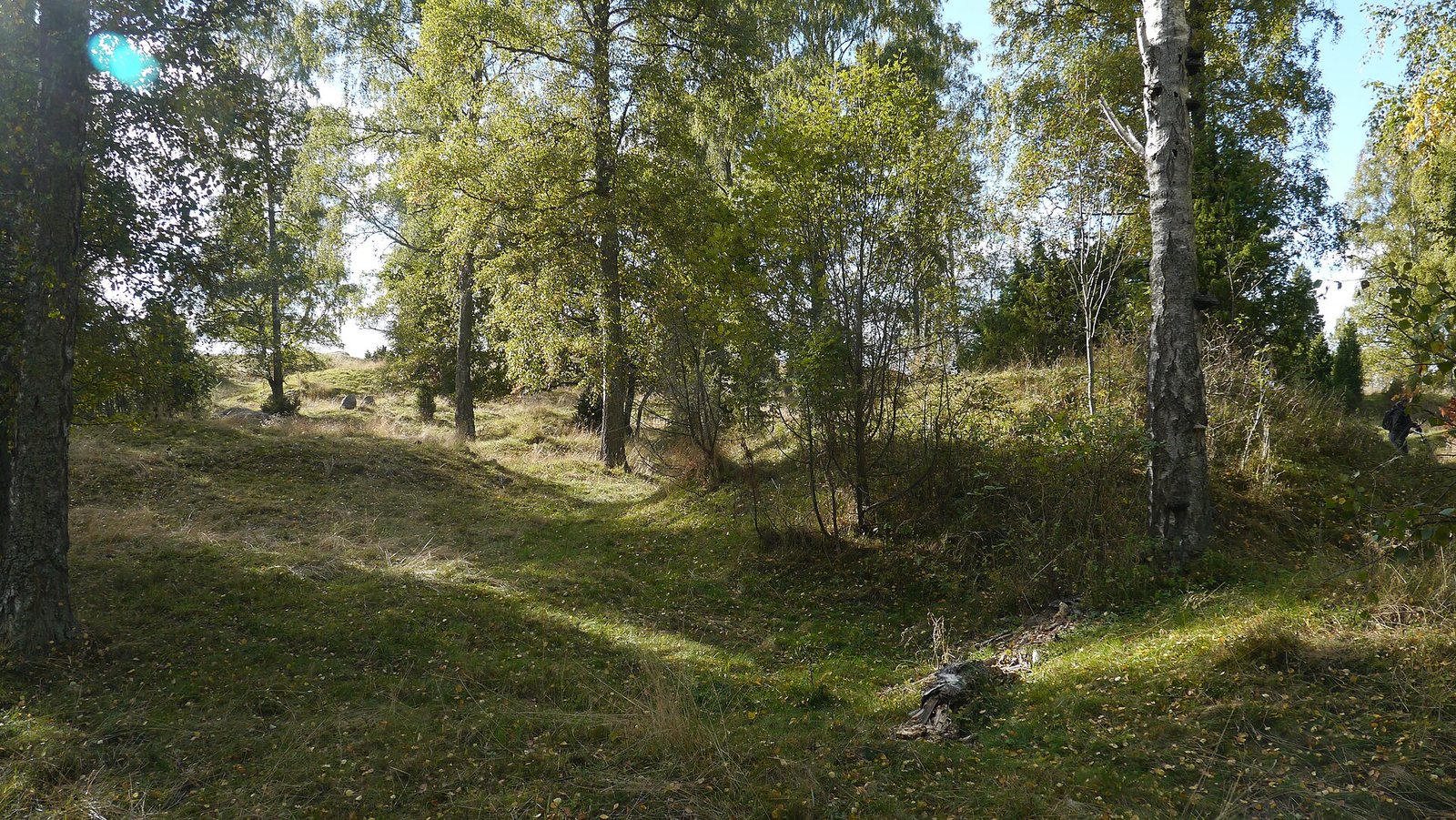
Step off the summer tour boat at Björkö and the first thing you notice is sheep. Then juniper, birch trees, a few red wooden cottages. And then, once your eyes adjust, the mounds. They are everywhere, low humps scattered among the trees like upturned bowls. Every one of them is a grave. UNESCO counts more than 3,000 on the island, and each is a reminder that this quiet patch of pasture was once one of the busiest places in northern Europe.
Birka is what the Frankish missionaries of the ninth century called it, and they were the first to write the name down. For two centuries the town sat on a crossroads of routes that ran from the North Sea to the Volga and on to Baghdad. Because nobody built over it for the next thousand years, it survives as one of the most complete Viking Age trading towns anywhere. That is a gift for archaeologists, and a good reason to look closely at what we really know.
Björkö means "Birch Island", and the name Birka probably comes from the same root, though that is not certain. The island lies in the eastern part of Lake Mälaren, Sweden's third-largest lake. In the Viking Age, however, Mälaren was hardly a lake at all. Scandinavia has been rising slowly since the end of the Ice Age, a process geologists call post-glacial land uplift, so the water stood considerably higher than it does now, by around five metres according to common estimates. Mälaren was a sprawling inlet of the Baltic, a maze of islands, sounds and bays reaching deep into fertile Uppland and Västmanland.
Björkö sat where several of these waterways met. Iron from Bergslagen, furs from the north and grain from Uppland had to pass this way to reach the coast, and imported goods from the Baltic had to pass it on the way inland. The island offered sheltered bays and was hard to reach by surprise from the open sea. A merchant from Hedeby or Gotland needed local pilots to find his way in, which is exactly what a ruler who wants a controlled market would like.
Within sight lay the neighbouring island of Adelsö and the royal estate of Hovgården. We will come back to it, because Birka makes little sense without it.
Archaeology places Birka's beginnings in the mid-eighth century; UNESCO gives roughly 750 to 980 as the life of the trading town. That makes Birka one of the first generation of Scandinavian trading places, alongside Ribe in Jutland, which is a little older, and Hedeby on the Schlei. Scholars call such sites "emporia": trading places that did not grow out of a village but were deliberately laid out, usually under the protection and control of a king.
Population figures are estimates. The usual range is 500 to 1,000 inhabitants, perhaps around 700 at the peak. That sounds like a village. In a ninth-century north where almost everybody lived on scattered farms, it was a town, and in summer visiting traders, sailors and craftsmen would have swelled it further.
The end came in the late tenth century. The latest coins from the settlement layers date from the decades around 960, and the end is usually placed around 975. Why the town was given up has no single answer; more on that below.
You can still recognise the town area by the colour of the soil. In the north of the island lies the "Svarta jorden", the Black Earth: a dark occupation layer, in places several metres thick, built up from charcoal, ash, food waste, bone, dung and building debris. To an archaeologist this is a treasure chest, every layer a page of urban history. The area covers about seven hectares.
Large-scale excavations took place here between 1990 and 1995 under Björn Ambrosiani. They revealed a planned town rather than a random sprawl: fenced plots, houses rebuilt again and again on the same parcels, and workshops working at full stretch. Bronze casters turned out jewellery in series, and their moulds and crucibles survive in thousands. Comb makers carved antler into the combs found in almost every grave. Bead makers melted glass, some of it from imported mosaic tesserae and broken vessels, into the colourful strings worn by women across the north.
Along the shore lay the harbours. Several landing places are known, among them Kugghamn and Korshamn, with jetties pushed further out as the waterline dropped. Divers have found rows of piles in the water off the settlement, interpreted as barriers and breakwaters. Adam of Bremen describes the approach in very similar terms in the eleventh century: hidden rocks guarded the harbour and endangered anyone who did not know the way.
Birka was no open market on a green field. On the landward side a town rampart, the "stadsvallen", enclosed the settlement in a half-circle, timber-reinforced and pierced by several gateways. Its visible line is thought to date from the tenth century, when the Baltic was becoming a more dangerous place.
South of the Black Earth rises a rock outcrop crowned by a hillfort, simply called "Borgen", the Fort. It served as refuge and lookout. Right below it lay an area researchers call the "Garrison". Excavations around the turn of the millennium uncovered a hall with a striking number of weapons, fragments of lamellar armour and belt fittings. Several pieces show eastern forms from the world of the Rus and the steppe peoples. This suggests a warrior class closely linked to the east.
No text tells us who these warriors were. A king's retinue, a town guard, hired men? The finds only show that people for whom weapons were everyday equipment lived right next to the market.
Birka's wealth came from trans-shipment. From the north and east came the pelts of squirrel, marten, fox and beaver, along with antler, hides, down and iron. Via the Baltic and the Russian rivers these goods travelled as far as the Volga, where Muslim merchants waited. The envoy Ibn Faḍlān, who met the Rus on the Volga in 922, gives a vivid picture of that world.
What came back was silver, above all Arab dirhams: coins of the Abbasids and later of the Samanids of Central Asia. In the north nobody counted them; they weighed them. Coins were cut up, nicked to test their quality and weighed on small folding balances. We explain how this hacksilver economy worked in a separate article. Balances and weights are typical grave goods at Birka.
Other goods show just how far the network reached: silk from Byzantium and the Orient, glass from the Rhineland, Frankish wine jugs, carnelian beads whose raw stone probably came from India, rock crystal and bronze vessels. The textile finds are a story of their own. Around 4,800 fragments survive, and the textile scholar Agnes Geijer published a landmark study of them as early as 1938. They include silk ribbons, gold braid and fabrics worked with silver wire, the clothing of an elite that liked to show what it had. For the bigger picture of routes and goods, see our article on Viking trade.
Part of this trade was in people. Rimbert tells how Ansgar found Christian captives held at Birka. Unfree people, the thralls, were captured, sold and passed on around the Baltic, and some of the silver in the graves was their price. That belongs to the town's story too, even if it does not shine.
Few single finds show Birka's reach as clearly as a small finger ring from grave Bj 515. Hjalmar Stolpe recovered it in the nineteenth century from the burial of a woman laid to rest in the ninth century. The ring is silver and set with a violet stone engraved with a short Arabic inscription.
In 2015 a team led by the biophysicist Sebastian Wärmländer of Stockholm University examined the ring under a scanning electron microscope and published the results in the journal Scanning. Two findings stood out. First, the supposed amethyst is in fact coloured glass, at the time an exotic material in its own right. Second, the surface showed hardly any wear. The researchers concluded that the ring had not passed through many hands and may have travelled fairly directly from the Islamic world to Birka. The inscription is usually read as "for Allah" or "to Allah", although the exact reading is not entirely clear.
Rich as the soil is, the written record is thin. Almost everything contemporary about Birka comes from one text, the Vita Anskarii or Life of Saint Anskar. It was written by Ansgar's pupil and successor Rimbert, archbishop of Hamburg-Bremen, in the years after Ansgar's death in 865.
Ansgar was a monk of Corbie and Corvey. Around 829 Emperor Louis the Pious sent him north after a Swedish embassy had asked for priests. The journey turned into an ordeal. On the way, Rimbert says, pirates attacked the merchants the missionaries were travelling with. The traders fought back bravely at first but were overcome; the ships and nearly everything aboard, books included, were lost. On foot, we are told, Ansgar and his companion Witmar finally reached the harbour called Birka.
There King Björn received them kindly and let them preach. One of the first converts was Herigar, the prefect of the town and a confidant of the king. He built a church on his own land, the first we know of in Sweden; UNESCO dates the founding of this congregation to 831. Ansgar soon returned and became archbishop of Hamburg, and a bishop named Gautbert went to Birka in his place. Gautbert was later driven out in an uprising and his nephew Nithard was killed.
Around 852 Ansgar came a second time. A king called Olof now ruled. Whether the Christians could stay was not decided by royal command but at the thing, the assembly of free men, and by casting lots. In the end Ansgar was allowed to remain and have a church built again. The mission did not last; Sweden's conversion took another two centuries.
Two centuries later, around 1075/76, the Bremen canon Adam of Bremen wrote his history of the archbishops of Hamburg, and Birka appears again. Adam describes it as a town in the middle of the Swedes' land, with a harbour where ships of Danes, Norwegians, Slavs, Sembians and other peoples regularly gathered. He also records that Archbishop Unni of Hamburg-Bremen died at Birka in 936.
The catch: Adam never went there. He relied on older texts, above all Rimbert, and on what travellers told him, for example at the court of the Danish king Svein Estridsson. In a later marginal note he adds that Birka had by then become deserted, with hardly a trace left. His harbour description is memory rather than observation, but it shows that Birka lived on in eleventh-century minds as a great trading place.
Where the texts fall silent, the dead speak. Several cemeteries surround the Black Earth, the largest called Hemlanden. More than 3,000 graves are known, visible as mounds and stone settings, and geophysical survey has found more. About a third have been investigated.
Most of that work was done by a single man, Hjalmar Stolpe (1841–1905). He was trained as a zoologist and entomologist and first came to Björkö to study insects in amber. Then he found graves and stayed. Between 1871 and 1895, with interruptions, he excavated around 1,100 burials. He drew grave plans, numbered the finds and even labelled individual bones in ink. That is precisely why his excavations can be re-examined today with DNA and isotope analysis. The graves were later published in the series "Birka", above all in Holger Arbman's "Birka I. Die Gräber" (1940/43).
Cremations lie next to inhumations, plain pits next to lavish chamber graves furnished with furniture, weapons and sometimes horses.
Religious change is in the ground too. Birka has yielded around ten small silver cross pendants and, alongside them, 27 Thor's hammer pendants from the tenth century. Christians and pagans lived side by side here, and some people may have worn both.
Several women's chamber graves also contained iron staffs. Neil Price and Leszek Gardeła cite grave Bj 845 among others and consider whether these staffs might be linked to sorceresses like the völva of the sagas. Others prefer more prosaic readings such as measuring rods or distaffs. We explore that debate in our article on seiðr and the völva.
No grave from Birka is as famous as Bj 581. Stolpe opened it in 1878. It sits on a raised terrace at the edge of the town, right next to the Garrison and the hillfort. The equipment is impressive: a sword, an axe, a fighting knife, two lances, two shields and 25 armour-piercing arrowheads. Add a complete gaming set with pieces and dice, perhaps a form of hnefatafl, and two horses, one bridled for riding. A coin, a quartered Samanid dirham struck after 913, dates the burial to the tenth century, probably around its middle.
Because the contents looked typically male, Bj 581 served for more than a century as the textbook example of a high-status warrior grave. As early as the 1970s an osteological study suggested a female skeleton, but nothing came of it. In 2016 osteologist Anna Kjellström of Stockholm University reached the same conclusion.
Genetics followed in 2017. A team led by Charlotte Hedenstierna-Jonson of Uppsala University analysed DNA from a tooth and an upper arm bone and reported in the American Journal of Physical Anthropology: two X chromosomes, no Y. The woman was over 30 when she died. Strontium isotopes suggested she had not grown up in Birka but moved there. The paper's title left no room for doubt: "A female Viking warrior confirmed by genomics".
What followed was one of the liveliest debates in recent Viking studies, and the serious objections came from within the field. Viking Age scholar Judith Jesch criticised the study's handling of written sources and its limited discussion of alternatives. Fedir Androshchuk pointed to disturbed contexts: Birka graves had been altered by stone robbing and later interventions, and Stolpe worked with untrained helpers. Had the wrong skeleton been sampled? Was there a second body? And back in 1980 Anne-Sofie Gräslund had warned in general against reading weapons in a grave as the dead person's profession. Weapons can also signal rank, family or inheritance.
In 2019 Neil Price, Charlotte Hedenstierna-Jonson and colleagues replied in Antiquity with "Viking warrior women? Reassessing Birka chamber grave Bj.581". They laid out Stolpe's documentation, showed that the sampled bones clearly belonged to the grave and that only one person had been buried there. Their reading: a woman of high rank who lived as a warrior and may even have commanded mounted troops. Her gender identity, they conceded, cannot be proven.
Birka was not a royal seat, and kings did not live among comb makers and bronze casters. Their estate lay on neighbouring Adelsö at Hovgården, within sight and with its own harbour. Large burial mounds, the so-called King's Mounds, rise there. A runestone carved around 1070 names a "bryti", a royal steward, a reminder that the estate remained a royal domain long after Birka's end. In the thirteenth century King Magnus Ladulås built the palace of Alsnö hus here, and in 1280 the royal council met there.
This division of labour is typical of the Viking Age: the market here, the power there. Uppland also had a second power centre with royal mounds at Old Uppsala. Since 1993 Birka and Hovgården together form a UNESCO World Heritage Site, inscribed as an exceptionally complete testimony to the Viking Age trade network and to the link between market and royal power.
To understand Birka, get to know Hedeby (Haithabu). The Danish trading town on the Schlei near today's Schleswig was something like Birka's twin sister. Both arose in the eighth century, both lay sheltered on inland waters, both had a semicircular rampart, harbour works and vast cemeteries. And Ansgar stood in both: in Hedeby he had a church built around the middle of the ninth century.
Ships ran between the two. Hedeby was the gate to the North Sea, the Frankish realm and England; Birka the gate to the Baltic and the east, to the Rus and on to Byzantium and the Caliphate. The difference lies in how they ended. Birka faded quietly around 975. Hedeby lasted longer but was burned by Harald Hardrada around 1050 and destroyed by Slavs in 1066. Since 2018 Hedeby and the Danevirke have been on the World Heritage list as well.
There is no evidence that Birka was conquered. It simply lost its reasons to exist, as several developments came together. Arab silver, the fuel of eastern trade, dried up in the decades after 960 as Central Asian silver mines declined and the Samanid state ran into crisis. Trade routes shifted west and south. And the land kept rising: channels grew shallower and harbours silted up.
About 35 kilometres to the north-east, the new town of Sigtuna appeared around 970/980, Christian from the start, with churches and a royal mint, close to the crown. It took over Birka's role, and Birch Island went back to being pasture.
Birka is a day-trip destination today, but a peaceful one. In the summer season you reach it by tour boat from Stockholm, departing from Klara Mälarstrand by the City Hall and taking about two hours each way, or by a short boat ride from Hovgården on Adelsö, which you reach by car ferry. Season dates and timetables change every year, so check with the operator first.
On the island there is a museum with models and finds, a reconstructed Viking quarter with houses and boats, and guided walks past grave mounds, the hillfort, the Black Earth and grave Bj 581 to the Garrison. On the hill stands the Ansgar Cross, a nineteenth-century memorial, and a little way off a small chapel. Allow three to three and a half hours on the island. The original finds, including the ring from Bj 515, are in the Swedish History Museum in Stockholm. For more places to add to your trip, see our guide Experiencing the Vikings: museums and sites.
A tip from our workshop: walk across the Hemlanden cemetery alone for a few minutes once your group has moved on. It gets very quiet between the mounds, and Birka stops being a ruin. It becomes a place of fur traders, comb makers, missionaries, slaves and a woman buried with a sword. If you want to know what these people were called, and how Vikings differ from Normans and Varangians, read on in Vikings, Normans, Norsemen, Varangians, Rus.
Where is Birka? On the island of Björkö in Lake Mälaren, about 30 kilometres west of Stockholm, in Ekerö municipality. Across the water lies Adelsö with the royal estate of Hovgården.
When did Birka exist? From about 750 to about 975. The latest coins from the settlement date from the decades around 960, after which Sigtuna took over as the region's trading centre.
Was the Birka warrior woman real? The skeleton in grave Bj 581 is genetically female and was buried with a full set of weapons and two horses. Whether she fought herself or the weapons expressed her rank is still debated by researchers.
What is the Birka Allah ring? A silver ring with a violet glass setting and an Arabic inscription, from the ninth-century female grave Bj 515. A 2015 analysis suggests it reached Birka fairly directly from the Islamic world.
How many graves are there at Birka? More than 3,000. Hjalmar Stolpe excavated around 1,100 of them between 1871 and 1895, and about a third have been investigated in total.
Can you visit Birka? Yes, in the summer season by boat from Stockholm or from Adelsö. The island has a museum, guided tours and a reconstructed Viking quarter; the original finds are in the Swedish History Museum in Stockholm.
For courage. For remembrance. For legends that live on.
Hedeby · Hacksilver – silver as currency · The silver hoards · Uppåkra – Scandinavia's cult place · The Oseberg ship & the two women.
All History & Finds articles →
Since 1878, Birka’s grave Bj 581 had been the textbook example of a high-status Viking warrior – the „ultimate Viking" …
Read more →Sometimes history is found not with the spade but with the computer. For a long time four of Harald Bluetooth's famous …
Read more →