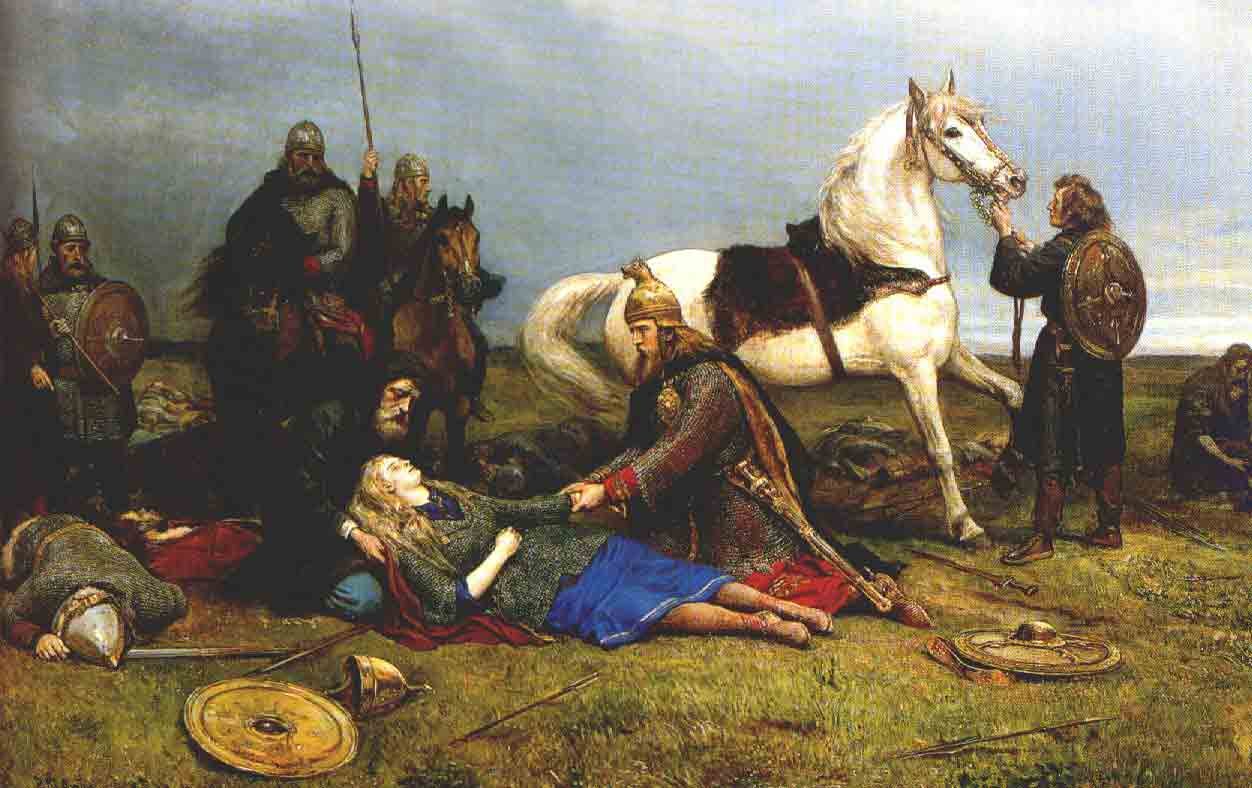
Few images from the Viking world stir as much excitement – and as much argument – as the shield-maiden: the woman with shield and sword who rides into battle beside the men. Between medieval poetry, one famous grave and modern television romance lies a surprisingly thin yet fascinating body of evidence. We separate honestly what is proven, what is interpretation, and what is pure invention.
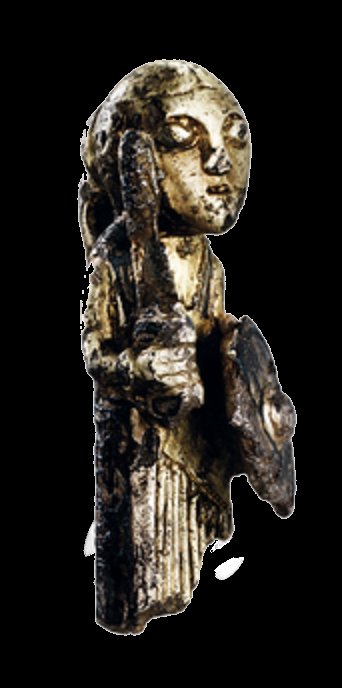
The Old Norse word skjaldmær literally means „shield-girl" or „shield-maiden" – a woman who bears weapons and fights. She appears again and again in the medieval Icelandic and Danish texts: as a bold warrior, a royal avenger, a superhuman valkyrie. She is one of the most vivid figures in Norse tradition. Yet this is exactly where the difficulty begins: almost everything we know about her comes from stories written down centuries after the Viking Age. The shield-maiden is first a literary figure – and only secondarily a possible historical reality.
To treat the subject honestly, three levels must be kept apart: poetry (the sagas and Saxo), myth (the valkyries) and archaeology (the weapon graves). Each level says something different – and none on its own proves that fighting women were common in everyday Viking life.
The richest literary source is the Danish scholar Saxo Grammaticus, who around the year 1200 wrote his „Gesta Danorum" – the Deeds of the Danes. Saxo describes several times women who put on men's clothing, took up the sword and fought in armies. He writes about them with something close to astonishment and thereby gives us the fullest early „evidence" for the shield-maiden.
There were once among the Danes women who shaped their bodies to masculine hardness and devoted almost every waking moment to the craft of war. They shunned the soft life, hardened body and mind with toil, and laid aside all womanly gentleness.Saxo Grammaticus, Gesta Danorum, Book 7 (c. 1200; paraphrased translation, public domain)
Saxo also introduces Lagertha (Old Norse Hlaðgerðr), who stands out in battle through her courage and is later linked to Ragnar Lodbrok. However striking these accounts are, one must understand how Saxo worked: he wrote in the Christian High Middle Ages, a good two hundred years after the Viking Age, and he had a clear agenda. His warrior women are often moral examples, sometimes admired, sometimes rebuked as a „reversal of the natural order". Classical models – the Amazons of Greek and Roman tradition – noticeably shaped his picture. Saxo is therefore an important but not a neutral source: literarily rich, historically to be read with care.
The Icelandic sagas, too, know the fighting woman. In the „Hervarar saga" appears Hervör: she dons men's clothing, takes a man's name, becomes a viking, and even descends into her father's burial mound to claim the cursed sword Tyrfing. Her granddaughter bears the same name and later falls in battle against the Huns – a woman with the sword in her hand, in the thick of the fight.
The „Fornaldarsögur", the sagas of ancient times, teem with such figures. They are heroic, often of royal descent, and their battles belong to the adventurous tone of these tales. One recurring pattern is telling: the shield-maiden fights until she marries – then she lays down her weapons and returns to the expected role of a woman. This reveals much about the storytellers and their time: the warrior woman is a dramatic exception, a breaking of the norm, not a picture of everyday life. Precisely because she is unusual, she makes a great story.
Above the earthly shield-maiden stands the valkyrie, the „chooser of the slain". She is not human but a supernatural being in Odin's service: she decides victory, gathers the fallen warriors for Valhalla and there hands them the mead. In poetry, valkyrie and shield-maiden often blur into one another – Brynhildr, for instance, appears as a valkyrie and at the same time as a warlike, royal woman. Anyone who wants to know more about these figures will find a dedicated article on the valkyries with us.
The distinction matters: the valkyrie is mythology, not a historical model. She shows that the Norse imagination knew and prized warlike femininity – but she says nothing about whether women actually went into battle. Myth and everyday life are two different things, and many romantic shield-maiden images carelessly mix the two.
Here archaeology enters – and with it the real turning point of the debate. In the trading town of Birka near Stockholm, an especially richly furnished chamber grave was uncovered as early as 1878, catalogued as Bj 581. It contained a full warrior's equipment: sword, axe, spear, arrows, a fighting knife, two shields and two sacrificed horses. For over a century it was taken for granted to be the grave of a high-ranking male warrior – no one doubted the sex, because the weapons seemed to answer the question.
In 2017 a study led by Charlotte Hedenstierna-Jonson changed the picture fundamentally. An osteological and genetic examination of the bones showed that the individual carried two X chromosomes and no Y chromosome: biologically a woman. That was the solid sensation – for the first time, a Viking-Age woman buried with full weaponry was clearly identified by genetics. Anyone wishing to read the find in detail will find a full article on the warrior woman of Birka with us.
As important as the find is, it must be interpreted just as carefully. What is proven is that a woman was buried with warrior equipment. What is not proven is what she did in life. A grave reflects the ideas of the mourners, not necessarily the daily life of the dead. The grave goods may mean: she was a warrior. But they may also express rank, family, or a symbolic or ritual role. Critics also note that the bones come from an old excavation of 1878 and that the assignment of the grave goods is not, in every detail, beyond all doubt.
Honestly put: Bj 581 shifts the balance noticeably – from „pure poetry" toward „there was at least one woman who was seen and honoured as a warrior". A single grave, however, does not yet make it a widespread phenomenon. There are indications of further possible weapon graves of women (for example in Norway and the Baltic), but there the sexing is often less clear or the weapons more sparing. Scholarship is deliberately cautious here.
To place the shield-maiden correctly, it helps to look at Viking women as a whole. Measured against their era, they held remarkable rights: they could own property, run farms, divorce and trade. The house key at the belt was a sign of power and responsibility. Yet this strong, respected role played out mainly in the sphere of house, farm and economy, not on the battlefield. More on this in our article about the women of the Viking Age.
That is exactly why the shield-maiden is so fascinating: she cuts across this order. Whether she was a rare reality, a respected exception or a literary ideal cannot be finally decided with today's sources. A spectrum is most likely: individual women who really bore weapons, together with a rich cultural idea of warlike femininity that elevated these individual cases and carried them into the sagas.
Two names stand out. We know Lagertha almost solely through Saxo – a single medieval author, roughly two centuries after the Viking Age. No archaeological or contemporary evidence for a historical Lagertha exists. She is a transmitted saga figure, not a documented person; our own article on Lagertha sets this out.
Hervör, in turn, is pure saga literature: mighty, tragic, immortal as a tale – but a tale. Her story lives on burial mound, cursed sword and fate, not on chroniclers' reports. We also have a dedicated text on Hervör. These names are cultural treasures of the first rank – one should simply not confuse them with documented biographies.
A large part of today's shield-maiden image comes not from the Middle Ages but from cinema and streaming. The series „Vikings" made a Lagertha into a central warrior heroine and thereby shaped millions of viewers. That is gripping storytelling – but modern fiction, which fuses literary fragments (Saxo), an archaeological find (Bj 581) and a great deal of dramatic invention into one catchy picture. The same is true of video games and fantasy novels.
One may enjoy this, but should not take it for history. The real evidence is thinner, more cautious and, precisely for that reason, more exciting: it forces us to distinguish honestly between knowledge and wish.
An often underrated point: the medieval authors of the North did not write in a vacuum. They knew the learned culture of their day, and that included the Amazons of Greek and Roman tradition – a whole people of warrior women at the edge of the known world. This ancient image coloured the portrayal of the shield-maiden. Saxo, for instance, describes his warrior women with phrasing that clearly echoes classical models. That does not mean he invented everything – but it warns against taking every detail as a direct report from the Viking Age.
The shield-maiden thus stands at the meeting point of two currents: a possibly genuine Norse memory of individual fighting women, and a learned, literary ideal of the warrior maiden that travelled across Europe. To tell the two apart is the core of serious source criticism – and it is what makes the subject truly exciting.
Bj 581 does not stand entirely alone. In various Viking-Age graves, weapons or weapon-like objects have turned up beside skeletons identified as female – in Norway, on the British Isles and in the Baltic region. Yet caution is needed: often these are single arrowheads or an axe that could be tool as well as weapon. Frequently, too, the sexing rests only on the grave goods or a rough bone analysis, not on secure genetics. In some older excavations, skeleton and grave goods can no longer be matched with certainty.
The result is a blurred picture: there is more than Bj 581 alone, but no second grave of comparable evidential weight. Serious scholarship therefore says neither „isolated case" nor „mass phenomenon", but rather: a small number of indications that deserve honest discussion – without inflating them into proof of a Viking-Age class of warrior women.
The heart of the whole debate lies in a simple, often overlooked truth: a grave tells of the living, not only of the dead. The survivors choose the grave goods – according to rank, family, belief, grief and what they wished to say about the deceased. A sword in the grave can mean „she fought", but it can also mean „she came from a warrior lineage", „she ran a high-status household" or „these weapons had a ritual meaning". Exactly the same caution applies, by the way, to men's graves – only there few people ask, because the image of the male warrior was never questioned.
This methodological openness is not evasion but sound scholarship. Whoever instantly declares Bj 581 a „Viking warrior woman who rode into battle" goes beyond the evidence – just as much as those who play the find down. The most honest stance is to bear that we do not know for certain, and yet to hold fast: this woman was buried as a weapon-bearer, and that matters.
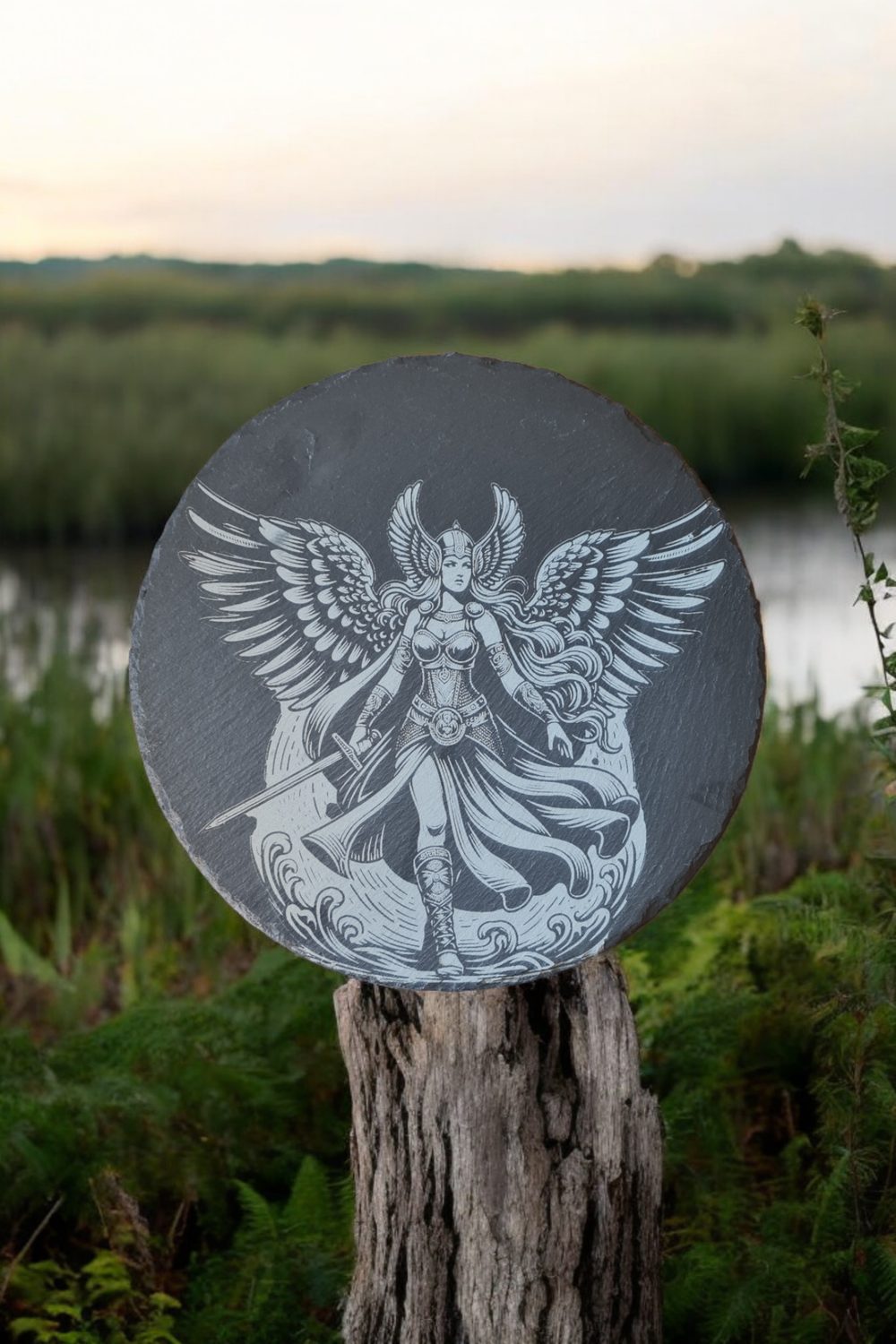
Whether historically widespread or not, the shield-maiden touches something fundamental: courage, self-determination, the readiness to step beyond one's assigned role. That is exactly why she lives on in art, jewellery and engraving. Whoever depicts her honours her best by honouring the whole truth: a powerful figure of the Norse imagination, anchored in real poetry and in a real grave, but not overloaded with invented certainty. So she remains strong – and honest at the same time.
The Birka Warrior · The Valkyries · Viking women · Lagertha the Shield-Maiden · Hervör.
All History & Finds articles →
The Viking battle was no wild scramble but a hard struggle shield to shield. A look at tactics and weapons beyond the …
Read more →Long before the Viking Age and before the Icelandic Edda there was Germanic cult – and one of the most striking stood …
Read more →