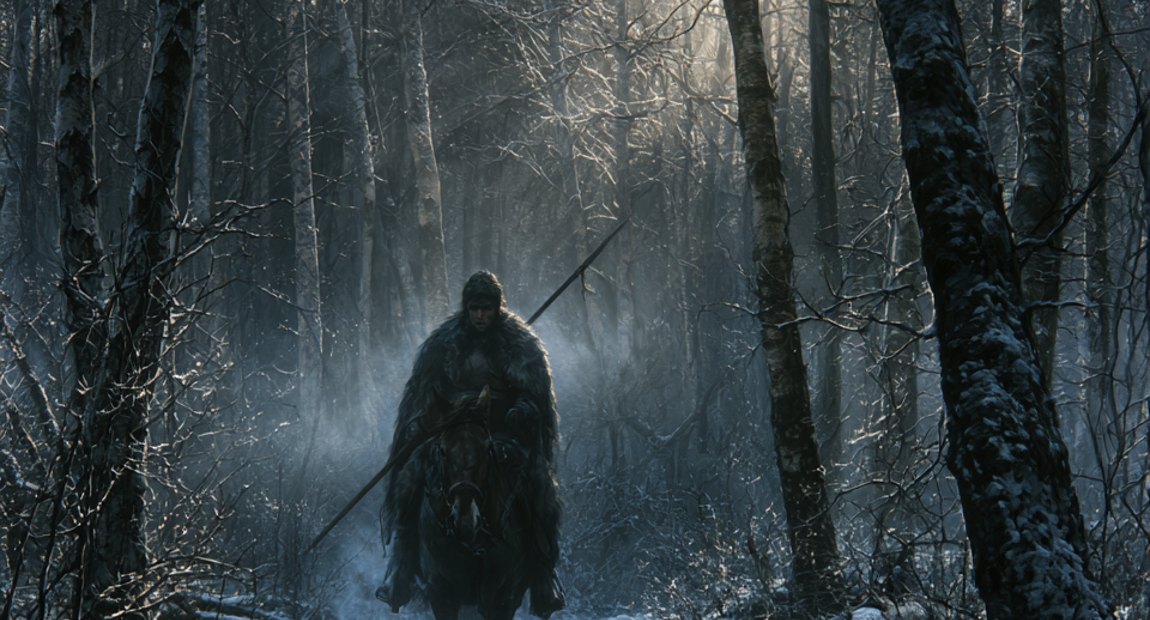
There are scenes in Norse poetry that take your breath away. Hervör’s night walk to the grave-mound of her dead father is one of them.
To understand Hervör, we first have to look at the sword she is after. Tyrfing was forged by two dwarves whom King Svafrlami had cornered and forced to make him a blade that would never miss, never rust and cut iron like cloth. Cornered smiths, though, are dangerous smiths: the dwarves laid a threefold curse on their work. Tyrfing would kill a man every single time it was drawn, it would be the death of three great deeds of shame, and it would bring the bane of Svafrlami himself. A weapon of matchless quality and matchless doom in one – the very tension that runs through the whole saga.
The blade passes down through blood and violence until it lies buried with the berserker Angantýr on the island of Samsø, where he fell with his eleven brothers. Angantýr never knew he had a child; his daughter Hervör grows up with her grandfather, is called the child of a slave, and rebels against the narrow role laid out for her. She takes up weapons, adopts a man’s name and way, and goes to sea – first as a viking, then with one goal: to reach her father’s grave and claim what is hers.
The heart of the Hervararkviða is her night on Samsø. The island is shunned; the herdsmen she meets beg her to turn back, for once the sun sets the grave-mounds open and burn with balefire. Hervör walks on regardless. What follows is one of the most striking dialogues in all of Old Norse poetry: a living woman standing in the fire, calling her dead father up out of the earth.
She does not plead. She commands, she taunts, she refuses to be frightened by flames or by the barrow-wight her father has become. Angantýr answers from below that no living kinsman lies there to give her anything, that she is braver than is good for her, and that the sword is better left where it is. Hervör will not hear it.
„Awake, Angantýr! Hervör wakes you, your only daughter." — Hervararkviða, after Nora Kershaw (1922)
In the end Angantýr yields and hands Tyrfing up out of the mound – but not without the warning that gives the scene its weight. The blade, he tells her, will destroy her whole line; it will be the ruin of her son. Hervör takes it anyway. That is the tragic core of the poem: she wins her fight against fear and death, and in the same moment she carries the curse home with her.
The saga proves him right. Hervör’s son Heiðrek becomes the owner of Tyrfing, and the cursed blade drives the bloody events that follow, down to a great battle between Goths and Huns. The courage of the mother and the doom of the sword are two sides of one coin – exactly the kind of hard, unsentimental fate the old poems are so good at.
How much history stands behind the shield-maiden? Armed women appear in Norse art (as Valkyrie figurines, for instance) and in a few archaeological finds, but the fighting woman as a social norm cannot be demonstrated. Hervör is first of all a literary figure – yet one rooted deep in old ideas of honour, inheritance and fate. The fascination endures: J. R. R. Tolkien knew the Hervararkviða closely, translated it, and let its barrow and cursed-sword motifs flow into his own world.
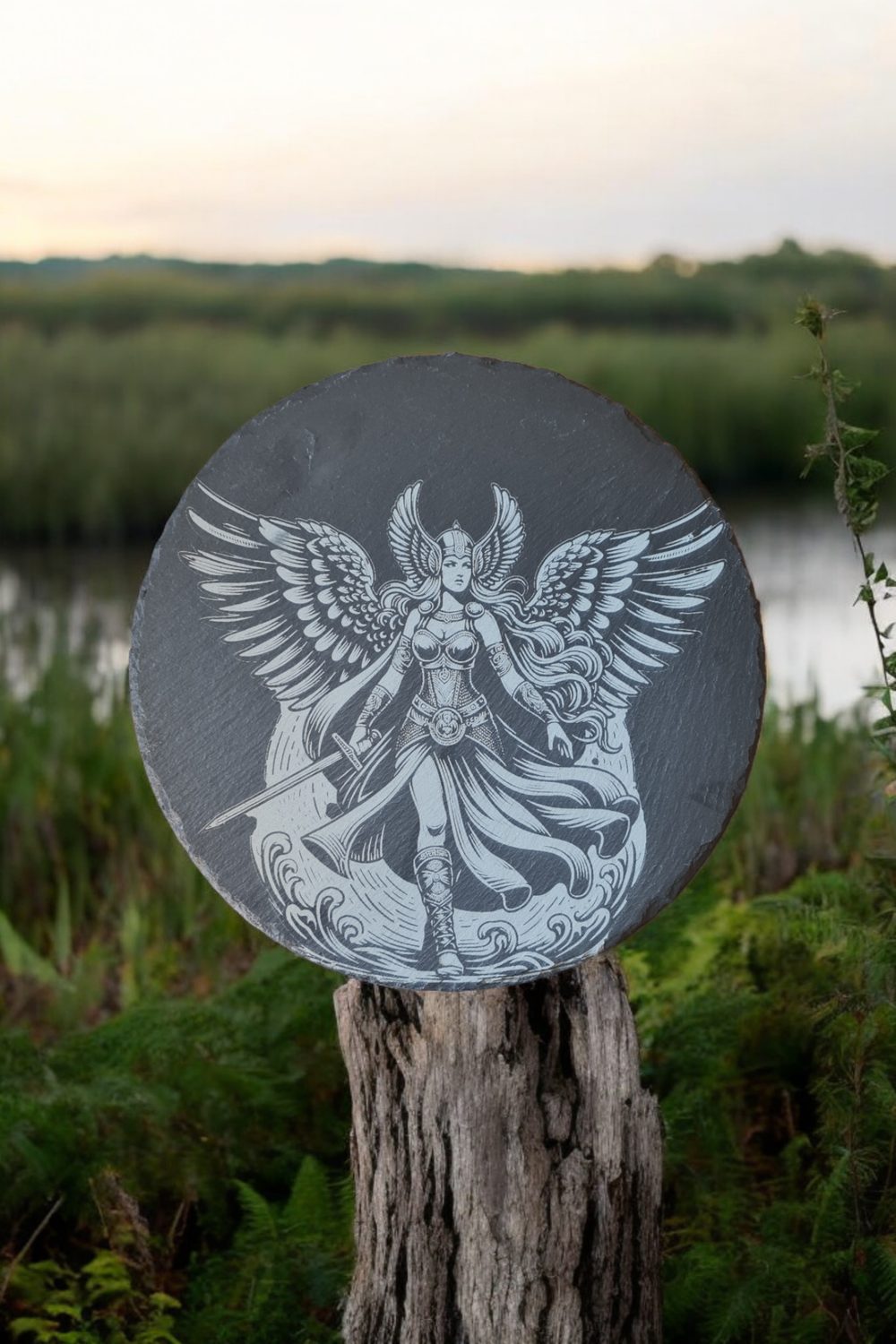
For us Hervör is one of the strongest figures you can bind into stone or wood: a woman who faces the fire and the dead to take what is hers. Characters like her are the reason we engrave Norse motifs at all – they carry an attitude that still does something to us a thousand years on.
At its core the Hervarar saga is the story of a family and its cursed heirloom. Tyrfing wanders from hand to hand, and the curse travels with it: every bearer pays. Hervör’s son Heiðrek becomes a powerful but hot-tempered king who in the end turns the sword against his own people and falls by it himself. After that a great war over Tyrfing and the inheritance flares up between Goths and Huns, told in the old Battle of the Huns lay – one of the oldest heroic poems of the North.
Remarkably, in a later generation a second Hervör bears the name and dies in battle as a leader. The saga deliberately lets the ancestress’s boldness return. So a single grave-mound scene becomes a family fate across generations – courage and curse are inherited together, and neither is ever wholly lost.
Historically the fighting woman remains hard to pin down. There are a few striking finds – such as the richly furnished weapon grave Bj 581 at Birka, which recent analysis showed held a woman – and a whole imagery of small valkyrie and shield-bearing figurines. Yet whether women regularly stood in battle-lines cannot be deduced from this. The shield-maiden is first of all a powerful literary and mythic idea, rooted deep in thinking about honour, inheritance and fate – and one that plainly fascinated the Norse, or they would not have sung and depicted her so often.
That fascination reaches into our own time. J. R. R. Tolkien, philologist and connoisseur of Old Norse poetry, translated the Hervararkviða and let its motifs – the walk to the mound, the cursed sword, the defiant heiress – flow into his own world. Anyone reading today of inheriting warrior-women and enchanted blades stands in a line that runs back over a thousand years to Hervör at the burning mound.
Grottasöngr · Sigurd & the Cursed Gold · Grave-mounds & Burial · Valkyries.
Hervarar saga ok Heiðreks; Nora Kershaw, Anglo-Saxon and Norse Poems (1922). Rudolf Simek, Dictionary of Northern Mythology.
When the shining god Baldr dies, the Æsir give him the most splendid funeral of the North – upon Hringhorni, the …
Read more →It begins with a drunken braggart and ends with a splinter in the thunder god's skull. The tale of Thor and Hrungnir is …
Read more →In their grief for the shining god Baldr, even the gods reach their limits. His funeral ship stands fast in the sand …
Read more →Idun keeps the gods’ greatest secret in a simple box: the apples that keep them young. Without them even Odin and Thor …
Read more →