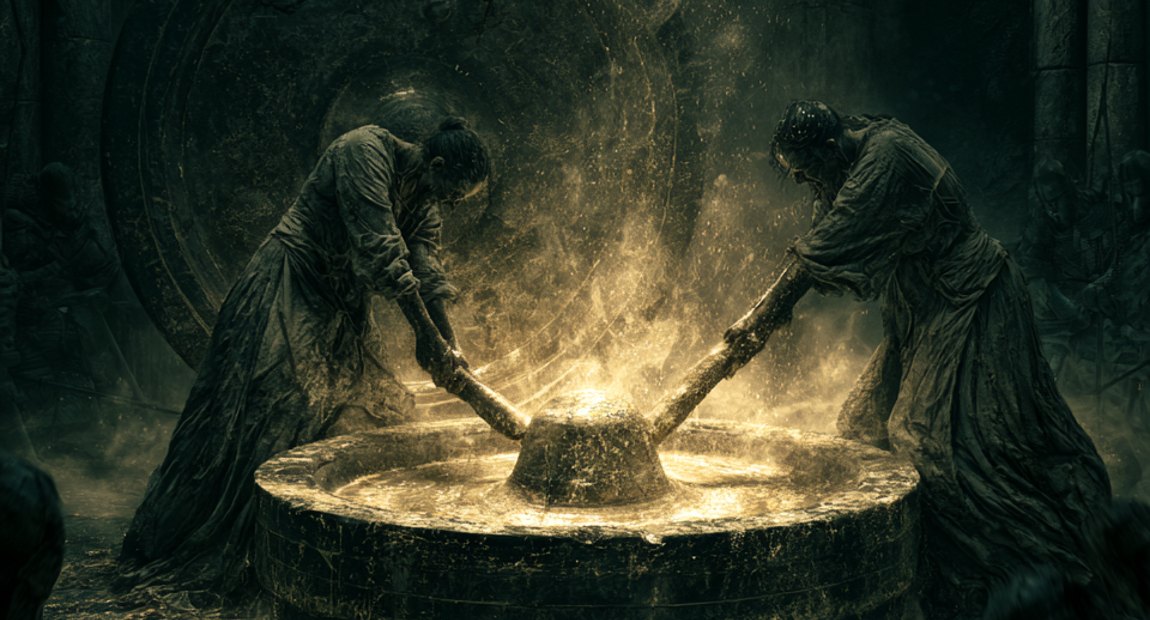
A king has gold and peace ground for him – and grants the maids who turn the mill no rest. Grottasöngr is one of the North’s sharpest stories about power and its limits.
The Grottasöngr, the „mill-song", is among the most uncanny and modern of Norse tales – a story about wealth, greed and the limits of power that one still reads with a shiver today. At its centre stands the Danish king Fróði, a descendant of Odin, and a mill that grinds no ordinary grain. It is called Grótti, and it grinds whatever the one who turns it wishes: gold, fortune, peace – or their opposite.
But the stones of this mill are so monstrously heavy that no human can move them. So Fróði buys two maids of giant strength at a market in Sweden, Fenja and Menja. What he does not know, or does not wish to know: the two are no ordinary bondwomen but beings of giant kin, older and mightier than can be good for the king. They sense their own descent and their strength – and they remember how they are treated.
At first Fróði has the two grind gold, peace and fortune for his realm. The fabled Fróði-peace begins: a golden age in which no one harms another, in which gold may lie open by the roadside without a thief taking it. For a moment the king seems to have everything a ruler could wish.
„Let us grind for Fróði wealth and peace, fortune and plenty on the luck-bringing mill." — Lay of Grótti, after Simrock 1851
But Fróði knows no measure. He drives the maids ever harder and grants them no rest – only as much pause as a cuckoo’s call lasts, or as long as it takes to sing a stanza. Day and night they must turn the heavy stones. Here the story turns: the wealth the mill creates is inseparably bound to the exhaustion of those who drive it. Fróði sees only the gold, not the hands that grind it.
Exhausted, humiliated and furious, Fenja and Menja at last begin to sing a different song. In their work-chant they recall their giant descent and their own strength – and they grind no longer peace but an army and ruin for Fróði. Their song becomes a prophecy that fulfils itself that very night: the sea-king Mýsingr falls upon Fróði’s hall, kills the king and ends the golden peace at a stroke.
Mýsingr takes the wonder-mill as plunder aboard his ship and – as immoderate as his predecessor – now has it grind salt. Him, too, no one grants an end: the maids grind and grind until the ship sinks under the weight of the salt. Where the stones sink into the sea a whirlpool forms, and because the mill grinds on underwater, the sea became salty forever. Thus the tale explains, in passing, a great question of nature.
The Grottasöngr is more than an origin-myth of the salty sea. It is one of the sharpest critiques of rulership in all Norse tradition. Fróði is not destroyed by an enemy but by his own excess: he exploits the powers his fortune lives on to the breaking point – and it is exactly those powers that become his undoing. Fenja and Menja are no evil forces; they turn dangerous only because they are worked beyond all measure.
This reading as a warning against greed and hubris is modern, but grounded in the text itself. Snorri later links the Fróði-peace to the peace around the birth of Christ – that is medieval interpretation. The hard core, though, is timeless: whoever sees those who work for him as mere tools of his wealth grinds, in the end, his own ruin. Such stories we gladly dig up from the old North – they are hard-grained, honest and as current today as a thousand years ago.
Hervör & the Cursed Sword · Ragnarök · Hand-mills & Everyday Life · Loki.
Snorri Sturluson, Skáldskaparmál; Karl Simrock, Die Edda (1851). Rudolf Simek, Dictionary of Northern Mythology.
A boar whose bristles are gold and glow in the dark, running over sky and water faster than any horse: Gullinbursti …
Read more →Thor has his hammer, Freyr his ship – and Odin has the spear. Gungnir is the weapon of the All-Father: forged by …
Read more →The mead of poetry turns anyone who drinks it into a poet or sage. It lies deep in the mountain, guarded by the giant's …
Read more →The valkyries are seen as cold directors of battle. The story of Helgi and Sigrún shows the other side: love, loyalty …
Read more →