
Gullinbursti ("Gold-Bristle") is the golden boar of Freyr, the Norse god of fertility: according to Snorri's Prose Edda, the dwarf Brokkr and his brother forged him from a pigskin, he runs over air and water faster than any horse, and his bristles shine so brightly that no night is too dark. At Baldr's funeral he brings Freyr to the pyre. And here is the twist: Freyr's boar is not just poetry. Boar figures sit on real seventh-century helmets, and at Yule men laid their hands on a boar to swear their oaths.
A pig made from a pigskin. It sounds like a joke told at the forge, and in a way it is: a dwarf lays a scrap of hide in the fire, his brother works the bellows, a fly keeps stinging – and out trots a boar whose bristles glow so brightly that night turns to day around him. His name is Gullinbursti, and he belongs to Freyr.
What makes him remarkable is not the magic. What makes him remarkable is how close this boar stands to the real world. Boar figures sit on real helmets from real graves, an Old English epic sings about them, a Roman historian describes people who wore boar images for protection, and Icelandic texts tell of a boar on which men laid their hands at Yule to swear their oaths. We will walk through both: the story as the sources tell it, and the evidence as it came out of the ground.
It begins, like so much trouble among the gods, with Loki. He has secretly shorn off all the hair of Sif, Thor's wife. Thor is about to break every bone in his body, and Loki buys his life with a promise: he will get Sif new hair, made of gold, that will grow like real hair. He goes to the sons of Ívaldi, master craftsmen among the dwarves, and they deliver three treasures at once: the golden hair, the ship Skíðblaðnir, which always has a fair wind and folds up like a cloth, and the spear Gungnir.
Loki could have stopped there. He does not. He bets his own head with the dwarf Brokkr that Brokkr's brother cannot forge three things just as good. The brother takes the bet. He lays a pigskin in the hearth and tells Brokkr to work the bellows and not stop for anything until the piece comes out again.
As soon as the smith has left the forge, a fly lands on Brokkr's hand and stings. Every reader knows who the fly is. Brokkr keeps blowing. When the smith takes out the work, it is a boar with a mane and bristles of gold. For the second piece, a gold ring, the fly stings his neck, twice as hard. Brokkr keeps blowing, and out comes the ring Draupnir. For the third piece, made of iron, the fly stings him between the eyes, on the eyelid, and blood runs into his eyes. Brokkr lets go of the bellows with one hand to swat it away. Only for a moment. That is enough: the hammer Mjöllnir is finished, but its handle is too short.
Then comes the prize-giving. Odin, Thor and Freyr sit as judges. Loki hands over his gifts: the spear to Odin, the hair to Thor for Sif, the ship to Freyr. Brokkr hands over his: the ring to Odin, the hammer to Thor – and the boar to Freyr. The gods rule that the hammer is the finest treasure of all, because it will defend them against the giants. Loki has lost.
He tries to run, and Thor catches him. Then he saves himself with a lawyer's trick: his head belongs to Brokkr, fair enough, but his neck does not, and you cannot take the one without touching the other. Brokkr gives in, but takes his revenge. He decides to sew Loki's mouth shut. His knife will not pierce the lips, so he calls for his brother's awl, punches the holes and stitches Loki's lips together with a thong called Vartari. Loki tears it out.
Snorri describes Gullinbursti briefly but precisely. In Brokkr's words, roughly: the boar can run through the air and over the sea, by day and by night, faster than any horse, and no night is ever so dark, nor any world of darkness so black, that it is not bright wherever he goes – such light shines from his mane and bristles.
Three qualities, then: speed, the power to cross air and water, and a light of his own. That puts him in good company. Almost every gift of that forging contest breaks the bounds of the ordinary: a ship that fits in a pouch, a ring that multiplies every ninth night, a hammer that always comes back. Gullinbursti is the vehicle among them, a creature of travel and of light.
The name says exactly that. Gullinbursti combines gullinn, "golden", with bursti, "bristle" or "bristly crest" – so "Gold-Bristle". In the North, gold often carries the sense of light and brilliance; skaldic poets did not call gold "fire of the sea" or "glow of the arm" for nothing.
Snorri also knows a second name: Slíðrugtanni. It means something like "the one with the fearsome tusks"; Cleasby and Vigfússon's nineteenth-century dictionary renders it "fearful-tusk". Two names for one animal, one for the shine and one for the weapon in its mouth. That is no accident. For people of the early Middle Ages the boar was both: an image of wealth and the most dangerous game in the forest.
Gullinbursti's big scene is a funeral. When Baldr has been killed, the gods gather at his pyre. In Gylfaginning (chapter 49) Snorri lists who comes: Odin with Frigg, the valkyries and his ravens; Freyja with her cat-drawn carriage; Heimdall on his horse Gulltoppr – and Freyr, riding in a chariot drawn by the boar called Gullinbursti or Slíðrugtanni.
Many modern retellings insist at this point that Freyr only ever drives behind the boar and that anyone who puts him on its back has misread the source. It is not quite that simple, because Snorri had an older source for this very scene, and he quotes it himself.
Around 985 the Icelandic chieftain Óláfr pái, "the Peacock", built a splendid new hall at his farm of Hjarðarholt, its wall panels carved with scenes from the world of the gods. At his daughter's wedding feast the skald Úlfr Uggason performed a poem describing those carvings: the Húsdrápa, the "House Poem". That is how Laxdæla saga (chapter 29) tells it. The poem survives only in fragments that Snorri quotes in his Edda. One of them shows Freyr on his way to Baldr's pyre:
The battle-bold Freyr rideth / First on the golden-bristled / Barrow-boar to the bale-fire / Of Baldr, and leads the people.Úlfr Uggason, Húsdrápa, quoted in Snorri's Skáldskaparmál; translated by Arthur G. Brodeur, 1916
The Old Norse verb is ríðr, "rides". But ríða can also mean simply "to travel, to be carried along", and Snorri evidently saw no contradiction when, a few pages later, he gave Freyr a chariot. Whether Úlfr was looking at a carving of Freyr astride his boar or of Freyr in a cart can no longer be settled. The hall has been gone for nearly a thousand years.
The bigger point is a different one. The Húsdrápa proves that Freyr's golden-bristled boar was not Snorri's invention. In the late tenth century, while Iceland was still pagan, the boar belonged to Freyr so firmly that a woodcarver put him on the wall of a feasting hall and a skald praised him before an audience. The forging story with Loki and the fly, on the other hand, we know only from Snorri.
Gullinbursti is often confused with a second boar, and the reason lies in the Eddic poetry itself. In the poem Hyndluljóð, "The Lay of Hyndla", Freyja, Freyr's sister, rides out by night to a giantess called Hyndla. She wants to squeeze some knowledge out of her: the ancestry of her favourite, Óttar, who needs to win a wager over his inheritance.
Freyja arrives on a boar. Hyndla sees through it at once and mocks her: the boar Freyja is riding is really Óttar himself, transformed. Freyja denies it and describes her animal. It glows with golden bristles, it is called Hildisvíni, "Battle-Swine", and two cunning dwarves, Dáinn and Nabbi, made it for her.
See the resemblance? Golden bristles, forged by dwarves – it sounds almost word for word like Gullinbursti. The Old Norse stanza even uses the adjective gullinbursti as a description. Still, these are two different animals: a different owner, different smiths, a different name. And Freyja clearly rides Hildisvíni, even if the giantess claims there is an enchanted man under the saddle.
Where the parallel comes from is an open question. Perhaps the poet knew the image of Freyr's golden boar and transferred it to the sister. Perhaps the golden-bristled pig simply belonged to the picture of the two Vanir siblings. What we do know is that the poem is not in the Codex Regius; it is preserved in Flateyjarbók, a manuscript of the late fourteenth century.
One more detail: Hildisvín is also the name of a helmet. Snorri tells how the Swedish king Aðils, after the battle on the ice of Lake Vänern, took the helmet Hildisvín from the dead king Áli. A "battle-swine" as a helmet name – that is a bridge from myth to armour, and we will cross it in a moment.
Freyr and Freyja belong to the Vanir, the second family of gods alongside the Æsir. In the sources the Vanir stand for fertility, growth, prosperity, good weather and peace. According to Snorri, Freyr rules over rain and sunshine and therefore over the fruits of the earth, and he is the one to call on for good harvests and peace.
The pig fits that role like few other animals. It is fertile, bears large litters, fattens quickly and was a vital source of meat in the farming economy of the North. Plenty of pigs meant a good winter ahead. And the same animal can fight: a boar that stands its ground can kill a hunter.
How closely the pig was tied to this divine pair shows in a byname. Among the names Snorri lists for Freyja (Gylfaginning, chapter 35) is Sýr – which simply means "sow". A goddess's name that sounds like an insult today plainly meant something else then. Freyr has his boar; Freyja is the sow. The historian of religion Gabriel Turville-Petre concluded that boar and sow could stand for the deities themselves. That is an interpretation, not a quotation from a source – but a well-argued one.
The contrast with Odin's world is striking. Valhalla has a boar too: Sæhrimnir, slaughtered, cooked and eaten by the fallen warriors every day and whole again by evening. There the boar is food, endless wealth for the warriors. With Freyr he is companion, light and transport. Two sides of the same animal: the pig feeds you, and the pig carries you.
Now we leave the parchment and go into the earth. The protective boar is not just a poet's image. It can be held in the hand, centuries before Snorri.
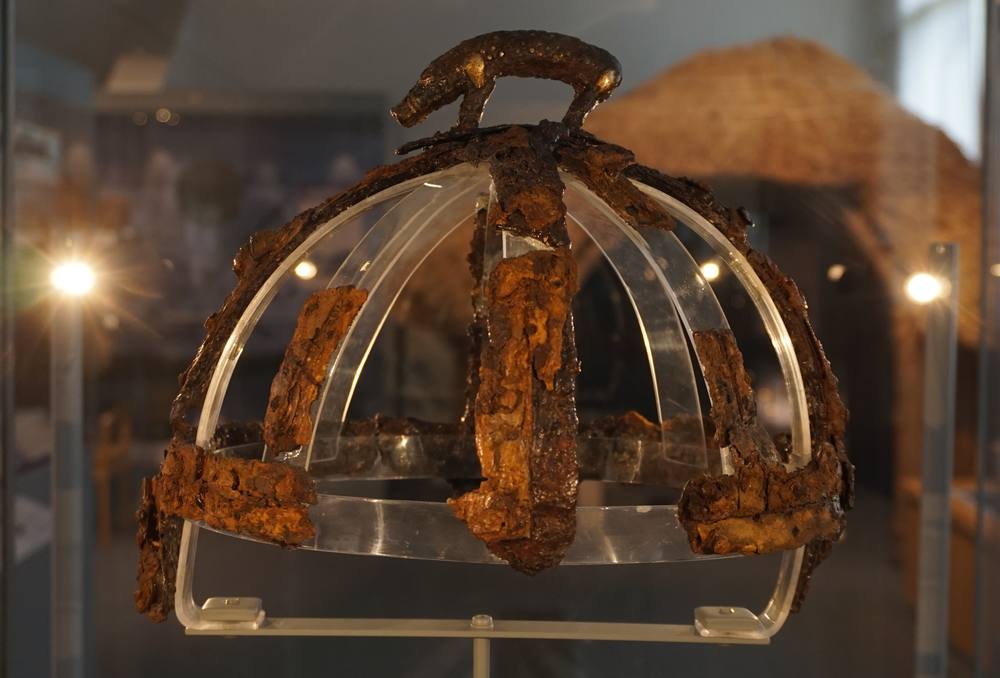
The most famous find is the Benty Grange helmet from Derbyshire. The antiquarian Thomas Bateman opened the barrow on 3 May 1848 and found the remains of a helmet from the first half of the seventh century. On its crown stands a small boar: a bronze core clad in iron plates, eyes of garnet set in gold, hip plates of gilded silver, and small gilded silver studs. The nasal of the same helmet carries a silver cross. The helmet is now in Weston Park Museum, Sheffield.
The second boar-crested helmet only came to light in 1997. At Wollaston in Northamptonshire a grave was excavated ahead of gravel quarrying; the find is named the Pioneer Helmet after the quarrying company. It dates to the late seventh century, belonged to a young man buried with a pattern-welded sword, and carries on its crest a plain boar forged from a single iron rod. No gold, no garnets – a working piece. It is on display at the Royal Armouries in Leeds.
The great helmet from Mound 1 at Sutton Hoo (c. 625) has no boar on its crest. But the eyebrows each end in a small gilded boar's head.
And in Scandinavia? In 1870 four bronze dies were found at Torslunda on the island of Öland – moulds used to press thin metal foils for decorating helmets. They date to the Vendel period (sixth to seventh century). One of them shows two warriors side by side, spears and swords in hand – and boars on their helmets. The dies are in the Swedish History Museum (Statens historiska museum) in Stockholm.
One thing matters for context: all of these helmets are older than the Viking Age. The only largely complete helmet from the Viking Age itself, the one from Gjermundbu in Norway, has no boar. The boar helmet belongs to the Vendel and Anglo-Saxon era – the generations the Vikings descended from.
What the helmets show, the poetry confirms. The Old English epic Beowulf, whose single manuscript was written around the year 1000, mentions boar helmets in five places. When Beowulf and his men land on the Danish coast, we read:
Eoforlic scionon / ofer hleorbergan gehroden golde, / fah ond fyrheard; ferhwearde heoldBeowulf, lines 303–305; roughly: "Boar-shapes shone above the cheek-guards, adorned with gold, gleaming and fire-hardened; they kept guard over life." (our own rendering)
Eoforlic literally means "boar-shape". And the key phrase comes last: the boar keeps ferhwearde, the guard over life. The boar on the helmet is not decoration; it is a protective charm. Later in the poem the pyre of the warrior Hnæf is heaped with helmets bearing "a swine all of gold, a boar iron-hard", and Beowulf's own helmet is said to be set with swine images so that no blade could bite through it.
The epic, by the way, is not set in England but in Scandinavia, among the Danes and the Geats of what is now southern Sweden. That fits nicely with the dies from Torslunda.
Far older still is a note by the Roman historian Tacitus. In his Germania (AD 98, chapter 45) he describes the Aestii on the Baltic coast, a people who gather amber. They worship, he writes, the mother of the gods, and as the emblem of their cult they wear the shapes of boars (formas aprorum). These protect the goddess's worshipper in place of weapons, even in the midst of enemies.
More than five hundred years separate Tacitus from the Benty Grange helmet, so we should not pretend that all this was a single belief. The Aestii were most likely not Germanic at all but ancestors of the Baltic peoples. Yet the idea is astonishingly durable: a boar image protects the one who wears it, and it is linked to a fertility deity. Those are exactly the two sides that Freyr would later unite.
From the helmet we move into the feasting hall. Two Old Norse texts describe a custom that puts the boar at the centre of Yule.
The first is in the Poetic Edda, in a prose passage of Helgakviða Hjǫrvarðssonar. Heðinn, a king's son, meets a troll-woman in the forest on Yule Eve; she rides a wolf with snakes for reins. He turns her away, and she threatens that he will pay for it at the king's toast. That evening the vows are made. The sónargǫltr is led in, the men lay their hands on it and swear their oaths over the bragarfull, the ceremonial cup. Heðinn vows to win Sváva, his own brother's bride – an oath he regrets at once but cannot take back.
The second is in Hervarar saga ok Heiðreks. King Heiðrekr has a great boar raised and dedicated to a god – in the version of the saga that uses the word sónargǫltr, the god is Freyr. On Yule Eve the boar is led before the king, people lay their hands on its bristles and make their vows, and afterwards it is sacrificed.
What the word means exactly is disputed. Older scholars read it as "atonement boar". Since the German philologist Eduard Sievers it has usually been explained differently, as "herd boar" or "lead boar", the strongest male of the herd. Support comes from a related Lombard legal term in the Edict of King Rothari (643), which refers to a boar that beats all others in the herd.
How old the oath custom is, and whether it was practised everywhere, the sources do not say. Both texts were written down in the thirteenth century or later, by Christians telling of a past. Still, the connection is remarkable: in these stories boar, Yule and binding oath belong together – and the boar is Freyr's animal.
Whether there was ever a cult of Gullinbursti as a being in his own right, we cannot say; what is attested is a cult of Freyr, boar images and boar sacrifices. The forging story is probably Snorri's own composition, or his summary of a tradition otherwise lost. Snorri – Icelander, lawspeaker, politician and Christian – wanted to explain to young poets why gold could be called "Sif's hair". For that he needed a story that brought many treasures together. You can read more about him and his methods in our portrait of Snorri Sturluson.
And nineteenth-century scholars, who saw sun and storm behind many myths, liked to read the shining boar as an image of the sun or of the golden cornfield. That is an interpretation of its time; no source says so. We find the plainer reading more convincing: gold stands for worth, and light for the god who brings good years.
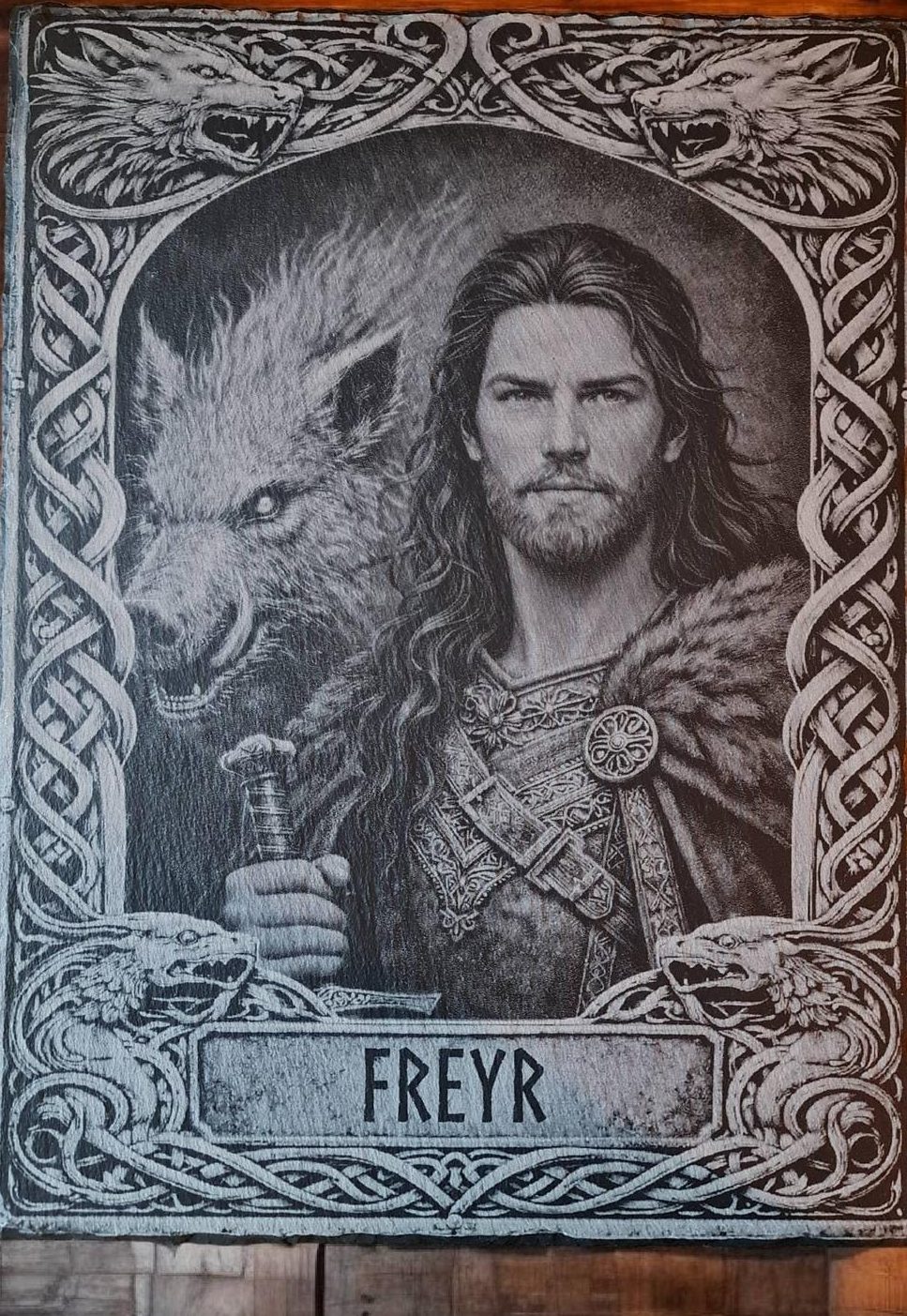
In our workshop Gullinbursti is a motif that almost designs itself, because the historical models are so strong. If you want a boar in the style of the period, look at the crest from Benty Grange: a compact animal, short legs, a ridge of bristles along the back. Or at the Torslunda dies, whose lines are clean enough to work on slate.
On slate the engraving comes out light against a dark ground – which is more or less exactly what Snorri describes: a shining animal in the night. On wood a boar looks warm and earthy, fitting for a god of the fields. And on glass, for example on a lantern, a candle really does make the bristles glow. Add a short line – the name in runes, or a phrase about good years and peace – and the piece tells its own story.
Who is Gullinbursti in Norse mythology? Gullinbursti ("Gold-Bristle") is the golden boar of the god Freyr. According to Snorri's Prose Edda, the dwarf Brokkr and his brother (Eitri or Sindri, depending on the text) forged him from a pigskin; he runs through air and over water faster than any horse and lights up the night.
Does Freyr ride Gullinbursti or drive him? Both are attested. In Snorri's Gylfaginning the boar draws Freyr's chariot to Baldr's funeral; in the older skaldic stanza of the Húsdrápa, Freyr "rides" on the golden-bristled boar.
Is Hildisvíni the same as Gullinbursti? No. Hildisvíni is Freyja's boar in Hyndluljóð, made by the dwarves Dáinn and Nabbi; according to the giantess Hyndla it is really Freyja's transformed protégé Óttar.
Were there real boar helmets? Yes. The Benty Grange helmet (7th century) and the Pioneer Helmet from Wollaston (late 7th century) carry boar figures on their crests, the Sutton Hoo helmet has eyebrows ending in boar heads, and the Torslunda dies show warriors in boar-crested helmets.
Why is the boar Freyr's animal? Freyr is a god of fertility and prosperity, and the pig was seen as fertile, nourishing and fierce all at once. His sister Freyja even bears the byname Sýr, "sow".
For courage. For remembrance. For legends that live on.
Thor has his hammer, Freyr his ship – and Odin has the spear. Gungnir is the weapon of the All-Father: forged by …
Read more →The mead of poetry turns anyone who drinks it into a poet or sage. It lies deep in the mountain, guarded by the giant's …
Read more →The valkyries are seen as cold directors of battle. The story of Helgi and Sigrún shows the other side: love, loyalty …
Read more →When Baldr is dead, one dares the most perilous ride of all the myths: Hermod, a son of Odin, rides into the underworld …
Read more →