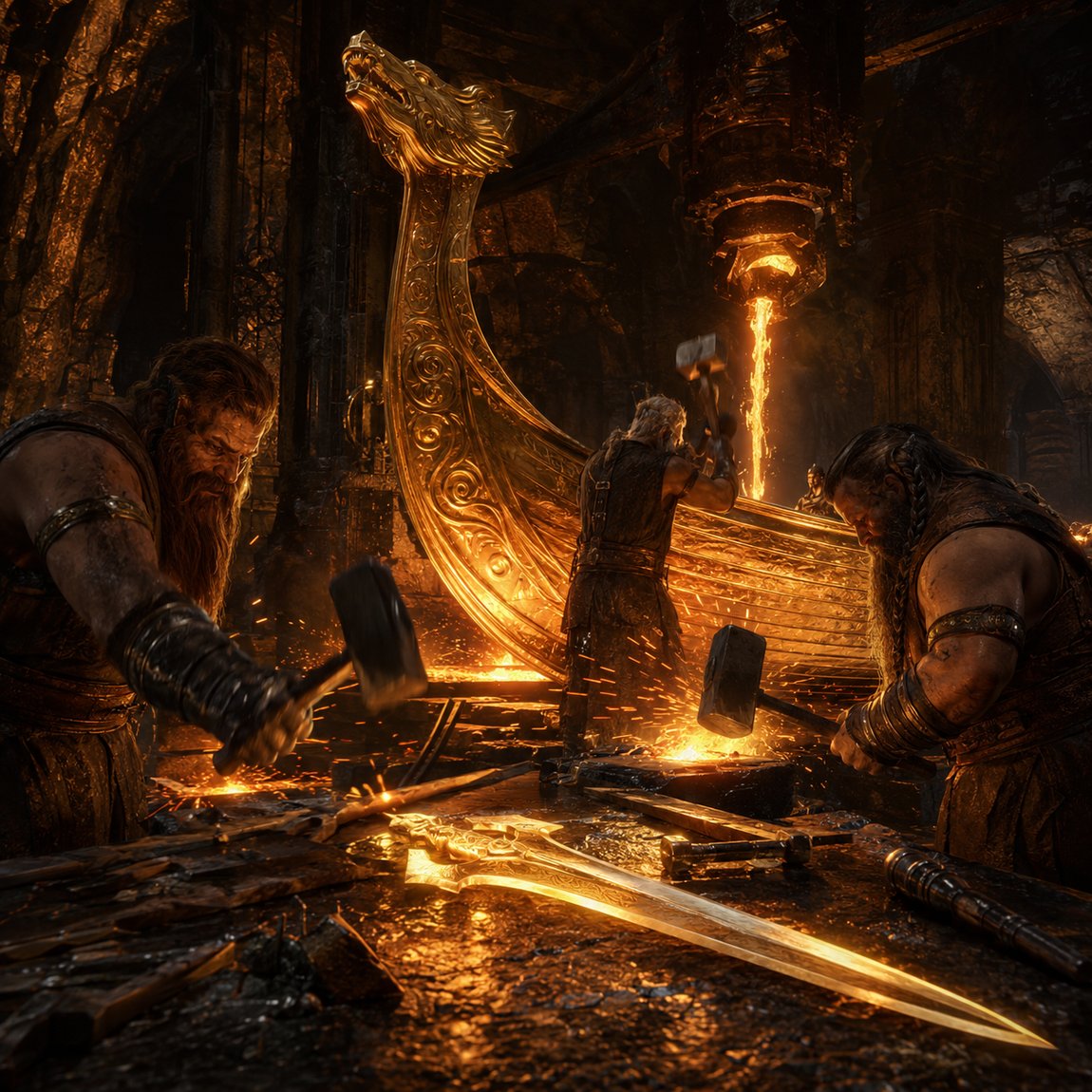
Ivaldi (Old Norse Ívaldi) is the father of the sons of Ivaldi, a group of dwarf smiths who, according to Snorri Sturluson, made three of the most famous treasures of the Norse gods: Sif's golden hair, the folding ship Skíðblaðnir and Odin's spear Gungnir. The medieval sources say almost nothing about Ivaldi himself and remarkably little about his sons. That is exactly why a careful look pays off: what the Eddas actually say, what a seventeenth-century poem added, and what a nineteenth-century theory turned it all into.
Picture a workshop that, in a single job, turns out three objects the gods will be arguing over for the rest of time. Hair of gold that takes root. A ship that carries an army and then fits in a pouch. A spear whose thrust nothing can stop. The smiths who made them have no names, no faces, no story of their own. They are simply Ívalda synir: the sons of Ivaldi.
If you have searched for Ivaldi online, you have probably met a lot of confident detail: an elf prince, three named sons, a blood feud with the gods, a world-ending winter. Very little of that is in any medieval manuscript. So we are going to do this the slow way, source by source, and keep a clear line between what is attested, what is late, and what is modern speculation.
The sons of Ivaldi are mentioned in exactly three texts: one stanza of the Eddic poem Grímnismál; two passages in the Prose Edda of the Icelander Snorri Sturluson (c. 1220); and one stanza of Hrafnagaldr Óðins, a poem that modern scholarship places in the early modern period. That is the whole dossier. No saga tells their story, no runestone names them, no tenth-century skald praises them.
Grímnismál is one long monologue by Odin. Disguised as the wanderer Grímnir, he sits bound between two fires in the hall of King Geirrøðr and recites the dwellings of the gods, the rivers of the world and the wonders of the cosmos. In the middle of that catalogue comes a stanza that mentions, almost in passing, who built the finest of all ships. Henry Adams Bellows translated it in 1923:
In days of old | did Ivaldi’s sons
Skithblathnir fashion fair,
The best of ships | for the bright god Freyr,
The noble son of Njorth.Grímnismál 43, translated by Henry Adams Bellows (1923)
Three things stand out. First, í árdaga, “in days of old”: the sons of Ivaldi belong to the dawn of the world, the phase in which the gods acquire their equipment. Second, the ship is made for Freyr, son of Njörðr, god of fertility and peace. Third, there is no Sif, no Gungnir, no wager. The poem knows the shipwrights and nothing else.
Whether the stanza originally belonged to the poem is an open question. Bellows himself thought it an interpolation, because it interrupts the flow of the passage. The next stanza, Grímnismál 44, is a list of superlatives: Yggdrasil the best of trees, Skíðblaðnir the best of ships, Odin the greatest of the gods, Sleipnir the best of steeds. That too is often read as a later addition. Even so, both stanzas are part of the medieval tradition and older than anything written after Snorri.
The familiar version comes from Snorri’s Skáldskaparmál, his handbook of poetic language. The framing matters. Snorri is explaining why poets can call gold haddr Sifjar, “Sif’s hair”. A figure of speech like that is a kenning: a poetic image that names one thing through another. So in Snorri’s book the story of Ivaldi’s sons first appears as the explanation of a metaphor.
In paraphrase: Loki, out of mischief, cuts off all the hair of Sif, Thor’s wife. Thor grabs him and is ready to break every bone in his body. Loki buys his life with an oath: he will get the dark elves to make Sif hair of gold that grows like any other hair. Then, again paraphrasing Snorri: “After that Loki went to the dwarves who are called the sons of Ivaldi.”
They deliver not one piece but three: the hair, the ship Skíðblaðnir and the spear Gungnir. Snorri never says why Loki comes home with two extras. Narratively the reason is obvious. Loki needs something to show off.
Snorri explicitly calls the sons of Ivaldi dvergar, dwarves. In the sentence just before, though, Loki promises to get the hair “from the dark elves” (Svartálfar). For Snorri these are evidently the same people. In Gylfaginning he likewise sends Skírnir “down into Svartálfaheimr to certain dwarves” to have the fetter Gleipnir made.
The Poetic Edda has no such scheme. It has dwarves and elves, often named together, but no division into light elves, dark elves and black elves. Most scholars read Snorri’s threefold system as his own tidying-up, possibly influenced by Christian ideas of angels and fallen angels. For our smiths that means: anyone who calls them “dark elves” is following Snorri, not some older layer of tradition.
When the treasures are handed over, Snorri gives each one its signature quality. The magic is in the detail, so let us take them one at a time.
Sif’s golden hair. The moment it touches Sif’s head it takes root and lives like real hair. Notice who receives it: Thor, not Sif. That small detail tells you whose story this is. What survived in poetry is the kenning: gold is “Sif’s hair”.
Skíðblaðnir. The name means roughly “assembled from thin strips of wood”. The ship has a fair wind as soon as the sail is hoisted, wherever it is meant to go, and it can be folded up like a cloth so that Freyr can carry it in his pouch. In Gylfaginning Snorri adds that it is big enough to carry all the Æsir with their weapons and war gear. If you know how real Viking ships were built, with overlapping planks riveted together and every hull hauled up, tarred and guarded, you get the joke: the wonder-ship is everything a real ship is not.
Gungnir. Odin’s spear, which, in Snorri’s words, never stops in its thrust. That is not quite the same as “never misses”, though it is often translated that way: the point is that nothing halts the stroke. The Eddic poem Sigrdrífumál mentions runes cut “on Gungnir’s point”. For the spear’s role in the first war in the world and the real rune-inscribed spearheads of the Migration Period, see our article on Gungnir.
With three masterpieces in hand, Loki gets cocky. He bets his head with the dwarf Brokkr that Brokkr’s brother cannot forge three treasures as good as these. The brother sets to work. Brokkr has to pump the bellows and must not stop until the pieces come out of the forge.
Loki cheats. As a fly, he lands on Brokkr’s hand and stings him. Brokkr keeps pumping, and out comes the boar Gullinbursti with bristles of gold. During the second piece the fly stings his neck, twice as hard; Brokkr holds on, and the result is the ring Draupnir. The third piece is iron. This time the fly settles between Brokkr’s eyes and stings his eyelids. Blood runs into his eyes, he cannot see, he swats at the fly – and for a moment the bellows sag. That is why the hammer’s handle comes out a little short.
It is one of the most precise workshop scenes in the whole mythology. Anyone who has stood at a forge knows the rule: lose the air for a moment and the heat drops. The story knows that moment and hangs its punchline on it.
What is Brokkr’s brother called? It depends on which manuscript you open. The Prose Edda survives in several medieval manuscripts that differ in detail. According to the notes of a French Edda translation, only the Codex Wormianus preserves the names Brokkr and Eitri; in the Codex Regius of the Prose Edda the passage is damaged, and the names Brokkr and Sindri were added later. Printed editions and translations follow one reading or the other: Arthur Gilchrist Brodeur’s 1916 translation has “Sindri”, while widely used later translations have “Eitri”. We have not been able to check the manuscripts themselves.
Where does “Sindri” come from? In Vǫluspá, a golden hall “of Sindri’s kin” stands on Niðavellir, the “dark fields”. In Gylfaginning, Snorri turns this into a hall that is itself called Sindri. So in the Poetic Edda Sindri is a family name, in Snorri a hall – and in part of the Prose Edda tradition the smith. In our article on Sindri and Brokkr we use the name most readers know, while keeping in mind that it is not the only reading.
The parties now go before the judges. Snorri names three: Odin, Thor and Freyr. Loki hands over his pieces: Gungnir to Odin, the hair to Thor, Skíðblaðnir to Freyr. Brokkr hands over his: Draupnir to Odin, a ring from which eight rings of equal weight drip every ninth night; Gullinbursti to Freyr, a boar that runs through air and water faster than any horse and whose bristles light up the darkest night; and the hammer to Thor.
Of the hammer Brokkr says that it will strike whatever Thor aims at, will never fly so far from his hand that it fails to come back, and can be made so small that Thor can carry it inside his shirt. Its one flaw is the short handle. The gods rule that the hammer is the best treasure of all, because it is the best defence against the frost giants. This is the hammer we know as Mjölnir; for its story and for the real Thor’s hammer amulets, see our dedicated article.
So the sons of Ivaldi lose – even though they never placed a bet. Loki gambled with someone else’s work. That is the quiet core of the story, and it gets lost in most retellings: the sons of Ivaldi are the suppliers, not a party to the wager.
Loki offers to buy back his head. Brokkr refuses. Loki runs – Snorri mentions that he had shoes in which he could run through the air and over water. Brokkr asks Thor to catch him, and Thor does. Now Brokkr wants to cut off the head, and Loki plays his last card: the head belongs to Brokkr, but the neck does not.
Brokkr concedes the point and takes his revenge another way. He decides to sew Loki’s lips together. His knife will not go through, so he wishes for his brother’s awl; it is there at once and pierces the lips. The thong used to stitch Loki’s mouth shut is called Vartari – and Loki rips it out.
The third source points somewhere else entirely. Hrafnagaldr Óðins (“Odin’s raven-charm”), also called Forspjallsljóð, used to be printed alongside the old Eddic poems. Its sixth stanza describes the goddess Iðunn sinking down from the world tree. Benjamin Thorpe translated it in 1866:
In the dales dwells the prescient Dis, from Yggdrasil’s ash sunk down, of alfen race, Idun by name, the youngest of Ivaldi’s elder children.Hrafnagaldr Óðins 6, translated by Benjamin Thorpe (1866)
The phrasing is odd. “The youngest of Ivaldi’s elder children” implies that Ivaldi had an older and a younger set of children, perhaps by different mothers. On that reading Iðunn would be a sister of the smiths.
The catch is the date. Sophus Bugge argued in 1867 that the poem was a seventeenth-century composition, and most scholars have followed him. Annette Lassen, in her 2011 critical edition, calls it a post-medieval poem, probably composed soon after the Codex Regius resurfaced in 1643. It survives only in paper manuscripts, none older than the late seventeenth century. A few scholars have argued for an earlier date; that view has not prevailed.
For Ivaldi this means that the only text that gives him a named child was written by a learned poet who had already read the Edda. Whether he knew a lost tradition or combined the names himself cannot be decided. As evidence for Viking Age belief, the stanza does not hold up.
No source gives Ivaldi a deed, a trait or a home. He is a patronymic and nothing more. His sons stay anonymous too: no number, no names, no personalities.
The meaning of the name is uncertain. Rudolf Simek’s dictionary offers two possibilities: a compound of the word for yew or bow (Old Norse ýr) with an element meaning “to rule”, giving something like “the one who wields the yew bow”; or a development of an older name related to Ingvaldr. Both are hypotheses, and any website that hands you a definitive translation is claiming more than the linguists can.
There is a striking echo, though. The giant Þjazi is called the son of Alvaldi in Hárbarðsljóð and the son of Ölvaldi in Skáldskaparmál. A father whose name ends in -valdi, sons connected with gold (according to Snorri, Þjazi and his brothers split their father’s gold by each taking a mouthful), and a link to Iðunn, whom Þjazi abducts: these parallels have led modern interpreters to equate Ivaldi with Alvaldi. It is possible. It is not attested.
This is exactly where the Swedish writer and scholar Viktor Rydberg (1828–1895) stepped in. In his Undersökningar i germanisk mythologi (two volumes, 1886 and 1889; the first appeared in English in 1889 as Teutonic Mythology, translated by Rasmus B. Anderson), he set out to rebuild a continuous mythic history from the scattered fragments. Ivaldi and his sons became key players.
In outline: Rydberg identified the sons of Ivaldi with the three brothers of the Eddic poem Vǫlundarkviða – Völundr (Wayland the Smith), Egill and Slagfiðr. He further identified Völundr with Þjazi. He read the lost smithing contest as an insult that turned Ivaldi’s kin against the gods and led, in the end, to a cosmic catastrophe: the great winter.
Why bring it up at all? Because the theory is very much alive online. Countless websites, fantasy novels and games have absorbed Rydberg’s combinations, usually without saying where they come from. Search for “Ivaldi” and you soon find a seemingly seamless saga of revenge, betrayal and world-winter. It is a good story. It just isn’t the Edda.
To be fair: Rydberg was no idle fantasist. He knew the sources thoroughly, and some of his observations are still discussed. The problem is method. Where the sources fall silent, he filled the gaps with identifications, and each identification carried the weight of the next.
The sons of Ivaldi are not the only dwarves with a forge. In Norse tradition almost every magical object comes out of a dwarven workshop. According to Snorri, dwarves in Svartálfaheimr make Gleipnir, the fetter that holds the wolf Fenrir. In Sörla þáttr, a late tale, four dwarves forge Freyja’s necklace Brísingamen. In Hervarar saga a king forces the dwarves Dvalinn and Durinn to make the sword Tyrfingr. For an overview of these treasures, see our article on the treasures of the gods.
The pattern is clear. Gods own; dwarves make. Divine power rests on objects someone else produced. And dwarves rarely give up their work willingly – they are coerced, tricked or, like the sons of Ivaldi, dragged into a wager they never agreed to.
Behind this lies a real experience. Viking Age smiths commanded techniques that looked like sorcery to outsiders: pattern welding, in which different grades of iron were forged together, and the finest filigree and granulation in gold and silver. The tool chest from Mästermyr on Gotland, turned up by a farmer’s plough in October 1936 and dated to around the year 1000, held more than 200 tools and pieces of work: hammers, anvils, tongs, nail-making irons, plus axes, saws and augers for woodworking. There is more on the craft in our article on Viking smithing.
Read the wager as a story about craftsmen rather than gods. Two workshops each deliver three pieces. One delivers elegance – hair that grows, a ship that folds, a spear that never stops. The other delivers under sabotage, with a flaw in its final piece, and still wins. The hammer with the short handle beats the flawless marvels because it keeps the giants away from the world.
You don’t have to turn that into a moral. But the punchline is hard to miss: the judges reward usefulness, not perfection. The flawed piece is the one that matters most. Anyone who works with their hands knows that feeling.
In our workshop in Alsdorf, the bellows scene hits close to home. Engraving has its own moment where one interruption changes the piece – though in our case the culprit is never a fly, at worst a slate that is a touch too damp.
The sons of Ivaldi have no symbol of their own and no surviving Viking Age image. That is an opportunity, not a problem, as long as nobody invents an “ancient sign”. A few ideas we think work honestly:
Got an idea of your own? Talk to us. We would rather engrave a well-explained stanza than a made-up symbol.
Who is Ivaldi in Norse mythology? Ivaldi is the father of the dwarf smiths who, according to Snorri Sturluson, made Sif’s golden hair, the ship Skíðblaðnir and Odin’s spear Gungnir. The sources record nothing about him beyond his name.
What are the names of the sons of Ivaldi? No medieval source gives their names or their number. The popular identification with Völundr, Egill and Slagfiðr comes from Viktor Rydberg in the nineteenth century and is speculative.
What did the sons of Ivaldi make? Sif’s golden hair, the folding ship Skíðblaðnir for Freyr and the spear Gungnir for Odin, according to Snorri’s Skáldskaparmál. Grímnismál mentions only the ship.
Did the sons of Ivaldi make Mjölnir? No. The hammer came from the forge of Brokkr and his brother, who is called Eitri or Sindri depending on the manuscript. It was part of the counter-wager.
Is Iðunn the daughter of Ivaldi? Only Hrafnagaldr Óðins 6 says so, and most scholars date that poem to the seventeenth century. The old Eddic poems and Snorri know nothing of it.
Are the sons of Ivaldi dwarves or elves? Snorri calls them dwarves and in the same breath links them to the dark elves. In his writing the line between dwarves and dark elves is not sharp.
For courage. For remembrance. For legends that live on.
All Beings & Creatures articles →
Far below, where the roots of the World Tree reach down into cold and darkness, lies a creature that never rests …
Read more →Between crown and root of the World Ash Yggdrasil scurries a small, restless creature: Ratatoskr, the squirrel. It …
Read more →Without the giants there would be no Norse world – in the most literal sense. Out of a giant it arose, against the …
Read more →In Valhalla an eternal feast holds sway – provided by a single animal that never runs out: the boar Sæhrimnir.
Read more →