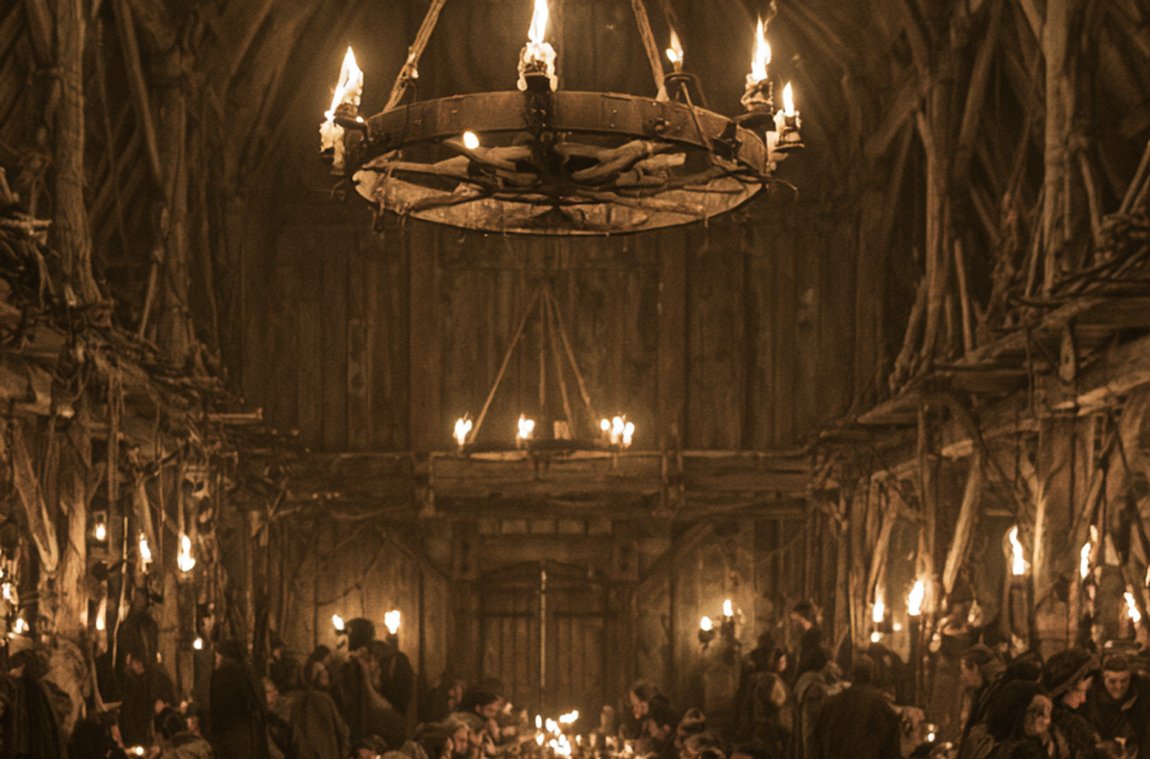
Sæhrímnir (often spelled Saehrimnir) is the animal whose meat feeds the einherjar in Valhalla: the cook Andhrímnir boils it in the cauldron Eldhrímnir, and according to Snorri Sturluson it is cooked every day and whole again by evening. The Eddic poem only calls it "the best of pork"; it is Snorri who explicitly makes it a boar. Here is what the sources actually say, what the puzzling name might mean, which relatives the endless roast has in myth and saga – and what was really in the cauldron in the halls of the Viking Age.
Every hall-lord of the Viking Age lived with one question that decided his reputation and his following: is there enough food? If you wanted warriors around you, you had to feed them, winter after winter, feast after feast. Norse mythology solves that crisis for Odin's hall with one wonderfully dry image: an animal that never runs out.
It sounds like a land of plenty. But the sources are far thinner than most retellings suggest – so let us take it in order: poem, Snorri, names, relatives, bones.
The oldest mention is in Grímnismál, "The Lay of Grímnir", one of the mythological poems of the Poetic Edda. It survives in the Codex Regius, an Icelandic manuscript written around 1270; how old the poem itself is cannot be pinned down. The frame story is grim enough. Odin, disguised as Grímnir ("the masked one"), sits bound between two fires in the hall of King Geirrøðr and, scorched by the heat, starts reciting the dwellings of the gods. In the middle of his description of Valhalla comes stanza 18:
Andhrímnir lætr í Eldhrímni
Sæhrímni soðinn,
fleska bezt;
en þat fáir vitu,
við hvat einherjar alask.– Grímnismál 18, Old Norse text
Henry Adams Bellows translated it in 1923 like this:
In Eldhrimnir Andhrimnir cooks
Sæhrimnir's seething flesh,
The best of food, but few men know
On what fare the warriors feast.– Henry Adams Bellows, The Poetic Edda (1923, public domain)
That is all. A cook, a cauldron, a piece of meat – and a closing line that immediately pulls the picture back into mystery. The poem says nothing at all about an animal that is slaughtered and gets up again.
Stanza 19 follows straight on: Odin feeds his wolves Geri and Freki and lives himself "on wine alone". Stanza 20 brings in the ravens Huginn and Muninn. In his notes Bellows suggested that stanzas 18 to 20 might be a later interpolation. That is not certain.
The final verb, alask, means "to be nourished, to be reared". The einherjar – the warriors fallen in battle whom Odin gathers to himself – are "nourished" on something few people know about.
Some fifty years before the Codex Regius was written, around 1220–1225, the Icelandic scholar and politician Snorri Sturluson composed his Edda. In the section called Gylfaginning ("the tricking of Gylfi"), the Swedish king Gylfi, travelling under the name Gangleri, questions three mysterious figures: Hár, Jafnhár and Þriði. In chapter 38 (in the standard numbering of Anthony Faulkes' edition) the talk turns to food.
Gangleri sets a sober arithmetic problem. If every man who has fallen in battle since the beginning of the world is now with Odin in Valhalla, what does Odin give them to eat? Hár agrees that the crowd is enormous and will grow much larger – and yet, in Arthur Gilchrist Brodeur's 1916 translation, "it will seem all too small, in the time when the Wolf shall come." Ragnarök is already lurking in a question about catering.
Then the answer, in Old Norse: aldri er svá mikill mannfjölði í Valhöll, at eigi má þeim endast flesk galtar þess, er Sæhrímnir heitir. Brodeur renders it:
But never is so vast a multitude in Valhall that the flesh of that boar shall fail, which is called Sæhrímnir; he is boiled every day and is whole at evening.– Snorri Sturluson, Gylfaginning 38, trans. Arthur Gilchrist Brodeur (1916, public domain)
Snorri then quotes the Grímnismál stanza as his proof text. And Hár adds a remark that reads almost like a footnote to the poem: on this question, he thinks, few may be so wise as to be able to tell the truth of it. Snorri echoes the poem's "few know" – and gives a very concrete answer anyway.
When Gangleri asks whether Odin eats the same food, Hár explains that Odin gives his meat to his two wolves and needs no food himself: wine is both drink and meat to him.
Two things are new in Snorri. First, the word göltr (genitive galtar), "boar", an uncastrated male pig – the poem only had flesk. Second, the renewal: hann er soðinn hvern dag ok heill at aptni, "he is boiled every day and whole by evening". The miracle at the heart of modern retellings is Snorri's.
The first thing you notice is the sound. Andhrímnir is the cook, Eldhrímnir the cauldron, Sæhrímnir the meat. All three share the element -hrímnir. That is not chance; it is poetic craft. The stanza is built on the echo.
Old Norse hrím first of all means "rime, hoar-frost" – the same word sits in the frost giants, the hrímþursar. But it can also mean the black coating that builds up on a pot hanging over the fire: soot. The Cleasby–Vigfusson Icelandic dictionary gives both senses. In a kitchen, soot is the obvious choice.
With Eldhrímnir the case is clearest: eldr means "fire", so the cauldron is "the one sooted by fire". Andhrímnir is usually rendered "sooty-faced" – Bellows' own gloss – or "the one exposed to soot"; the prefix and- means "against, facing". The cook holds his face into the smoke. That reading is not watertight either, but it fits.
Sæhrímnir is where it gets difficult. The simplest way to read sæ- is as sær, "sea". That produces the meaning you find in most handbooks, "sooty sea-beast"; Rudolf Simek lists it in his dictionary with a question mark, and the question mark is honest. A sea creature fits a pig rather badly. A second proposal links the name to sjóða, "to boil, to seethe", and its derivative seyðir, a cooking pit in which meat was cooked with heated stones. Then Sæhrímnir would simply be "the boiled, sooty one" – not without linguistic problems, but strikingly apt.
One small and often overlooked piece of evidence helps. In the Nafnaþulur, the verse name-lists attached to Snorri's Skáldskaparmál, Sæhrímnir appears among the poetic names for swine. In thirteenth-century Iceland, then, the name was clearly understood as a pig's name – whatever it may originally have meant.
That sounds like hair-splitting. It is not. The poem says fleska bezt. Flesk is the Old Icelandic word for pork, often for bacon or fat pork; it lives on in Norwegian flesk and Swedish fläsk, and anyone buying pork belly in Scandinavia today buys exactly that. So pig it is. Whether the poem means a living animal, one particular animal, or simply the best roast pork imaginable, it leaves open.
Translators have handled this differently. Lee M. Hollander wrote "the boar" straight into his version of the poem; Benjamin Thorpe, Bellows and Anthony Faulkes do not name a species. Karl Simrock's 1851 German version just says "the best meat" and drops the pig entirely. So whenever you read that "the Edda calls Sæhrímnir a boar", you are really reading Snorri – or a translator who already had Snorri in mind.
Rudolf Simek finds the difference telling. He reads Snorri's version as an embellishment that owes more to the image of a medieval paradise – a world where the food never runs out – than to an older, independent tradition. That is an interpretation, not proof – but it suits Snorri, who systematised and filled gaps, sometimes with inventions of his own.
Our verdict: boiled pork in Valhalla is old and attested; the self-renewing boar is Snorri's version. Tell both – just know which one you are telling.
An animal that is eaten and comes back is not unique in Norse tradition. Its most famous cousins are Thor's goats Tanngrisnir and Tanngnjóstr. In Gylfaginning 44, at the start of Thor's journey to Útgarða-Loki, Snorri tells how Thor and Loki stop at a farmer's house. In the evening Thor slaughters both his goats, and then: Eftir þat váru þeir flegnir ok bornir til ketils – "after that they were skinned and carried to the cauldron". A cauldron again, and boiled meat again.
Thor spreads the hides by the fire and has the bones thrown onto them. In the morning he raises his hammer Mjöllnir, hallows the goatskins – and the goats stand up. One of them, though, is lame in a hind leg, because Þjálfi, the farmer's son, had split a thigh bone to get at the marrow. As compensation Thor takes the farmer's children, Þjálfi and Röskva, into his service.
The parallel is close: meat, cauldron, renewal. Simek suspects that the motif of the self-renewing beast goes back to old sacrificial and hunting ideas of the kind known from shamanic cultures, such as keeping an animal's bones intact so that it can return. Thor's limping goat shows exactly that logic. Whether a specific rite lies behind it cannot be proved from the texts alone.
A second relative comes from Ireland. In Irish tradition the sea god Manannán mac Lir owns swine that are killed and eaten and are alive again the next day; whoever eats their meat is spared age and death. Lady Gregory retold the story in 1904 in Gods and Fighting Men: Manannán gives his pigs to the Tuatha Dé Danann for their "Feast of Age". A direct link cannot be shown; the resemblance is striking all the same, not least because the pigs belong to a sea god.
Sæhrímnir is only half the menu. The other half stands on the roof. Grímnismál 25 says that the goat Heiðrún stands on the hall and browses the branches of the tree Læraðr, filling a vessel with clear mead. Next to her stands the stag Eikþyrnir, from whose antlers drops fall into the spring Hvergelmir, the source of all rivers.
Snorri expands this too. In Gylfaginning 39, Gangleri asks whether the einherjar drink water. Of course not: from Heiðrún's teats flows mead, and every day she fills a skapker, a great mixing vat, so large that all the einherjar can drink themselves full. No detour via milk that somehow turns into mead – it is mead straight from the udder. The image is absurd, and that is precisely its joke.
Who serves? According to Grímnismál 36, the valkyries carry ale to the einherjar. And how many are there? Stanza 23 gives Valhalla 540 doors, through each of which 800 einherjar march out at once. That makes over 400,000 warriors. Anyone who has catered a village party knows why that takes a miracle.
Why a pig, of all animals? Because in the North the boar was a beast of rank. The god Freyr owns the golden-bristled boar Gullinbursti, forged by dwarves; in the poem Hyndluljóð, Freyja rides the boar Hildisvíni ("battle-swine"). For the wider symbolism, see our article on the boar in the Norse world.
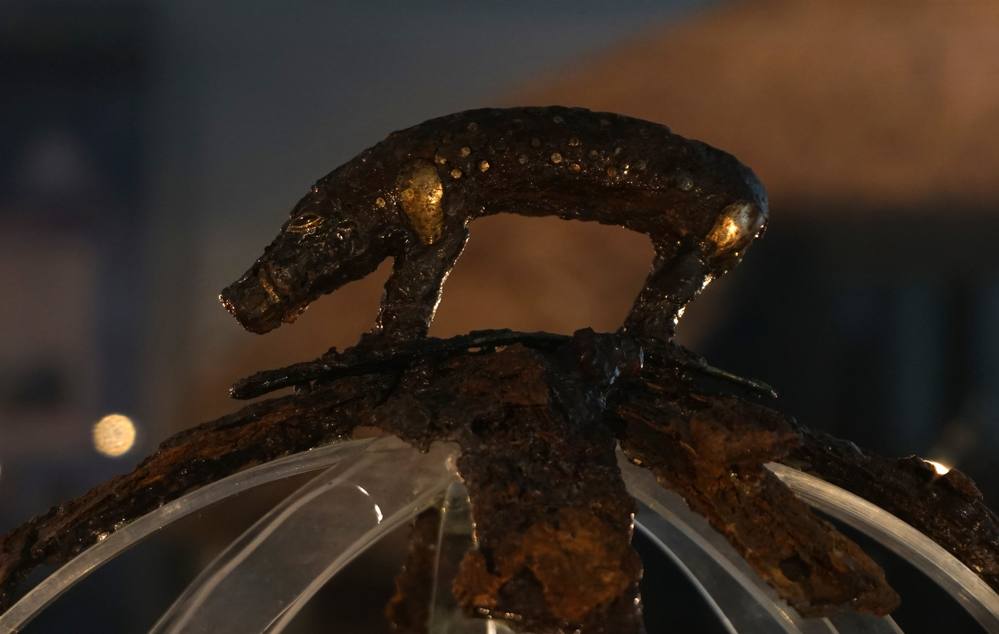
The boar also sat on helmets. The Anglo-Saxon helmet from Benty Grange in Derbyshire, seventh century, carries a complete boar figure on its crest, and so does the Wollaston helmet from Northamptonshire. The Old English epic Beowulf describes warriors with boar images gleaming above their cheek-guards.
The clearest case of the boar as a feast animal, though, is the sónargöltr. In the prose of Helgakviða Hjörvarðssonar, a heroic poem in the Poetic Edda, Heðinn comes home from the forest on Yule Eve. Then we read:
Um kveldit váru heitstrengingar. Var fram leiddr sónargöltr. Lögðu menn þar á hendr sínar ok strengðu menn þá heit at bragarfulli.– Helgakviða Hjörvarðssonar, prose; our translation: "In the evening vows were made. The sónargöltr was led in. The men laid their hands on it and then made their vows over the bragarfull."
The bragarfull is the cup over which solemn promises were made. That night Heðinn swears to win Sváfa, the beloved of his brother Helgi – and bitterly regrets it at once. An oath over the boar was binding, even if it was sworn in drink.
Hervarar saga ok Heiðreks knows a similar custom. King Heiðrekr keeps a huge boar dedicated to Freyr; in one manuscript version it is called the sónargöltr and is led into the hall before the king on Yule Eve, where men lay their hands on its bristles and swear vows.
What sónar- means is disputed. It was once read as "atonement boar" or "sacrificial boar"; since Eduard Sievers (1892) it is often taken as "herd boar", supported by Lombard sonorpair in the Edict of Rothari, a boar that beats all others in the herd.
There is a contemporary voice, however. The traveller Ibrāhīm ibn Yaʿqūb visited Hedeby around 965; his report survives in a thirteenth-century Arabic compilation. He describes a feast held in honour of their god: whoever slaughters a sacrificial animal – an ox, a ram, a billy goat or a pig – fixes it on poles outside his door so that people know he is making his offering. The pig stands quite naturally in the list of sacrificial animals, in the words of an outside observer. More in our article on Ibrāhīm ibn Yaʿqūb in Hedeby.
Later folk customs offer themselves as echoes. In 1672 Olaus Verelius described a Swedish julagalt, part of which was kept until the spring sowing, and the Christmas ham is still the centrepiece of the Scandinavian festive table. Whether all this goes back in an unbroken line to the sónargöltr is not demonstrated. More likely the pig simply stayed the winter feast animal because it was slaughtered before fodder ran short. For the festival as a whole, see our article on Yule.
Now to the bones. On a Viking Age farm the pig had a special role: the National Museum of Denmark points out that it was the only domestic animal kept purely for its meat. As omnivores they managed on kitchen waste, woodland pasture and acorns, bred quickly and yielded fat that could be salted and stored. For a feast, they were ideal.
Isotope studies show how an early town was supplied. For Birka on Lake Mälaren, a team led by Nina Schjerven in 2024 analysed animal bones with several isotope methods (carbon, nitrogen, sulphur, strontium). The result: pigs and sheep or goats were apparently raised in the nearby countryside, their strontium values matching the region. The cattle, by contrast, carried non-local signatures and probably came from further away – most likely on their own legs, as "walking commodities", slaughtered only on arrival. Most pigs died young, as subadults or young adults, which is typical of urban sites.
Pork, then, was the meat from next door; beef was the meat you had to bring in. At Hedeby hundreds of thousands of animal bones have been recovered. Cattle and pig rank among the main meat animals there, while Ibrāhīm ibn Yaʿqūb noted that the people mainly ate fish, of which there was plenty. The two do not contradict each other: fish was everyday food, meat was what came to the table when there was something to celebrate. For an overview of the menu, see our article on Viking food and drink.
Iceland is a revealing case. The settlers brought pigs with them, and place names such as Svínafell and Svínavatn preserve the memory. Later, pig keeping there declined sharply. For the big feast, Icelandic chieftains apparently relied on something else. In 2013 Davide Zori, Jesse Byock and colleagues showed that at the chieftain's farm of Hrísbrú in the Mosfell valley, beef and barley – that is, beer – were the key ingredients of feasting.
And cooking really was mostly done in cauldrons. Iron cauldrons, soapstone vessels and cooking pits with heated stones are all well attested in Viking Age kitchens. Boiled meat was the rule; the spit-roast was more the exception. When Grímnismál has the cook Andhrímnir boil his meat in Eldhrímnir, it describes exactly what happened in human halls – only without end.
Against this background Sæhrímnir becomes almost matter-of-fact. Valhalla is a lord's hall, only larger than any on earth. Odin is the host who must maintain his following, and he does it like every hall-lord: with meat from the cauldron and mead in the horn. The only difference is that his supplies never run out.
At the same time, the endless roast is not abundance for its own sake. It keeps a system running that is aimed at a single day: the day the Wolf comes. Hár's line in Snorri – that the vast host will still seem too small then – makes that plain. The einherjar are fed so that they are ready, not so that they can have a good time.
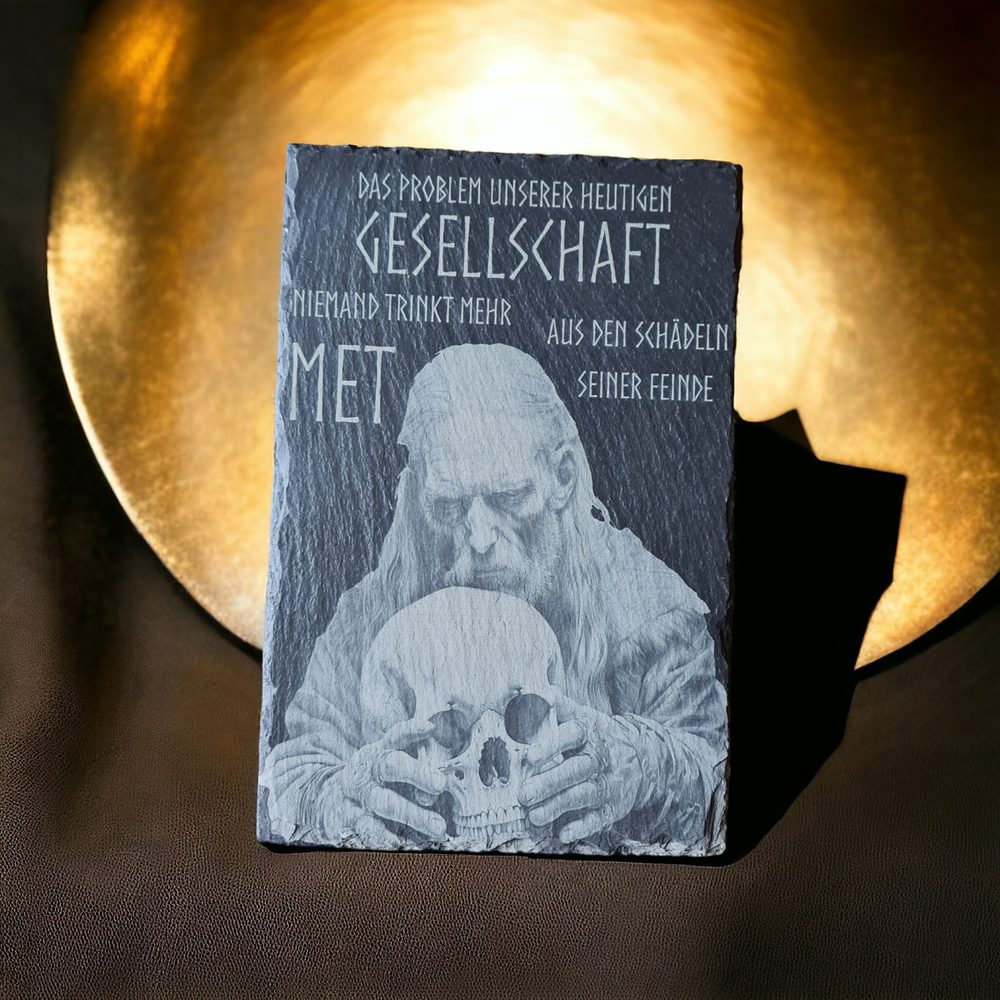
In our workshop in Alsdorf near Aachen, customers often ask for motifs for the kitchen, the barbecue or the feast table – and Sæhrímnir is almost too good for that. A wooden chopping board or tree-slice with a boar in Norse animal style and the words fleska bezt, "the best of pork", underneath: that is a genuine Edda quotation and a promise to every guest at the same time.
On slate, the whole stanza in Old Norse works especially well, perhaps with cauldron and fire as the image. If you prefer something plainer, take just the three names stacked: Andhrímnir, Eldhrímnir, Sæhrímnir. We leave out horned helmets and fantasy runes; our boar gets bristles, tusks and the line work of the old animal styles.
What is Sæhrímnir in Norse mythology? Sæhrímnir is the animal whose meat the einherjar eat in Valhalla. In Grímnismál 18 the cook Andhrímnir boils it in the cauldron Eldhrímnir; Snorri calls it a boar that is cooked every day and whole again by evening.
Is Sæhrímnir a boar? In Snorri's Prose Edda, yes – he calls it göltr, boar. The older Eddic poem only says fleska bezt, "the best of pork", and does not commit to a particular animal.
What does the name Sæhrímnir mean? Nobody knows for certain. "Sooty sea-beast" is often proposed; an alternative links it to sjóða, "to boil". The element -hrímnir probably refers to the soot on the cooking pot.
What do the warriors drink in Valhalla? Mead from the teats of the goat Heiðrún, who stands on Valhalla's roof. According to the Edda, Odin himself drinks only wine and gives his food to the wolves Geri and Freki.
For courage. For remembrance. For legends that live on.
All Beings & Creatures articles →
Two wolves race across the firmament – one after the sun, the other after the moon. It is the oldest chase in the …
Read more →Eight legs, a one-eyed rider and a road that leads all the way down into the realm of the dead: Sleipnir is no ordinary …
Read more →No horse draws the chariot of the strongest god, but two goats: Tanngrisnir („teeth-barer") and Tanngnjóstr …
Read more →Almost everything that makes the gods mighty comes from a single set of hands: those of the dwarves. Thor’s hammer …
Read more →