
When you picture the roof of Valhöll, you probably think of shields and the golden gleam of Odin's hall. Yet above the beams stands a far quieter creature that keeps the whole world alive: a stag with antlers like the branches of an oak. Its name is Eikþyrnir, and from what drips off its antlers spring every river in the world. A small image, easily overlooked – and yet one of the most beautiful symbols of how, in the North, all water and all life begin at a single point.
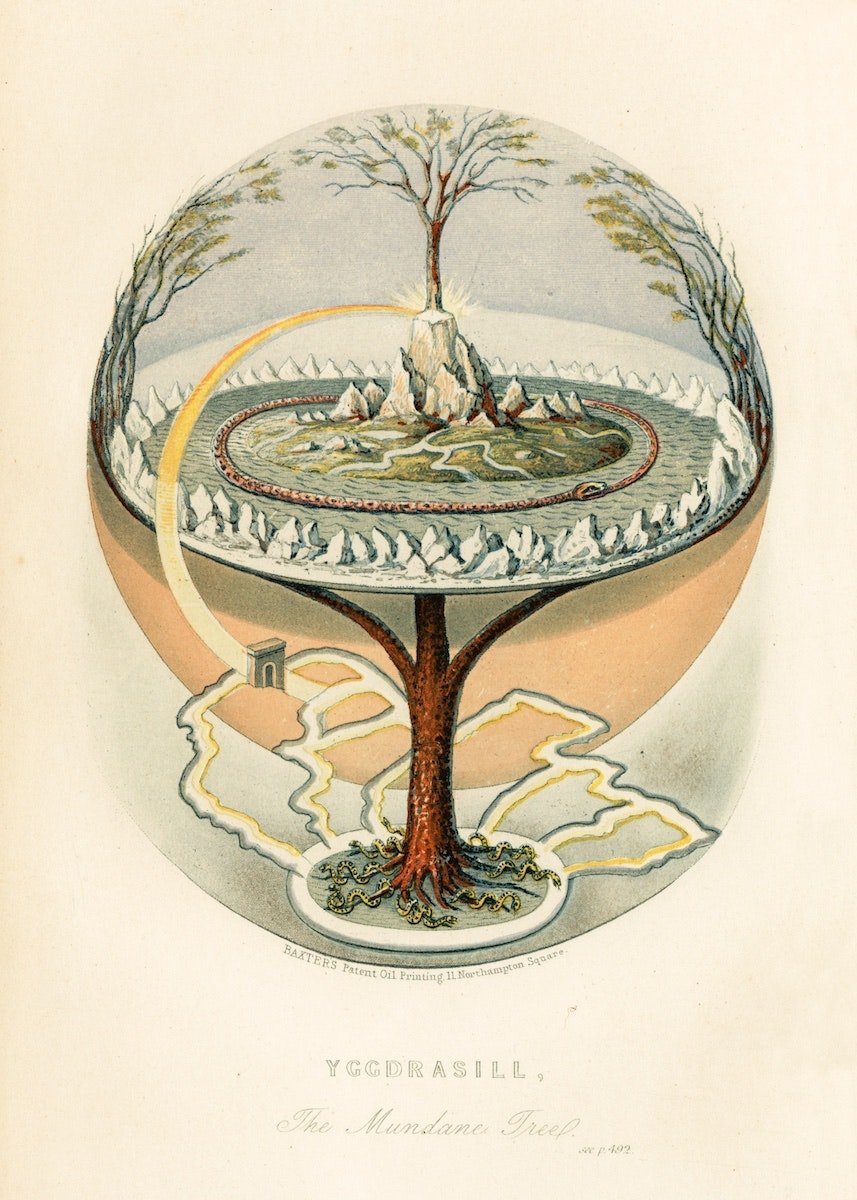
Our main source is the Eddic poem Grímnismál, in which the bound Odin lays out the order of the world for King Geirröðr. In stanza 26 the gaze turns upward, to the roof of the hall of the slain. There stands the stag, gnawing at the branches of a tree called Læraðr.
Eikthyrnir the hart is called, that stands o'er Othin's hall and bites from Læráth's limbs; from his horns a stream into Hvergelmir drops, thence flow the waters all.Grímnismál 26, translated by Henry Adams Bellows (1923)
Two things stand firmly together here: a browsing stag and a spring. Hvergelmir – the „bubbling cauldron" – is one of the three great wells beneath the world tree, the oldest and deepest, set in the cold mists of Niflheim. What Eikþyrnir's antlers give off does not gather just anywhere, then, but in the very wellspring of the North.
And then the Edda opens the floodgates. In the following stanzas it lists what pours out of Hvergelmir: a long, almost breathless string of river names. Síð and Víð are named, Fjörm and Fimbulþul, along with a good dozen more streams – some flow around the dwellings of the gods, others down to humankind and on into Hel. We deliberately name only a few of them, because the list is meant less as a map than as an incantation: so many waters, and all from a single root.
That makes Eikþyrnir, mythologically, nothing less than the origin of all flowing water. The stag feeds at the tree, the water drips into the heart of the world, and from there it streams into every river a person has ever crossed. A cycle at whose highest point stands a single animal.
The name Eikþyrnir combines Old Norse eik („oak") and þyrnir („thorn", related to our „thorn") – often rendered as „oak-thorn" or, more freely, „the one with the oak-branch antlers". Anyone who has seen a broad red-deer's rack understands the image at once: branched, gnarled, like the boughs of an old oak. The name is no chance sound, then, but a small description. The stag carries the tree on its head, so to speak – fitting for an animal grazing high up on the world tree.
Eikþyrnir does not stand up there alone. Directly before it, in Grímnismál 25, the Edda names the goat Heiðrún, who also browses on Læraðr's branches – but from her udder flows the clear mead on which the Einherjar feast night after night. Stag and goat form a pair: one gives the fallen their drink, the other feeds the rivers of the whole world. Mead for Valhöll, water for everything else. (We have devoted a separate article to Heiðrún.)
What is attested: Eikþyrnir is described in Grímnismál 26–28 – the stag on the roof, the dripping antlers, Hvergelmir and the rivers that spring from it. In the 13th century Snorri Sturluson takes up the passage in the Gylfaginning (ch. 39) and summarizes it. That is the entire secure tradition – brief, but unambiguous.
Myth-check: In many retellings you read that Eikþyrnir grazes on Yggdrasil, the world tree. But the source names the tree Læraðr – not Yggdrasil. The equation Læraðr = Yggdrasil is well founded in scholarship and held by most experts (its position above Valhöll, its nearness to Hvergelmir and the roots all support it), yet it is not stated that way in the text. It is a plausible interpretation, not a proof. A second common mix-up: Eikþyrnir is not one of the four stags that nibble the buds in Yggdrasil's crown (Dáinn, Dvalinn, Duneyrr and Duraþrór). Those are four separate animals from Grímnismál 33. Eikþyrnir is a single, entirely different stag with an entirely different task. Four feed on the tree – one feeds the world.
The image of an animal from which the world's waters flow does not stand alone. Again and again, old traditions place cosmic creatures at the edge or the root of creation – beings on whom it depends whether life streams or runs dry. We won't turn that into a quick equation; such comparisons easily tempt one to overreach. But the underlying idea is worth holding onto: at the world tree, where sky and hall touch, the water without which nothing grows springs from a living being. The North gave that origin an antler shaped like an oak.
The stanza about Eikþyrnir does not stand alone. It ends with the statement that from his antlers all waters fall, and in doing so it opens one of the most peculiar passages in the whole Poetic Edda: a long, almost rushing catalogue of river names. In the three following stanzas the bound Odin names river after river, as though reeling off the water-veins of the entire world before King Geirröðr. Anyone who wants to understand the Eikþyrnir myth has to read this list along with it, for it is the concrete continuation of the image: first the single drop in the spring, then the streams into which it branches.
The verses arrange the rivers in three groups, and this order is no accident. The first group circles the dwelling of the gods, the second runs down to mortals and on into the realm of the dead, the third is reserved for those waters that Thor must wade through every day.
Sith and Vith, Sækin and Eikin, Svöl and Gunnthro, Fjörm and Fimbulthul, Rin and Rennandi, Gipul and Gopul, Gomul and Geirvimul, that flow through the fields of the gods; Thyn and Vin, Thöll and Höll, Grath and Gunnthorin.Grímnismál 27, trans. Henry Adams Bellows (1923)
That is the first row: thirteen names that, as the verse says, wind around the hoard of the gods. They belong to the sphere of Asgard; they gird the divine order. The second row strikes an entirely different note. It leads away from the gods, down into the world of mortals, and finally into the depths:
Vina one is called, a second Vegsvinn, and Thjothnuma a third; Nyt and Nöt, Nönn and Hronn, Slith and Hrith, Sylg and Ylg, Vith and Van, Vönd and Strönd, Gjöll and Leipt, that flow to men, and hence they fall to Hel.Grímnismál 28, trans. Henry Adams Bellows (1923)
With that, the arc opened by Eikþyrnir is complete: a water that rises in the primal spring divides into streams that encircle the world of the gods, others that run through the land of men, and still others that at last empty into Hel's realm. The catalogue is a map made of names. The third group, finally, in stanza 29, names the four rivers Thor must cross day by day when he rides to judgement at the World Tree, because the gods' bridge stands in flame: Körmt and Örmt and the two Kerlaugar.
The last of the three groups falls outside the frame of the other names, for it is not simply another row of streams but tied to an action. Grímnismál 29 names four waters – Körmt and Örmt and the two Kerlaugar – that Thor must wade through every day when he rides to the judgement of the gods, held at the foot of the World Tree. The reason why the strongest of the Aesir does not simply ride across the bridge stands right beside it: the gods' bridge, Ásbrú – that is, Bifröst – is in flames, and the holy waters seethe. Thor, in the old conception, is too weighty or too fiery for the bridge; he must go through the water.
For Eikþyrnir this closing group is instructive, because it binds the river catalogue back to the centre of the world: to the tree at which judgement is held, which – if one equates Læraðr with Yggdrasil – is the same tree above which the stag stands. Whether these four rivers of Thor's belong to those waters that come from Eikþyrnir's antlers, the text does not say. They form their own, third group with its own task. We read them as part of the same great water-image, without blurring the limits of what is attested.
To modern ears a bare string of proper names sounds dry at first. In Old Norse poetry, however, it is a distinct and highly valued art form. Such versified lists, often called þulur after the medieval collections, were memory stores: rows of names bound in alliteration could be passed on orally and preserved across generations. A skald who could recite the rivers, the dwarves, the names of Odin or the words for the sea commanded a treasury of images and kennings to draw upon.
That such water-lists formed a tradition of their own is shown by a second catalogue: in the so-called Nafnaþulur, the lists of names appended to some manuscripts of Snorri's Edda, there is a separate row of river names. The Grímnismál stanzas thus do not stand in isolation; reciting the waters was a fixed part of skaldic knowledge, handed on beyond any single text.
But the river catalogue does more than aid memory. In sound and rhythm it unfolds what the Eikþyrnir stanza asserts: that the world is threaded through with water-veins that all spring from one source. The sheer number of names makes the image large. No river is arbitrary; each has a name, each belongs to one of the three spheres. Thus a sober statement becomes a worldview: water as the element that binds the home of the gods, the world of men, and the realm of the dead.
For us today this very form has an appeal of its own: it forces slow reading. Name after name passes by, and with each the sense grows that behind the one stag and the one drop stands a whole world made of water. Whoever chooses one of these names for an engraving carries on a piece of that old order – most honestly with the knowledge of what is secure and what remains interpretation.
Some of the names can be interpreted with fair confidence, others remain obscure, and this very distinction should be kept honest in engraving as in storytelling. Reasonably clear are, for instance, Síð as “the broad” or “the slow”, Víð as “the wide”, Rennandi as “the running, flowing” one. Fimbulþul contains the element fimbul, “mighty, huge”, and is usually understood as “the mightily murmuring” or “the great thunderer”. Leiptr carries the sense of “lightning” and probably means “the flashing, gleaming” one. Gjöll means “the loud, roaring” one – notable, because Gjöll is at the same time the name of the river that flows right before Hel's realm, spanned by the golden bridge Gjallarbrú. Slíð or Slíðr, “the cruel”, we know from the Völuspá as a stream in which swords drift. Svöl means simply “the cool” one; Sylgr and Ylgr can be read as “the swallowing” one and “the she-wolf”, an audible rhyming pair. Notable is Ván: in Snorri's rendering the same name is borne by the river that forms from the slaver of the bound Fenris-wolf – whether the poet of the Grímnismál thought of exactly that remains open, but the echo is there. The names, then, carry moods: breadth, cold, noise, danger.
Other names resist any confident translation. Sækin, Eikin, Gipul, Göpul, Gömul, Geirvimul, Vegsvinn, Þjóðnuma – here even scholarship moves in the realm of cautious conjecture. Some proposals are appealing but not provable. Anyone who uses these names should not load them with invented meanings.
Attested: The three groups of names and their assignment stand verbatim in Grímnismál 27 to 29: the rivers that wind around the hoard of the gods (27), those that fall near men and on to Hel (28), and the four that Thor wades through (29). Two names recur elsewhere in the Edda and anchor the catalogue: Gjöll appears as the river before Hel's gate, Slíð in the Völuspá as a sword-filled stream.
Interpretation, not fact: Identifying individual names with real rivers is old scholarly conjecture. Rín is read almost as a matter of course as the Rhine, Vína often linked to the north Russian Dvina (Düna). Both are plausible but not certain: the poet may have picked up geographical names and set them into a mythic catalogue without meaning any “real” watercourse. The many unclear names call for restraint – a catalogue of names is poetry, not a map in the modern sense.
Eikþyrnir does not gnaw at just any branches, but at the boughs of a tree the Edda calls Læraðr. This name appears in all surviving poetry only twice, both times in the Grímnismál: in stanza 25 in connection with the goat Heiðrún, in stanza 26 with Eikþyrnir. Both animals browse on Læraðr, both stand above the hall of the War-father. The tree, then, is firmly bound to Valhalla – but what sort of tree is it?
The most widespread interpretation equates Læraðr with Yggdrasil, the World Tree itself. Several observations speak for it. Yggdrasil is the tree that bears and overtops all worlds; when a tree rises above the highest hall of the gods, it is natural to think of it. The motif of an animal feeding on a cosmic tree also recurs with Yggdrasil: on its branches, famously, four stags browse, and at its root the dragon Níðhöggr gnaws. Finally Snorri Sturluson, who in the thirteenth century summarises the Grímnismál passage in the Gylfaginning, assigns Heiðrún and Eikþyrnir to the tree by Valhalla and treats the cosmic order so uniformly that many readers simply merge Læraðr and Yggdrasil into one.
For all its plausibility, the equation is not proven, and there are good reasons for caution. The strongest is the simplest: the poem gives the tree its own name. Had the poet meant Yggdrasil, he could have named it, as he does elsewhere. Læraðr stands there as an independent designation. It is possible that Læraðr is the particular tree that grows precisely above Valhalla, while Yggdrasil spans the whole cosmos – two names close to each other but not necessarily meaning the same thing. Etymology is of little help: the name Læraðr is itself uncertainly interpreted; senses such as “the one that grants protection” or, in a wholly different direction, “the one that works harm” have been proposed. The spelling too wavers in the manuscripts between Læraðr and Léraðr. Where even the name is unsettled, a hasty equals sign is out of place.
Snorri himself does not force the equation either. In the Gylfaginning he names the tree whose branches spread over Valhalla with the name Læraðr and reports the goat and the stag upon it, without expressly calling it Yggdrasil. He fits the images into an overall system – that is his way – but the plain equation “Læraðr is Yggdrasil” he too states nowhere in a single sentence. The widespread notion that the two are the same is thus rather a natural synthesis by later readers than a statement of the source.
Interpretation, not fact: “Læraðr is Yggdrasil” is a well-founded but unproven reading. What is attested is only that a tree named Læraðr stands above Valhalla and that Heiðrún and Eikþyrnir browse on its branches (Grímnismál 25 and 26). Whether it is the World Tree itself, a tree related to it, or a tree of its own, the source does not say. We describe the image honestly as an open question and do not sell the equation as a fact.
Two animals stand above Valhalla's roof, and they belong together like the two sides of one image. Immediately before the Eikþyrnir stanza the Edda names the goat Heiðrún, who likewise browses on Læraðr's boughs. From her udder flows not water, however, but the clear mead on which the einherjar drink their fill night after night. Set side by side, the two form a deliberately built pair of opposites: the goat and the stag, the mead and the water, the tightly bounded feast of the fallen and the world-spanning flow of all rivers.
This juxtaposition is more than pretty symmetry. It orders the provisioning of the cosmos into two channels. Heiðrún's mead is the drink of the chosen warriors in Odin's hall, a drink of honour, of intoxication, of the fellowship of the dead; it stays inside, in Valhalla. Eikþyrnir's water, by contrast, stays nowhere: it drips from his antlers into the spring Hvergelmir and from there draws into every river in the world. The one is culture and feast, the other nature and cycle. The one tree bears both at once – the gift for the fallen and the gift for the whole world.
The two images are also joined by the thought of inexhaustibility. Of Heiðrún it is said that the mead she gives fills a whole vessel for all the einherjar and does not run dry; of Eikþyrnir, that his drop feeds all rivers. It is abundance itself that stands here above the hall: a drink that never ends and a water that never fails. In a world whose stores could grow scarce in the long winter, that is a powerful image – overflow at the highest point of the cosmos, for the dead as for the living earth.
One should not overstretch the reading; the Edda simply places the two animals side by side without adding a comment. But the logic of the image is unmistakable, and it makes Eikþyrnir larger: he is not merely a strange animal on a roof, but the water-half of a double image of abundance. (We have devoted a separate article to Heiðrún, in which the mead and the hall take centre stage.)
The most peculiar thing about Eikþyrnir is not that he stands on a roof, but what proceeds from him: from his antlers runs moisture that feeds all rivers in the primal spring. An animal as the origin of water – this image calls for interpretation and at the same time for restraint, for the source itself does not explain it.
An obvious thought is of an animal that gives water as a cloud gives rain. From a towering being it drips down and becomes the source of the streams – reminiscent of the eternal cycle of evaporation and precipitation, from above to below, from the height into the depth of the spring. The stag stands at the highest point, the roof of the gods' hall, and what he gives off falls to the lowest root, to Hvergelmir in the world of mist. Thus in a single image he joins above and below, the height of the sky and the depth of the spring.
Appealing too is the resemblance of form that echoes in the name. A stag's antlers branch like a tree, like a river system, like the roots beneath Yggdrasil. The name Eikþyrnir, “oak-thorn” or “with branching thorns like an oak”, ties the stag to the tree on which he feeds: antlers and boughs are patterned on one another. From the many tines of an antler to the many veins of a river system is only a short step of thought – but it is a thought we add, not one the Edda voices.
Notable too is where the water falls. Hvergelmir is not merely one spring among many, but the deepest and oldest of the three great wells beneath the World Tree, lying in the cold mists. In this very kettle, the transmitted order says, dwells the dragon Níðhöggr, who gnaws at the root. The drop from Eikþyrnir's antlers thus falls to the same place where the devouring power of the world resides: origin and decay lie in the same ground. This is no grim coincidence, but fits a worldview in which becoming and passing away are not separate ends but belong together – the source of all water and the gnawer at the root in the same dark kettle.
Interpretation, not fact: That Eikþyrnir is a “cloud” or “rain stag” or dispenses a “water of life” is not stated in the sources. Grímnismál 26 says only what happens: the stag gnaws at Læraðr's branches, from his antlers a drop runs into Hvergelmir, from which all waters fall. The reading of a world-nourishing water-giver is a plausible poetic interpretation of the image, not a doctrine of the mythology. Broader claims – a “sun stag”, a shamanic power animal, an Indo-European origin myth – go beyond what the text and serious scholarship can carry. We describe the image and mark interpretation as interpretation.
The stag is no arbitrary animal in the North. It appears in art, in graves and in symbols long before and far beyond the Viking Age, and this background makes it understandable why a stag at the World Tree could seem so natural at all. Antler, moreover, was a highly valued material: from it people made combs, gaming pieces, needles and handles. Viking-age combs, often of red-deer or imported reindeer antler, are among the most common finds of all and show how present the material was in everyday life. The stag was thus not merely an image, but an animal whose antler one held in one's hands.
That the stag was at once game and raw material took nothing from its dignity – on the contrary. Whoever carried a comb-case of antler at the belt held a piece of the very animal that, in the poetry, browsed above the hall of the gods. Between the everyday object and the cosmic image there was no contradiction: the North thought its myths out of the things it knew, and the stag was close enough to be at once a useful animal and a figure of its worldview.
As a symbol the stag stands for strength, renewal and dignity. Its antlers grow back, are shed and formed anew – a visible sign of cycle and return that fits well with the water image of Eikþyrnir, without one being allowed to make a fixed doctrine of it. In the visual art of the Germanic world the stag appears again and again as a prominent animal; the famous sceptre from the Anglo-Saxon ship burial of Sutton Hoo bears a stag figure at its tip, and far older rock and cave art already knows the stag as a meaningful motif. One need not link these witnesses directly to Eikþyrnir to see that the stag was an animal of rank in the North.
A small, often overlooked snag lies in the stag's name itself. Eikþyrnir carries the element eik, “oak”. The World Tree Yggdrasil, however, is expressly an ash in the sources – askr, “the ash of Yggdrasil” it is called again and again. Whoever equates Læraðr with Yggdrasil and at the same time translates Eikþyrnir as “oak-stag” seems to face a contradiction: an oak-animal at an ash.
The contradiction dissolves once the name is read correctly. The “oak” in Eikþyrnir most probably refers not to the species of tree on which he feeds, but to his antlers: they branch, gnarled and wide, like the boughs of an oak. The name describes the animal, not the tree. The species of Læraðr, in turn, the Edda does not name at all – whether oak, ash, or a tree without earthly equivalent remains open. One should therefore not overstretch the “oak” echo and draw from it no botanical statement about the World Tree. It is an image for the sprawling antlers – striking precisely as a motif, but no proof that Læraðr were an oak.
A clean distinction is important here, one that is often blurred online. Eikþyrnir is not one of the four stags that, according to Grímnismál 33, browse the highest shoots in the crown of Yggdrasil: Dáinn, Dvalinn, Duneyrr and Duraþrór. Those four belong to the World Tree and to its being eaten and passing away; Eikþyrnir, by contrast, stands above Valhalla and is bound to the water, not to the biting of buds. Both images show stags at a great tree, but they fill different roles and stand in different stanzas. Whoever engraves or narrates should not reckon the one stag in among the other four.
Attested: Eikþyrnir is named exclusively in Grímnismál 26 (and in Snorri's summarising rendering in the Gylfaginning); the four crown-stags Dáinn, Dvalinn, Duneyrr and Duraþrór stand in Grímnismál 33. They are two different passages and two different motifs. No separate cult of Eikþyrnir is attested anywhere – he is a figure of the surviving poetry, not a god with documented worship.
Taking it all together – the browsing stag, the tree Læraðr, the dripping spring, the long catalogue of rivers – what remains is an image of great clarity: all the water of the world has one origin. It does not arise everywhere at once and out of nothing, but at a single place, high above, where an animal feeds at the World Tree, and it gathers in a single kettle, deep below in the mists. From there it divides into the streams that gird the gods, that pass through the land of men, and that at last fall into the realm of the dead.
This image moves us because it brings order into something that seems beyond overview. We know countless rivers and sense that all water is somehow connected; the old poetry says it without ado and gives the connection a shape. The one drop and the many rivers, the one spring and the wide world – that is a thought of unity one need not study to feel. It fits a worldview in which everything is bound together through the World Tree, in which height and depth, the home of the gods and the world of men, feast and cycle are not separate domains but branches and roots of the same whole.
As a motif for a lasting piece the image has a quiet power: an animal on the height, a drop from which streams become. It tells of origin, of abundance, and of the silent connection of all things – without noise, but with a long echo.
Eikþyrnir survives in a few lines and is yet one of the most far-reaching figures of Norse tradition: a single stag on whom the origin of all rivers hangs. Whoever takes him seriously reads the river-catalogue stanzas along with it, keeps the question of Læraðr open, sees the counter-image of the goat Heiðrún, and resists the temptation to make an elaborated doctrine out of the terse text. What is attested is a clear, great image; everything further is interpretation, and one may keep the two apart. Thus Eikþyrnir, precisely in his sparseness, stays larger than many broadly told figures: a few lines suffice to sketch an image of the whole world, and what is secure in it carries on its own. It is precisely in this honesty that the appeal lies: a stag on a roof, a drop in the spring – and from it all the waters of the world.
Yggdrasil – the world tree · Niðhöggr – the gnawer at the root · The nine worlds · The Norns · Heiðrún – the mead-goat.
All Beings & Creatures articles →
Without the giants there would be no Norse world – in the most literal sense. Out of a giant it arose, against the …
Read more →In Valhalla an eternal feast holds sway – provided by a single animal that never runs out: the boar Sæhrimnir.
Read more →Two wolves race across the firmament – one after the sun, the other after the moon. It is the oldest chase in the …
Read more →Eight legs, a one-eyed rider and a road that leads all the way down into the realm of the dead: Sleipnir is no ordinary …
Read more →