The nine worlds of Norse mythology are firmly attested – but only as a number. The seeress of the Völuspá says she remembers nine worlds, the giant Vafþrúðnir claims to have visited all nine, and Snorri gives the goddess Hel power over nine worlds. Not one medieval source tells us which nine they are. The familiar line-up of Asgard, Vanaheim, Alfheim, Midgard, Jotunheim, Svartalfheim, Niflheim, Muspelheim and Hel is a modern compilation of genuine names. Here is where each name comes from, and where the neat order starts to wobble.
Picture an old house with a sign over the door: "Nine rooms." You walk the corridors and count. Sometimes you get seven, sometimes twelve, and one door carries a nameplate added later in a different hand. That is exactly what happens when you ask the Old Norse sources about the nine worlds.
The number itself is not in doubt. It appears in the Poetic Edda, preserved above all in the Codex Regius (the "King's Book", GKS 2365 4to, written in Iceland around 1270), and in the Prose Edda of the Icelandic scholar and chieftain Snorri Sturluson, composed around 1220–1230. Both come from Christian Iceland, generations after the conversion around the year 1000. What they tell us about the cosmos is memory, poetry and learned systematisation – not a Viking Age textbook.
Völuspá, stanza 2. The "Prophecy of the Seeress" opens the Codex Regius. Right at the start, the seeress recalls the giants of old who raised her and says: níu man ek heima, níu íviðjur – "nine worlds I remember, nine …". The second word is still disputed. Íviðja is usually read as a giantess or wood-woman; others think of tree-spirits or the roots of the world tree, which appears in the same stanza as a glorious "measuring tree" beneath the earth. Henry Adams Bellows chose a tidy solution in 1923:
"Nine worlds I knew, the nine in the tree"Völuspá 2, translated by Henry Adams Bellows (1923, public domain)
That "in the tree" is Bellows' interpretation, not a fact of the text. What matters: the seeress gives a number, not a single name.
Vafþrúðnismál, stanza 43. In the battle of wits between Odin and the giant Vafþrúðnir, the giant explains how he knows the secrets of the gods: he has come to nine worlds, down to Niflhel, where the dead go when they die out of Hel. Number yes, list no. And the line is ambiguous. It can be read as the giant passing through nine worlds beneath Niflhel. Some scholars have wondered whether the nine worlds were originally tiers of the underworld rather than the whole cosmos. That cannot be proven, but it shows how thin the ice is.
Alvíssmál. The "Lay of All-Wise" is often cited as a third witness, and here you need to read closely. The dwarf Alvíss lists what earth, sky, moon and much else are called "in every world" – among men, Æsir, Vanir, giants, elves, dwarves, in Hel and among other divine hosts. That is an order of beings, not of places. The explicit line in which Alvíss claims to have travelled all nine worlds is not in the Codex Regius. Bellows noted in 1923 that it survives only in late paper manuscripts, which some editors insert. Evidence, then, but added later.
Snorri's Prose Edda. In Gylfaginning ("The Deluding of Gylfi") the number appears twice. In chapter 3, evil men go to Hel and from there down to Niflhel, "into the ninth world". And in the chapter on Loki's children, Odin throws the goddess Hel into Niflheim and gives her authority over nine worlds, so that she may assign lodging to all who are sent to her. Again, no list.
The list you find in every encyclopedia entry, on posters and in video games is a reconstruction. Scholars of the nineteenth and early twentieth centuries gathered the world names scattered across the poems and Snorri and arranged them into a set of nine. How open the result was shows in Bellows' note on the Völuspá: he names Asgard, Vanaheim, Alfheim, Midgard, Jotunheim, Muspellsheim, Svartalfaheim and Niflheim – and adds, in effect, that the ninth is uncertain, perhaps the world of the dwarves. Eight worlds and a question mark, where today we usually see nine and an exclamation mark.
Depending on the author, the ninth slot goes to Hel, to Niðavellir, to a split between dark elves and black elves, or Niflheim and Hel are merged into one. Every single name is genuine. The set of nine as a whole is not.
Asgard (Ásgarðr, "enclosure of the Æsir") is the seat of the larger family of gods around Odin, Thor and Frigg. The name is attested in the Poetic Edda, for example in Þrymskviða, where Loki warns that giants will soon settle in Asgard if Thor does not get his hammer back. Snorri fills it with halls such as Valhalla and Bilskirnir. In his account Asgard lies explicitly "in the middle of the world" – and in his euhemerist prologue, which explains the gods as deified humans, he even equates it with Troy. Yet the gods also ride daily over the bridge Bifröst to hold court at Urd's well "in heaven". So Asgard is sometimes the centre, sometimes up above. Read more in our article on Asgard.
Vanaheim (Vanaheimr) is the home of the Vanir, the second family of gods, to which Njord, Freyr and Freyja belong. Vafþrúðnismál (st. 39) says that the wise powers created Njord in Vanaheim and gave him to the gods as a hostage – an echo of the war between Æsir and Vanir. Snorri repeats this in Gylfaginning, and in Ynglinga saga he places "Vanaland or Vanaheim" by the river Tanakvísl, the Don, at the edge of his learned world map. That is about all. What Vanaheim looks like, the sources never say. Our article on Vanaheim digs deeper.
Alfheim (Álfheimr, "home of the elves") first appears in Grímnismál, a poem in which Odin, in disguise, lists the dwellings of the gods. Stanza 5 says the gods gave Alfheim to Freyr in days of old as a tannfé, a tooth-gift – the present given to a child on cutting its first tooth. Here Alfheim is a divine estate, not a separate world.
Snorri makes more of it. In Gylfaginning (ch. 17) the light elves (ljósálfar) live in Alfheim, "fairer to look upon than the sun". Against them he sets the dark elves (døkkálfar), "blacker than pitch", who live down in the earth. Some scholars suspect Christian models behind this light-and-dark scheme, such as the doctrine of angels and fallen angels. That remains an interpretation. The link between the Vanir god Freyr and the elves, however, is striking and old: several poems pair "Æsir and elves" as a fixed formula. More on these beings in our article on the elves.
Midgard (Miðgarðr, "middle enclosure") is the world of humans – and the most widely attested world name of all, because it is not only Norse. Gothic has midjungards in Wulfila's Bible translation (fourth century), Old English has middangeard, Old High German mittilgart. The idea of a fenced middle where people live is therefore common Germanic and clearly older than the Viking Age. An Oxford philologist named Tolkien turned middangeard into his "Middle-earth".
In the Völuspá (st. 4) the sons of Burr raise up the land and shape "glorious Midgard". Snorri tells it more graphically: Odin and his brothers build a wall against the giants from the eyebrows of the slain primeval giant Ymir and call the enclosed space Midgard. The giants get the land along the outer shore. All around lies the world ocean, where the Midgard Serpent bites its own tail. See our article on Midgard.
Jotunheim (Jötunheimr, usually plural Jötunheimar) is the land of the giants. The plural matters: the poems speak of "giant-homes", a zone rather than a kingdom. In the Völuspá (st. 8) three mighty giant maidens come "out of Jötunheimar" and end the golden age of the gods. In Þrymskviða Loki flies there to look for Thor's hammer.
Where is it? In Snorri, on the outer edge of the world, beyond the sea, and mostly in the east: Thor goes "east" to fight trolls, and his great journey to Útgarða-Loki takes him eastward across the deep sea. Útgarðr, "the outer enclosure", is the counterpart to Midgard. At the same time Snorri puts one root of the world tree among the frost giants, where Ginnungagap once was. Giant country is out there and down below at once.
The giants are no mere monsters. They are the eldest beings, keepers of knowledge, often related to the gods by marriage or blood: Skadi, Gerd and Odin's own mother Bestla all come from their kin. More in our article on Jotunheim.
This is where things get tangled – and, for us as a workshop, rather endearing, because this is where the smithing happens. The name Svartálfaheimr, "home of the black elves", occurs only in Snorri. In Gylfaginning Odin sends his messenger Skírnir down to Svartalfheim, to certain dwarves, to have the fetter Gleipnir made that will bind Fenrir. In Skáldskaparmál, the second part of his Edda, Loki travels to Svartalfheim and extorts the gold for the otter's ransom from the dwarf Andvari.
Snorri thus treats black elves and dwarves as practically the same, without ever saying so outright. Whether his dark elves of chapter 17 are the same beings as the black elves, he leaves open. The poems, by contrast, know the dvergar, dwarves, as a group of their own who live in stone and rock.
Niðavellir, "dark fields" or "fields of the new moon", appears exactly once: in the Völuspá (st. 37 in the usual numbering) a hall of gold for Sindri's kin stands in the north on Niðavellir. Sindri is the name of a master-smith dwarf, so Niðavellir counts as a dwarf world. Some editors prefer to read -fjöll ("mountains") instead of -vellir ("fields"). A world resting on half a stanza and a disputed reading – and still often the ninth on the list. More in Svartalfheim.
For Snorri, fire and ice are older than anything else. Before earth, sky or gods existed, Muspell lay in the south, bright and hot, guarded by the giant Surt with his flaming sword. To the north lay the cold. Between them gaped Ginnungagap, the yawning void. Where rime and sparks met, the ice thawed, and from the drops the primeval giant Ymir arose. From the sparks flying out of Múspellsheimr, the gods later set the sun, moon and stars in the sky.
Muspelheim as a word form is found only in Snorri. The word Muspell itself, though, is old and reaches far beyond Scandinavia. In the Völuspá (st. 51) "Muspell's people" come across the sea at the end of the world; in Lokasenna "Muspell's sons" ride out. The Old Saxon Heliand (ninth century) knows mutspelli as the Last Judgement, and a Bavarian poem of the same period is known today as Muspilli. Whether the word was originally Christian or pagan is still unresolved. What seems clear is that Muspell was first a world-fire, an event, and Snorri turns it into a place. Our article on Muspelheim goes further.
Niflheim (Niflheimr, "mist-home") is likewise found only in Snorri. There rises the spring Hvergelmir, source of the primeval rivers, and there the dragon Níðhöggr gnaws at a root of the world tree. The poems know Niflhel instead, "mist-Hel", the deepest, darkest underworld – in Vafþrúðnismál, for instance, or in Baldrs draumar, where Odin rides "down to Niflhel". Much suggests that Snorri formed Niflheim from Niflhel as a counterpart to Muspell. In his text the boundaries promptly blur: Hel is thrown "into Niflheim", the wicked go "to Niflhel". Read on at Niflheim.
Hel is both a place and a person. The word is related to English "hell" and German "Hölle" and probably meant "the hidden place". As a place, Hel is attested many times in the poems: you "go to Hel" when you die. In the Völuspá a soot-red rooster crows beneath the earth in the halls of Hel. In Grímnismál (st. 31) Hel lives beneath one of the three roots of the world tree.
As a figure, Hel appears above all in Snorri: daughter of Loki and the giantess Angrboda, half blue-black, half flesh-coloured, ruler over those who die of sickness and old age. Her hall is called Éljúðnir, her plate "Hunger", her knife "Famine", her threshold "Falling Peril". The road there leads "down and north"; Hermóðr rides nine nights through dark valleys until he reaches the bridge over the river Gjöll. The form "Helheim", under which the world usually appears in lists today, plays hardly any role in the sources. More in our article on Helheim.
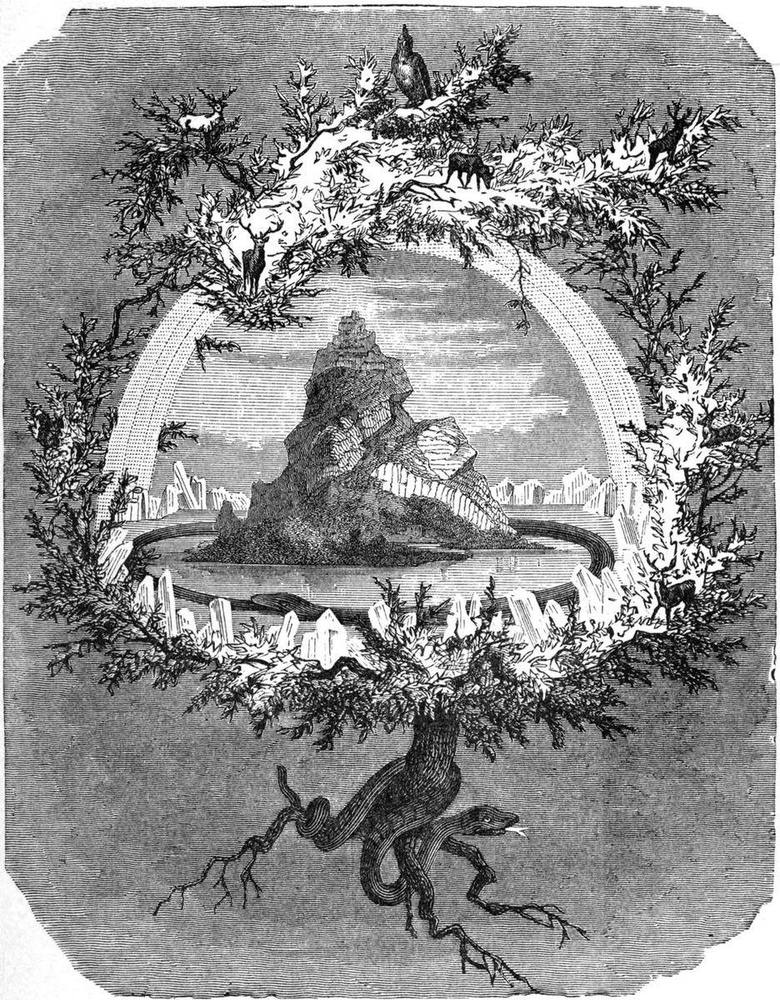
The popular diagrams stack the worlds on three levels: Asgard, Vanaheim and Alfheim at the top, Midgard, Jotunheim and Svartalfheim in the middle, Niflheim, Muspelheim and Hel at the bottom, all lined up neatly along Yggdrasil's trunk. It looks tidy. No source describes it that way.
In the 1970s the Russian scholar of myth Eleazar Meletinskij proposed describing Norse cosmology with two axes. On the horizontal axis the worlds lie in rings around one another: Asgard and Midgard in the ordered centre, Útgarðr and Jotunheim in the wild outside, the sea in between. On the vertical axis stands the world tree, linking sky above and underworld below. In a 1990 paper on "horizontal and vertical axes", the Danish historian of religion Jens Peter Schjødt examined how the two systems fit together and connected them with the oppositions of culture and nature, cosmos and chaos.
You can see both models side by side in Snorri himself. Asgard lies "in the middle of the world" – and also in heaven, reached by Bifröst. Jotunheim lies to the east at the world's edge – and also under a root of the tree. Hel lies "down and north". And the three roots themselves: in Snorri they reach to the Æsir, to the frost giants and to Niflheim. In the older Grímnismál they stand over Hel, the frost giants and humankind. Two texts, two cosmoses.
Why so contradictory? Recent scholarship stresses that there never was a single Old Norse religion. In his 2007 essay "How uniform was the Old Norse religion?", the Swedish place-name scholar Stefan Brink used place names to show how regional the cults were: some gods were worshipped in certain landscapes and apparently not at all elsewhere. If even the gods varied by region, Norwegians, Swedes, Danes and Icelanders hardly shared the same cosmic map for centuries. Snorri's system is a snapshot from learned thirteenth-century Iceland. For the individual names and their sources, Rudolf Simek's Dictionary of Northern Mythology remains the standard reference in English.
No number turns up at key moments of Norse tradition as often as nine.
In Hávamál (st. 138) Odin hangs nine nights on the windswept tree, wounded with a spear, given to himself, before he takes up the runes; right afterwards he learns nine mighty songs from his mother's brother. Heimdall is the son of nine mothers – so says Hyndluljóð, which even names the nine giantesses, and Snorri quotes a lost poem in which Heimdall calls himself the son of nine mothers. Our article on Heimdall's nine mothers tells the whole story.
The list goes on. At the end of the world Thor walks nine steps after slaying the Midgard Serpent before he dies of its venom (Völuspá 56). Hermóðr rides nine nights to Hel. In Skírnismál Gerd promises Freyr a meeting after nine nights in the grove of Barri, and Freyr finds even one night unbearably long. Every ninth night, eight rings of equal weight drip from Odin's ring Draupnir. Ægir and Rán have nine daughters, the waves.
Nine appears outside myth too. Around 1075 Adam of Bremen reports that at the sanctuary in Uppsala a great festival was held every nine years, at which nine of every male creature were sacrificed. Adam never went there himself and wrote from second-hand reports, so his numbers need caution. That it was nine he was told about fits the pattern, though.
A common explanation: nine is three times three, and three stands for completeness – three Norns, three roots, three brothers who order the world. That is an interpretation. The sources themselves never explain the nine. They simply use it, as naturally as we use a dozen.
That almost everyone has heard of "the nine worlds" today owes a lot less to the Eddas than to comics and games. Marvel's Thor comics since the 1960s, and above all the films from 2011 onwards, made the "Nine Realms" a household term. Marvel splits Svartalfheim and Nidavellir into two realms and turns Bifröst into a kind of wormhole – science fiction with a Norse coat of paint. What goes back to real sources we check in our Marvel Thor fact check.
The game series God of War (2018) and its sequel Ragnarök (2022) turn the worlds into explorable realms reached through a world tree. The developers clearly read the Eddas and invented freely where the story demanded it – legitimate modern reception, not tradition. Our God of War fact check separates the two. Both franchises adopt the handbook list of nine and make it firmer than it ever was: a nineteenth-century reconstruction turned twenty-first-century canon.
In our workshop in Alsdorf the world tree is one of the most requested motifs. We think you can engrave the worlds beautifully without pretending the Edda handed down a map.
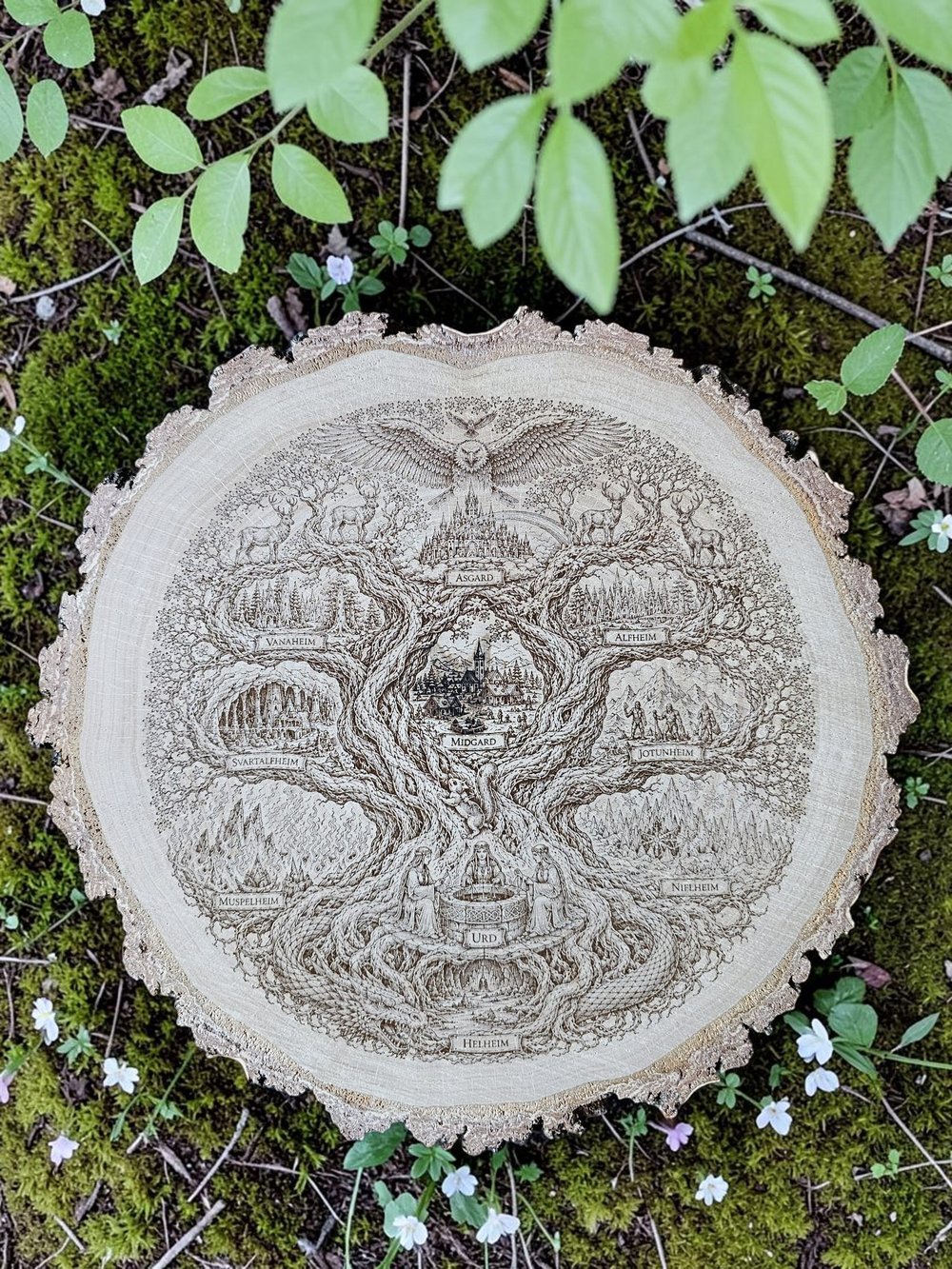
One design we love: Yggdrasil at the centre of a wood slice or slate plaque, with the half-line from the Völuspá above it – níu man ek heima, "nine worlds I remember". We set the world names not in floors but in a ring around the trunk, like Meletinskij's horizontal model: Asgard and Midgard inside, Jotunheim outside, Hel and Niflheim down by the roots. If you like, the names can also be cut in the runes of the Younger Futhark, the rune row of the Viking Age. Slate gives it a cool, bright contrast; birch makes it warm and alive. What hangs on your wall is then what the sources really offer – a number, a tree and an order you are free to rethink.
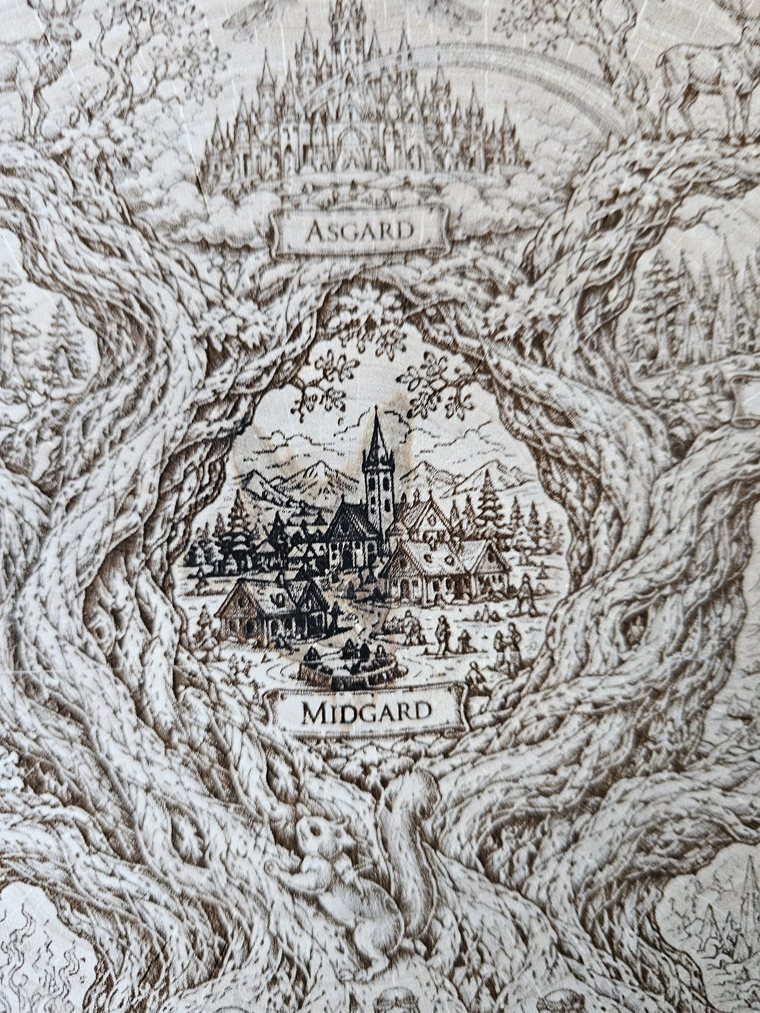
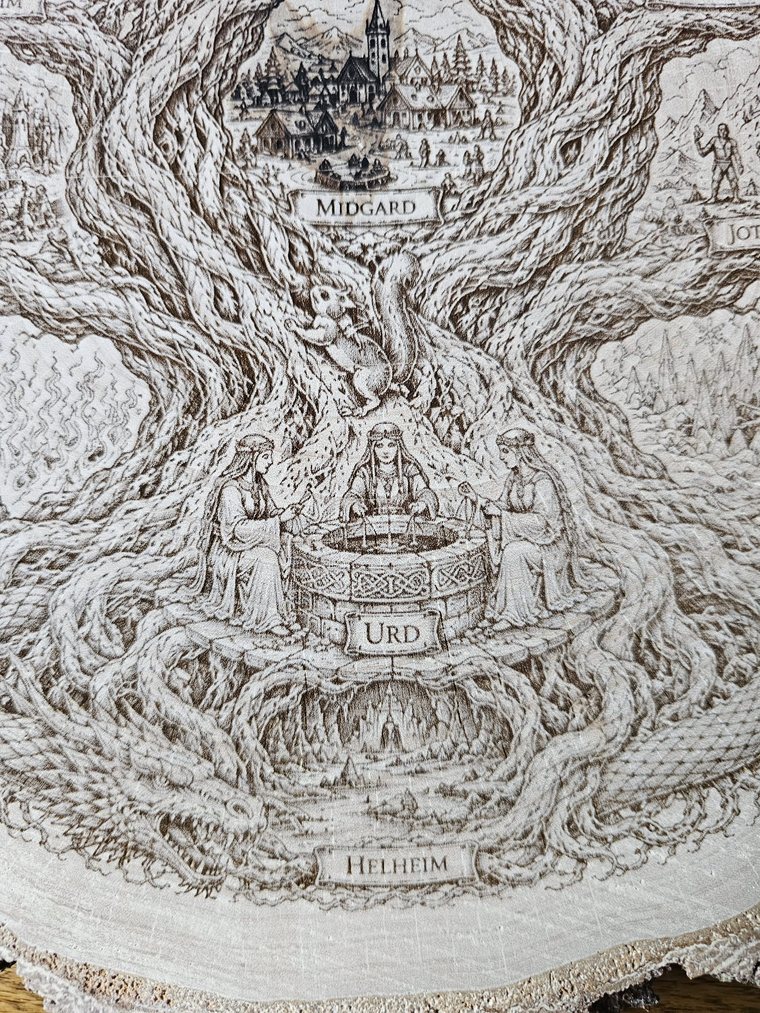
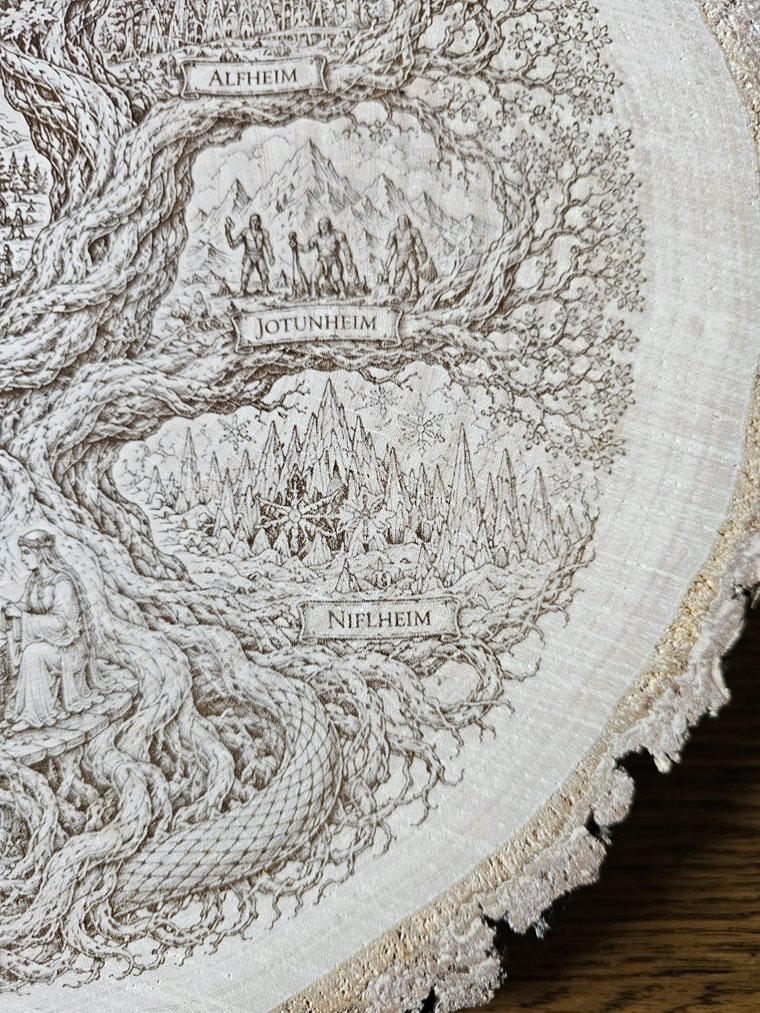
What are the nine worlds in Norse mythology called? The usual modern list is Asgard, Vanaheim, Alfheim, Midgard, Jotunheim, Svartalfheim (or Niðavellir), Niflheim, Muspelheim and Hel. It is a modern compilation; no medieval source lists the nine worlds.
Where are the nine worlds mentioned in the Edda? In Völuspá 2, Vafþrúðnismál 43, a late extra stanza of Alvíssmál and twice in Snorri's Gylfaginning. Each time only the number is given.
Are the nine worlds attached to Yggdrasil? It is a natural picture, but not one the sources spell out. Snorri says the ash's branches spread over all worlds and its three roots lie among the Æsir, among the frost giants and over Niflheim.
Is Niflheim the same as Hel? Not quite. The poems know Hel, and Niflhel as the deepest underworld; Niflheim appears only in Snorri, who does not keep the terms cleanly apart himself.
Why is the number nine so important in Norse mythology? It recurs constantly: Odin's nine nights on the tree, Heimdall's nine mothers, Thor's nine steps, the Uppsala festival every nine years. The sources never explain why.
Are Marvel's Nine Realms historically accurate? The names come from the sources; the layout and look of the realms are modern inventions.
For courage. For remembrance. For legends that live on.
Yggdrasil in detail · Ginnungagap · Ymir & the making of the world · The Norse pantheon · Fenrir · Jörmungandr · Ragnarök · What comes after.
Above the gods stands something to which even Odin bows: fate. And fate has three shapes – the Norns, who sit at the …
Read more →It is perhaps the most famous bargain in all of mythology: the highest of the gods gives up an eye – willingly – for a …
Read more →Can a poem save a life? In the North, yes. The skald Óttarr svarti („the Black") had drawn the wrath of King Óláfr the …
Read more →Norse religion has no distant, all-powerful deity on a throne. It has a family – quarrelsome, cunning, loving, mortal …
Read more →