
Svartalfheim (Old Norse Svartálfaheimr, “home of the black elves”) is the underground place in Norse mythology where dwarves live and work – yet the name occurs only twice in the medieval sources, both times in Snorri Sturluson's Prose Edda from the 13th century. The gods send Skírnir there to order the fetter Gleipnir, and Loki there to squeeze the dwarf Andvari for his gold. No Eddic poem places Svartalfheim on a list of nine worlds. Here is what the sources say, what was added later, and why this realm still works so well.
Picture a map with a country everyone talks about – and when you finally look for it, all you find are two footnotes. That is roughly what happens when you go hunting for Svartalfheim in the medieval texts. In books, games and films it is fixed in place: one of the nine worlds on the World Tree, gloomy, full of forges, home to dwarves or dark elves. In Old Norse tradition, though, Svartalfheim is somewhere you are sent when you need something only dwarves can make or own. No description, no ruler, no position on the tree.
That is no reason for disappointment. Precisely because the evidence is so thin, Svartalfheim shows beautifully how much of Norse mythology we owe to a single Icelandic scholar.
Svartálfaheimr has three parts: svartr (“black”), álfar (“elves”, genitive plural álfa) and heimr (“home, world, dwelling”). Literally, then, “world of the black elves”. It is built exactly like Álfheimr, the home of the elves, or Jǫtunheimr, the world of the giants.
“Svartalfheim” is the simplified modern spelling; you will also meet “Svartalfaheim” and, in English, simply “the land of the black elves”. What Snorri gives us is mainly the place name. As a group he introduces the dǫkkálfar, the “dark elves” – more on them shortly. For the elves themselves, see our article on elves (álfar).
The first passage is in Gylfaginning (“the tricking of Gylfi”), the first major part of Snorri's Edda, written around 1220. Snorri tells how the gods try to bind the wolf Fenrir. Two chains, Lœðingr and Drómi, the beast snaps with ease. So Odin – here called Alfǫðr, “All-father” – tries something else. The Old Norse says he sent Skírnir, Freyr's messenger, “ofan í Svartálfaheim til dverga nǫkkurra”: down into Svartalfheim, to certain dwarves. There he had the fetter made that is called Gleipnir.
“Allfather sent him who is called Skírnir, Freyr's messenger, down into the region of the Black Elves …”Gylfaginning 34, translated by Arthur Gilchrist Brodeur (1916, public domain)
Gleipnir is made of six things that do not exist: the noise of a cat's footfall, the beard of a woman, the roots of a mountain, the sinews of a bear, the breath of a fish and the spittle of a bird. That, Snorri notes drily, is why a cat makes no sound when it walks. The result is smooth and soft as a silken ribbon, and it holds. The price is paid by Tyr, who lays his hand in the wolf's mouth as a pledge and loses it.
Two details stand out. First, the little word ofan, “down”: Svartalfheim lies below the world of the gods, and very likely below ground. Second, “to certain dwarves”. Snorri gives no names. The makers of Gleipnir stay anonymous, and Svartalfheim is simply where you find such specialists.
The second passage is in Skáldskaparmál (“the language of poetry”), Snorri's handbook for skalds. He is explaining why gold can be called “otter's ransom” in verse. Odin, Loki and Hœnir are travelling; Loki kills an otter with a stone – but the otter is Otr, son of Hreiðmarr, who fished for salmon in animal shape. Hreiðmarr demands compensation: the otter's skin is to be filled with gold and covered completely.
Where to get it? Snorri writes: “Þá sendi Óðinn Loka í Svartálfaheim, ok kom hann til dvergs þess, er heitir Andvari.” Andvari lives in the water in the shape of a fish. Loki catches him with his bare hands and demands as ransom all the gold the dwarf keeps in his rock. Andvari tries to hold back one ring, because with it he could make his wealth grow again. Loki takes that too. So the dwarf curses the ring: it shall be the death of everyone who owns it.
“Then Odin sent Loki into the Land of the Black Elves, and he came to the dwarf who is called Andvari, who was as a fish in the water.”Skáldskaparmál 39, translated by Arthur Gilchrist Brodeur (1916, public domain)
That curse starts the whole chain of the Völsung and Nibelung legend: Hreiðmarr is killed by his son Fáfnir, Fáfnir becomes a dragon, Sigurd slays him. Follow the story further in Andvari's cursed gold. What matters here: the Poetic Edda tells the same episode in the prose introduction to Reginsmál, but never mentions Svartalfheim. There Andvari lives in a waterfall, Andvarafors, and Loki catches him with the net of the sea goddess Rán. The location “Svartalfheim” is therefore Snorri's addition – or comes from a source we no longer have.
Nearly every modern account counts nine worlds, and Svartalfheim is nearly always among them. The sources are more reserved. The number nine really is in the Eddic poems: in Vǫluspá (stanza 2) the seeress remembers “níu heima”, nine worlds, and in Vafþrúðnismál (stanza 43) the giant boasts he has been through nine worlds, down to Niflhel. Snorri knows the number too: according to Gylfaginning, Odin gives Hel power over nine worlds. But not one of these passages gives a list of names.
The line-up that now passes as canon – Asgard, Vanaheim, Alfheim, Midgard, Jotunheim, Muspelheim, Niflheim, Svartalfheim, Hel or Helheim – is a modern compilation. It gathers place names scattered across different sources and uses them to fill the number nine. Some writers put Niðavellir in place of Svartalfheim; others treat Hel and Niflheim as one or two. There is no medieval model for the list.
The poems do say a fair amount about where dwarves live – just without a name. In Alvíssmál the dwarf Alvíss answers Thor that he dwells beneath the earth and has his place under the stone. In the Ragnarök stanzas of Vǫluspá the dwarves groan before their doors of stone, the wise ones of the rock walls. The same poem names, in the north, the Niðavellir, the “dark fields” (another reading is “fields of the new moon”), where a hall of gold stands for Sindri's kin. Snorri picks this up in Gylfaginning and calls the hall on the Niðafjǫll itself “Sindri” – after Ragnarök, good people are to live there.
So the idea of dwarves living in stone is old and well attested; the world name Svartalfheim is not. If you want the whole question of cosmic order, read our article on the nine worlds.
Now it gets tangled. In Gylfaginning 17 Snorri describes two kinds of elves. The ljósálfar, light elves, live in Álfheimr and are “fairer to look upon than the sun”. The dǫkkálfar, dark elves, live down in the earth and are “blacker than pitch”. They are unlike the light elves in appearance, and still more unlike them in nature.
Snorri never says outright that the dark elves are the dwarves. Nor does he explain whether the dark elves (dǫkkálfar) and the inhabitants of Svartálfaheimr (svartálfar) are the same. Both seem obvious: dark elves live underground, Svartalfheim lies “down”, and wherever Snorri mentions Svartalfheim, you meet dwarves there. But between “seems obvious” and “it says so” there is a gap.
Scholars handle that gap differently. Rudolf Simek, John Lindow and Andy Orchard all allow in their reference works that svartálfr and dwarf may simply be two words for the same thing. Lindow adds that it remains unclear whether Snorri saw dark elves and black elves as one group. Alaric Hall, who examined the Scandinavian evidence closely in his study of elves in Anglo-Saxon England, sees the light-versus-dark contrast above all as Snorri's own systematising – possibly shaped by the Christian contrast between good and fallen angels. For the older poetry, he argues, that neat division is not attested.
There are hints in the poems themselves that elves and dwarves overlapped. In the Dvergatal, the catalogue of dwarves in Vǫluspá, several dwarves have names in -álfr: Gandálfr, Vindálfr and a plain Álfr. It was from this very list that J. R. R. Tolkien took the name Gandalf and the names of nearly all the dwarves in “The Hobbit”.
On the other hand, elves and dwarves keep appearing as separate groups in the Eddic poems. In Hávamál (stanza 143) Odin carves runes for the gods, Dáinn for the elves, Dvalinn for the dwarves. In Alvíssmál, gods, humans, giants, elves and dwarves are listed as distinct speakers, each with their own words for earth, sky and moon. The formula “Æsir and elves” (æsir ok álfar) occurs in several poems; the dwarves are usually not part of it. Terry Gunnell has therefore asked how “elvish” the elves of the poems really were; broadly, he sees them in the poetry standing closer to the gods than to the dwarves.
What emerges is a picture in three layers. The older poems mostly treat elves and dwarves as separate, occasionally overlapping groups. Snorri, in the 13th century, puts things in order and perhaps invents the light/dark contrast – or perhaps takes it from a lost tradition. And modern readers draw the conclusion: black elves equal dark elves equal dwarves. That conclusion is defensible, but it remains an interpretation. For the origins, names and nature of the dwarves – from maggots in the giant's flesh to the disease demons of the charms – see our big article on dwarves in Norse mythology.
If Svartalfheim is the dwarves' world, it is worth asking how the sources say dwarves came to be. Vǫluspá (stanza 9) describes the gods taking counsel over who should shape the race of dwarves from Brimir's blood and Bláinn's limbs – two names usually read as by-names of the primeval giant.
“Then sought the gods their assembly-seats, / The holy ones, and council held, / To find who should raise the race of dwarfs / Out of Brimir's blood and the legs of Blain.”Vǫluspá 9, translated by Henry Adams Bellows (1923, public domain)
Snorri turns this into a starker image in Gylfaginning 14: the dwarves first came alive in the flesh of the slain giant Ymir, as maggots. Only then did the gods give them human shape and understanding. Since then they live in the earth and in rocks. In Gylfaginning 8 he also sets four dwarves – Austri, Vestri, Norðri and Suðri – under the four corners of the sky, which is made from Ymir's skull. From the very beginning, Snorri's dwarves belong to the below: to earth, rock and the body of the world. Seen that way, Svartalfheim is simply the inside of the world itself.
The dwarves' greatest fame rests on their handiwork. The best-known episode is again in Skáldskaparmál. Loki has maliciously cropped the hair of Sif, Thor's wife. To escape Thor's fury he promises a replacement and goes to the dwarves called the sons of Ívaldi. They forge three things: new hair of gold for Sif, which takes root at once; the ship Skíðblaðnir for Freyr, which always has a fair wind and folds up like a cloth; and the spear Gungnir for Odin, which never stops in its thrust. More in our article on Ívaldi and his sons.
Then Loki bets his head with the dwarf Brokkr that Brokkr's brother cannot make three treasures as good. Depending on manuscript and edition, the brother is called Sindri or Eitri. Brokkr has to work the bellows, and Loki, as a fly, stings him three times. Out come the boar Gullinbursti, the ring Draupnir, from which eight rings of equal weight drip every ninth night, and the hammer Mjǫllnir, whose handle came out a little short because of the fly. The gods judge the hammer the best of all; Brokkr wins – and because Loki pledged his head but not his neck, the dwarf sews his lips shut instead. The whole tale is in Sindri & Brokkr.
Now the crucial point for our subject: in this chapter Snorri names no location. Neither Ívaldi's sons nor Brokkr and his brother are placed in Svartalfheim. The text speaks only of the smithy. When modern retellings say Mjǫllnir or Gungnir were “forged in Svartalfheim”, that is a natural but added location.
The same goes for other famous dwarf-made works:
Not one of these pieces is explicitly made in Svartalfheim in the sources. The only thing we know was produced there is Gleipnir. That is no contradiction, but it is a warning: the equation “Svartalfheim = the gods' foundry” is a modern composite into which several stories have been bundled.
What the stories do make clear is the dwarves' character as craftsmen. They do not work out of kindness, but to order, under duress or to win a bet. Andvari curses his gold, Fjalarr and Galarr murder Kvasir, Brokkr wants Loki's head.
That hardness matches what the poems say about dwarves elsewhere. The dwarf Alvíss wants to marry Thor's daughter Þrúðr; Thor keeps him talking in a contest of knowledge until dawn, and when the sun shines into the hall the dwarf is finished – usually read as him turning to stone, though the poem does not spell it out. We tell that story in Thrud & Alvíss. Daylight is dangerous for dwarves – and Snorri's “blacker than pitch” fits that picture.
For us in the workshop it is an honest thought. The old stories did not see the smith as a cosy hobbyist, but as someone who handles fire, stone and metal and makes things mightier than the people who order them. Good work has its price – though nobody here bets their head on it.
Svartalfheim belongs to storytelling, not archaeology – but respect for the smith has a real background. Iron smelted from bog ore, blade-making techniques such as pattern-welding, and the finest goldsmith's work were highly valued skills in the Viking Age. A striking witness is the Mästermyr tool chest from Gotland, found in a bog in 1936 and usually dated to the late Viking Age: tongs, hammers, files, anvils and half-finished pieces belonging to a craftsman who worked iron, copper alloys and precious metal.
Whether the idea of smithing dwarves grew directly out of such craft circles cannot be proven. Lotte Motz, in her study “The Wise One of the Mountain” (1983), linked dwarves with mountain, craft and knowledge and looked for parallels in other cultures. Stimulating, but not generally accepted. For how Viking smiths actually worked, see our article on Viking blacksmithing.
Why does Snorri, of all people, have the name Svartalfheim? The honest answer: we do not know. Snorri Sturluson (1179–1241) was a politician, lawspeaker and scholar in Iceland, writing more than 200 years after the island's official conversion to Christianity. His Edda is a textbook for poets that combines old poems, oral tradition and his own system. Where the poems only hint, he arranges; where there are gaps, he sometimes fills them. More in our portrait of Snorri Sturluson.
Svartálfaheimr can therefore be one of two things. Either an old word that happens to survive only in Snorri's work – plenty of traditions hang on a single witness. Or Snorri's own coinage, modelled on Álfheimr and fitting his doctrine of light and dark elves. Both possibilities are debated.
Today many people know the name not from the Edda but from the cinema. In “Thor: The Dark World” (2013), Svartalfheim is a darkened, ruined world and home of the Dark Elves under their leader Malekith. The dwarves, meanwhile, Marvel moved to Nidavellir in “Avengers: Infinity War” (2018), where the giant dwarf Eitri forges the weapon Stormbreaker in the heat of a star. Hollywood solved the source problem in its own way: dark elves and dwarves each get a world of their own.
That has little to do with the Edda. Snorri knows no army of dark elves, no Malekith, no giant-sized dwarf; and in his work Svartalfheim is precisely the place where you meet dwarves. Which elements of the Marvel films go back to old tradition and which do not, we have taken apart in our Marvel Thor fact check.
Svartalfheim is the finest example of a world that can be large even when the sources are small. Two sentences in Snorri, a few stanzas about dwarves behind stone doors and golden halls in the north, plus the great forging tales – that is all. And yet it carries an entire imaginative world: the darkness beneath the rock, the glow of the forge, masters better than those who hire them. Feel free to paint it in your mind – just know where the brush of the sources stops. We work the same way in our workshop: check the evidence first, then create.
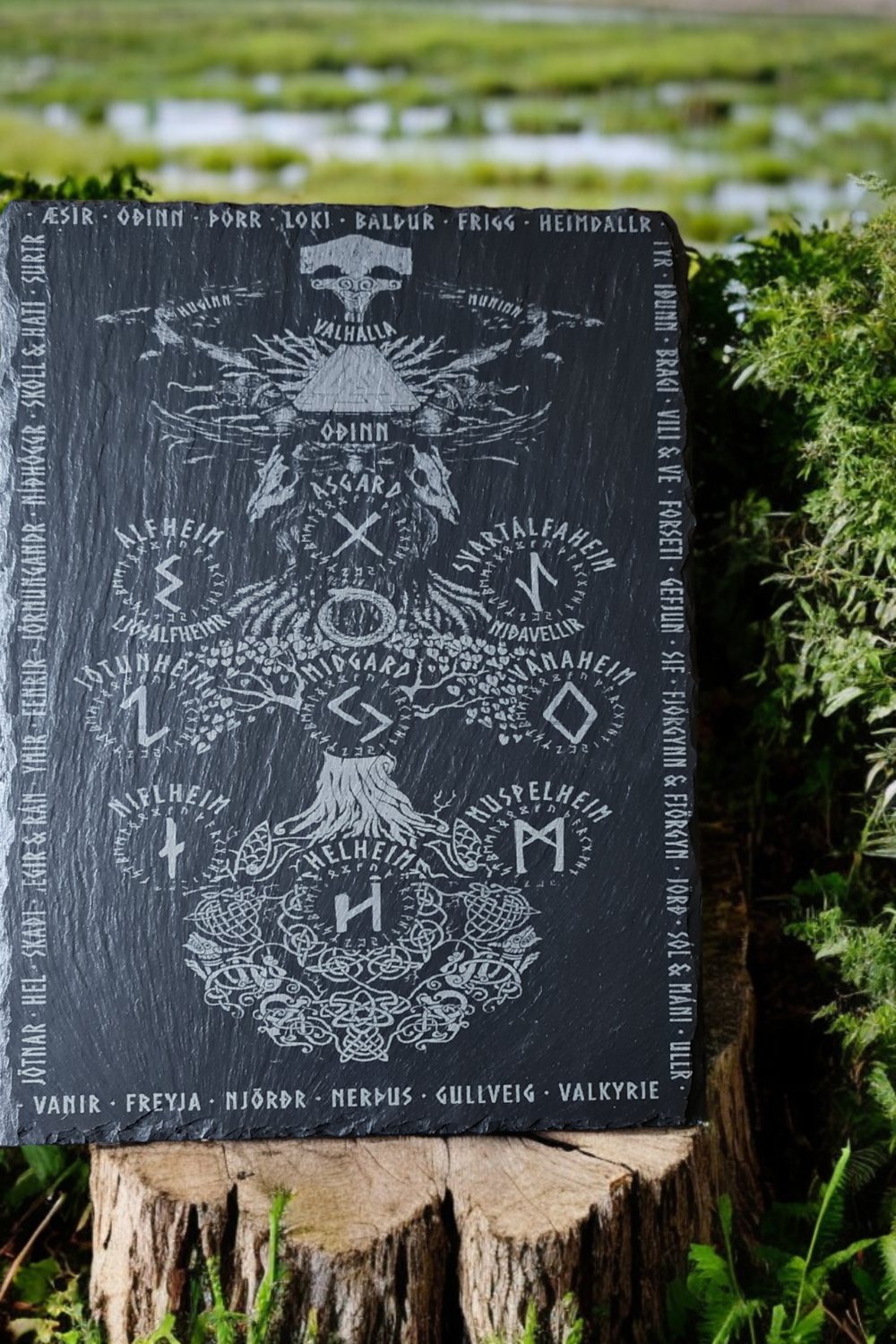
What is Svartalfheim in Norse mythology? Svartalfheim (Old Norse Svartálfaheimr, “home of the black elves”) is an underground place where, according to Snorri's Prose Edda, dwarves live. Skírnir is sent there for the fetter Gleipnir, and Loki for Andvari's gold.
Is Svartalfheim one of the nine worlds? In modern lists, yes; in the medieval sources, not explicitly. The Eddic poems speak of nine worlds but name none of them, and Svartalfheim never appears in the poems at all.
Are black elves and dwarves the same? Probably, but not certainly. In both passages where Snorri mentions Svartalfheim, dwarves live there, so many scholars treat “black elf” and “dwarf” as synonyms. The sources never equate them explicitly.
Was Mjölnir forged in Svartalfheim? Snorri tells the making of Mjǫllnir in detail but names no location. Placing it in Svartalfheim is a later, natural addition.
Who lives in Svartalfheim in the Marvel films? In “Thor: The Dark World” (2013), the Dark Elves led by Malekith. Marvel's dwarves and their smith Eitri live in Nidavellir instead – a division the Edda does not make.
For courage. For remembrance. For legends that live on.
Mjölnir – Thor's hammer · Midgard · Jötunheim · The Norse pantheon · The Nine Worlds.
All The Nine Worlds articles →
Apart from Asgard, in a world whose location the sources leave vague, dwell the Vanir – the other family of gods …
Read more →The world was ordered, the sun ran its course – but the shore lay empty. Then three gods found on the sea-strand two …
Read more →Before there were gods, before the world was formed, there were two beings in the frost: the primal giant Ymir and a …
Read more →Deep below, beyond a dark river and a gold-roofed bridge, lies Helheim – the realm of the dead. Not the shining hall of …
Read more →