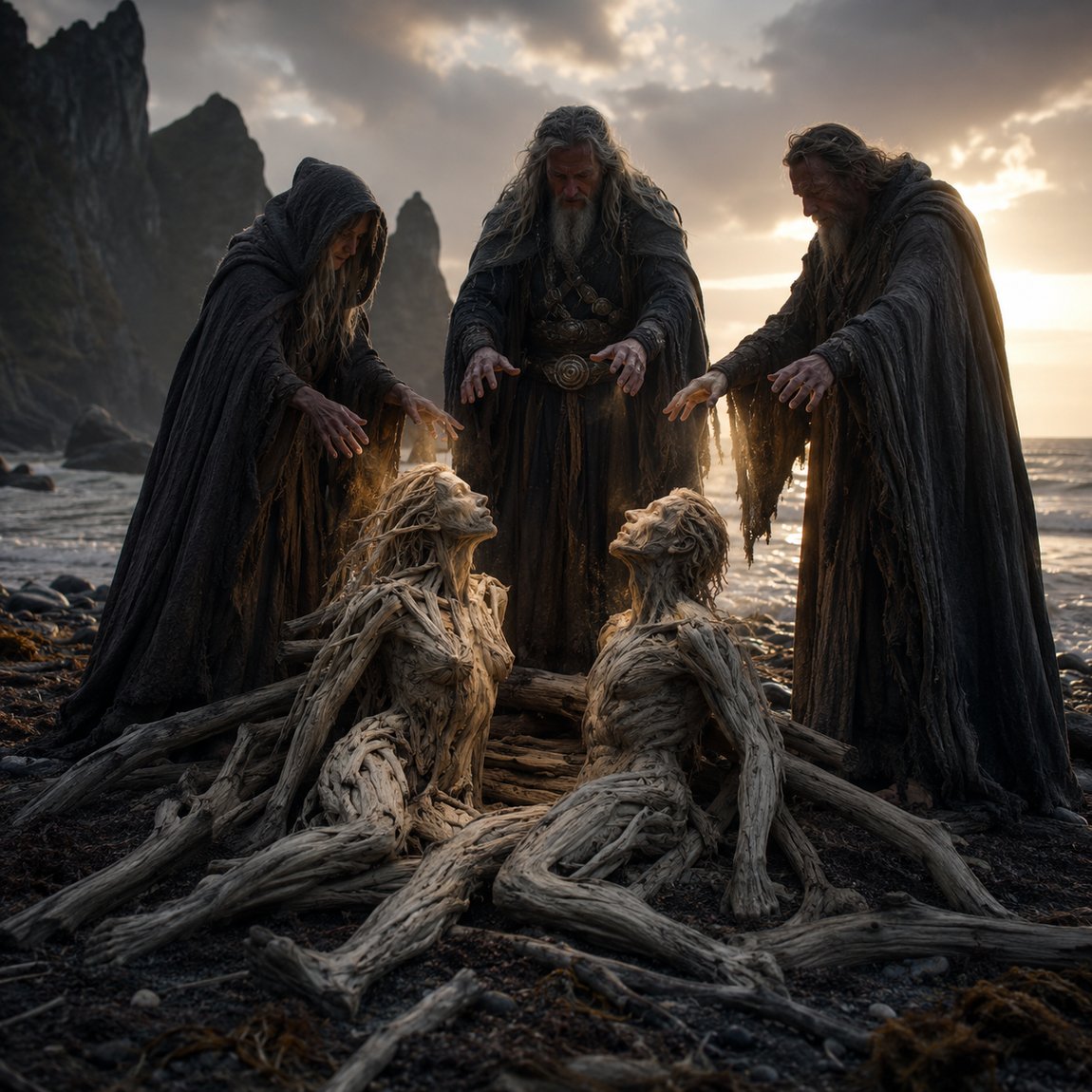
Ask and Embla are the first man and woman in Norse mythology: according to the Edda, three gods found two lifeless beings without fate and gave them breath, mind, vital warmth and colour. Ask certainly means “ash tree”; what Embla means is still disputed. Here is what the Völuspá and Snorri actually say, where the two sources disagree, what may lie behind the names, and why this pair now turns up on wedding gifts.
Sooner or later every culture has to answer a child’s question: where do people come from? The Bible answers with clay and divine breath. The North answers with wood. Two pieces of it, somewhere on a coast, powerless and without a future. Then three gods pass by, and what could have been firewood becomes a man and a woman. The story is told in a handful of lines, almost in passing, and that is exactly what gives it its force.
Before we get to interpretation, let us sort the evidence. Exactly two medieval texts tell of Ask and Embla as the first humans. Both come from Iceland, and both were written down in the 13th century, more than two hundred years after Iceland formally adopted Christianity around the year 1000. There are no archaeological finds, runic inscriptions or contemporary reports that name Ask and Embla. Everything we know rests on these two passages and on what scholars have read into them.
The older source is the Völuspá, “the prophecy of the seeress”, the opening poem of the Poetic Edda. It survives in the Codex Regius (c. 1270) and, in a somewhat different form, in Hauksbók (early 14th century). Nobody knows exactly when it was composed; many scholars think of the late 10th or early 11th century, the age of conversion. In it a völva, a seeress, tells Odin the history of the world from its beginning to its destruction and beyond.
After the making of the world, the ordering of the heavenly bodies and a long passage listing the dwarfs, stanza 17 reads (text after the Neckel/Kuhn edition, normalised):
Unz þrír kómu / ór því liði / ǫflgir ok ástkir / æsir at húsi, / fundu á landi / lítt megandi / Ask ok Emblu / ørlǫglausa.Völuspá 17, Old Norse text
Henry Adams Bellows rendered it in 1923 like this:
Then from the throng did three come forth, / From the home of the gods, the mighty and gracious; / Two without fate on the land they found, / Ask and Embla, empty of might.Völuspá 17, translation Henry Adams Bellows (1923, public domain)
Note one detail: the Old Norse says á landi, “on the land”. That may mean a shore, but it need not. The beach only enters the story with Snorri. Then comes the famous stanza 18:
Soul they had not, sense they had not, / Heat nor motion, nor goodly hue; / Soul gave Othin, sense gave Hönir, / Heat gave Lothur and goodly hue.Völuspá 18, translation Henry Adams Bellows (1923, public domain)
In the original there are five words, which the poem first denies the pair and then hands out. They show what people in the North thought a living human being was.
Ǫnd is Odin’s gift. It means “breath” and is related to Latin animus and anima. It is the breath of life, the thing that separates a body from an object. Bellows’ “soul” sounds too Christian to modern ears.
Óðr comes from Hœnir. It is a word with many layers: mind, wit, sense, excitement, poetic inspiration, even frenzy. It is the same word that sits inside Odin’s own name (Óðinn) and inside the name of Óðr, Freyja’s vanished husband. So it is the silent Hœnir, elsewhere portrayed as rather slow on the uptake, who gives humanity its mind. Scholars have long puzzled over that irony.
Lá, læti and litr come from Lóðurr. Lá is the darkest word of the series. It is translated as “blood”, “vital fluid” or “vital warmth” (Bellows: “heat”), and none of these readings is certain. Læti means gestures, movement, voice, the whole lively bearing of a person. Litu góða, finally, is “good colour”, a healthy, living complexion. Because the manuscripts do not mark vowel length reliably, the phrase can also be read litu goða, “the colour or likeness of the gods”. Then humans would have received a godlike appearance. Both readings have their supporters.
Taken together, the picture is remarkably precise: a person is breath, mind, warm bodily fluid, movement and expression. Wood is merely lítt megandi, “of little might”.
The finest word comes at the end of stanza 17: ørlǫglausa, “fateless”. Ørlǫg is literally “that which is laid down first”, what is fixed at the beginning and gives a life its course. Ask and Embla do not have it yet. They are not only lifeless; they are without a story.
And here it gets interesting. Immediately afterwards, in stanzas 19 and 20, the seeress describes the ash Yggdrasil, the well at its foot and the three Norns, who lay down laws for the children of men, choose their lives and declare their ørlǫg. The poem deliberately sets two images side by side: two pieces of wood without fate, and the world tree at whose roots fate is allotted. Whether humans receive their fate when the gods animate them, or only later from the Norns, the text leaves open.
The second source is the Prose Edda of the Icelander Snorri Sturluson, written around 1220–1230. In the section Gylfaginning (“the deluding of Gylfi”) a mysterious trio explains the world to the Swedish king Gylfi. After the gods have made earth, sea and sky from the body of the primeval giant Ymir, the creation of humans follows. In Arthur Gilchrist Brodeur’s 1916 translation:
When the sons of Borr were walking along the sea-strand, they found two trees, and took up the trees and shaped men of them: the first gave them spirit and life; the second, wit and feeling; the third, form, speech, hearing, and sight. They gave them clothing and names: the male was called Askr, and the female Embla, and of them was mankind begotten, which received a dwelling-place under Midgard.Gylfaginning 9, translation Arthur Gilchrist Brodeur (1916, public domain)
Read closely and the differences jump out. In Snorri there are clearly tré tvau, two trees or trunks, and they lie on the sævarstrǫnd, the sea-shore. That is where the popular image of driftwood comes from. The word “driftwood”, however, appears in neither source. It is an obvious and very Icelandic reading: on an almost treeless island, timber washed ashore from Siberia and Scandinavia was a precious resource.
Snorri’s gifts sound different, too. Breath and life, wit and movement roughly match the Völuspá. But his third gift is very concrete: face, speech, hearing and sight. And there is a new element the poem lacks: clothing and names. The word “fateless”, on the other hand, is missing in Snorri.
The biggest difference concerns the creators. In the Völuspá they are Odin, Hœnir and Lóðurr. In Snorri they are “the sons of Borr”, which according to Gylfaginning 6 means Odin and his brothers Vili and Vé, the same three who killed Ymir. Snorri does not assign the gifts to individual names; he only speaks of the first, the second and the third.
Why the switch? The simplest explanation is that Snorri was building a coherent system. If the brothers Odin, Vili and Vé create the world, it makes sense for them to create humans as well. Older scholars such as Eugen Mogk and Sigurður Nordal therefore suspected that Snorri harmonised the trios. We know Snorri knew the Völuspá, because he quotes it at length elsewhere. Yet these two stanzas he does not quote. So he may also have had a different tradition in front of him. There is no way to settle it.
And who is Lóðurr? Honestly: we do not know. Outside Völuspá 18 the name hardly appears at all. Since the 19th century he has often been identified with Loki, because Odin, Hœnir and Loki travel together as a trio in other stories, such as the tale of the giant Thjazi or of the otter’s ransom. Bellows thought Lóðurr was an older name for Loki and linked his gift of heat to an old fire god. Tempting, but unproven. The identification remains disputed, and some scholars see Lóðurr as an independent deity who was forgotten early.
One question remains open: were Ask and Embla already human-shaped figures when the gods found them? Some scholars read the Völuspá that way. Directly before stanza 17 comes the long section on the dwarfs, and stanza 10 says the dwarfs made “many human likenesses” (mannlíkun mǫrg) out of the earth. Hence the idea that the dwarfs made the rough forms and the gods merely brought them to life. Whether this link is intended or simply an accident of arrangement is speculation, especially since many scholars regard the dwarf catalogue as a later insertion.
Another passage is often brought in. In the Hávamál (stanza 49) Odin says he once gave his clothes to two trémenn, two “wooden men” out in a field. Dressed, they looked like proper men; the naked man, by contrast, is mocked. These are probably wooden figures. Because Snorri stresses that the first humans received clothing, some have seen here an echo of a lost myth. It cannot be proven.
Archaeology does offer large wooden human figures from the North. The best known are the two figures from the bog at Braak in Schleswig-Holstein, found in 1947: a man about 2.75 metres tall and a woman about 2.30 metres, carved from naturally forked oak branches and dated to the pre-Roman Iron Age, centuries before the Viking Age. The British historian of religion Hilda Ellis Davidson considered whether such pairs might be connected with the Ask and Embla tradition. That is a possibility and no more.
On the first name scholars agree: Old Norse askr means “ash tree”, from Proto-Germanic *askaz, the same word as English “ash”. In Old Norse askr could also denote things made of ash wood, such as a spear or a ship.
The ash is no ordinary tree in the North. Yggdrasil, the world tree, is explicitly called an ash in the Völuspá. The first man therefore bears the name of the tree that holds up the worlds. Whether the poet intended that link we cannot know, but it has been debated for a long time. You can read more about sacred trees in the Germanic world in a separate post.
Poetry offers a related clue. In skaldic verse, men and women are constantly described with tree words. A warrior can be a “tree of battle”, a woman a “tree of gold” or of jewellery. These circumlocutions, called kennings, are so common that Carolyne Larrington connected them with the myth of humans made from trees.
Embla is where things get difficult. The name has no convincing etymology, and some scholars see exactly that as a sign of great age. The main proposals:
The vine and fire theories belong together. When you make fire with a fire drill, you twist a hard wooden stick in a softer base until an ember forms. If Ask were the hard drill and Embla the soft wood, the creation of humans would at the same time be an image of procreation and fire. In many Indo-European cultures, fire-drilling carries strong sexual symbolism. It sounds convincing, but there is a catch: there is no evidence that people in the North used ash wood in particular for the drill. The honest answer is that we do not know what Embla means.
Ask and Embla do not stand alone. The idea that humans come from trees or wood is widespread in Europe and among Indo-European peoples, while Mesopotamia and the Old Testament prefer clay and earth. The Swedish historian of religion Anders Hultgård examined this comparatively in 2006.
In Hesiod (around 700 BC) Zeus creates the bronze race of men “from ash trees” – again the very tree in Ask’s name. In Iranian tradition the first humans, Mašya and Mašyāna, grow out of the earth as a plant, at first joined as a single growth before they separate. And in the 7th-century origin legend of the Lombards, two Vandal leaders called Ambri and Assi appear, a pair of names that reminds some readers of Embla and Ask.
For the Germanic world, though, the oldest origin story is a different one. Around AD 98 the Roman Tacitus writes in his Germania (chapter 2) that the Germans celebrate in ancient songs the earth-born god Tuisto and his son Mannus as the origin and founders of their people. From the three sons of Mannus descend the Ingaevones, Herminones and Istaevones. That is not a first human couple but a genealogy of ancestors, more than a thousand years before the Edda. Still, it shows that Germanic peoples had origin myths of their own.
One trail even leads close to our own region. In chapter 3 of the Germania Tacitus reports that some believed Asciburgium on the Rhine had been founded by Ulysses. Asciburgium is today’s Asberg near Moers on the Lower Rhine. In 2015 the linguists Krzysztof Tomasz Witczak and Elwira Kaczyńska argued that behind the name lies a Germanic wanderer *Askiz, and that Völuspá 17–18 does not describe a creation at all but the revival of two figures from his cycle of legends. It is a minority view, but a thought-provoking one.
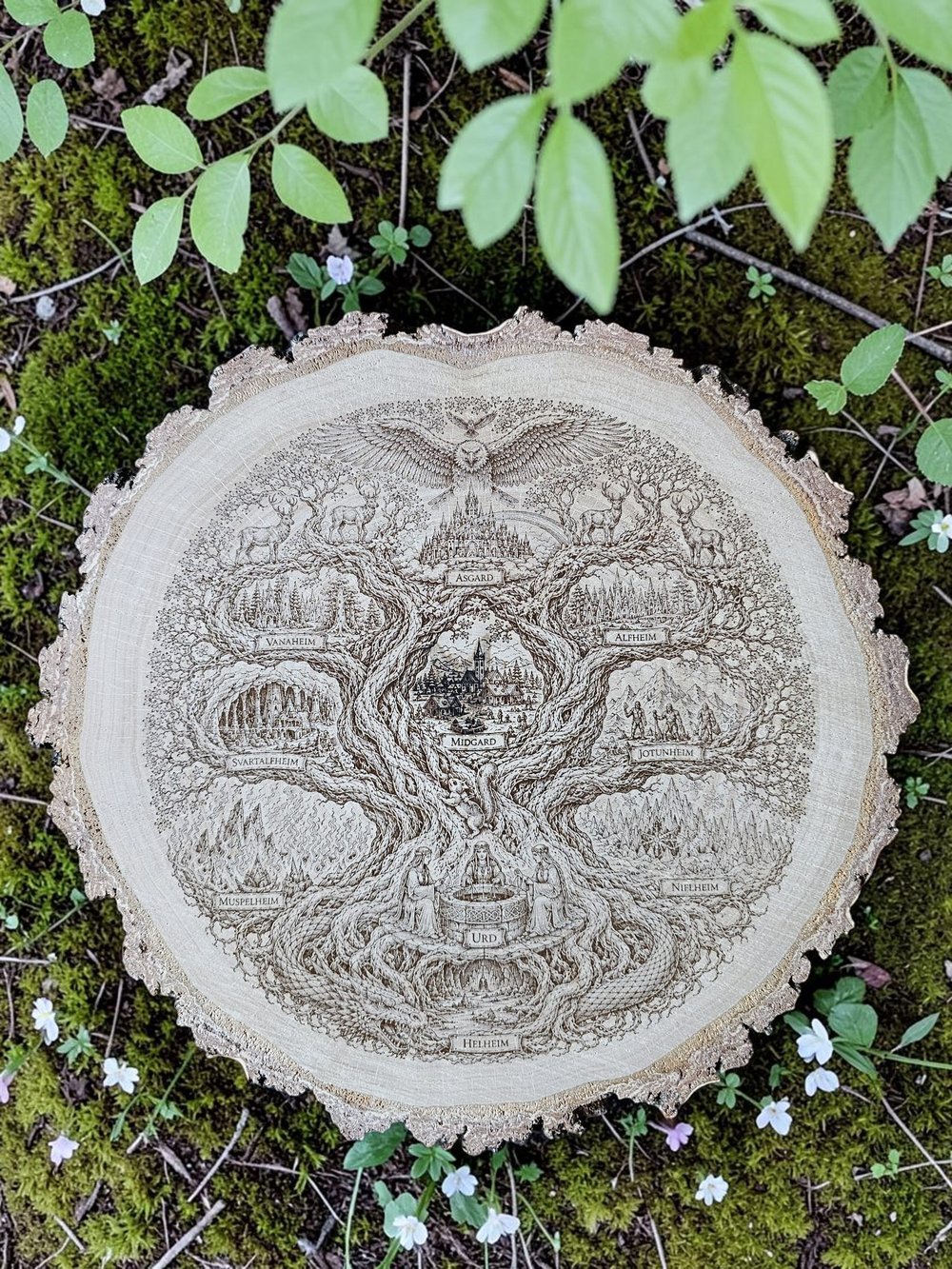
Snorri gives Ask and Embla and their descendants a fixed address: Midgard, Old Norse Miðgarðr, “the middle enclosure” or “the fenced land in the centre”. According to Gylfaginning 8 the gods made a rampart from Ymir’s eyebrows around the inhabited land as protection against the giants, and called this stronghold Midgard. Outside lies the wild land of the giants, and around it all the ocean in which the Midgard Serpent lies coiled.
It is a farmer’s view of the world: the first humans are not placed in a paradise but in a fenced farmstead among the nine worlds, where order rules and the uncontrollable stays outside the wall.
There is a lovely arc to the end of the world. When a new world rises after Ragnarök, humanity starts again, and once more wood is involved: according to Vafþrúðnismál, Líf and Lífþrasir survive hidden in Hoddmímir’s wood. Humanity begins with two pieces of wood on the shore and survives the end of the world in a grove. Whether that frame is intentional we cannot say.
Today the pair turns up in many places. In Sölvesborg in southern Sweden there is a sculpture by Stig Blomberg from 1948, and at Oslo City Hall the couple appears in Dagfin Werenskiold’s painted wooden reliefs of scenes from Norse mythology. In Norway and Sweden, Embla and Ask have been used as given names for some years, Embla quite frequently. If you are looking for more names, have a look at our overview of Norse girls’ names.
Above all, Ask and Embla have become a symbol of couples and weddings. At heathen-style ceremonies, Norse-inspired weddings and on gifts for newlyweds their names appear, often as two intertwined trees. Here we have to be honest: not a single Viking Age source connects Ask and Embla with marriage. The Edda does not even say the two were husband and wife, only that humankind descends from them. Reading them as a symbol of love and partnership is modern.
That does not make it wrong. A couple who invoke Ask and Embla are saying, in effect: we are two different kinds of wood, and something living grows from us. How such celebrations are shaped today is something we describe in our posts on heathen life-cycle celebrations and on Norse gifts for weddings and christenings.
For us, a family business engraving wood, slate and glass, Ask and Embla is almost a workshop myth. If you want the pair as a motif, we recommend staying close to the source: two trunks, an ash with its typical pinnate leaves and a second tree beside it. Since Embla’s tree is unknown, you are free to choose – elm, vine or a tree of your own. Underneath, the two names and the wedding date fit nicely.
If you want runes, keep in mind that the names are Old Norse, so the matching script is the Younger Futhark of the Viking Age. It has no separate sign for e; Embla is written with the i-rune. A line from the Völuspá works well too, for instance ǫnd gaf Óðinn, “breath gave Odin”. Which rune row suits which purpose is explained in Which rune should I engrave?. On a slice of real wood the motif feels especially right, because there the story returns to its material. You will find more on our page about wedding engravings.
Who are Ask and Embla? According to the Edda, Ask and Embla are the first humans in Norse mythology. Three gods found them lifeless and without fate and gave them breath, mind and life; all of humankind descends from them.
What does the name Embla mean? Nobody knows for sure. “Elm” is the most common answer but is linguistically difficult; other proposals include vine or creeper, fire-maker and several more. Only Ask is certain: it means ash tree.
Which gods created Ask and Embla? In the Völuspá they are Odin, Hœnir and Lóðurr; in Snorri’s Prose Edda the sons of Borr, that is Odin, Vili and Vé. The two sources contradict each other here.
Were Ask and Embla made from driftwood? Snorri speaks of two trees on the sea-shore, while the Völuspá names no material at all. Driftwood is a natural modern reading but appears in neither source.
Are Ask and Embla the Norse Adam and Eve? They play a similar role, but most scholars today see them as an independent tradition with Indo-European parallels. Christian influence on details of Snorri’s account is possible.
Where did Ask and Embla live? According to Snorri, humans were given Midgard as their home, the land in the middle of the world that the gods walled in.
For courage. For remembrance. For legends that live on.
Ymir & the making of the world · Audhumla & Buri · Midgard · Odin · The Nine Worlds.
All The Nine Worlds articles →
Before there were gods, before the world was formed, there were two beings in the frost: the primal giant Ymir and a …
Read more →Deep below, beyond a dark river and a gold-roofed bridge, lies Helheim – the realm of the dead. Not the shining hall of …
Read more →Beyond the wall, beyond the roaring rivers, lies Jötunheim – the land of the giants. It is the world of the untamed …
Read more →When the sun is devoured, when fire and flood have taken the world – then not all is over. Two humans survive Ragnarök …
Read more →