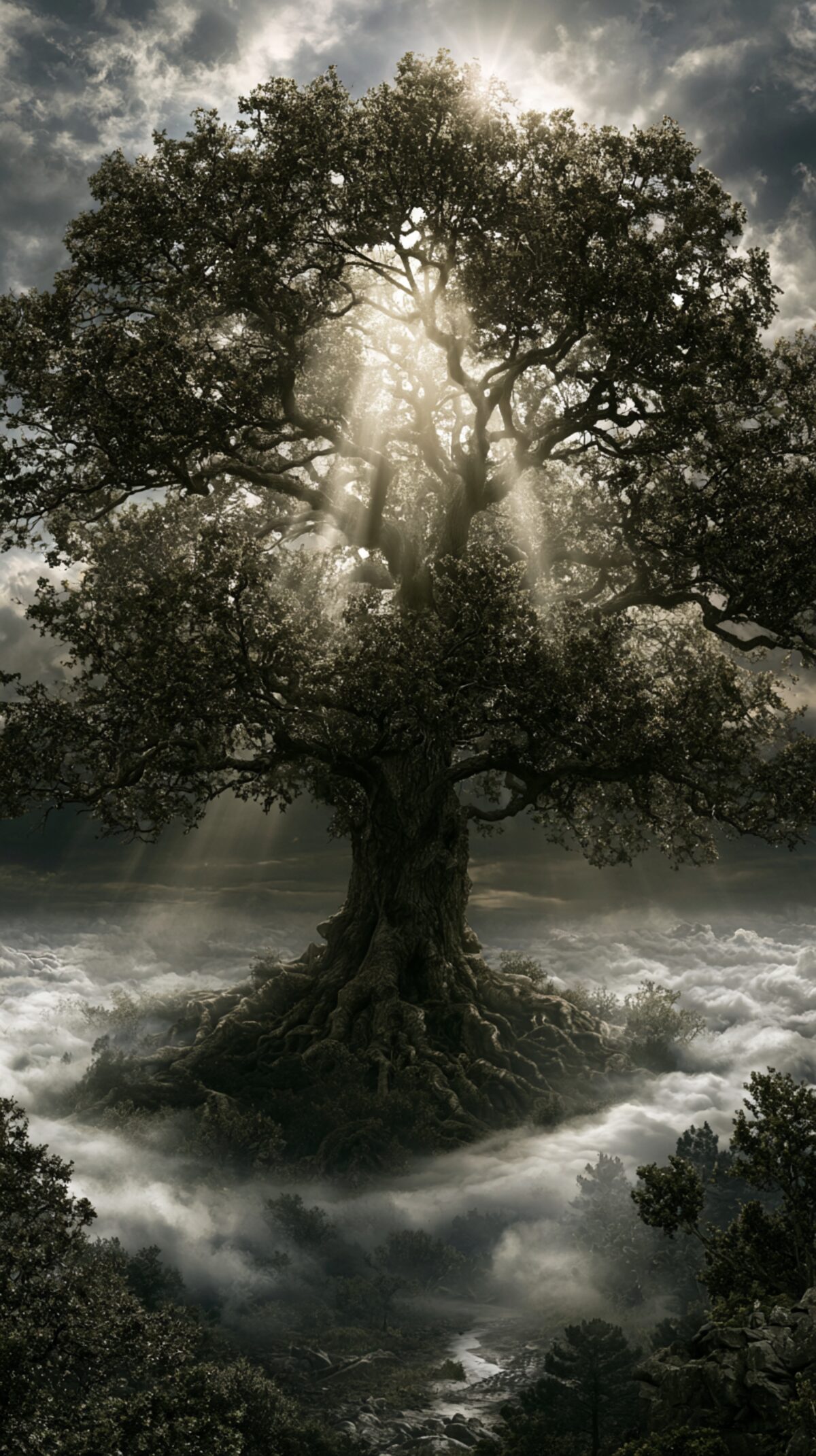
Long before churches were built of stone, the forest itself was the temple. Germanic and Norse peoples sought their gods not in buildings but in groves, at springs and beneath mighty trees. This article gets to the root of the sacred tree: the ash Yggdrasil, Boniface's Thor's Oak, the Saxon Irminsul, the tree of Uppsala – and what we can honestly know versus what later ages added.
To picture Germanic religion as a network of temples is to think too Roman. The ancient observers agreed that the Germanic peoples specifically did not shut their gods away in buildings. Tacitus writes in the Germania (chapter 9) that they consider it incompatible with the grandeur of the heavenly ones to confine gods within walls or to model them in any human likeness. Instead they consecrated groves and woods, and gave the name of a deity to that hidden power which they perceived only in reverent awe.
"For the rest, they judge it incompatible with the majesty of the heavenly ones to shut the gods within walls, or to fashion them in any human likeness. They consecrate woods and groves, and with the names of gods they call that mystery which they behold in reverence alone."Tacitus, Germania 9 (paraphrased translation)
The Roman term for this was lucus or nemus – the sacred grove, an enclosed, awe-inspiring place in the landscape. Such groves were not mere backdrops but the actual cult space: people sacrificed there, gathered, held court. The tree, the clearing, the spring at its centre carried the holiness – not a roof over a statue.
The most striking image of a sacred grove comes from Tacitus in Germania 39. He describes the grove of the Semnones, the oldest and noblest of the Suebian tribes. At fixed times, envoys from all the kindred peoples gathered there and performed a rite that opened with a human sacrifice. The grove was so holy that no one might enter it except bound with a fetter – a sign of submission to the higher power. Anyone who fell was not allowed to rise and stand, but had to roll himself out along the ground.
This rule of fettering is more than a curiosity. It shows that the sacred place had its own order, one that made the human being smaller. Tacitus implies that here the origin of the whole people was venerated and that a god was conceived of as "ruler over all" (regnator omnium deus). Whether a single sky god was meant remains open – the Latin phrase is a Roman interpretation, not a Germanic self-testimony. What is certain is only this: the wood itself was the altar.
From the individual cult grove a line runs to the greatest tree of all – the world ash Yggdrasil, which in Norse tradition bears the nine worlds. In the Völuspá and in Snorri's Edda it is the axis of the cosmos: at its roots lie the wells of wisdom and fate, in its crown dwell an eagle and a squirrel, and from it Odin hangs nine nights to win the runes. Anyone who wishes to understand the sacred trees of earth finds in Yggdrasil their heavenly mirror. We have devoted a separate, detailed article to the world tree, unfolding its inhabitants, roots and interpretations.
One often-overlooked detail matters here: the sources call Yggdrasil askr, that is, an ash. The popular image of an all-embracing yew or an indefinable "world tree" is a later simplification. The Völuspá says expressly that the ash Yggdrasil stands high and holy, sprinkled with white loam. In the text, then, the sacred tree of the North is named botanically – a small point that says a great deal about dealing honestly with the sources.
No sacred tree is as well attested as the oak that the Anglo-Saxon missionary Boniface had felled near Geismar in Hesse around the year 723. It was dedicated to the thunder god – the source calls it the "Oak of Jupiter", meaning the Germanic Donar (Thunor/Thor), whom the Romans equated with Jupiter. Boniface's pupil Willibald reports in the Vita Bonifatii that the saint took up the axe while the heathens cursed and awaited the wrath of their god. When the mighty tree fell under a few strokes and burst into four pieces, without any lightning striking down, many saw in it a proof of the powerlessness of the old cult.
"When, in the strength of his steadfastness, he had cut down the tree, there stood a vast oak of enormous size, which in the old tongue was called the Oak of the thunder god."after Willibald, Vita Bonifatii (paraphrased translation)
From the wood, tradition says, Boniface had a chapel built for Saint Peter. The scene is so effective because it sets two worldviews against each other: the living, venerated tree and the Christian house of prayer timbered from it. That a single tree could be considered so important that its fall served as an argument for conversion shows what rank the sacred tree held in Germanic belief.
Another tree sanctuary fell a good half-century later. In 772 Charlemagne destroyed the Irminsul during the Saxon Wars, a central sanctuary of the Saxons. The monk Rudolf of Fulda describes it as an upright tree trunk or a wooden pillar, venerated in the open air, which they called in their language Irminsul – interpreted as "the universal pillar that, as it were, upholds all things." With this, the Irminsul stands in line with the idea of a world-bearing axis, such as Yggdrasil also embodies.
Historically the Irminsul is graspable as a cult pillar and as a political target for Charlemagne: its destruction was a blow against the religious heart of Saxon resistance. On its precise appearance and location, however, the sources are largely silent. Everything beyond that is reconstruction. Anyone who wishes to read about the connecting threads and the famous later interpretation at the Externsteine will find a separate article from us – and there, too, the caution this subject demands.
The most famous description of a tree in the whole Middle Ages comes from the far North. Around 1075, Adam of Bremen depicts the sanctuary of Uppsala in Sweden in his history of the Hamburg church. Beside the temple, Adam says, stands a very great tree that is green in summer and winter alike, and no one knows of what kind it is. Nearby lies a spring into which offerings are sunk. From the branches of the surrounding trees hung the bodies of sacrificed men and animals.
Adam's report is at once the most important and the most problematic source. He wrote from a distance, with a declared missionary purpose, and wanted to paint heathendom in lurid colours. His numbers and details are to be taken with care. But what fits the pattern is the core: a holy, evergreen tree beside a sacrificial spring, surrounded by a cult wood. Exactly the same triad – tree, spring, grove – meets us right across the Germanic world.
Sacred trees were not only places of sacrifice but also of law. Assemblies and courts, the things, often took place beneath a prominent tree or within an enclosed area. The tree marked a place where a different, higher order applied: here the peace was kept, here law was spoken, here men bound themselves by oath. Scandinavian place names still preserve the memory of such consecrated sites, where cult and jurisdiction touched.
The idea that a tree makes a place special and legally binding held on for a long time in European culture – down to the village lindens under which, well into modern times, people still danced, met and gave judgment. How much of this goes back to Viking-Age roots and how much is later custom can rarely be cleanly separated in the individual case.
This brings us to one of the most beloved notions: the farmstead tree, Swedish vårdträd, Norwegian tuntre. It means a specially tended tree at the farm, held to embody luck, protection and the bond with the ancestors – often interpreted as a living echo of Yggdrasil. The image is beautiful and is readily sold as a direct continuation of Viking-Age belief.
Honestly viewed, however, the demonstrable farmstead-tree custom stems overwhelmingly from the modern folklore of the eighteenth and nineteenth centuries. For a continuous, clearly Viking-Age farmstead-tree ritual, the early sources are lacking. The thought that a tree at the homestead is special may be old – but the concrete practice, as modern descriptions paint it, is reconstruction and romantic elaboration. That does not make it worthless, but it should not be passed off as secured Viking heritage.
Lay the testimonies side by side and a pattern emerges that runs through centuries and across wide regions. In the Semnones' grove, at the tree of Uppsala, at Yggdrasil's roots – again and again three elements combine: a prominent tree, a spring or body of water, and an enclosed area in which sacrifice took place. This triad is no coincidence. It shows that the sacred place was built around a shared sensibility: the tree as a living link between earth and sky, the water as a threshold to the underworld, the grove as the boundary between the everyday and the holy.
The manner of sacrifice fits the picture too. At Uppsala the offerings hung in the branches; in the bogs, weapons and treasures were sunk in the water. The tree was recipient and mediator at once. That trees in particular – unlike perishable timber buildings – grew across generations made them the natural symbol of endurance, ancestry and fate. A tree outlived the person who sacrificed beneath it; it joined the living with those who had stood there before them.
Veneration of the tree was no otherworldly cult but rooted in daily life. The ash, Yggdrasil's species, supplied the toughest and most elastic timber of the North – from it were made spear shafts, so that the Old Norse word askr could mean both ash and spear. The sacred tree and the warrior's weapon bore the same name. The creation story picks this up as well: the first man is called Askr, "ash", shaped from driftwood on the shore. Man himself, in the Norse imagination, comes from the tree.
Wood was the material par excellence – for ships, halls, tools and carving. Whoever worked daily with oak, ash and yew knew their quirks, their age, their strength. Out of that familiarity grew reverence. The sacred tree was not the opposite of the useful tree but its heightening: the same substance that gave boats and spears bore, in its mightiest form, the world.
The sacred tree is an image that carries across the centuries, precisely because it is so simple: a living being that grows older than a human life, that drives roots into the depths and branches into the sky, and so joins above and below. Whether as the world ash Yggdrasil, as Thor's Oak, as the Irminsul or as the evergreen tree of Uppsala – always the same thought is at work: that the holy does not dwell in walls but in living nature.
That is exactly why the honest look is worthwhile. You need to invent nothing to find the sacred groves fascinating. The sources themselves – Tacitus, Willibald, Adam – tell it forcefully enough. And whoever wears or gives a Norse tree motif carries with it no esoteric horoscope, but the memory of a world in which the forest itself was the temple.
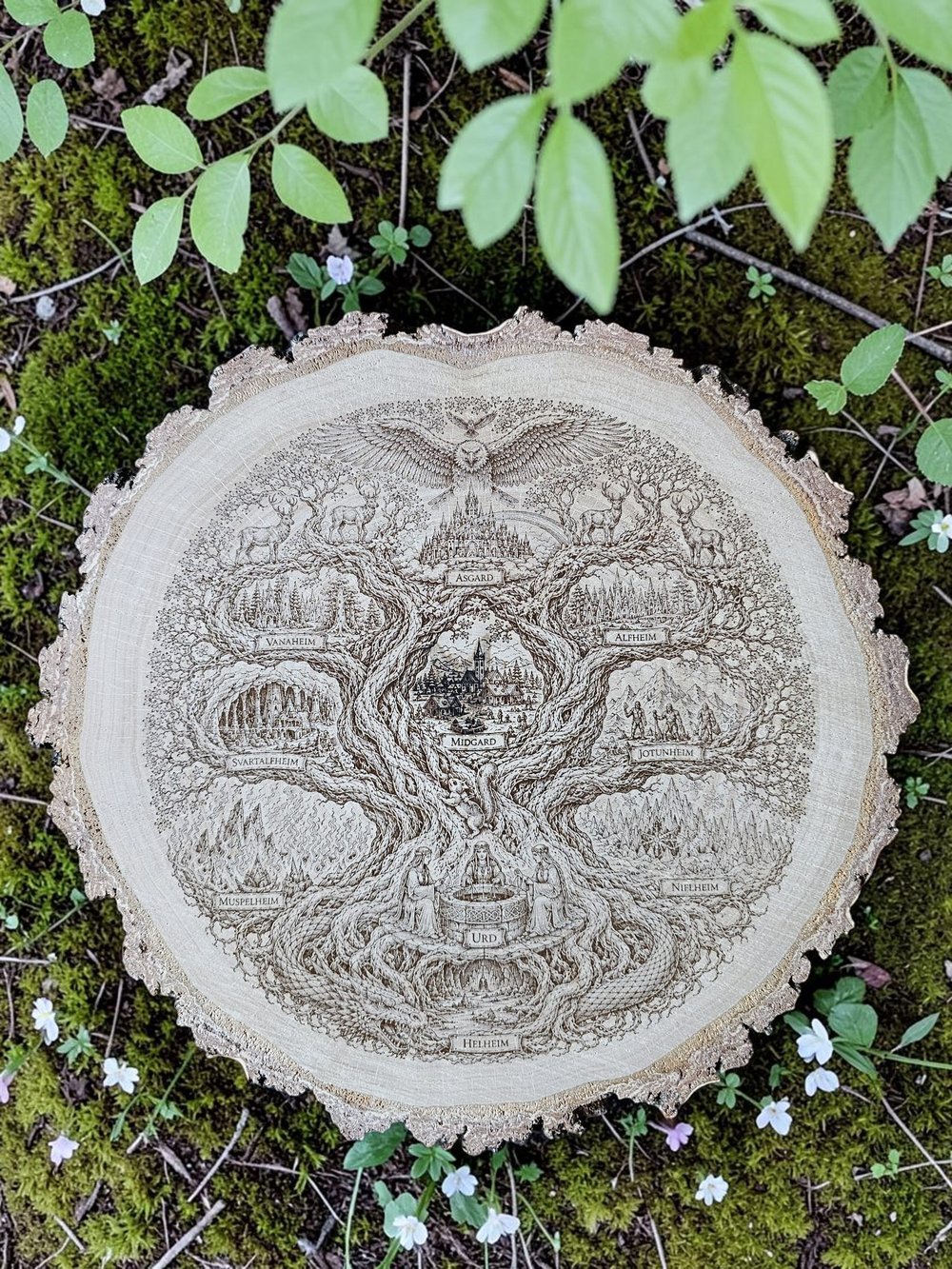
Sacred Places of the North · Yggdrasil – the world tree · The Irminsul · The Externsteine – an invented cult site? · The Donar oak & Boniface.
All Festivals & Belief articles →
In the North a mountain is rarely just a mountain. In the sagas the dead live inside it, giants dwell in its clefts …
Read more →Where water rises from the earth, the familiar world ends and another begins. To the people of the Germanic and Norse …
Read more →There are cosier Christmas figures than a house-sized cat that prowls through the winter night to check who did not …
Read more →