Where water rises from the earth, the familiar world ends and another begins. To the people of the Germanic and Norse world, springs, wells and lakes were thresholds to the otherworld – places where you gave something to the powers below the surface and hoped for something in return. What is actually attested, what is myth, and what is modern invention – we look at it honestly.
For us, you turn on the tap. For the people of the Iron Age and the Viking Age, a spring was something else entirely: a place where something emerged from the hidden. Water welling up from the ground with no rain to explain it seemed alive and mysterious at once. Such places lay on the border – between above and below, between the living and whatever dwells beneath.
This experience of the threshold explains why springs, bogs, lakes and, later, dug wells became cult sites across northern Europe again and again. People did not go there to fetch water but to give something into it: jewellery, weapons, coins, food, sometimes animals. The water was not a symbol but a real address. Whoever gave into it gave to a power they could not see, yet whose nearness they felt.
There is also a very practical quality to water: what falls in is gone. You cannot give a gift halfway and then take it back – the water takes it for good. This irreversibility is what makes the offering serious in the first place. A ring lowered into a bog no longer belongs to people from that moment on. Perhaps it also mattered that still water throws back one's own image: whoever bends over a dark spring sees themselves, and behind them the depth. Threshold, mirror and final surrender – three reasons why water of all things became a sacred place.
In the Norse worldview, the water beneath the earth is not mere scenery but the core of the whole order. The world ash Yggdrasil stands above three wells, and from them comes what holds the world together: wisdom, fate, the water of all rivers. We have devoted a full, detailed article to this web – "The Three Wells" – so here the overview will do.
There is the Well of Urd (Urðarbrunnr), where the Norns dwell and the gods ride to judgement each day. There is Mimir's Well (Mímisbrunnr), in which wisdom lies hidden. And there is Hvergelmir, the seething cauldron in the cold north from which, according to Snorri Sturluson, all rivers spring. Three waters, three roots, three meanings – fate, knowledge, origin. The North consistently imagined its greatest powers as springs.
No image makes the matter clearer than Odin's bargain at Mimir's Well. In the Völuspá and in Snorri's Gylfaginning it is told that the god leaves his eye in the well to receive in return a drink from the water of wisdom. The highest of the gods pays a lasting price – an eye for insight – and the counter is a well.
You need not take this story literally to see its heart: water from the deep gives nothing for free. Whoever wants something must give something. The same logic – gift for counter-gift, a pledge in the water – reappears centuries earlier in the sediments of real springs and bogs. The myth tells what the finds show.
Archaeology recovered the well and water cult not from texts but from the mud. Again and again, springs, wells and former lakes yield objects that did not end up there by accident: carefully deposited brooches and pendants, whole sets of weapons, tools, animal bones and – above all in Roman-influenced regions – coins. The quantity and arrangement often rule out "simply lost".
Coin deposition in particular is tangible across Europe: people threw money into the water, literally. From this ancient gesture eventually came the harmless wishing-well coin we still toss into any fountain, without knowing its origin. What looks like superstition is the last echo of a very seriously meant sacrificial custom.
The mightiest form of water offering was not single coins but whole sets of army equipment. In Danish bogs and former lakes – Nydam, Illerup Ådal, Ejsbøl – the weapons and gear of defeated armies came to light, often deliberately made useless: swords bent, shields shattered, everything sunk in the water. The victor gave the booty to the water rather than keeping it.
These weapon bogs belong overwhelmingly to the pre-Roman and Roman Iron Age, that is, centuries before the Viking Age. They show the same basic pattern as the little coin in the well, only raised to the monumental: water is the recipient to whom the most precious thing is entrusted. For our theme they are proof of how deep and how old the idea runs that standing water is an address – and, at the same time, a reminder not to muddle the eras.
An example from the Viking Age itself comes from the Danish ring fortress of Trelleborg. Excavations uncovered a well containing, alongside tools and everyday objects, jewellery and the remains of animals – and the bones of several small children. Such deposits cannot be explained as refuse. They point to deliberate placement, probably with a ritual background, at the transition from pagan to Christian times.
Restraint matters here: exactly what happened at the Trelleborg well, and whether and in what form people were sacrificed, cannot be fully clarified from the find alone. What is certain is that a well here was far more than a water source – it was a place where people entrusted something to the powers beneath the fortress.
How alive a spring sanctuary could be is shown most vividly by the Celtic–Gallo-Roman comparison. At the source of the Seine near Dijon lay the sanctuary of the goddess Sequana, the "Fontes Sequanae". Hundreds of votive offerings were found there: coins and bronze figures, but above all a unique hoard of wooden votives – carved images of body parts, whole people, limbs, heads.
These wooden votives are usually interpreted as offerings by people who came to the spring with an ailment and laid down an image of the affected body part – hoping for the goddess's help. So the place was linked to healing. But caution: what is attested is the religious plea, the ritual, the gift. Whether the spring water itself ever made anyone well is another matter entirely – more on that below.
You need not travel to Scandinavia or the Seine for the spring cult. On our own doorstep, in the Eifel, it becomes tangible. At Nettersheim, the "Grüner Pütz" is the spring where the Roman Eifel aqueduct once began, carrying drinking water to Cologne over some hundred kilometres. The Romans framed the spring carefully in a stone spring-house – water from the ground was a value they honoured in stone too.
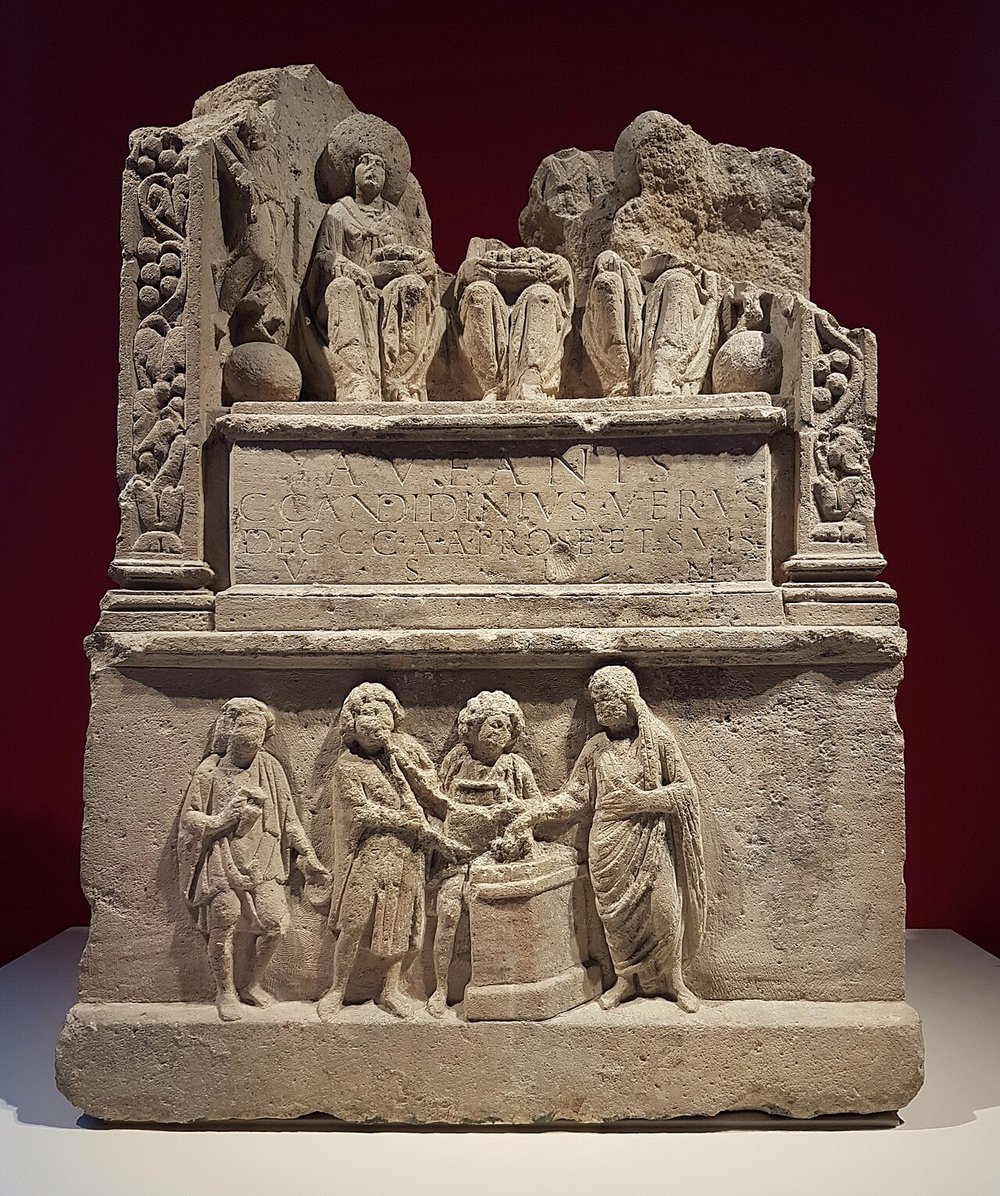
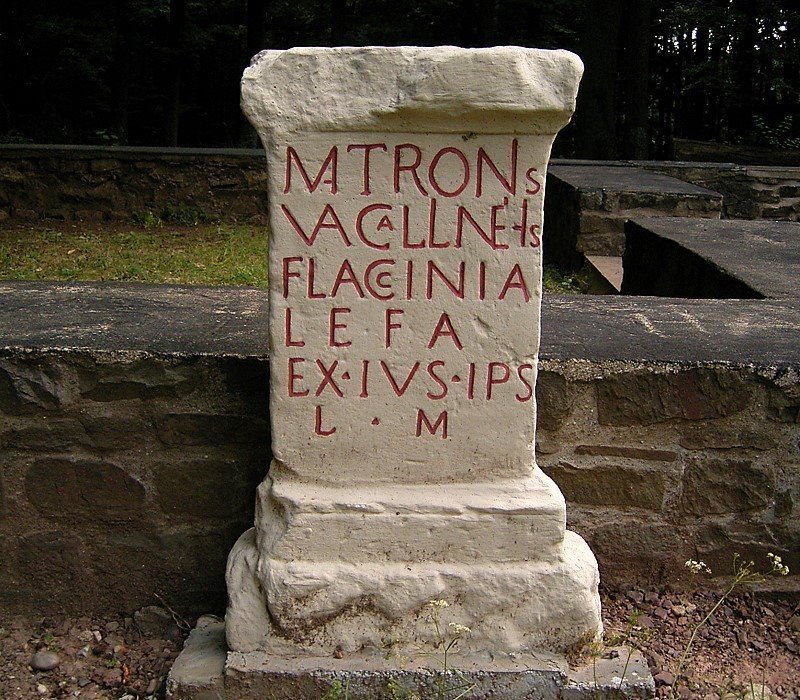
Only a few steps away, on the Görresburg near Nettersheim, lay a sanctuary of the Matronae. In the Eifel and the Rhineland everything that makes up this deep-dive is condensed into a small space: captured springs, a water sanctuary, revered mother goddesses. Anyone walking the countryside around Nettersheim today walks through one of the densest cult landscapes of north-western Europe.
The Matronae are Rhenish mother goddesses, mostly shown as three, often with baskets of fruit – the Aufaniae at Bonn, further sanctuaries at Pesch and, indeed, Nettersheim. Their votive stones date from Roman times, but their names are Germanic-Celtic: here local people honoured their own goddesses in Roman stone form. They stood for fertility, protection and the thriving of kin and land.
On the North Sea coast, at the mouth of the Scheldt, the goddess Nehalennia joins them. At Domburg and Colijnsplaat hundreds of votive altars for her came to light – dedicated by merchants and seafarers who hoped for a safe crossing and good business. She is shown with a dog, a cornucopia and often with a ship. From Rhineland to coast, the same pattern appears: where water carries life and trade, goddesses dwell whom people thank and endow.
The most famous ancient account of a Germanic water ritual comes from the Roman Tacitus. In the "Germania" he describes the cult of the goddess Nerthus, who dwells on an island in a sacred grove and is drawn through the land in a veiled wagon. In the end the sanctuary is washed in a secluded lake – and those who assist vanish forever.
The chariot, the vestments, and, if you care to believe it, the deity herself are bathed in a secluded lake. This service is performed by slaves, whom the same lake at once swallows up.Tacitus, Germania 40 (public-domain translation)
Tacitus must be read with caution – he writes from Roman distance about foreign peoples and likes to season with the lurid. Yet the core fits the wider picture: a sacred water, a ritual washing, and a lake to which life is given. The water is not a stage but a recipient.
The old spring sites did not vanish with Christianity – they changed their names. The water of a goddess or a spirit became the "holy well" of a saint. All across north-western Europe there are such well-saints and "holy wells" where people continued to wash the sick, tie cloths to trees and lay down small gifts – now within a Christian frame.
Churchmen repeatedly railed against the veneration of springs, stones and trees; those very lists of prohibitions are valuable testimony to us that the custom lived stubbornly on. Christianisation overwrote the spring cult; it did not erase it. Many a pilgrimage well is the last, baptised descendant of an ancient holy water.
The longest survivor, of all things, is the smallest gesture. Anyone who today tosses a coin into a fountain and makes a wish repeats – without knowing it – the ancient bargain: a gift to the water, a plea to the counterpart. The seriousness has faded, the form has remained. That is exactly the charm of this story: it is not closed off but echoes on in a harmless everyday custom.
The cloth on the tree beside a holy well, the candle at the spring, the stone laid down – these too are late relatives of the votives of Nettersheim and the Seine. You need believe in none of it to recognise the chain that runs from the bronze figure of Sequana to the two-cent coin in a shopping centre. To this day, people meet the hidden with a gift.
Here we separate things cleanly, as is our way. First: the term "healing spring", or even "energy spring", is in its present form largely modern esotericism. What is attested is that people asked for healing at springs and brought gifts – not that the water had a measurable healing effect. The cult is historical; the "power of the water" is belief, not evidence. Whoever honestly separates the one from the other honours the past more than whoever turns it into a wellness legend.
Second: the spectacular human sacrifices in water mostly do not belong to the Viking Age. The famous bog bodies of northern Europe overwhelmingly date to the pre-Roman Iron Age, long before the Vikings. The Trelleborg well is a special case at the transition to Christianity and remains open in its interpretation. Whoever names "Vikings" and "human sacrifice in the lake" in one breath is confusing eras.
From Mimir's Well to the Grüner Pütz runs a single thread: where water rose from the earth, the familiar world ended for people. They gave there what was precious to them, and they believed in a counterpart that listens. This belief raised altars to goddesses such as Sequana, the Matronae and Nehalennia, filled wells and made lakes into recipients – and it lives on, baptised, at many a holy well to this day.
We do not need to invent the power of water to take it seriously. It is enough to see honestly what was: a world that met the hidden with a gift, and places on the threshold where this world and the otherworld touched for a moment.
Sacred Places of the North · The three wells · The Matronae · Nehalennia.
All Festivals & Belief articles →
There are cosier Christmas figures than a house-sized cat that prowls through the winter night to check who did not …
Read more →