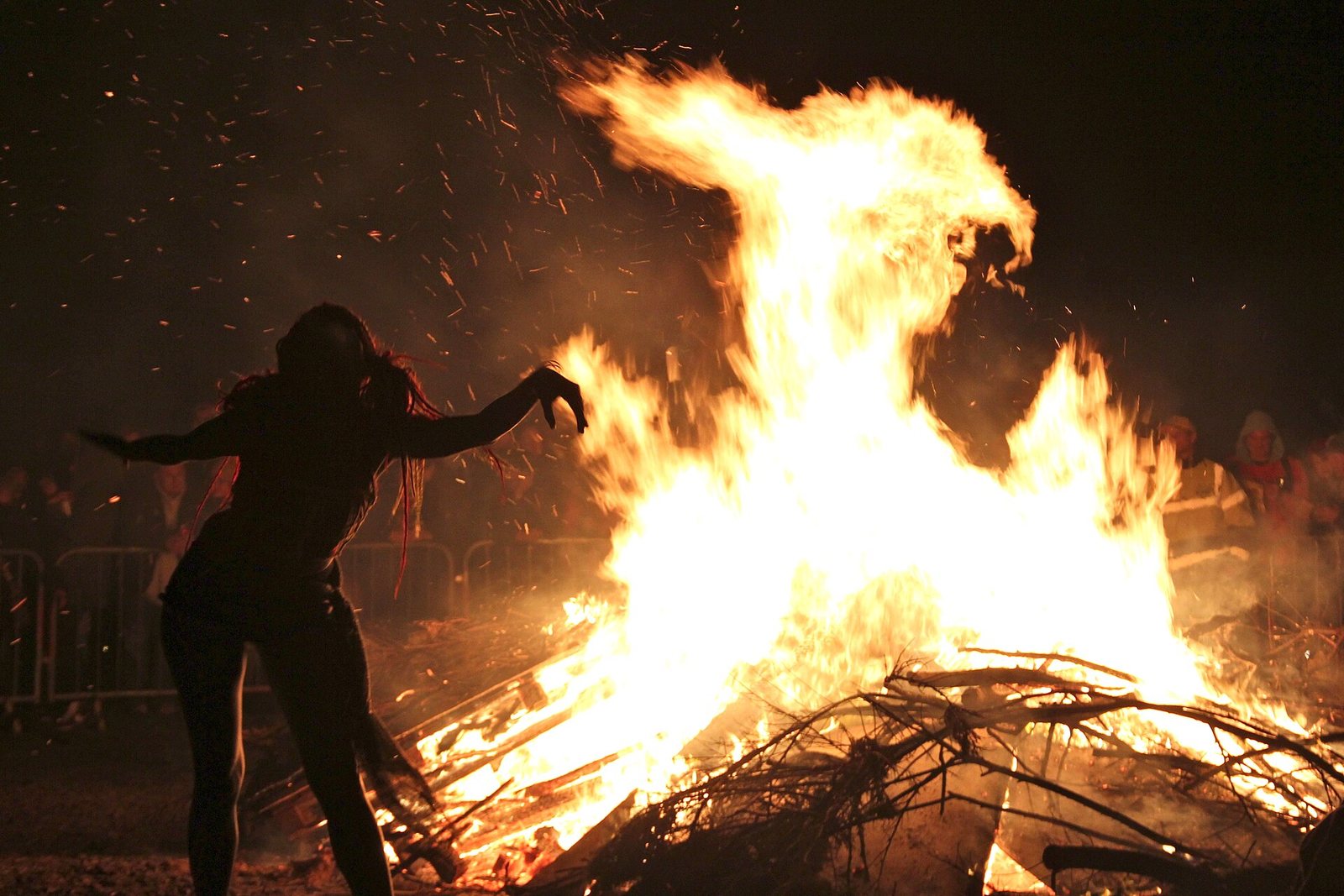
The Celts divided the year above all into a summer and a winter half – and marked the transitions with four great festivals, the so-called fire festivals. Unlike among the Greeks or Romans, the solstices were not at the centre, but the points in between: the beginning of the seasons from a farming viewpoint.
Samhain (early November) was the most important festival: the beginning of winter, the turn of the year and a festival of the dead, when the boundary to the Otherworld grew thin. From it, via All Saints, developed our Halloween.
Imbolc (early February) marked the end of deep winter, when the ewes began to lamb. It was dedicated to the goddess Brigid – a festival of purification, fire and hope, which later passed into Saint Brigid's day.
Beltane (early May) opened the summer half. Cattle were driven between two fires to protect and bless them. The name sounds of the light god Belenus.
Lughnasadh (early August) was the harvest and assembly festival, named after the god Lugh, who is said to have dedicated it to his foster-mother Tailtiu: market, contests and thanks for the grain.
"Wits must he have who wanders wide, but all is easy at home."Hávamál 5, after Henry A. Bellows 1923 (public domain)
The Celts divided the year by four great festivals that accompanied the farming rhythm of sowing, pasture and harvest. They marked the transitions between the seasons and were at the same time religious highlights – the four Celtic fire festivals.
Samhain (1 November) was the most important festival: the beginning of the dark half of the year, at which the boundary to the otherworld was regarded as permeable – a forerunner of Halloween. Imbolc (1 February) celebrated the first light of spring and the goddess Brigid.
Beltane (1 May) welcomed summer with great fires, through which cattle were driven to protect them. Lughnasadh (1 August) was the harvest festival in honour of the god Lugh – a time of markets, contests and the first grain.
All four festivals were closely bound to fire, fertility and community. They show a people that lived in harmony with the cycles of nature – and whose festivals still echo in folk customs today.
The four Celtic festivals are the honest core of the "Celtic year" – four thresholds, celebrated with fire. How this relates to the Germanic and modern year's cycle is shown on our large comparison page Wheel of the Year Festivals.
Samhain · Belenus · Brigid · Lugh · Celtic Religion.
All Festivals & Belief articles →
Before a Viking ship glided toward home, the crew took the carved dragon-heads down from the prow. Not out of modesty …
Read more →