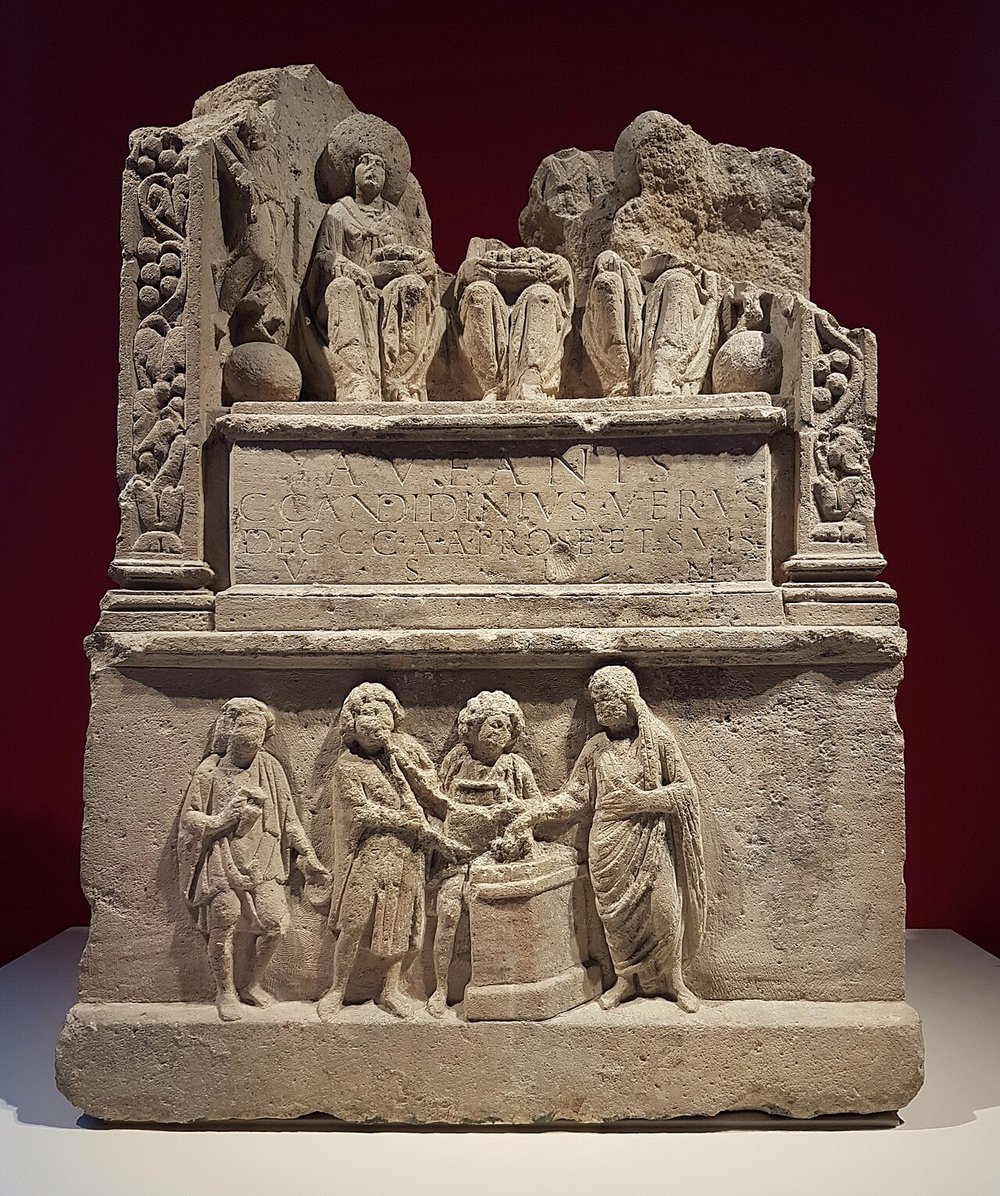
The Matronae were triple mother goddesses worshipped mainly in the Roman Rhineland from the late 1st to the 4th century AD, and we know them from more than a thousand votive stones carved with Latin inscriptions and local names. Sculptors showed them as three seated women, two of them wearing enormous round bonnets, and people thanked them for protection, health and success. Their heartland runs from Cologne and Bonn to the northern Eifel and the Jülich plain, a short drive from our workshop in Alsdorf near Aachen. This article covers what the stones really show, where the strange names come from, and how much truth there is in the link to the dísir and the Norns.
Ask people where to look for the old Germanic gods and they will point north: Iceland, Uppsala, the Eddas. Fair enough. But one of the richest bodies of evidence for pre-Christian religion in Europe lies right here in the Rhineland, a few miles from our workshop. Drive a quarter of an hour south-east from Alsdorf and you reach Eschweiler-Fronhoven, where altars to the Matronae Amfratninae came out of the ground. Keep going and you pass Jülich, Zülpich, Lechenich and Rödingen, all find spots of Matronae stones. Beyond Zülpich the hills of the northern Eifel begin, with the great sanctuaries at Pesch and Nettersheim.
The Matronae have no myths. Nobody wrote down their stories. There is no Eddic poem about them, no saga, no hero who met them in a forest. What we have instead is stone, and in a way that is more honest. Hundreds of people in the Roman Rhineland paid a stonemason to carve an altar because they believed three mothers had helped them. For us as engravers these stones have a special appeal: they are lettered stone, and after almost two thousand years many of the letters are still crisp enough to read.
The answer depends on how you count, and it is worth being upfront about that. Across the Roman Empire more than 1,100 inscriptions and monuments to the Matres and Matronae are known. A large share comes from the province of Lower Germany (Germania Inferior), the strip of land west of the Rhine between the North Sea and roughly Remagen. More than 800 Matronae stones have been found there alone. Recent surveys of all dedications from Lower Germany count around 1,600 dedications to deities in total, and slightly more than half of them go to the Matronae. In this province, the mothers outnumber Jupiter, Mercury and Mars.
The cult runs from the late 1st century to the 4th. The earliest dated dedications come from the Andernach area and the Brohl valley, set up by soldiers under the emperor Domitian (81–96 AD). They have no by-names yet and are simply addressed to "their mothers" (matribus suis). The famous carved scenes of three women only start around 160 AD. The peak falls between about 150 and 250/260 AD, the quiet decades of the Roman Rhineland before the Frankish raids. After that new stones become rarer, but some sanctuaries carried on: the temple precinct at Pesch was still lavishly rebuilt in the 4th century.
Once you have seen three of these altars, you never forget the image. Three women sit side by side on a bench, facing you, often framed in a small niche shaped like a miniature temple. Baskets of fruit rest in their laps. The two outer women wear huge, almost circular bonnets that frame their heads like discs. The woman in the middle has her hair loose to the shoulders, sometimes held by a headband.
Those bonnets are not artistic fancy. They match the costume of married women seen on tombstones from the territory of the Ubii, the Germanic people settled around Cologne. Loose hair, by contrast, marked a young unmarried woman. Many scholars therefore read the trio as stages of life: a girl in the middle, flanked by mother and grandmother, or simply by two married women. Either way, the goddesses wore the clothes of the women who worshipped them. They looked like family.
The finest example of the type stands in the LVR-LandesMuseum in Bonn. It was dedicated by Quintus Vettius Severus, quaestor (a financial magistrate) of the Colonia Claudia Ara Agrippinensium, which is Roman Cologne. Because the inscription names the consuls Macrinus and Celsus, it can be dated precisely to 164 AD. The front shows the three women in their niche, while the sides are decorated with plants and sacrificial scenes.
The side panels of many altars repay a closer look. You see attendants leading pigs to sacrifice, bowls of fruit, incense boxes, trees and vines. On some stones snakes wind around a tree. The Austrian scholar Rudolf Simek cautiously links the snakes with the underworld or the dead, and the children and swaddling clothes on some reliefs with a role in childbirth and the care of infants. These are interpretations, but they fit the overall picture: goddesses of thriving, responsible for family, fields and offspring.
You often read that the Matronae were the goddesses of humble country folk. The stones tell a different story. Anyone who could afford a carved altar was not poor. Among the dedicators are strikingly many soldiers and officials: legionaries, sailors of the Roman Rhine fleet, and again and again beneficiarii, soldiers excused from ordinary duties and posted to administrative and policing jobs, for instance at road stations. Add to them city magistrates like Vettius Severus, well-off landowners and tenants, craftsmen and traders.
Their names are a story in themselves. Many dedicators carry the three-part names of Roman citizens; others bear local Celtic or Germanic names rendered in Latin. Often the father still has a native name while the son already has a Roman one. In these inscriptions you can watch Ubii turn into Rhineland Romans, without forgetting their mothers.
The inscriptions nearly always follow the same pattern: the goddesses' name in the dative, the name of the donor, then the closing formula V·S·L·M, short for votum solvit libens merito. Behind it lies the Roman logic of the vow. You ask for something and promise a gift if it is granted. When it works out, you pay up.
To the Aufanian Matronae. Quintus Vettius Severus, quaestor of the Colonia Claudia Ara Agrippinensium, fulfilled his vow willingly and deservedly, in the consulship of Macrinus and Celsus.Votive altar from Bonn, 164 AD, LVR-LandesMuseum Bonn (our own translation)
What exactly people asked for is almost never stated. Some donors dedicate "for themselves and their own", some "for the welfare of the emperor". The stones say nothing about safe births, good harvests or a son coming home from the frontier. Popular accounts often tell such stories as if they were carved on the altars. They are not; they are reasonable guesses.
The real treasure of the Matronae lies in their by-names. They are almost never just "the Matronae" but "the Matronae of …" or "the …ian Matronae". Several dozen such names are known. Some appear only once, others on dozens of stones. For linguists they are a gift: among the oldest written traces of the local languages on the Rhine, scratched in Latin letters centuries before the first Old High German texts.
Germanic names. A large group ends in -ehae or -ahenae (dative -ehis, -ahenis). This ending is regarded as a Germanic suffix corresponding to Gaulish -ik-. Examples include Vacallinehae, Austriahenae, Albiahenae and Rumanehae. Other names can be explained from Germanic roots. The Gabiae and Alagabiae probably belong with the verb "to give": "the givers" or "the all-giving ones". The Aufaniae are often connected with Gothic ufjō, "abundance", which would make them something like "the bountiful ones". That reading is not certain, but it is the most widely accepted. Linguists are especially excited by a few rare forms in -ims, such as Vatvims or Aflims, which are read as very early Germanic dative plural endings.
Places and peoples. Many by-names seem to refer to a place, a river or a community. The Albiahenae are linked to Elvenich near Zülpich, probably derived from a Roman Albiniacum. The Renahenae from Bonn carry the Rhine in their name. The Hamavehae belong to the Chamavi, the Hiannanefatae probably to the Cananefates of the Rhine delta. For the Vacallinehae, scholars think of a kin group or settlement called "Vacalli", and a link with the place name Wachendorf has also been suggested. Neither is certain.
Celtic and mixed names. Some by-names are Celtic. The Suleviae, for example, are attested in Gaul, Britain and even Rome. The Ambiomarcae from Remagen mix Celtic and Germanic elements, and the reading "those dwelling on both sides of the border" is a proposal, not a result. The frame is Latin throughout: the word matronae, the formulas, the script.
This three-language mix is the key to the whole cult. The Matronae are not a purely Germanic religion that the Romans happened to write down. They are a product of a frontier zone where Celtic, Germanic and Roman traditions flowed together. We look at how the Romans slotted foreign gods into their own system in our article on Interpretatio Romana. With the Matronae, though, something like the reverse happened: the native names survived, and only the form became Roman.
The Matronae Aufaniae are among the most frequently attested Matronae of all. Two cult centres are known, Bonn and Nettersheim. Single dedications to the Aufaniae have even turned up in Lyon and in southern Spain, probably left by people from the Rhineland who took their goddesses with them.
In Bonn the focus lies where the minster stands today. Excavations in this area produced well over a hundred stone monuments, many of them for the Aufaniae. The cult centre flourished in the decades around 200 AD. A number of stones were later reused in other buildings, which is lucky for archaeologists, because that is how they survived.
What came next is just as interesting. Beneath the crypt of Bonn Minster excavators found a cella memoriae from the second half of the 3rd century, a small memorial building for funeral meals at graves that were later venerated as martyrs' tombs. Around 400 a first church room was built there. The place where people had set up altars to the mothers became a place of Christian saint veneration. Whether this was a deliberate takeover is an open question. The continuity of the site is striking all the same.
If you want to see the Matronae outside a museum, head for the northern Eifel. Two sanctuaries there have been excavated and can be visited. A small correction to many accounts, including the earlier version of this article: the two sites belong to different Matronae.
The "Heidentempel" (heathen temple) at Pesch lies near Nöthen in the municipality of Bad Münstereifel. It was dedicated exclusively to the Matronae Vacallinehae, whose worship was largely confined to the land between Rhine and Meuse. The Bonn archaeologist Hans Lehner excavated the site between 1913 and 1918. The oldest stone buildings date to the 1st century. The complex included a Gallo-Roman ambulatory temple with an almost square cella, an open courtyard where donors set up their votive stones, a three-aisled assembly hall with benches, and a portico around 120 metres long that bounded the festival ground. Only fragments of votive stones were found; the altars on display today are replicas. In the 4th century the precinct was generously remodelled, and by the 5th century at the latest it ended in fire and destruction.
The Görresburg near Nettersheim sits on a spur of land between the Urft and the Schleifbach. Here people worshipped the Aufaniae. The temple precinct, with several tile-roofed stone buildings, was excavated in the early 20th century. Two donors are well known, and both fit the pattern. Marcus Pettronius Patroclus, a beneficiarius, dedicated an altar shaped like a small temple with the three seated women towards the end of the 2nd century. Another beneficiarius consularis, Marcus Aurelius Agrippinus, fulfilled his vow "for the welfare of the emperor". Officials at a road station praying to the local mothers for protection: that was religion in the Roman Rhineland. Replicas of the altars stand on site today.
One of the oddest finds came to light in 1958 in the Rhineland lignite mining district at Morken-Harff, now part of Bedburg. During quarrying, workers hit an embankment made largely of smashed votive stones. According to the specialist literature there were well over a thousand fragments belonging to several hundred monuments. Almost all were dedicated to the Matronae Austriahenae, who are attested nowhere else. Hans-Georg Kolbe published the find in the Bonner Jahrbücher in 1960.
Two lessons follow. First, some Matronae were intensely local, tied to a single cult site, and still had hundreds of worshippers there. Second, at some point these stones became nothing more than building material to someone.
Triple mother goddesses were not unique to the Rhine. The oldest dedications to Matres come from southern Gaul in the mid-1st century. A little later they appear in northern Italy, usually without by-names. Smaller groups are known from Spain and Portugal, such as the Matres Gallaicae, the "Galician Mothers", and from Britain. The image type probably reached the Rhineland through the Celtic-Roman world, and the Germanic peoples of the region, above all the Ubii, took it up and filled it with names of their own.
That sounds drier than it is. Borrowing a form does not mean importing the belief. More likely, older local ideas of protective female powers found a new Roman way of expressing themselves: the inscribed stone altar. Something similar can be seen with the goddess Nehalennia at the mouth of the Scheldt, whose altars are stylistically close to the Matronae stones. For the Celtic background, our piece on Celtic religion is a good next step.
It also matters who spread the cult. Germanic soldiers in Roman service carried their mothers to other corners of the empire, which explains why Rhineland by-names turn up in Lyon or Spain. The Matronae were at once deeply local, bound to a village, a stream or a kin group, and mobile whenever their worshippers moved on.
This brings us to traces that may reach beyond the Roman period. The most important comes from England. The Anglo-Saxon scholar Bede describes the old calendar of his people in De temporum ratione ("The Reckoning of Time", 725). According to him the year began on 25 December, and the night before it had a name of its own:
Et ipsam noctem nunc nobis sacrosanctam, tunc gentili vocabulo Modranicht, id est matrum noctem appellabant. (And that very night, now most holy to us, they then called by the heathen name Modranecht, that is, the night of the mothers.)Bede, De temporum ratione, ch. 15 (725); our own translation
Bede writes "of the mothers", plural. He does not say what the Anglo-Saxons did that night. But much suggests that a related idea of collective mothers is showing through here, some four hundred years after the last Rhineland Matronae stones and on the far side of the North Sea. Rudolf Simek sees Modranecht as a link between the West Germanic Matronae cult and the Scandinavian dísablót. The scholar Philip A. Shaw has pointed out that the Rhineland inscriptions indirectly support Bede: collective mother goddesses among Germanic-speaking peoples were real.
How Mothers' Night later merged with the Twelve Nights and the turn of the year is the subject of our article on the Rauhnächte and Mother's Night.
Since the 19th century scholars have compared the Matronae with other female collectives, above all the dísir and the Norns.
The dísir. In Old Norse tradition the dísir are female guardian spirits closely tied to kin and family. Sweden had a dísablót, a sacrificial feast for them, and Uppsala a market called the Disting. The comparison is obvious: female collectives watching over a family or community and receiving a feast. We cover them in depth in our article on the dísir. A related idea is that of fylgja and hamingja, the following spirit and the luck of the kin.
The idisi. In the first of the Merseburg Charms, written down in the 10th century, idisi settle "here and there" and hold back an enemy army. The word is probably related to Old Norse dís. Again we have women acting as a group. Equating them with the Matronae is still a guess, not a finding.
The Norns. Urd, Verdandi and Skuld of the Völuspá are the best-known female trio of the North. The comparison with the Matronae rests mainly on the number three and on a shared closeness to birth and fate. Be careful, though. The Norns are not fixed at three everywhere in the sources; elsewhere in the Eddas there are many Norns. And between the Rhineland altars of the 2nd century and the Icelandic manuscripts of the 13th lie a thousand years, two changes of religion and several hundred miles of sea.
Our view is simple. The connection is a respectable scholarly hypothesis, not a certainty. Anyone who wants to honour the Matronae does not need the Norns to justify it. The stones speak for themselves.
The Matronae cult did not end overnight. From the later 3rd century onwards new stones become rarer. The crises of the empire, Frankish raids and economic decline made expensive dedications harder to afford. At the same time Christianity spread, especially in the towns. In Bonn, as we saw, people were already praying at graves in the 3rd century, graves from which the minster later grew. In the countryside the sanctuaries held on longer, and Pesch was still being rebuilt in the 4th century. In the 5th century the traces vanish.
Whether anything lived on afterwards is one of the most tempting and least certain questions in Rhineland religious history. In the western Rhineland there are legends of "Juffern", mysterious maidens who appear at particular spots. Some folklorists see them as a distant echo of the Matronae. Similar claims are made for cults of "three holy maidens" in southern Germany and Tyrol. A direct line cannot be proven. It is just as possible that people in different centuries came up independently with the image of three helping women. How such ideas might live on in figures like Frau Holle is likewise a matter of tracing hints rather than proof.
What certainly remained are the stones themselves. They were built into walls, buried, dumped into embankments, and that is exactly why they survived. Today you can see them at the LVR-LandesMuseum Bonn, the Römisch-Germanisches Museum in Cologne and at the reconstructed sites at Pesch and Nettersheim. A name in stone is a request that does not want to be forgotten.
For our workshop in Alsdorf the Matronae are more than a chapter of religious history. They are local history. The people who set up these stones lived on the same loess soil, by the same streams, under the same grey Rhineland sky as we do. They had their thanks cut into stone; we laser ours into slate.
Who were the Matronae? The Matronae were mother goddesses worshipped mainly in the Roman Rhineland from the late 1st to the 4th century AD. They usually appear as three seated women and carry by-names written in Latin but often Germanic or Celtic in origin.
How many Matronae stones have been found? More than 1,100 inscriptions and monuments to the Matres and Matronae are known in total. Over 800 Matronae stones come from the province of Lower Germany alone, most of them from the southern Rhineland.
Where can I see Matronae altars? The most important pieces are in the LVR-LandesMuseum Bonn, with more in the Römisch-Germanisches Museum in Cologne. In the Eifel you can visit the sanctuaries at Pesch near Bad Münstereifel and the Görresburg near Nettersheim, both with replica altars.
Why do the Matronae wear big bonnets? The large round bonnets match the dress of married women among the Ubii. The central figure with loose hair is usually read as a young unmarried woman.
Were the Matronae Germanic or Celtic? Both, and Roman too. The image type probably came from the Gallo-Roman world, many by-names are Germanic, some Celtic, and the inscriptions are in Latin.
Are the Matronae related to the Norns? That is a popular hypothesis based on the number three and a shared link to birth and fate. A direct, continuous connection has not been proven.
For courage. For remembrance. For legends that live on.
Nerthus – the earth goddess · Interpretatio Romana · How the Germanic peoples honoured their dead · The grove of the Semnones · The Germanic feasts.
All Festivals & Belief articles →
Between the years lies a time that ticks differently: the Rauhnächte, the Twelve Nights around the winter solstice. The …
Read more →Emperor Barbarossa sits in the Kyffhäuser, his head propped on the table, his beard grown through the stone slab …
Read more →The summer solstice is the longest day of the year – and was one of the great feasts of pagan Europe. Germanic peoples …
Read more →The Vikings had no capitals, but they had places of power: sites where law was spoken, sacrifice made and the ancestors …
Read more →