The dísir (singular dís) are female supernatural powers in Old Norse tradition, bound to a family, a farm or a single person: they help at childbirth, protect in danger, announce death – and can kill. People honoured them at the dísablót, a sacrificial feast mentioned in several sagas, and their name survives to this day in the Disting, the old winter market of Uppsala. Here is what the sources actually say, where the dísir blur into valkyries, norns and fylgjur, and how far the popular equation with the idisi of the Merseburg Charm really holds.
A farm in East Iceland, autumn, the Winter Nights have begun. Inside, guests sit at the feast; outside, the weather is foul. A seer has given a warning: tonight nobody opens the door, whoever knocks. Then someone knocks. Once, twice, three times. Young Þiðrandi, eighteen years old and too proud to leave guests standing in the cold, takes his sword and steps out. From the north ride nine women dressed in black, swords drawn. From the south come nine in bright clothes on white horses. The black riders are faster. By morning Þiðrandi is dead.
The women in this story are dísir. They are among the most elusive figures in Norse tradition: almost never described, often named in half a line of verse, yet present wherever the old texts deal with birth, battle, fate and death. Their trail runs through Eddic poems, Icelandic sagas, a Swedish market and a charm written down in Merseburg – and at every step we will tell you where the evidence ends and interpretation begins.
The Old Norse word dís (plural dísir, sometimes anglicised as "disir" or "dises") in poetry first of all simply means "woman", usually with a dignified ring to it: "lady", "mistress". Alongside that sits the narrower sense this article is about: female beings beyond the human world who stand over individual people or whole kindreds.
Where the word comes from is unclear. An older etymology, taken up by the Dutch scholar Jan de Vries, links dís to an Indo-European root meaning "to suckle, to nourish", which would make the dísir originally "the nourishing ones". Others compare Sanskrit dhiṣaṇā, a term for a divine woman. Both ideas are possible; neither is proven. Just as open is the relationship to the West Germanic words itis (Old High German), idis (Old Saxon) and ides (Old English), all meaning "woman, lady". Whether they are genuinely related to dís is disputed, because nobody has convincingly explained how the initial vowel would have disappeared in Norse.
The trail through personal names is easier to follow. Þórdís, Ásdís, Hjördís, Vigdís, Halldís, Freydís: the element -dís appears in a whole series of Old Norse women's names, and several of them are still in use in Scandinavia. Whether parents in the tenth century thought of guardian spirits when they chose them, or simply of "lady", we cannot know. If Norse names are your thing, have a look at our section on Nordic names.
The Poetic Edda, written down in the thirteenth century in the Codex Regius but containing older material, names the dísir in a handful of places. None of them explains who the dísir are. Each passage, however, shows a different face, so they are worth looking at one by one.
Midwives. In Sigrdrífumál, the awakened valkyrie teaches young Sigurd about different kinds of runes. Stanza 9 deals with the bjargrúnar, "help-runes" or "birth-runes", meant to aid a woman in labour:
Bjargrúnar skaltu kunna, ef þú bjarga vilt / ok leysa kind frá konum … / ok biðja þá dísir duga.Sigrdrífumál 9, excerpt; roughly: "Help-runes you must know if you would help, and loosen the child from the woman … and then ask the dísir for aid." (our own rendering)
Here the dísir are plainly benevolent. You call on them when life and death hang in the balance in the birthing room. For the full rune stanzas of this poem, see our bilingual Sigrdrífumál.
Angry powers. Grímnismál shows the opposite face. Odin, disguised as Grímnir, sits tormented between two fires in the hall of King Geirröðr and finally reveals himself. In stanza 53 he says: úfar ro dísir – "the dísir are hostile to you" or "the dísir are angry". Moments later Geirröðr stumbles and falls on his own sword. Here the dísir act like a verdict of fate.
Treacherous companions. In Reginsmál, the god Hnikarr – one of Odin's many names – gives Sigurd advice for battle. Stanza 24 warns: tálar dísir standa þér á tvær hliðar, "treacherous dísir stand on both sides of you", and they want to see you wounded. The man who stumbles in a fight faces not just enemies but unseen women waiting for his misfortune. The same poem, in stanza 11, also calls a giant's daughter dís úlfhuguð, "wolf-minded woman", which shows how elastic the word is.
Instigators. At the end of the heroic poems stands Hamðismál. The brothers Hamðir and Sörli have killed their half-brother Erpr on the road and realise too late that his help is exactly what they lack. In stanza 28 Sörli says in effect: the dísir drove us to it – hvöttumk at dísir. The blame is shifted outward, onto powers that want the house to fall.
Dead women. Perhaps the darkest passage appears in Atlamál (stanza 26 or 28, depending on the edition). Glaumvör, Gunnar's wife, tells of a dream: dead women came in the night, poorly dressed, wanting to take her husband away. Her reading: his dísir have lost their strength. Ancestral women, guardian spirits and messengers of death merge into one image. Gunnar rides to Atli anyway, and does not come back. How seriously such dreams were taken is the subject of our piece on dreams as omens.
Then there are passages where dís clearly means valkyrie. In the first Guðrúnarkviða (st. 19), according to Rudolf Simek's dictionary, valkyries are called Herjans dísir, "Odin's dísir". And in the first Helgi lay the valkyrie Sigrún is addressed as a "southern dís". The Edda, in other words, knows no neatly defined being called a dís – only a word that can carry protection, anger, battle and death.
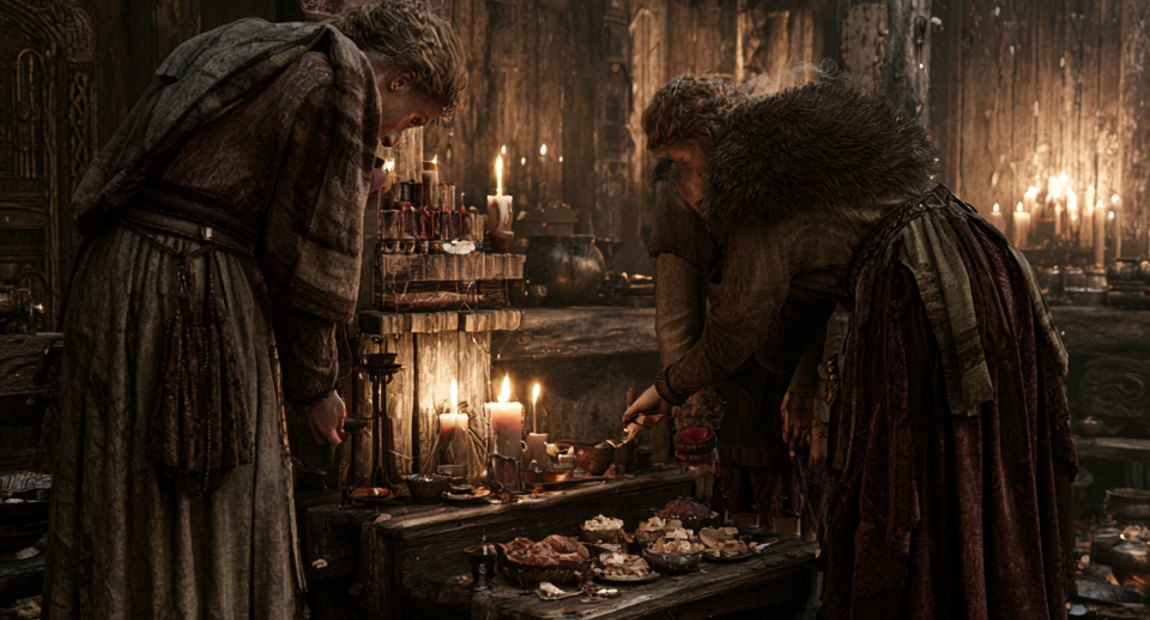
Unlike many beings of "lower mythology", the dísir had a cult with its own name: the dísablót, the "sacrifice to the dísir". Blót is the general Old Norse word for a sacrificial rite with a feast (see our overview of Germanic festivals). No text describes how a dísablót was conducted. We know it from asides in stories about something else entirely. That actually makes these asides more trustworthy: nobody was trying to invent a ritual; it is simply the backdrop.
Víga-Glúms saga, chapter 6. The young Icelander Glúmr visits his grandfather Vigfúss at Voss in western Norway. The saga says that at the Winter Nights a feast was prepared and a dísablót held, and everyone was expected to take part. Glúmr sulks in bed at first, until a berserk threatens the guests and he proves himself a hero. What matters for us is the setting: an autumn feast on a great farm at the start of winter, with guests from outside.
Egils saga, chapter 44. Egill Skallagrímsson also stumbles into a dísablót, and a dangerous one. On the island of Atley in Norway, the king's steward Bárðr hosts a feast for King Eiríkr Bloodaxe and Queen Gunnhildr: ok skyldi þar vera dísablót, "and there was to be a dísablót", with the finest food and heavy drinking in the hall. Egill is handed a horn of poisoned drink. He carves runes on the horn, reddens them with his own blood, and the horn shatters. By the end of the evening Bárðr lies dead. It is one of the best-known rune scenes in the sagas; for more on the poet himself, read our portrait of Egill Skallagrímsson. Again the dísablót is the stage, not the subject.
Ynglinga saga. In the first part of his Heimskringla (around 1225), Snorri Sturluson tells of the death of the Swedish king Aðils: the king was at a dísablót and riding around the dísarsalr, the "hall of the dísir", when his horse stumbled. Aðils was thrown, struck his head on a stone and died. The chapter is number 29 in the standard Icelandic editions; older translations number it differently. Snorri draws on the skaldic poem Ynglingatal, which mentions the fatal fall from the horse. The place and occasion – dísablót and dísarsalr – appear, as far as we can tell, only in Snorri's prose.
Hervarar saga. This legendary saga mentions the feast twice. Álfhildr, daughter of a King Álfr, is abducted during a night-time dísablót while she is reddening a hörgr, a stone altar. Elsewhere a queen hangs herself in the dísarsalr after her father's death. The saga is heavily literary and probably reflects thirteenth-century imagery more than ninth-century practice.
The word dísarsalr occurs only in sagas, not in inscriptions, and nowhere is such a hall described. Was it a separate cult building, a room within the main hall, a fenced enclosure? Archaeology cannot say. Excavated cult buildings, such as the one at Uppåkra in Scania, cannot be assigned to a specific cult like that of the dísir. For what research does know about such places, see our article on hörgr, hof and cult halls.
Some scholars have read Aðils' fatal ride around the hall as a veiled royal sacrifice. That is an interpretation, not a finding; Snorri tells it as an accident.
In the saga of St Olaf (Heimskringla, chapter 77 in the usual numbering), Snorri records an observation about Sweden. In paraphrase: it was an old custom in Sweden, while heathendom prevailed, that the chief sacrifice should be held at Uppsala in the month of Gói, roughly mid-February to mid-March. People sacrificed for peace and for their king's victory, and came from all over the Swedish realm. At the same time the assembly of all Swedes was held, along with a market that lasted a week. After Christianisation, when the kings no longer resided at Uppsala, the market was moved to Candlemas (2 February) and shortened to three days.
A point for careful readers: in this very passage Snorri calls the feast a höfuðblót, a "chief sacrifice", not explicitly a dísablót. The link to the dísir comes from the name under which the market was and is known in Sweden: Disting, from dísaþing, "assembly of the dísir". According to the usual accounts the form is already attested in the Uppland Law of 1296. That assembly, market and dísir cult belonged together at Uppsala is therefore a well-founded inference from the name and Snorri's report – but no single source says so in one sentence. For more on the site and its royal mounds, read our piece on Old Uppsala; for the assembly itself, see our article on the Thing.
The timing is puzzling. The sagas place the dísablót in autumn, Uppsala places its great sacrifice in late winter. Regional differences, or two different festivals under similar names? The sources are not enough to decide.
What makes the market remarkable is its sheer staying power. The Disting survived Christianisation, the move to Candlemas and centuries of urban change. In 1611 the scholar Johannes Messenius had his play Disa performed at the Disting in Uppsala, an early Swedish-language drama about a clever girl named Disa who persuades the king and the assembly to give up a cruel custom aimed at the weak and the old. The Disa legend is late medieval and shares at most a name with the dísir of the Edda. The market was officially abolished in the late nineteenth century but carried on regardless, and according to accounts of the town's history it is still held in Uppsala in early February. A winter market whose name leads back to a heathen cult of female powers: Europe does not have many of those.
Back to the opening scene. It comes from Þiðranda þáttr ok Þórhalls, a short tale (þáttr means "strand" or "short narrative") preserved in Flateyjarbók, a large Icelandic compilation manuscript of the late fourteenth century, embedded in the long saga of Olaf Tryggvason. Þiðrandi is the son of the historical chieftain Hallr of Síða, who later became one of the leading supporters of Christianity in Iceland.
The plot is short. At the Winter Nights feast Hallr's friend Þórhallr, a seer, warns that nobody should go outside that night. Þiðrandi answers the third knock, sees the nine black riders from the north and the nine bright riders from the south, is mortally wounded by the black ones, manages to tell in the morning what he saw, and dies. Þórhallr explains it: these were the family's fylgjur, its dísir. The black ones, bound to the old gods, knew that the family would soon accept the new faith and turn away from them, and they took their share before it happened. The bright ones wanted to help but were not yet strong enough.
This tale was written down by Christians as part of a conversion narrative, and its message is clear: the old powers are dangerous and ultimately powerless, the new ones come from the bright south. Jan de Vries called it an example from an age in which the old ideas had already blurred. Yet it preserves something old: the idea that guardian spirits are bound to a family, that they want to stay bound, and that breaking with them has a price.
Sooner or later anyone who studies the dísir runs into the same question: how do they relate to the other female powers of the North?
Valkyries. The overlap is obvious. Valkyries are the "choosers of the slain", Odin's battle-maidens (covered in depth in our article on the valkyries). When the Edda calls them Herjans dísir, dís is the umbrella term and valkyrie a special form. In late poetry such as Krákumál, the death song put into the mouth of Ragnar Loðbrók, a line runs roughly "the dísir invite me home" – meaning valkyries come to take the hero to Valhalla.
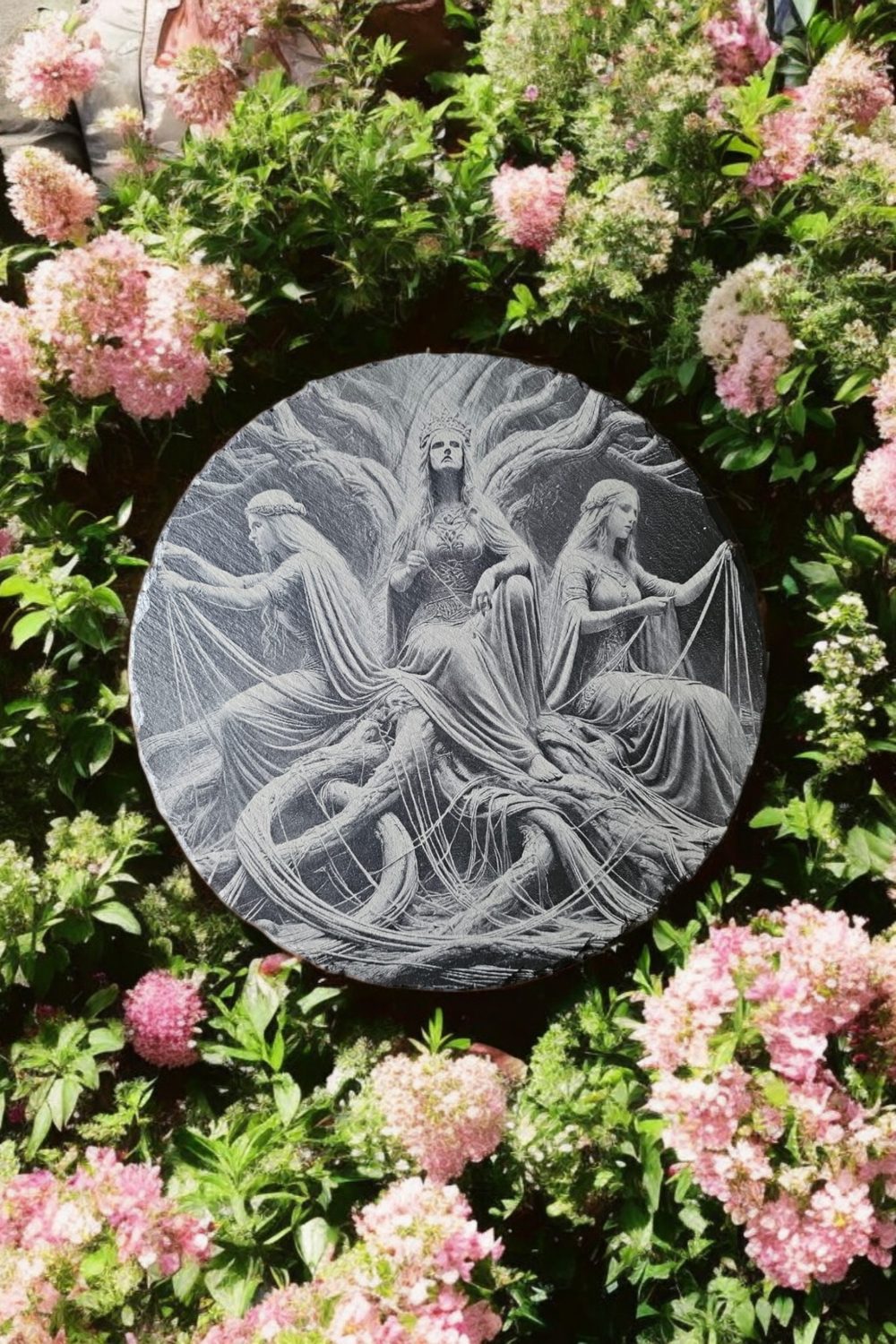
Norns. The norns shape destiny at birth. When the dísir help at childbirth in Sigrdrífumál and seal a king's end in Grímnismál, they come very close to the norns. Henry Adams Bellows even translated dísir in Hamðismál as "norns".
Fylgjur. The closest link is with the fylgja, the "follower", a guardian spirit attached to a person or a family. In Þiðranda þáttr the seer uses both words for the same women. Still, the distinction is useful. The fylgja is usually personal, often appears in animal form and in dreams, and is closely tied to the hamingja, a person's luck and fortune. The dísir, by contrast, almost always appear as a group, a female plural, and they have a festival. We explain the following-spirit and family luck in detail in Fylgja & Hamingja.
Matrons. Rudolf Simek and others have placed the dísir alongside the matrons, the mother goddesses commemorated on hundreds of Roman-era votive stones in the Lower Rhineland, often as a trio (see our article on the matrons). A note by the Anglo-Saxon scholar Bede from the early eighth century fits here: the heathen English, he says, called the night before the new year Modranecht, "the night of the mothers". Gabriel Turville-Petre compared this Mothers' Night with the dísablót. It is a stimulating bridge across centuries and hundreds of miles, but it remains a scholarly hypothesis.
Most specialists today lean towards a pragmatic conclusion: "dísir" was a broad collective term for female supernatural powers, within which valkyries, norns and fylgjur could come to the fore depending on the story. Sorting them into tidy boxes is more the work of modern handbooks than of the sources themselves.
Probably in the tenth century, someone wrote two heathen charms onto the flyleaf of a religious manuscript now kept in Merseburg, Germany. The first begins like this:
Eiris sazun idisi, sazun hera duoder, / suma hapt heptidun, suma heri lezidun, / suma clubodun umbi cuoniouuidi: / insprinc haptbandun, inuar uigandun.First Merseburg Charm, Old High German; roughly: "Once the idisi sat, sat here and there. Some fastened fetters, some hindered the host, some tugged at the bonds: leap free of the fetters, escape the foes!" (our own rendering; individual words are debated)
The idisi intervene in battle, binding and loosening fetters. That immediately recalls valkyries, and since Jacob Grimm they have often been equated with the Norse dísir. Grimm also read the name Idistaviso – the battlefield on the Weser where, according to Tacitus, Germanicus fought Arminius in AD 16 – as *idisiaviso, "meadow of the idisi". That too is a scholarly emendation of the transmitted text, not a secure reading.
How solid is the equation idisi = dísir? Linguistically, everything hinges on whether dís and idis are the same word. That is possible, but because of the missing initial vowel in Norse it is not certain. In content, the image of women intervening in battle fits well – but it fits valkyries in general just as well. The idisi of Merseburg and the dísir of the North probably belong to a shared Germanic world of female powers of fate and battle. That they are "the same beings" is a hypothesis with good arguments, not a fact. For the manuscript, the find and the second charm with Phol and Wodan, read our article on the Merseburg Charms.
In Old English, ides simply means "woman, lady". In Beowulf, Queen Wealhtheow is the ides Scyldinga (line 1168), which Grimm compared with dís Skjöldunga in the second Helgi lay. A striking parallel, but it only proves that both languages had a similar honorific for high-born women.
Where people worshipped, they often left names on the land. For the dísir, the literature cites several: Norwegian Disin, interpreted as Old Norse Dísavin, "meadow of the dísir", and Swedish names such as Disevid ("wood of the dísir") along with formations in Dis- like Diseberg or Disåsen.
Caution is needed here. Place-name interpretation is a tricky business. A first element Dis- may go back to dís, but it may equally derive from other words or from a personal name. Not every farm called Disen was a cult site. Whether a particular Dis- place really was a sanctuary of the dísir can only be judged case by case by name scholars. What can be said is that the dísir probably left traces in the Scandinavian name landscape, if less clear ones than Odin, Thor or Freyr.
The Viking-Age world was not populated only by great gods like Odin, Thor and Freyja. Beneath them lay a dense layer of powers close to everyday life: land spirits such as the landvættir, the dead in their mounds, and the dísir. It is striking how often birth, fate and death in battle are tied to female figures. And the dísir cut both ways: they helped in the birthing room and lurked on the battlefield, they protected the kin and in the end took Þiðrandi. They are what family often is – supportive and demanding at the same time. That their festival fell at the turning points of the year fits this picture; you will find related ideas in our article on ancestor veneration at Yule.
What are the dísir in Norse mythology? The dísir are female supernatural beings bound to a family, a farm or a person. They help at childbirth, protect, announce death, and in poetry can also be hostile or deadly.
What was a dísablót? A sacrificial feast in honour of the dísir, mentioned in Víga-Glúms saga, Egils saga, Ynglinga saga and Hervarar saga. In Iceland and Norway the sagas place it in autumn at the Winter Nights; no source describes the actual rites.
What does the Disting in Uppsala have to do with the dísir? The market's name derives from dísaþing, "assembly of the dísir". Snorri reports a great sacrifice, an assembly and a market at Uppsala in the month of Gói; the market is still held in early February.
Are the dísir the same as valkyries? Not quite. Valkyries are sometimes called dísir in the Edda, but dís is the wider term, also covering guardian spirits, birth helpers and powers of fate.
Are the idisi of the Merseburg Charm the same as the dísir? That is a widespread but unproven scholarly hypothesis. Both are female figures intervening in battle, but whether the words idis and dís are linguistically related is disputed.
What is the difference between a dís and a fylgja? A fylgja is usually a person's individual following-spirit, often in animal form. The dísir normally appear as a group and had their own cult, the dísablót, though the boundaries in the sources are fluid.
For courage. For remembrance. For legends that live on.
The Norns · Draumar – dreams as omens · Fylgja & Hamingja · Seiðr – the magic · Ancestor veneration at Yule.
All Festivals & Belief articles →
Forget the translucent veil-ghost. The draugr of the Old Norse sagas comes back in the flesh – heavy as an ox, darkly …
Read more →In the sagas of the North, no one sleeps harmlessly. A dream there is rarely a mere echo of the day, but a messenger …
Read more →A ring is a closed circle – no beginning, no end. No wonder the people of the North laid their most binding promises …
Read more →The old Norse people did not think of a person as a sealed self inside a skin. A life involved more powers than that: a …
Read more →