Before a Viking ship glided toward home, the crew took the carved dragon-heads down from the prow. Not out of modesty, but out of consideration - they did not want to frighten the spirits of the land. The landvaettir, the beings of the soil, were as self-evident to the old Norse people as wind and weather.
Landvaettir means literally "land-spirits" or "land-beings". They are place-bound spirits dwelling in a mountain, a river, a waterfall, a hill or a whole stretch of country. They do not belong to the great gods and have no names in the myths - they are the quiet lords of the ground on which one lives. Whoever has their favour sees their cattle thrive, their fields bear, their fishing grounds run rich. Whoever angers them watches their luck wither.
Dealing with them was practical and everyday. People respected sacred places, left certain stones and groves alone, and offered small gifts. There are reports of families honouring a stone or hill as the dwelling of their house-spirit and setting out food for it. These land-spirits are closely related to the beings who later lived on as elves and hidden folk - more on that in the piece on the elves and light-elves.
The best-known piece of evidence stands in the old Norwegian legal texts. In the tradition of Ulfljot's Law, which shaped the first Icelandic legal order, there is a rule that ships with raised dragon- or beast-heads were not to approach the land. When a ship sighted the coast, the crew had to take down the gaping heads, so that the landvaettir would not be startled and driven to flight.
This is a remarkably concrete glimpse. The menacing carved figures at the prow were thus not only ornament or war-symbol but had a spiritual effect that people reckoned with. To protect the spirits of one's own land was so important that it stood in the rank of law. Anyone interested in the ships and their dragon-heads will find more in the piece on the longships.
How seriously the landvaettir were taken shows in a famous scene from Egils saga. The poet and warrior Egil Skallagrimsson, at feud with the Norwegian king Eirik Blood-axe and his wife Gunnhild, raises a nidstong, a scorn-pole, on the coast: a stake onto which he fixes a horse's head. Then he speaks a curse and expressly calls upon the landvaettir of the land to wander restlessly until they have driven king and queen out of the country.
Egil thus turns not to the great gods but to the spirits of the soil themselves. They are the true lords of the land, mighty enough to drive out a king. The curse is a magical legal act that turns the invisible inhabitants against the visible rulers. Hardly any text shows more clearly how real and effective these spirits were in the thought of the age.
Here I set up a scorn-pole, and I turn this insult against King Eirik and Queen Gunnhild; and I turn it also against the land-spirits who dwell in this land, that they may all go astray and none find his dwelling until they have driven King Eirik and Gunnhild out of the country.
after Egils saga, public-domain translation tradition
The most famous tale of landvaettir stands in Snorri's Heimskringla. A Danish king wants to attack Iceland and sends a sorcerer ahead who scouts the coasts in the shape of a whale. But at each quarter of the sky a mighty guardian confronts him: in the east a dragon with a swarm of poisonous serpents, in the north a huge bird, in the west a great bull, in the south a mountain-giant with an iron staff. The sorcerer finds no way in, and the attack is abandoned.
These four beings - dragon, bird, bull and mountain-giant - are alive to this day: they adorn the Icelandic coat of arms and stand for the four quarters of the land. A tale from a saga has become a national emblem. Yet one should not press the everyday landvaettir belief onto the great guardian spirits of Snorri's story. The two belong together but are not the same.
Respect for the spirits of the land is one of the most durable traits of Norse folk piety. It outlasted Christianisation and lives on in Iceland to this day in the consideration for the huldufolk, the hidden people - sometimes even in altered building plans, when a rock is held to be the dwelling of a land-spirit. What began as heathen veneration of place-bound powers became a quiet reverence for the landscape that has held on astonishingly well.
The landvaettir are attested several times: in the tradition of Ulfljot's Law the rule to take the ships' dragon-heads down before the coast; in Egils saga the scorn-pole that calls the land-spirits against King Eirik; in Snorri's Heimskringla the four great guardians of Iceland. Belief in place-bound spirits to be respected is broadly attested and lives on in Icelandic folk piety.
The four great wights of Iceland (dragon, bird, bull, mountain-giant) are Snorri's literary tale and today a national symbol - they are not the same as the everyday landvaettir belief, which was a broad, well-attested folk piety. It is worth distinguishing the two cleanly: one strand is grand saga and national emblem, the other lived, place-bound veneration.
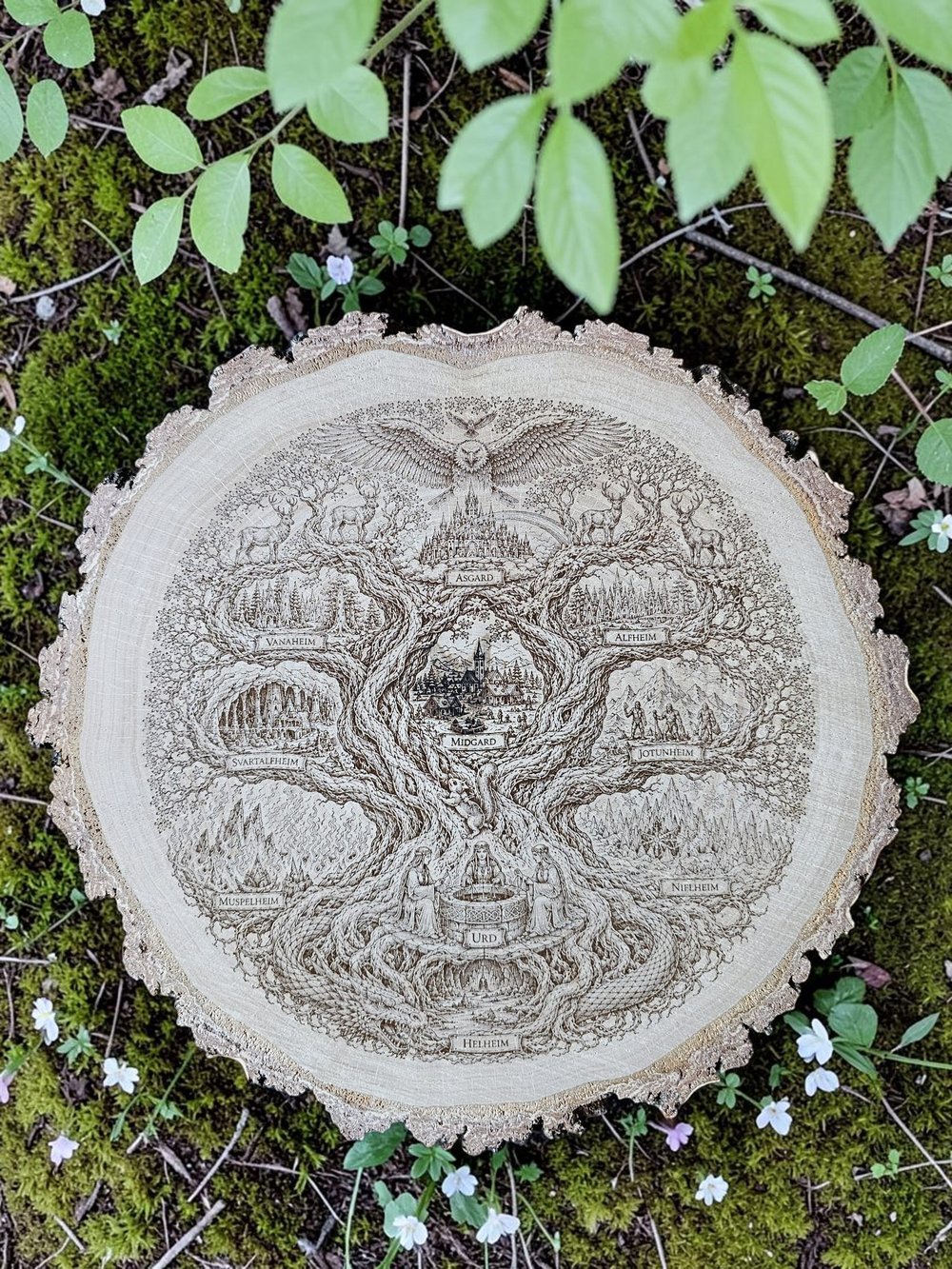
The elves · Yggdrasil – the world tree · The Wild Hunt · How the Germanic peoples honoured their dead · Seiðr – the magic.
All Festivals & Belief articles →
Between the years lies a time that ticks differently: the Rauhnächte, the Twelve Nights around the winter solstice. The …
Read more →Emperor Barbarossa sits in the Kyffhäuser, his head propped on the table, his beard grown through the stone slab …
Read more →The summer solstice is the longest day of the year – and was one of the great feasts of pagan Europe. Germanic peoples …
Read more →The Vikings had no capitals, but they had places of power: sites where law was spoken, sacrifice made and the ancestors …
Read more →