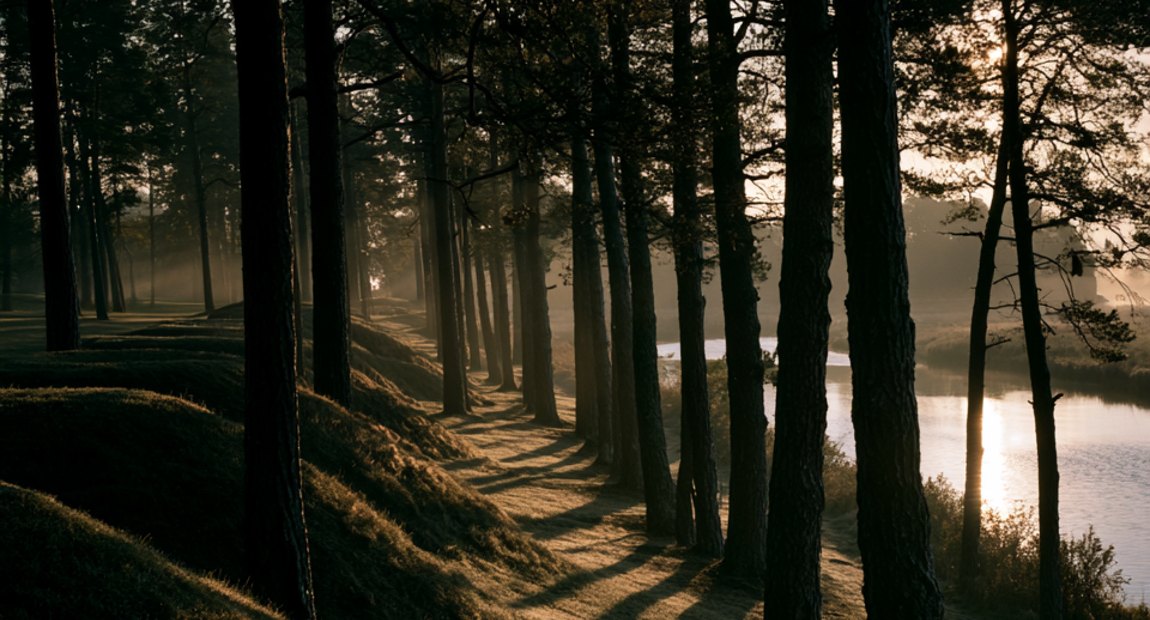
Emperor Barbarossa sits in the Kyffhäuser, his head propped on the table, his beard grown through the stone slab, waiting until one day he returns. Everyone knows the legend – but where does it come from? Its root reaches into a very old Germanic belief: the dead do not die into nothing but enter the mountains. A walk from the Icelandic sagas into German legend-lands.
In the Old Norse sources it is a familiar idea: after death the soul does not go into the distance but into the holy mountain of the kindred. The Eyrbyggja saga tells of Thorstein, who drowns while fishing. That same evening a shepherd sees the mountain Helgafell open: within, fires burn, horns sound, and one hears Thorstein being welcomed and bidden to take the high-seat opposite his father.
“He saw the mountain open; within, great fires burned, and he heard that Thorstein was welcomed and given the seat opposite his father.” after Eyrbyggja saga, ch. 11 (public-domain translation tradition)
Similarly Njáls saga: in a dream Flosi sees a mountain open and a man step out who calls his people by name – whoever is called is doomed to die. And the Landnámabók reports that whole families believed they would be taken into certain mountains after death. The mountain here is no grave but a hall: the place where the ancestors live on.
Exactly this image – the mighty one who lives on in the mountain and waits – returns in the German legends, only turned heroic. Most famous is Friedrich Barbarossa (originally even Friedrich II.) in the Kyffhäuser, ravens wheeling about him, who shall one day return when the realm needs him. Widukind, the Saxon leader, is said to rest in a mound by a Westphalian village. In Britain King Arthur waits in Cadbury Hill.
And the Visigothic king Alaric has the strangest resting place of all: by legend he was buried with rich treasure in a vault in the bed of the river Busento – the river was briefly diverted and then let flow back over it. The exact spot is unknown to this day.
Sometimes it is not a single sleeper. The Chronicle of Ursberg reports that in 1223 near Worms a band of armed warriors was seen stepping from a mountain and, after hours, vanishing into it again. One man took heart and spoke to one of them – the answer he received was that they were all ghosts of fallen knights. Here the mountain belief touches the Wild Hunt, the host of the dead that sweeps through the land above all in the Rauhnächte.
The sleeping king is, in the end, a consoling image. He is not extinguished but only hidden – absent and yet present, ready to return. In it lies the same conviction as in the old belief in the dead: that death is a threshold, not an abyss, and that the great of the past remain bound to us. No wonder the legend has found its own mountain in almost every German landscape.
The mountain episodes stand thus in the texts: Thorstein's entry into Helgafell (Eyrbyggja saga, ch. 11), Flosi's dream (Njáls saga) and the mountain-taking of whole families (Landnámabók). The Kyffhäuser legend of Barbarossa is broadly transmitted as a German legend (among others by the Brothers Grimm); Alaric's Busento grave is already reported by the Gothic historian Jordanes; the ghost-warriors at Worms in 1223 stand in the Chronicle of Ursberg.
The “sleeping king” is largely medieval and later legend-building, not Viking-age religion. The Kyffhäuser expectation attached itself to Barbarossa only late (at first it belonged to Friedrich II.); Widukind in the mound is legend, not history. The Old Norse “souls enter the mountain” belief, too, is reconstructed from Icelandic sources and was probably regional. What is certain: the motif is old, widespread – and tells more about the hope of the living than about verifiable fact.
The Wild Hunt · The Rauhnächte & Mother's Night · Hel – goddess and realm of the dead · How the Germanic peoples honoured their dead · The sacrificial moor of Oberdorla.
All Festivals & Belief articles →
The summer solstice is the longest day of the year – and was one of the great feasts of pagan Europe. Germanic peoples …
Read more →The Vikings had no capitals, but they had places of power: sites where law was spoken, sacrifice made and the ancestors …
Read more →In the middle of January, when the wind scours Iceland and the days have only just begun to lengthen again, Icelanders …
Read more →Through the long winters of Iceland's farmsteads ran a fear that had nothing to do with trolls or giants and everything …
Read more →