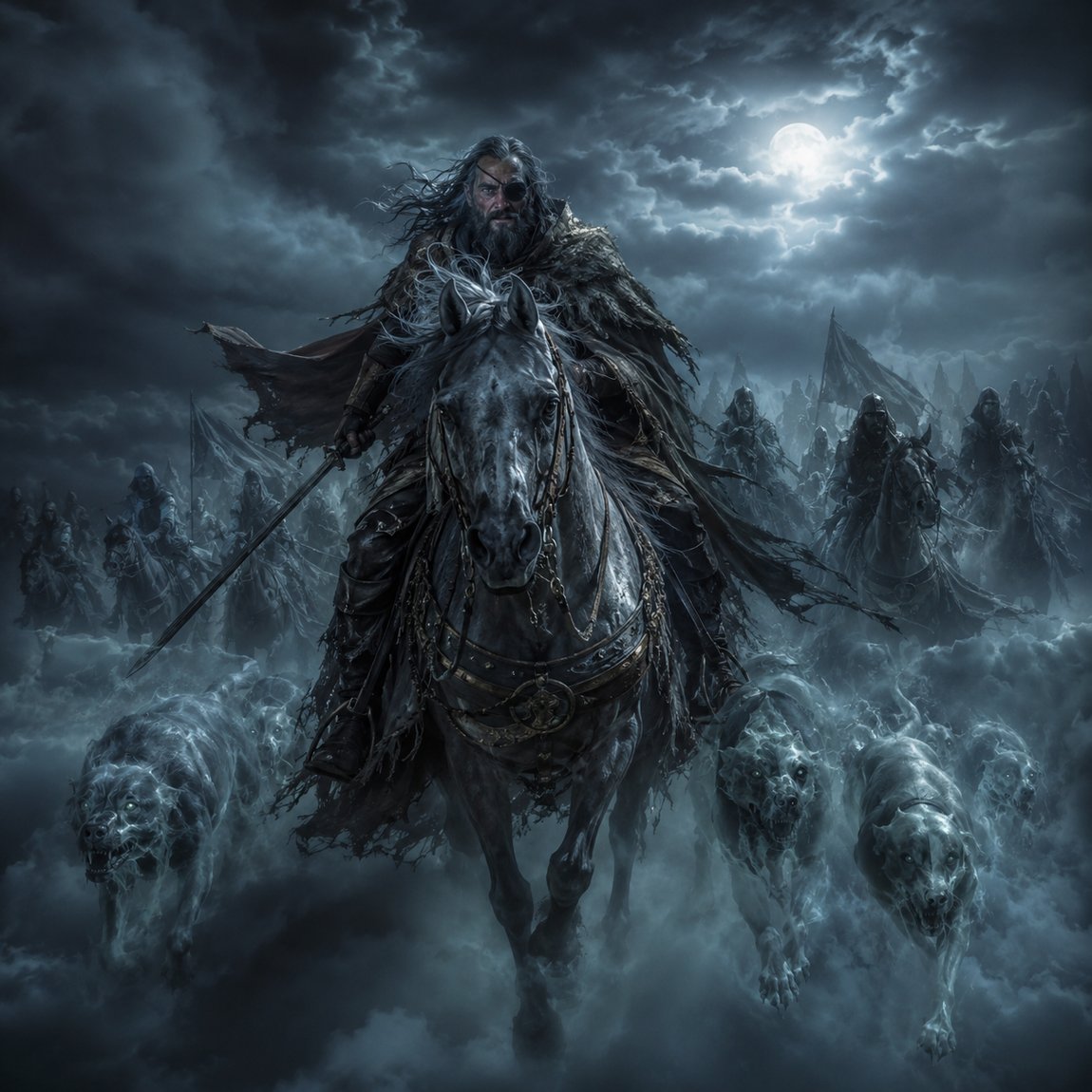
The Wild Hunt is a European folklore motif: a roaring host of the dead – riders, horses and hounds – that sweeps across the stormy winter sky, above all during the Twelve Nights around Yule. It is first recorded in 1091, when a Norman priest claimed to have met "Herlechin's household" on a lonely road. In Germany it is also called the furious host or Wodan's host, but the idea that Odin himself rides at its head goes back largely to Jacob Grimm. Here are the oldest sources, the German and Scandinavian legends, and what can actually be proven.
Picture a farmhouse on a January night. The wind is tearing at the shutters, and above the treetops comes a sound like baying hounds and horns – or like a storm, depending on who you ask. The people inside knew exactly what it was: the host was passing. Anyone still outdoors threw themselves flat on the ground and kept their mouth shut.
This is one of the most stubborn legends in Europe. In German it is the Wilde Jagd or the Wütendes Heer, the "furious host", often called Wodan's host. Norway knows it as the Oskoreia, Sweden as Odens jakt, medieval France as the Mesnie Hellequin, and English speakers simply as the Wild Hunt. It also sparked one of the great arguments in the study of myth: is that really the old god Odin riding at the front, or did nineteenth-century scholars put him there? We follow the trail through the oldest texts, the German legends and the Scandinavian parallels – and we keep a clear line between what the sources say and what we would simply like to be true.
The Wild Hunt is not a myth with a fixed text, like the Völuspá. It is a folklore motif: a storytelling pattern that turns up in hundreds of local versions. The building blocks are similar, but every region builds its own house from them.
The recurring parts are easy to list. A troop of riders, hounds and sometimes wagons races through the air or just above the ground. It is loud – horns, barking, hoofbeats, cries of "Hoo, hoo!". It comes mostly in the dark half of the year. The riders are the dead: restless souls, fallen warriors, sinners, unbaptised children. At their head rides a leader, sometimes a god, sometimes a damned nobleman, sometimes a woman such as Frau Holle or Perchta.
Then there are the rules for anyone who meets the hunt. Lie down, ideally in the middle of the road, and stay silent. Mock it or ask for a share of the game, and you may find a lump of carrion or a horse's leg flung at your door; in some versions the grisly gift turns to gold by morning. Sometimes the passing host is even a good omen for the harvest.
One point matters for everything that follows: most of these details come from nineteenth-century legend collections. How far back the belief goes can only be answered by older texts. Fortunately, there are some.
The earliest detailed account comes from Normandy. The Anglo-Norman monk Orderic Vitalis (1075 – c. 1142) wrote a vast church history, the Historia ecclesiastica, at the abbey of Saint-Évroul. In Book VIII he tells what happened to a priest called Walchelin of Bonneval, in the diocese of Lisieux, in January 1091.
Walchelin was walking home alone at night after visiting a sick parishioner when he heard the din of a great army. A procession passed him: people hauling plunder; biers carrying tormented souls; women on horses whose saddles were studded with red-hot nails; clergy; and finally a great host of knights. Among them Walchelin recognised people he had known, including his own brother, who begged him for prayers. This, he thought, must be the familia Herlechini – "Herlechin's household", which he had heard of. When he tried to seize a riderless horse as proof, he was wounded. Orderic insists he heard the story from the priest himself.
Herlechin lives on in disguise. In France the troop later appears as the Mesnie Hellequin, and it is often suggested that Harlequin of the Italian commedia dell'arte descends from this infernal rider. The derivation is widely repeated, but its details remain disputed.
The second early witness is the most famous, and it is English. The Peterborough Chronicle, a version of the Anglo-Saxon Chronicle continued at Peterborough Abbey, records an unwelcome event in 1127. King Henry I had imposed a new abbot on the monks, Henry of Poitou, whom the chronicle paints as greedy. Soon after he arrived – on the Sunday when the Mass chant Exsurge, quare obdormis is sung, in February – many people saw and heard a hunt.
"The hunters were swarthy, and huge, and ugly; and their hounds were all swarthy, and broad-eyed, and ugly. And they rode on swarthy horses, and swarthy bucks."— Peterborough Chronicle, year 1127, translated by James Ingram (1823)
The troop was seen in the deer park of Peterborough itself and in all the woods from there to Stamford, and at night the monks heard the horns. Reliable witnesses who kept watch reckoned there might be twenty or thirty horn-blowers. It went on, the chronicle says, from the abbot's arrival until Easter.
The entry is contemporary, which makes it precious, but it is also clearly slanted: the phantom hunt is a sign, a comment on an unpopular abbot. The chronicle names no leader and no god. What it does show is that a spectral hunting troop was a picture twelfth-century English readers understood instantly.
Late in the twelfth century, the court cleric Walter Map filled his book De nugis curialium ("Courtiers' Trifles") with curiosities. One of them is the tale of King Herla, a king of the ancient Britons. A dwarf king riding a goat invites Herla to his wedding in a realm inside a cliff. Herla feasts for what seems like three days and rides home with gifts, among them a small bloodhound set on his horse. No one, he is warned, may dismount until the dog jumps down.
Outside, centuries have passed and the Saxons rule the land. Some of Herla's men leap down anyway and crumble to dust. The dog, Map notes drily, has not jumped down yet, so Herla and his company still wander. Some said, Map adds, that the troop plunged into the River Wye in the first year of Henry II's reign (1154) and was never seen again.
Elsewhere Map calls this band the familia Herlethingi – an unmistakable echo of Orderic's familia Herlechini. Whether Herla, Herlechin and Hellequin all go back to one word, perhaps Old English here, "army", is a popular but unproven idea.
Secure German-language evidence begins in the thirteenth and fourteenth centuries. The verse romance Reinfried von Braunschweig (around 1300) mentions daz Wuotes her. A fourteenth-century charm, the Munich Night Blessing, lists the powers one wants protection from and names Wûtanes her und alle sîne man – "Wuotan's host and all his men".
Here lies the heart of the debate. Is Wuotes her the host of the god Wodan (Old High German Wuotan), or simply a "raging host"? Linguistically the two are closely tied, because the god's name is usually connected with a Germanic word for frenzy and ecstatic fury. So the word alone cannot tell us whether medieval people were thinking of a god. The form Wûtanes her in the charm does look more like a name.
Fuller descriptions follow in the sixteenth century, for example from the Lucerne town clerk Renward Cysat (1545–1614), who described the Guotisheer of central Switzerland. From then on the record grows steadily thicker.
In the legend collections of the nineteenth century, the Wild Hunt has almost as many leaders as Germany has landscapes.
In Mecklenburg and Pomerania the wild huntsman is Wode or Wod. Jacob Grimm, drawing on Mecklenburg sources, tells how Wode calls to travellers to keep "midden in den weg" – in the middle of the road. A farmer who ties the huntsman's chain to an oak is rewarded with a boot full of gold. A leader whose name sounds so close to the god's was, for Grimm, a key piece of evidence.
In the Harz and around Brunswick rides Hackelberg. According to legend, Hans von Hackelberg was master of the hunt to the Duke of Brunswick. He dreamed a boar would overcome him; the next day he killed a huge boar and kicked it in triumph, and a tusk pierced his boot. The wound festered and he died. On his deathbed he is said to have told the priest that God could keep his heaven as long as he kept his hunting – to which the reply came: then hunt until the Day of Judgement. Tradition places his grave at Wülperode near Hornburg. In one version an owl called the Tutosel flies ahead of him, once a nun with a dreadful singing voice.
Hackelberg shows how the motif works: a nobleman puts the hunt above his soul and is punished with eternal hunting. Such "Sabbath-breakers" appear in many regions – a lord of Maltitz in the Saarland, the knight of Rodenstein in the Odenwald.
Alongside them ride female leaders: Frau Holle in Hesse and Thuringia, Perchta in the Alpine regions, and Frau Gauden in the Prignitz with her daughters turned into hounds. In many legends Perchta leads the souls of unbaptised children. Whether these women are old goddesses or figures of Christian winter custom is as disputed as Wodan's role. Grimm simply made Holda and Berchta Wodan's wife – a construction few scholars would sign up to today.
That we almost automatically say "Wodan's host" is largely down to one book: Jacob Grimm's Deutsche Mythologie of 1835 (in English, Teutonic Mythology). Grimm laid the scattered legends of the furious host, the wild huntsman, Holda, Hackelberg and Wode side by side and turned "Wilde Jagd" into a scholarly umbrella term – the phrase itself was older and already familiar from poets.
His reading was bold: the wild huntsman was the old god Wodan, dethroned by Christianity. The god had become a spectre and a devil, his host of fallen warriors a train of damned souls. For Grimm, the Wild Hunt was a key to the lost religion of the Germanic peoples.
There is a lot to be said for it. In the Norse sources, Odin is a god of the dead, of ecstasy and of war. He is called Herjann ("army leader") and Valföðr ("father of the slain"), rides the eight-legged horse Sleipnir, and is accompanied by wolves and ravens. The names Wode and Wûtanes her sound like him.
But Grimm's method had weaknesses. He mixed nineteenth-century folk tales with medieval texts and thirteenth-century Icelandic literature as if they were all of one piece; whatever did not fit was explained away as later distortion. The result was a seamless picture that does not exist in the sources themselves. The neat equation "Wild Hunt = Odin cult" is a product of Romanticism.
Since Grimm, two broad camps have faced each other. One sees the Wild Hunt as a survival of pre-Christian ideas about a host of the dead under a divine leader. The other points out that the oldest sources are Christian through and through: in Orderic the dead do penance, and for the Sabbath-breakers eternal hunting is God's punishment.
The second camp includes a Rhinelander: the Bonn folklorist Karl Meisen (1891–1973), born in Blatzheim. In 1935 he published a collection of sources on the furious host and the wild huntsman and set out to explain the legends from Christian and classical roots rather than as Germanic heritage.
More recent scholarship is more cautious than either camp. Lotte Motz showed in 1984 that the motif is found above all in Germanic-speaking areas – an argument for old roots. Claude Lecouteux, in his work on the "phantom armies of the night", stressed how closely medieval ideas of the dead, church teaching and local storytelling are interwoven. Hans Peter Duerr pointed out that it is often impossible to say whether a report describes a demonic reading of natural phenomena or masked people in processions.
In most German legends the host rides during the Rauhnächte, the "Twelve Nights" between Christmas and Epiphany on 6 January; some regions counted from St Thomas's Day on 21 December instead. These days were seen as a time in between, when ordinary order was suspended. Spinning and laundry were forbidden, and the dead and spirits were abroad.
The origin of the name is uncertain. One explanation links it to the incense smoke (Rauch) used to bless house and stable, another to Middle High German rûch, "hairy", after the shaggy masked figures of the season.
For the Wild Hunt the Twelve Nights were doubly fitting: the darkest time of the year and the stormiest. That the Yule festival fell in the same weeks, and that in the North the dead were remembered at Yule (see ancestor veneration at Yule), ties the motif to very old ideas. A direct line from pagan Yule to the modern legend, however, cannot be demonstrated.
In Norway the troop is called the Oskoreia or Åsgårdsreia, also Julereia, the Yule ride. Only the second element is certain: rei comes from Old Norse reið, "ride". The first element, osko-, is unexplained. "The ride from Asgard" is a popular interpretation; some scholars prefer Old Norse ǫskurligr, "dreadful". The link to Asgard, the gods' stronghold, may therefore have been read into the name after the fact.
In content the Oskoreia closely resembles the German hunt. The dead who were fit for neither heaven nor hell – killers, drunkards, cheats – ride through the air with trolls at Yule, often led by a figure called Guro Rysserova. People protected themselves with steel over the door and crosses of chalk or tar on doors, ale barrels and horses. Anyone caught outside threw themselves face down with arms outstretched. And some mornings the horses stood sweating and trembling in the stable: the Oskoreia had ridden them in the night.
In Sweden people spoke of Odens jakt, Odin's hunt – here the huntsman carries the god's name outright. The hunt was usually heard rather than seen, a louder and a fainter barking of dogs, and it foretold a change in the weather, sometimes war. Denmark has legends of King Valdemar, condemned to hunt forever. Odens jakt and the German Wûtanes her are the strongest arguments that the god's name was not simply inserted into the legend by Grimm.
From here on it gets speculative, and we say so plainly. Anyone comparing the Wild Hunt with Norse myth soon arrives at the Einherjar: the fallen warriors who, according to the Eddas, live with Odin in Valhalla and will ride out with him to the last battle at the end of the world. A host of the dead led by Odin is the most obvious parallel, and scholars such as Jan de Vries, in his history of Germanic religion (1956), drew it explicitly.
An even older thread leads to Tacitus. Around AD 98 he describes the Harii, who attacked on dark nights with blackened shields and bodies, so that they looked like a feralis exercitus, an army of the dead. Some scholars see warrior bands ritually presenting themselves as the dead here, and a possible root of the later legend.
To be honest, though: between Tacitus, the thirteenth-century Eddas and the nineteenth-century legends lie centuries without connecting links. In the Eddas the Einherjar do not ride through storms at night, and the Wild Hunt does not head for Valhalla. Nor are the valkyries huntresses in the storm.
Here we need to correct the earlier version of this article, which claimed that local legends about Wotan reached all the way to our region. On closer checking we found no evidence for that, so we have dropped it.
What can be said is this: the "wild huntsman" also appears in nineteenth-century legend collections for the Rhineland; Ludwig Bechstein's Deutsches Sagenbuch lists a tale of that title in its section on the Rhine, Nahe and Moselle. We have found no documented Wodan as leader for the Eifel or the Aachen area. The genuine regional traces lead into the history of scholarship instead: to Regino of Prüm and to Karl Meisen in Bonn.
The best-known painting is by the Norwegian Peter Nicolai Arbo: Åsgårdsreien (The Wild Hunt of Odin), 1872, now in the National Museum in Oslo. Arbo painted a cavalcade of riders above a sea of clouds. According to the museum, Norwegian tradition has Sigurd Fåvnesbane leading the ghosts, Odin's ravens following, and Thor driving ahead with his goat chariot – a blend of folk legend and Edda typical of the nineteenth century.
In literature, Gottfried August Bürger's ballad Der wilde Jäger (1786), about a count damned for hunting on a Sunday, made the motif popular; it inspired César Franck's symphonic poem Le Chasseur maudit (1882). Theodor Körner wrote Lützows wilde Jagd in 1813, set to music by Carl Maria von Weber, whose opera Der Freischütz (1821) sends the wild host roaring through the Wolf's Glen.
Franz Liszt titled the eighth of his Transcendental Études "Wilde Jagd". Joachim Raff sent Frau Holle and Wotan through the forest in the finale of his symphony Im Walde (1869), and Arnold Schoenberg set King Valdemar's wild hunt in his Gurre-Lieder (premiered 1913). In popular culture the line runs from "Ghost Riders in the Sky" (1948) to The Witcher 3: Wild Hunt (2015).
Perhaps because it tells something true about winter: anyone who has walked through a forest on a stormy night understands why people heard hounds, horns and riders in that roar. And something true about the dead: that in the darkest nights of the year they pass by once more. For Orderic's priest it was his own brother. For the farmers of Mecklenburg it was Wode.
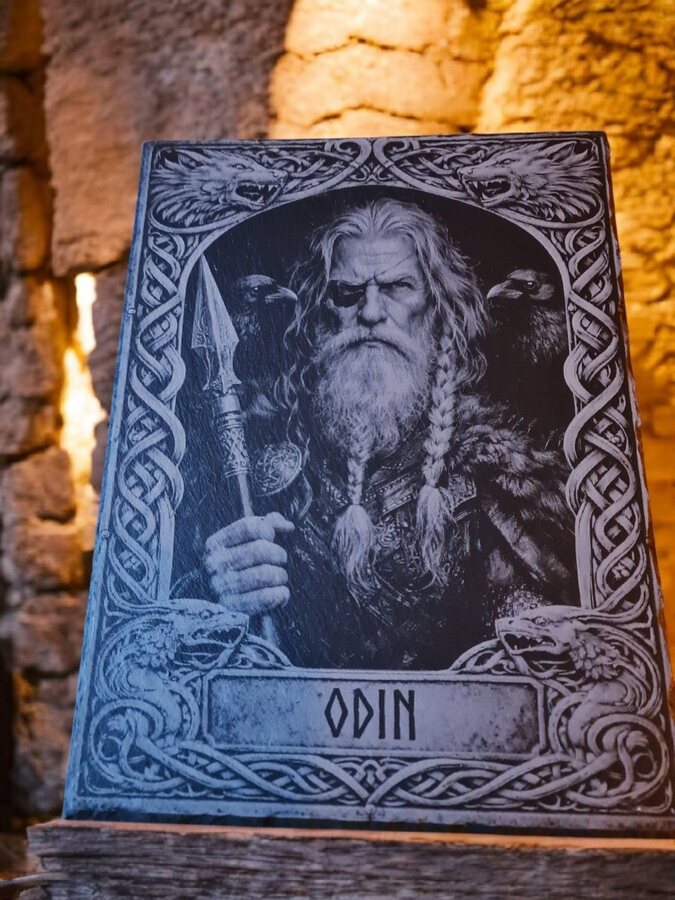
In our workshop in Alsdorf we engrave motifs from exactly this world – Odin, his wolves Geri and Freki, Sleipnir, runes and Edda verses on slate, wood and glass. The Wild Hunt needs no embellishment. It is eerie enough without invention.
What is the Wild Hunt? A European folklore motif of a noisy ghostly host of the dead, riders and hounds that sweeps through the air, mainly on winter nights. It is attested in writing from 1091.
Who leads the Wild Hunt? It depends on the region: Wodan or Wode, damned huntsmen such as Hackelberg, Frau Holle or Perchta, Odin in Sweden, King Herla in Walter Map. There is no single leader.
When does the Wild Hunt ride? According to folk belief mainly during the Twelve Nights between Christmas and 6 January, and in Norway at Yule.
Is the Wild Hunt really Odin's army? That is Jacob Grimm's interpretation from 1835. Names like Wûtanes her and Odens jakt support it, but the oldest accounts are Christian and name no god. The question remains open.
What is the earliest record of the Wild Hunt? Orderic Vitalis's account of the priest Walchelin, who is said to have seen the familia Herlechini in Normandy in January 1091, followed by the Peterborough Chronicle entry for 1127.
For courage. For remembrance. For legends that live on.
Odin (Wotan) · The Harii – the ghost host · Valhalla & the Einherjar · The Germanic tribes · Blót calendar & Yuletide nights.
At the centre of the Norse picture of the world stands a tree. At its roots fate is decided, in its crown an eagle …
Read more →The world of the Vikings is, quite literally, built from a corpse. From the slain primal giant Ymir the first gods …
Read more →Once a year the gods brewed not mischief but beer. The sea-giant Ægir welcomed them into his hall on the sea-floor …
Read more →Few stories in Norse tradition trail so much ruin behind them as this one: a careless throw, a dead otter, an …
Read more →