Once a year the gods brewed not mischief but beer. The sea-giant Ægir welcomed them into his hall on the sea-floor, where the ale poured itself into the horns and gold shone instead of fire. It could have been the finest feast in the North – had it not been for Loki. A look at Ægir's feast, the sacred truce of the old world, and the great flyting that tore it apart.
Ægir is a strange figure: a giant, and yet a welcome host to the Aesir. The sea is his – the waves are the nine daughters of him and Rán, his wife, who gathers drowned sailors in her net. But Ægir has another role that endears him to the gods: he is their master brewer. In his hall on the island of Hlésey he held a yearly feast for the Aesir at which the beer flowed freely. "Ægir's feast" is therefore a recurring frame in the Edda – the place where the gods gather and stories take their course.
Ægir shares the sea with his wife Rán. The two are a study in contrast: he the hospitable brewer, she the dark mistress of the deep, who draws the drowned to herself in her net. Their nine daughters are the waves themselves – the skalds gave them names like "High-wave", "Blood-red-hair" and "the Comber", and in some verses they even count as the nine mothers of the watchman-god Heimdall. Whoever sank in the sea had "gone to Rán"; and because gold lay on the sea-bed, it was said Rán loved gold – one gave it to the drowned so they would be well received by her. So Ægir's world is at once feast-hall and grave, beer and abyss – and that gives his feast a double bottom from the very start.
A feast for all the gods needs a mighty brewing-kettle – and at first Ægir had none. So Thor and Týr set out to fetch the world's greatest cauldron, a mile deep, from the giant Hymir. The Hymiskviða tells that journey: how, on the same trip, Thor hooks the World Serpent using an ox-head for bait, how he finally carries the cauldron off on his head and slays the pursuing giants. Only with this kettle can Ægir brew for the whole host of gods. So two tales hang together: Thor's most famous fishing-trip is at the same time the prelude to the feast.
That gold rather than fire lights Ægir's hall is more than a pretty image – it became a fixed figure of the poets. "Ægir's fire", "the light of the sea", "the fire of the water": all of these are kennings, coded circumlocutions for gold. In a culture where poetry counted as the highest art, that reveals much: the host's wealth and the splendour of his hall passed into the language itself.
Ægir was bound up with poetry in general. In the Prose Edda Snorri tells of a second "Ægir's feast" – this time Ægir is a guest in Asgard, and the god of poetry Bragi sits beside him and, over the drink, teaches him the origin of poetry and the art of the kennings. Ægir's hall is thus not only a place of beer but the place where the gods put their knowledge into words. No accident that it is here, of all places, that the sharpest war of words in the whole Edda is later fought.
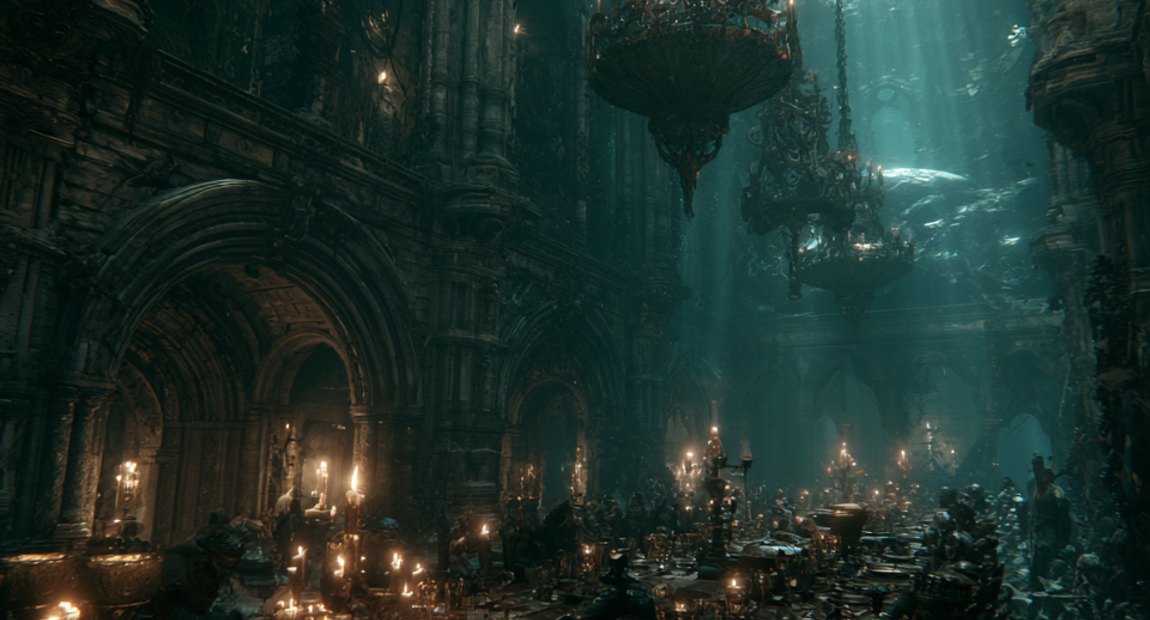
Ægir's hall is a wonder. Instead of a hearth-fire, glowing gold lights the room – "Ægir's fire" became a skaldic byword for gold itself. The beer is not poured; the horns fill themselves and pass around the circle. Two servants keep the feast, Fimafeng and Eldir, and Fimafeng does his work so well that the guests praise him aloud. Over it all lies the sacred truce: in Ægir's hall a holy peace holds, and none may harm another. It is precisely that peace that makes what follows so monstrous.
"Thirsty I come to this thine hall, / Loptr, from a journey long, / to ask of the gods that one should give / fair mead for a drink to me."Loki in the Lokasenna 6 · after Henry Adams Bellows 1923 (public domain)
Loki cannot bear the praise for the servant Fimafeng – and kills him in the very peace of the hall. Outraged, the gods drive him out. But Loki returns and demands entry by an old right: once he and Odin had sworn blood-brotherhood, that neither should drink without the other. They let him in – and now the great flyting begins, the Lokasenna. In turn Loki mocks every god and goddess, exposing cowardice, unfaithfulness and old embarrassments, until no name of honour is left whole. It is a senna, a ritualised war of words – vicious, unerring and deeply shaming for the gods. Whoever wants to read the insults one by one will find them in our piece on the Lokasenna.
Loki's insults strike each at their sorest point. He charges Odin with having practised magic (seiðr) as a man – to Norse ears a grave loss of honour; Odin retorts that Loki himself once lived eight winters as a woman underground and bore children. He accuses Freyja of unfaithfulness with everyone present, mocks Njörð for his origin, and jeers at one-handed Týr that his own wolf Fenrir bit off the god's hand. Not even Frigg, Idun and Sif are spared, and the little harvest-servants Byggvir and Beyla he derides as cowardly bootlickers.
The cruel part: much of what Loki says strikes a true nerve. He uses the rules of the senna to draw the dirty side out of real god-tales – he does not lie, he exposes. The gods can scarcely answer him; only Sif hands him a cup to appease him, yet her too he mocks. Only when Thor strides into the hall does the mere threat of the hammer end what words could not.
No word silences Loki – only raw force. When Thor at last strides into the hall and raises the hammer, the mocker falls quiet. Before he goes, Loki curses Ægir's hall: let fire close over it. Then he vanishes into the night. It is the last time the gods sit together like this; soon after, Loki is caught and bound, and the road to Ragnarök lies open. Ægir's feast, the fairest of feasts, thus becomes the eve of the end.
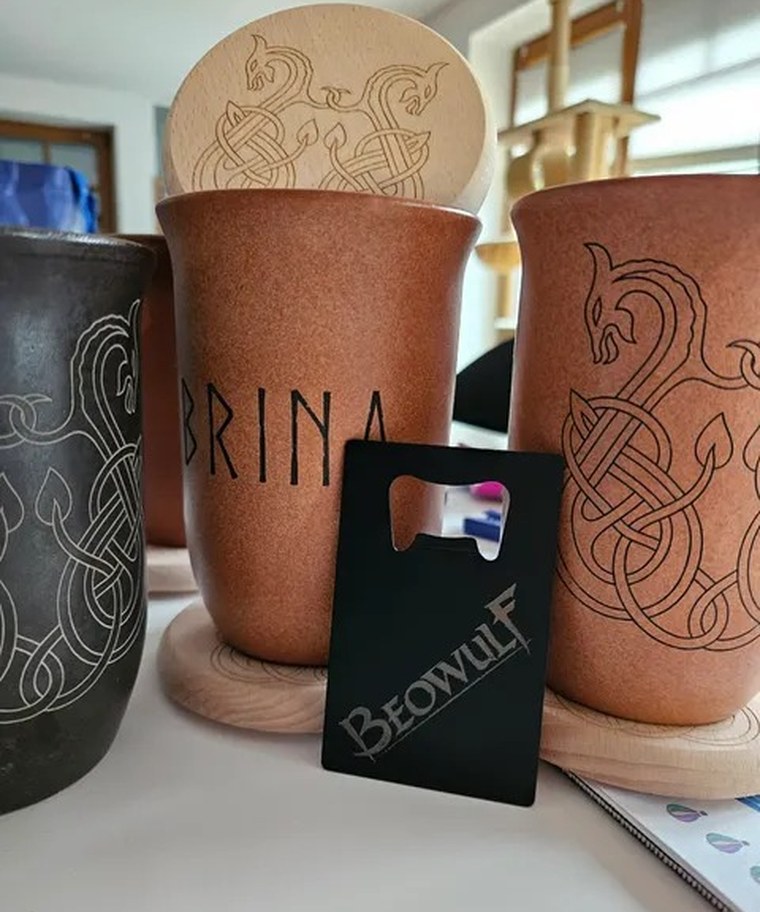
Behind the tale lies a real piece of Norse culture: the feast as the heart of the community. The horn went round, one drank to gods and ancestors, swore oaths and bound the kin together with the shared draught. The feast-peace was holy, the word held. "Raise the horn and Skál" is therefore more than a slogan – it is the echo of Ægir's hall. Whoever wants to bring that spirit to their own table, we engrave a name, a saying or a symbol into a mug, horn or tealight holder.
How seriously the North took its drinking is shown by the finds: precious drinking-horns with golden mounts like those of Gallehus, silver-mounted horns from princely graves, whole sets of cups and jugs in the halls of the mighty. Shared drinking was no mere carousing but a legal act: at the sumbel one made speeches, raised the minni to gods and ancestors, and swore vows that were binding before witnesses. Exactly this gravity resonates in Ægir's feast – and exactly for that reason Loki's breach of the feast-peace weighs so heavily.
The Lokasenna stands in the Poetic Edda (Codex Regius); its prose frame names Ægir's feast, the self-pouring ale, the gold as light, and the servants Fimafeng and Eldir. The huge brewing-cauldron and Thor's journey to Hymir are in the Hymiskviða; Snorri retells "Ægir's feast" in the Prose Edda (Skáldskaparmál). Ægir, his wife Rán and their nine daughters, and the island of Hlésey are attested more than once; "Ægir's fire" as a kenning for gold is skaldic practice.
The Lokasenna is probably a deliberately literary, satirical poem of the late tradition (written down in the 13th century). Some scholars read it as an artful exposure of the old gods, perhaps already at an ironic distance – so the mutual accusations need not be taken as plain "articles of faith". The tangle of names around Ægir, Gymir and Hlér is partly Snorri's ordering too. What is attested and old is the core: Ægir as sea-giant and brewer, the feast of the gods, and the sacred feast-peace.
Lokasenna – the flyting of the gods · Ægir & Rán – sea and mead · Loki · Thor · Mead – the drink of gods.
Few stories in Norse tradition trail so much ruin behind them as this one: a careless throw, a dead otter, an …
Read more →It is the moment when laughter vanishes from Asgard. The death of the shining Balder is the most moving legend of the …
Read more →Warriors who fought in bear pelts and wolf-skins, bit their shields and feared neither fire nor iron. The berserker is …
Read more →Valhalla was only one of many realms of the dead. The ideas of the afterlife were as varied as the burial customs …
Read more →