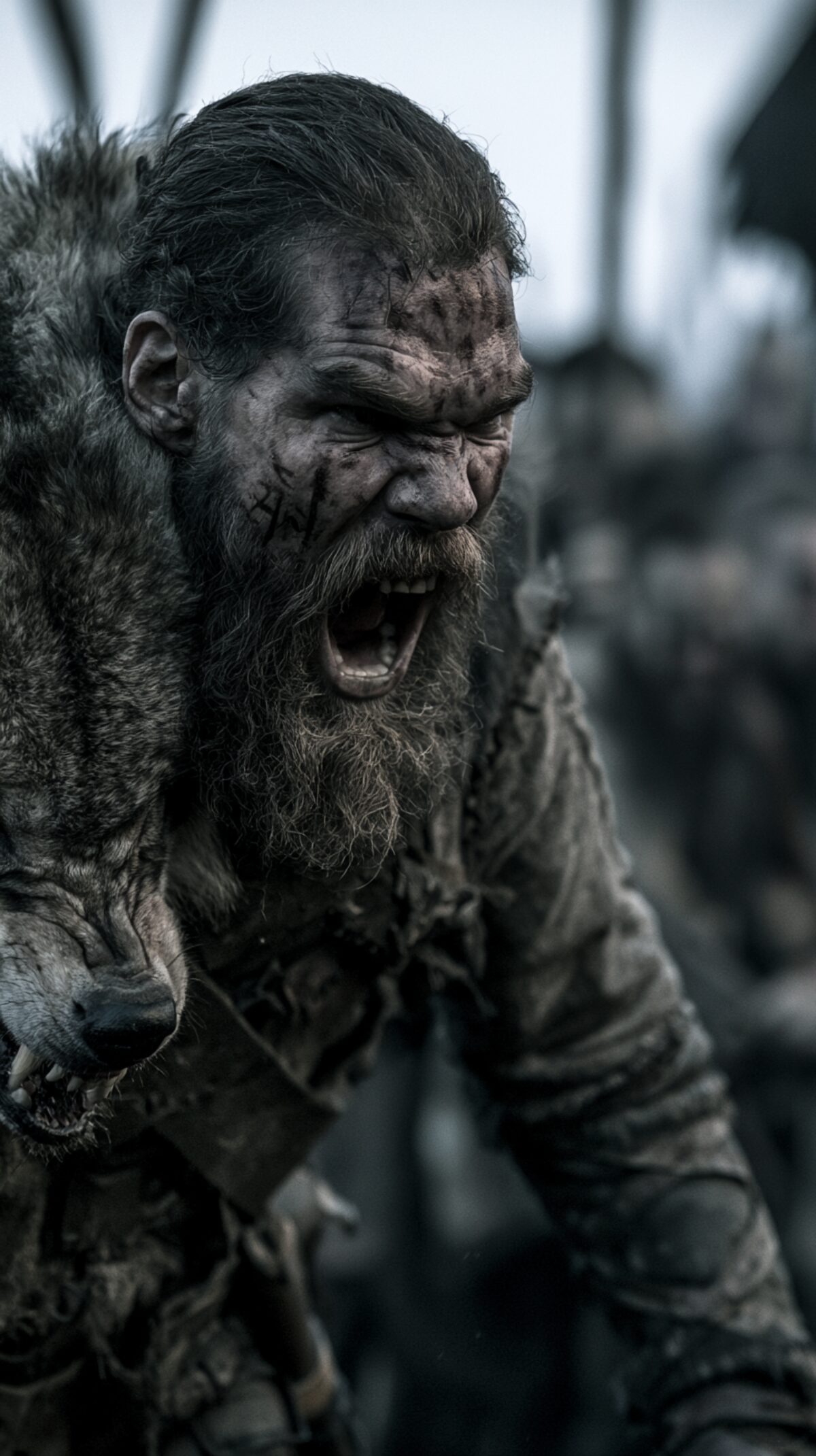
Berserkers were warriors who went into a feared battle-frenzy, the berserksgangr – first attested in the late ninth century as an elite unit of King Harald Fairhair of Norway. Everything after that is a long chain of sagas, chessmen, law codes and speculation: Snorri's invulnerable warriors of Odin, shield-biters carved in walrus ivory, an Icelandic ban and the fly-agaric theory of 1784. We walk through the sources in order and keep a clear line between hard evidence, thirteenth-century saga literature and modern hypothesis.
A fjord near Stavanger. Ships lashed together, spears, shields, noise. Some time in the late ninth century Harald Fairhair defeats a coalition of Norwegian petty kings here. Icelandic tradition put the battle of Hafrsfjord in 872; most modern historians lean towards the 880s. Nobody knows for certain. What we do know is that the oldest poem using the word this article is about comes from that day.
The praise poem Haraldskvæði, also called Hrafnsmál ("the Raven's Song"), is usually attributed to Þorbjǫrn hornklofi, one of Harald's court poets. A skald was a professional poet who praised rulers in tightly constructed verse. The poem is framed as a conversation between a valkyrie and a raven and survives only in fragments, quoted in kings' sagas of the thirteenth century. Some scholars assign individual stanzas to another skald, Þjóðólfr of Hvinir. So the attribution is not watertight, but a late ninth-century date is widely accepted.
"Grenjuðu berserkir … emjuðu ulfheðnar" – The berserks bellowed, battle had come for them; the wolf-skins howled and shook their iron spears.Haraldskvæði, stanza 8 (our own translation)
A few stanzas later the valkyrie asks the raven about the berserks: how do these men fare who wade into battle? The raven's answer, in substance, is that they are called wolf-skins, that they carry bloody shields, and that the king trusts only men who do not give way. That is all. No mushrooms, no horned helmets, no invulnerability. But it is a witness from the period itself.
Old Norse berserkr (plural berserkir) is a compound. The second element is clear: serkr means "shirt, tunic", related to the Scots and northern English sark. The first element has divided scholars since the nineteenth century.
Reading one: "bear-shirt". Ber- belongs to the old Germanic word for bear, which survives in Old Norse bersi ("bear", also used as a nickname). A berserk would then be a man in a bearskin – or a man who fought as if he wore one. The great Icelandic-English dictionary of Cleasby and Vigfússon (1874) favours this reading and points to the partner term in Haraldskvæði: úlfheðnar, "wolf-coats", from úlfr ("wolf") and heðinn ("fur jacket"). Bear and wolf side by side in one stanza make a strong case.
Reading two: "bare-shirt". Here the first element is berr, "bare, naked": a warrior who fights without mail. This idea leans on Snorri's remark that Odin's men went brynjulausir, "without byrnies". Sir Walter Scott, who brought the word into English in his 1822 novel The Pirate, seems to have understood it this way. Linguistically it is awkward: serkr is a noun, and "bare-shirt" makes an odd compound. Most specialists now prefer "bear-shirt", though the question is not closed for good.
The everyday English phrase to go berserk is not Viking idiom either. It grew up after Scott, when a Norse warrior's name turned into a word for anyone who loses their temper.
The most famous portrait of the berserks comes from Snorri Sturluson, writing around 1230 in Ynglinga saga, the opening part of his history of the Norwegian kings, Heimskringla. Snorri presents Odin as a sorcerer-king of the distant past, and in chapter six he describes his men. Samuel Laing's public-domain translation of 1844 reads:
"His men rushed forwards without armour, were as mad as dogs or wolves, bit their shields, and were strong as bears or wild bulls, and killed people at a blow, but neither fire nor iron told upon them. This was called Berserkergang."Snorri Sturluson, Ynglinga saga, ch. 6, trans. Samuel Laing (1844)
Nearly the whole picture we still carry around comes from this one paragraph: the frenzy, the shield-biting, the animal comparisons, the invulnerability, and the technical term berserksgangr, "berserk-going". But Snorri was an educated Christian Icelander putting pagan tradition into order. He wrote some 350 years after Hafrsfjord, from poems, stories and his own interpretation. The invulnerability in particular belongs to the world of legend rather than to a battle report.
The link with Odin is still no accident. His name is connected with Old Norse óðr, which means "frantic, furious" and also "poetic inspiration". Adam of Bremen put it bluntly around 1075: Wodan, id est furor – "Wodan, that is, fury". A god of ecstasy and of fortune in war, to whom men in battle-madness belong: it fits remarkably well, even if reconstructing a full-blown cult from it is a modern exercise.
Where there are berserks, the wolves are never far away. The úlfheðnar (singular úlfheðinn) already stand right beside them in Haraldskvæði, and there is a telling overlap: the valkyrie asks about the berserks and the raven answers with the wolf-coats. Either the two names describe the same troop, or two related sections of one warrior elite. The sources draw no hard line.
In the thirteenth-century sagas "berserk" becomes the umbrella term, while the wolf-coats almost disappear. Our rule of thumb: "berserk" is the broader word for the warrior in battle-frenzy, "ulfhednar" a variety defined by the wolf. Anyone who wants to separate them strictly is skating on thin ice. You will find more on the wolf warriors in our article on the Ulfhednar, and the bear itself – hunted, feared and revered in the North – has its own piece, The Bear in the North.
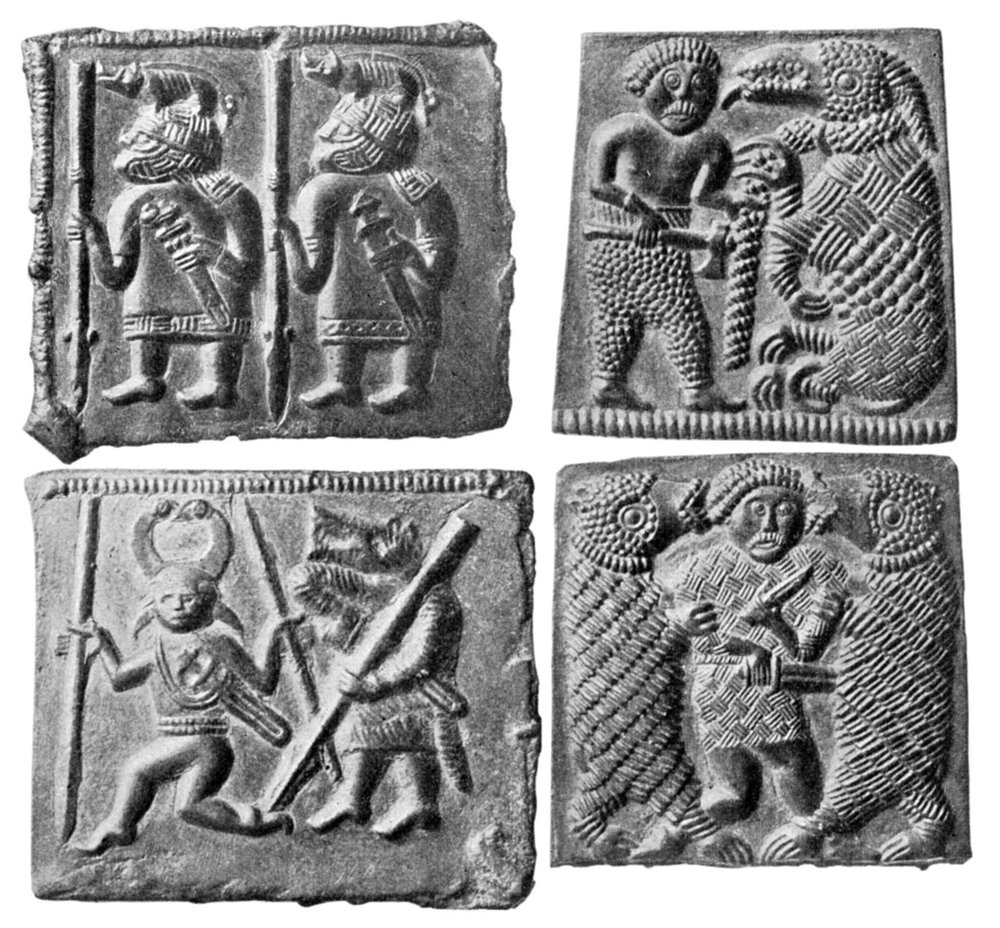
If you only trust texts, berserks pose a problem: almost everything was written in the thirteenth century. That makes older images all the more valuable. The most important are four small bronze dies, the Torslunda plates. They were found in 1870 in a cairn in Torslunda parish on the Swedish island of Öland and are now in the Swedish History Museum in Stockholm. They date to the Vendel Period, roughly the sixth to seventh centuries – a good two hundred years before the Viking Age began.
Craftsmen used such dies to press thin bronze foils that were riveted onto parade helmets. One plate shows a man between two bears, another warriors in boar-crested helmets, a third a man with an axe and a leashed beast. The fourth is the famous one: on the left a dancing man wearing a helmet whose horn-like arches end in birds' heads, beside him a figure with a wolf's head and wolf pelt, drawing a sword and holding spears.
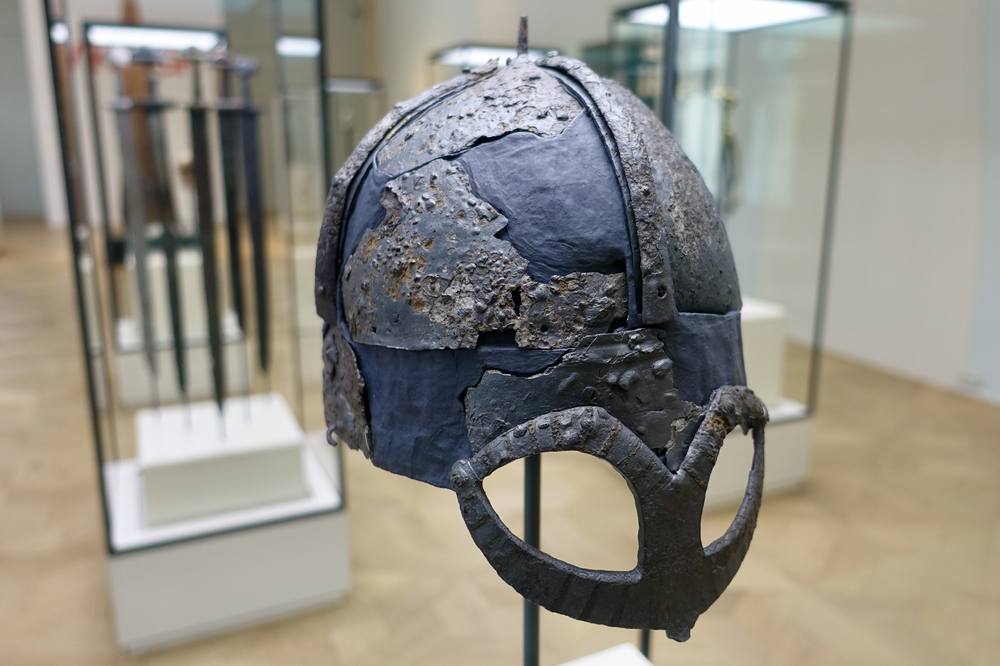
Laser scanning showed that the dancer is missing an eye, apparently removed already on the model from which the bronze was cast. A one-eyed dancer next to a wolf warrior: many scholars read this as Odin leading the wolf-coats into frenzy. The same or very similar scenes are known from helmets in the boat graves of Vendel and Valsgärde in Uppland and from the Anglo-Saxon helmet at Sutton Hoo.
Snorri says Odin's men "bit their shields". That this was a fixed motif and not just a figure of speech for rage is shown by the Lewis chessmen. They were found in 1831 on the Isle of Lewis in the Outer Hebrides: 78 chess pieces, 14 tablemen and a belt buckle, almost all carved from walrus ivory. They were probably made between 1150 and 1200, most likely in or around Trondheim in Norway, although some researchers argue for Iceland.
The rooks in this set are not castles but foot soldiers with shield, helmet and sword, known as warders. Four of them stare wide-eyed while biting the top edge of their shields. No other reading than the berserk has ever gained ground. Today 82 pieces are in the British Museum in London and 11 in the National Museum of Scotland in Edinburgh.
Most of the berserks you will meet live in the Icelandic sagas and the legendary sagas of the thirteenth and fourteenth centuries. And there something striking happens: the king's elite gradually turns into the stock villain.
Egils saga. Right at the start we meet Kveldúlfr, "Evening Wolf", grandfather of the poet Egill Skallagrímsson. He is called hamrammr, "shape-strong": towards evening he grows sullen and drowsy, and people whisper that he then roams about in another form. When he and his son Skalla-Grímr storm a ship, the berserk fury takes hold of them both; afterwards the old man lies exhausted and soon dies. Later Egill himself defeats the berserk Ljótr the Pale in a duel, a man who starts to rage and bite his shield before the fight.
Hrólfs saga kraka. The legendary Danish king Hrólfr kraki has twelve champions, the most famous of them Bǫðvarr bjarki – bjarki means "little bear". In the final battle a huge bear fights in Hrólfr's ranks while Bǫðvarr sits motionless in the hall. When a comrade rouses him, the bear vanishes. Shape-shifting rather than frenzy, but in the medieval imagination the two lay close together.
Why always twelve? Saga berserks rarely come alone; they come by the dozen. Arngrímr has twelve berserk sons who fall on the Danish island of Samsø fighting Hjálmarr and Ǫrvar-Oddr, a story told in both Hervarar saga and Ǫrvar-Odds saga. Twelve is most likely a storytelling convention for a complete retinue, not a muster roll. Yet it preserves an echo of the oldest source: berserks as a unit.
Grettis saga. In chapter 19 the young Grettir is spending Yule at a farm on the island of Haramsøy in Norway when a ship with twelve men lands. Their leaders are the brothers Þórir Paunch and Ǫgmundr the Evil, berserks who plunder farms and carry off women. Grettir tricks them into an outbuilding and kills them. In the 1869 translation by Eiríkr Magnússon and William Morris, they "howled like dogs" when the berserk rage came upon them.
Eyrbyggja saga. On the Snæfellsnes peninsula the chieftain Víga-Styrr is handed two Swedish berserks, the brothers Halli and Leiknir. Halli wants to marry Styrr's daughter. Styrr sets a condition: clear a path through the lava field. They finish it astonishingly fast, but instead of a wedding a scalding bathhouse awaits them, and they are cut down. The lava field is still called Berserkjahraun, and local tradition points to a track through it as their work.
Njáls saga. Around the year 1000 the missionary Þangbrandr travels through Iceland. At a feast the berserk Ótryggr confronts him. Þangbrandr has three fires lit: one hallowed by heathens, one blessed by himself, one left unhallowed. The berserk strides through the heathen fire, balks at the Christian one and is killed. There is more on this saga in our article on Njáls saga.
The pattern is clear: in Iceland the berserk becomes the figure against whom the hero, or the new faith, proves itself. Cleasby and Vigfússon note that saga berserks almost always come from outside, from Norway or Sweden. According to the same dictionary, Vatnsdæla saga even treats berserk-going like a possession cured by a vow.
The clearest sign that berserk-going was more than literature comes not from saga but from law. The law of the Icelandic Commonwealth is known as Grágás ("Grey Goose"), a name covering the legal texts preserved mainly in two thirteenth-century manuscripts. The first written version was begun in the winter of 1117–18.
The Christian Laws Section, the Kristinna laga þáttr, goes back to the bishops Þorlákr Runólfsson of Skálholt and Ketill Þorsteinsson of Hólar. It was drawn up between 1122 and 1133; the legal historian Peter Foote suggests "about 1125". The frequently quoted year 1123 for the "berserk ban" is therefore a simplification: what the evidence gives us is a window, not a date. The section states, in substance, that a man who goes berserk is punished with fjörbaugsgarðr, lesser outlawry, which normally meant three years' exile abroad. Those present incur the same penalty if they do not restrain him, unless they were unable to.
There is a report for Norway as well, though only from saga. Grettis saga says that Earl Eiríkr Hákonarson, who ruled Norway from about 1000 to 1015, abolished duels and outlawed all berserks who raided and disturbed the peace. That is where the year 1015 found in many popular accounts comes from. No law text survives. How law and assembly worked in the North more broadly is explained in Viking Law and the Thing.
The honest answer first: none of the following explanations is proven. They are hypotheses, some well argued, some much less so.
1. Fly agaric (Ödmann, 1784). The Swedish theologian Samuel Ödmann (1750–1829) published an essay in 1784 in the proceedings of the Royal Swedish Academy of Sciences, trying to explain berserk-going through natural history. His idea rested on travellers' reports of Siberian peoples who used the fly agaric mushroom (Amanita muscaria) as an intoxicant. The American neurologist Howard Fabing revived it in 1956, and it has haunted documentaries ever since.
2. Henbane (Fatur, 2019). The ethnobotanist Karsten Fatur of the University of Ljubljana proposed black henbane (Hyoscyamus niger) in the Journal of Ethnopharmacology in 2019. Its alkaloids can cause agitation, hallucinations and reduced sensitivity to pain, and henbane seeds are known from a richly furnished woman's grave at Fyrkat in Denmark; read more in our article on henbane. Fatur himself calls his proposal speculative. Specialists in Oslo objected that no source describes berserks taking anything before battle, and that late medieval medical texts use henbane quite differently.
3. Alcohol. Feasting is part of the saga berserk's entrance; Grettir's raiders get drunk first. As an explanation of frenzy in battle it hardly works: drunk men fight slowly and clumsily.
4. Illness. Epilepsy and mental illness have been suggested again and again. It chimes with the saga observation that the fit is followed by deep exhaustion, as with Kveldúlfr. The psychiatrist Jonathan Shay, in Achilles in Vietnam (1994), compared the berserk state with the hyperarousal of traumatised soldiers. It is a thought-provoking comparison, not a diagnosis; medieval literature cannot be put on the couch.
5. Ritual, trance and group dynamics. The explanation with the widest support among scholars: berserk-going was a practised, ritualised self-arousal. Howling, roaring, shield-biting, animal skins, perhaps dance – techniques by which a group of warriors could push themselves beyond fear and pain. The historian Michael Speidel sees in it a very old Indo-European tradition of "mad warriors". He points, for example, to Tacitus, who around AD 98 describes the Harii with black shields and painted bodies. Whether that line really runs to Hafrsfjord is disputed. In the tenth century a Byzantine book of court ceremonies describes a "Gothic dance" with furs and masks, which some connect with Norse warrior rites – again an interpretation.
This is where certainty ends, and that is part of the story. Almost everything we think we know about berserks stands in thirteenth-century Icelandic prose, written 300 to 400 years after the events, by Christians about a pagan past. The only truly contemporary witness is Haraldskvæði, and it explains nothing; it simply names them.
There is no grave that can be identified as a berserk burial. Bear claws do turn up in Scandinavian cremation graves, but they show bearskins as grave goods, not the dead man's profession. There is no runic inscription calling anyone a berserkr. And there is no eyewitness account of berserk-going.
What remains is still a great deal: a word from the ninth century, images from the sixth and seventh, chessmen from the twelfth, a law banning the behaviour, and a rich saga literature that recasts the berserk from elite warrior to villain. That is not little – it is just something other than what ends up printed on T-shirts. When we engrave a wolf warrior in slate, we do it in the style of the Torslunda plates, not in the style of a TV series.
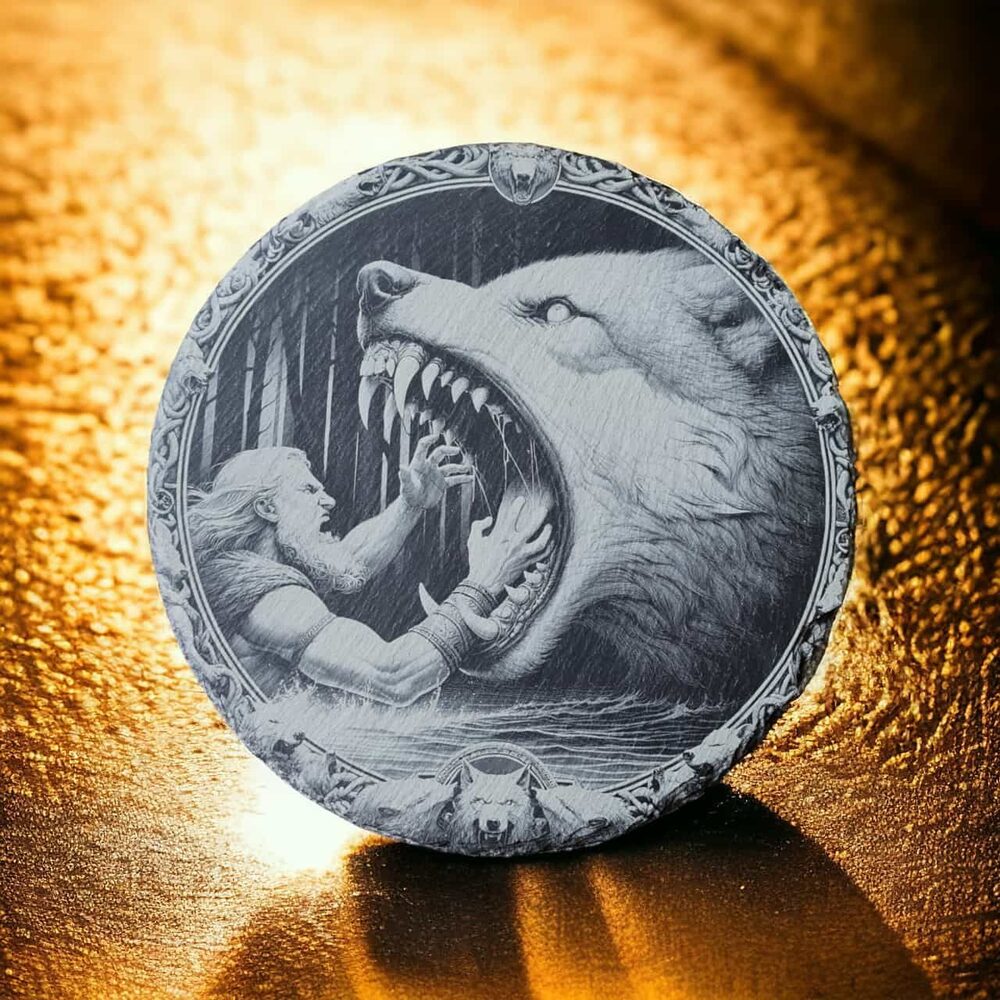
What was a berserker? A berserker was a warrior who fell into a frenzied state in battle, known as berserksgangr. The oldest source, from the late ninth century, shows berserks as an elite unit in the retinue of King Harald Fairhair of Norway.
What does the word berserker mean? Old Norse berserkr most likely means "bear-shirt", a man in a bearskin. The older reading "bare-shirt", a fighter without armour, is now considered less likely.
Did berserkers use mushrooms? There is no evidence for it. The idea goes back to Samuel Ödmann in 1784; no medieval source mentions mushrooms, and the effects of fly agaric fit battle-frenzy poorly.
What is the difference between berserkers and ulfhednar? By name, berserks are bear warriors and ulfhednar "wolf-coats". Both appear side by side in Haraldskvæði, but the sources do not separate them sharply.
When was going berserk outlawed? Icelandic church law, drawn up between 1122 and 1133, punished berserk-going with lesser outlawry. According to Grettis saga, Earl Eiríkr Hákonarson had already outlawed raiding berserks in Norway before 1015.
Were berserkers real? Yes – as a term and as a feared group of warriors they are attested in their own time, and a law banned their behaviour. Much of what is told about them, such as invulnerability or drug-fuelled rage, is legend or modern speculation.
For courage. For remembrance. For legends that live on.
The honest truth: much about the berserkers is interpretation. Where find and text support each other we say “evidence”; where only the saga speaks, or later authors embellish, we say “myth”.
Valhalla was only one of many realms of the dead. The ideas of the afterlife were as varied as the burial customs …
Read more →The most beautiful piece of jewellery in the world belongs to the most beautiful of the goddesses: Brísingamen, the …
Read more →We like to imagine valkyries as noble riders escorting the fallen to Valhalla. The Darraðarljóð shows them quite …
Read more →Some sayings are older than you would guess. What may be the finest words of consolation in the Germanic world sit …
Read more →