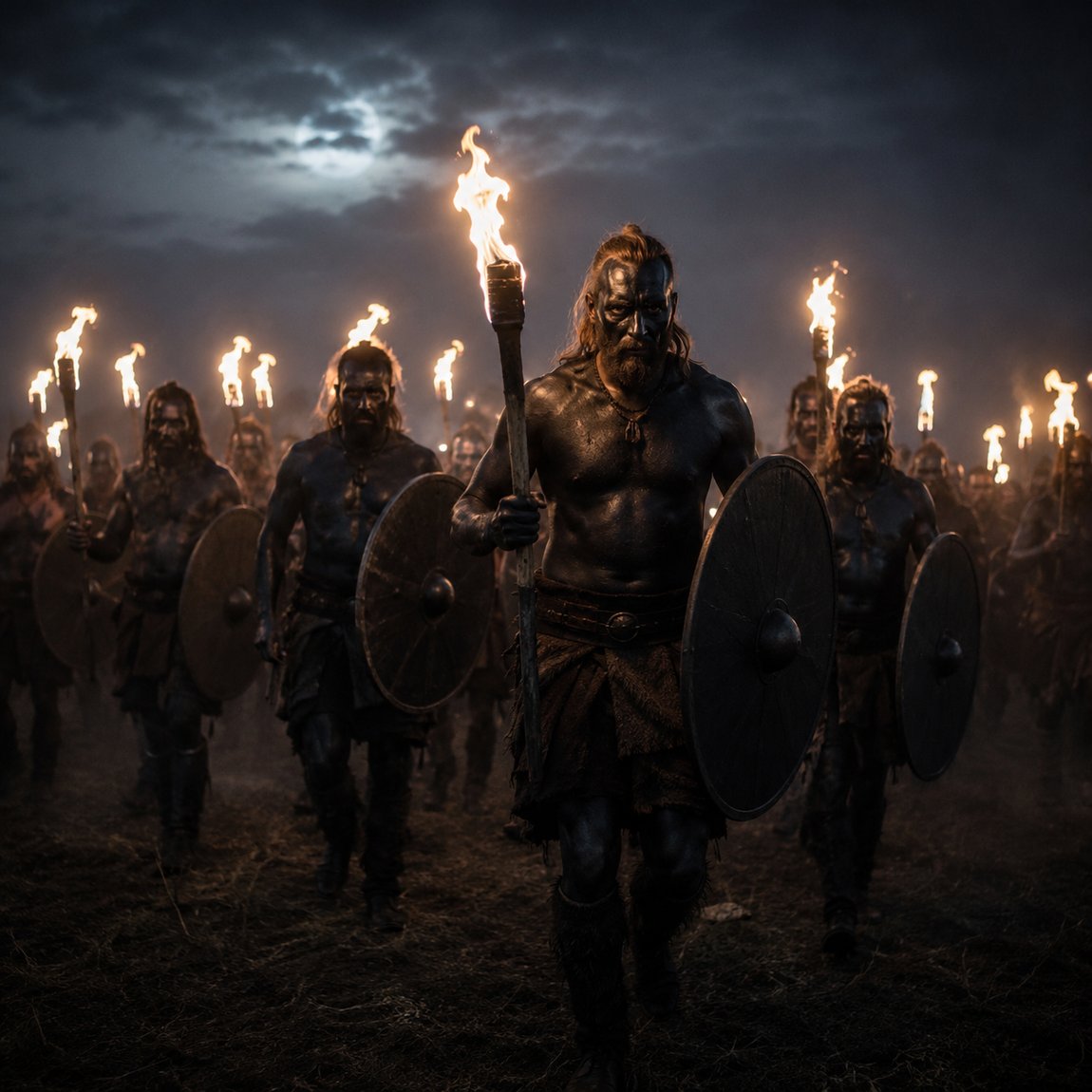
Long before the Vikings, a Roman writer describes a Germanic tribe that defeats its enemies not by number or strength, but by sheer terror: the Harii, who attack as a black-painted army on the darkest nights. They are one of the most haunting figures of the early Germani – and a textbook case of how carefully one must read the sources.
Our only real source is the Roman historian Tacitus in his Germania (AD 98, chapter 43). He counts the Harii among the East Germanic Lugii, somewhere in what is today east-central Europe. What he writes about them has burned itself deep into memory.
„Black are their shields, their bodies painted; they choose dark nights for battle, and by the very dread and shadow of a ghostly army they strike terror.“
— Tacitus, Germania 43 (after a public-domain translation)
Tacitus calls them a feralis exercitus – an „army of the dead“ or „ghost army“. No enemy, he writes, can withstand this strange, well-nigh infernal sight.
The Harii were a Germanic tribe of the East Germanic Lugii confederation between Oder and Vistula. Tacitus describes them in his "Germania" as especially wild – a people who made war a stage of terror.
According to Tacitus the Harii blackened their shields, dyed their bodies dark and chose dark nights for their attacks. Thus they appeared to the enemy like an "army of the dead" (feralis exercitus) – a ghostly apparition that paralysed by its very sight.
The tactic of the Harii aimed at fear: no army, according to Tacitus, could withstand the unaccustomed, as it were hellish sight. Whether real war custom or Roman embellishment – the image of the nocturnal army of terror has left a deep mark.
Some connect the Harii with ideas of the "Wild Hunt" and Odin's nocturnal procession of the dead. A direct connection is not attested – but the motif of the ghostly warriors fascinates to this day.
It is precisely here that the fascination of the Harii lies: they show how old the idea of the „transformed warrior“ in the Germanic world may be – and at the same time how much we honestly do not know. A good example of why we always keep myth and evidence cleanly apart.
Berserkers & Úlfheðnar · The Germanic tribes · Walhall & the Einherjar · Odin.
Tacitus, Germania (AD 98, ch. 43), public-domain translation. Scholarship: Rudolf Simek, Lexikon der germanischen Mythologie; Otto Höfler, Kultische Geheimbünde der Germanen (1934, to be read critically); more recent critical assessments in Walter Pohl and others.
All History & Finds articles →
The most famous eyewitness account of the Vikings comes not from the North, but from Baghdad. In 921 the Caliph sent …
Read more →Carved in stone over 1,000 years ago, a king proclaims the unification and baptism of Denmark – the same king whose …
Read more →Long before the Vikings they settled between the Eifel and the Danube, leaving behind gold hoards and princely graves …
Read more →Without their ships the Vikings would never have become Vikings. The longship was the high technology of its time …
Read more →