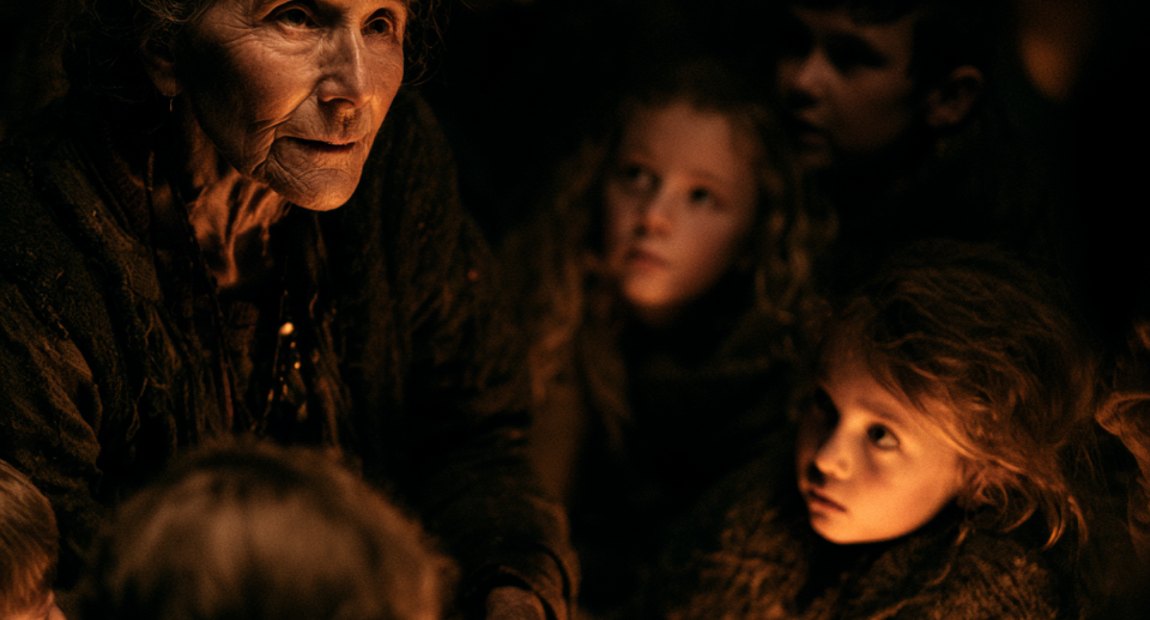
Some sayings are older than you would guess. What may be the finest words of consolation in the Germanic world sit inside a poem more than a thousand years old – spoken by a singer who has just lost everything. „Deor" is short, unsentimental and honest, and its refrain still holds: even the hardest things pass.
Picture a hall: smoke-dark beams, a hearth fire burning slowly down, and a man with a lyre resting on his knees. His name is Deor, and for years he was his lord's court poet – the man whose verses made the deeds of the family immortal, who was paid for fame with land, rings and a firm seat by the high place. And then another came. A rival named Heorrenda, more skilful or younger or simply better connected, took the lord's favour from him – and with it his land and his rank.
Out of this very human wound grows one of the most moving poems of the Germanic North. „Deor" is no boast of heroes and no battle song. It is the quiet, almost defiant meditation of a man who realises he has hit rock bottom – and painfully pulls himself upright again by looking back at all who suffered before him and whose suffering nevertheless once ended.
What makes „Deor" special is its form. Old English poetry barely knows stanzas, and certainly no recurring refrain – it flows on in long, alliterating lines. „Deor," by contrast, is divided into sections, and every section ends with the same sentence. In Old English it runs: „þæs oferēode, þisses swā mæg." Roughly: „That passed away, so may this."
Think of it as a deep, steadying breath. The singer names a misfortune, looks at it calmly – and then lays this line over it like a hand on the shoulder. Not „everything will be fine." Not „it wasn't so bad." But soberly: this too is finite. It is exactly this restraint that makes the comfort so believable. It promises nothing it cannot keep. It only says what anyone who has walked through a dark stretch of life knows afterwards.
„þæs oferēode, þisses swā mæg." – „That passed away, so may this."Deor, Exeter Book (late 10th c.), Old English, public domain
How does a person console himself once he has lost his footing? Deor does something wise: he does not make his misfortune larger, he places it in context. Instead of spiralling into self-pity, he calls up the great suffering figures of Germanic legend – people whose distress was far heavier than his, and whose stories he and his listeners all knew.
There is Weland the smith, captured and crippled by a cruel king who kept him alive only for his masterful hands. There is Beadohild, Nithhad's daughter, plunged by Weland's revenge into shame and pregnancy, who lives on all the same. There is the Gothic ruler Theodoric (Þeodric), and there is the notoriously cruel Eormanric, under whom his subjects suffered as under a wolf. After each of these names comes the refrain. It is as though the singer raises a whole chain of witnesses: look here, their suffering was vast too – and theirs also came to an end.
To truly understand „Deor," you have to know what a singer was in the Germanic North. He was called a scop. He was not merely entertainment after the mead, but the living archive of the community. In a world without books, the scop carried the genealogies of kings, the names of heroes and the memory of past battles in his head. Whoever rewarded him bought lasting fame; whoever cast the singer out risked slipping out of memory altogether.
That is exactly why Deor's fall stings so much. He is not just some dismissed employee. He is the man who made others immortal – and who now threatens to vanish himself. That he, of all people, composes a poem about the passing of grief carries a fine irony: his song of consolation outlasted him. The rival Heorrenda is a footnote; Deor's refrain lives.
„Deor" does not stand alone in the Exeter Book. A few pages away lies a sister poem that shows the same world from a different angle: „Widsith," the „far-travelled." Here too a scop speaks in the first person, but instead of lamenting he boasts of his journeys across the whole Germanic world. Widsith lists around seventy peoples and sixty-nine heroes, from Attila and the Gothic king Eormanric to Hrothgar – as if the singer were a walking register of fame and lineage.
The two poems belong together like two sides of a coin. Widsith shows the singer at the height of his power: celebrated, showered with gifts, master of the collective memory. Deor shows him in his fall: forgotten, replaced, thrown back on himself. Read both, and you understand how closely fame and ruin sat together in this culture – and why a singer knew so precisely about both.
„Deor" survives in a single place: the Exeter Book, an anthology manuscript of Old English poetry dated to the late 10th century (around 970) and held in the Cathedral Library of Exeter. Certain is its unusual form: a poem of about 42 lines divided into sections with a recurring refrain – a rarity in Old English literature. The legendary figures it names are also attested as fixed parts of Germanic tradition: Weland the smith and Beadohild link „Deor" to the Völundarkviða of the Poetic Edda, Theodoric and Eormanric to the Dietrich and Ermanaric material that „Widsith" knows as well. The refrain survives in its Old English wording and is in the public domain.
As clearly as the text lies before us, much remains open. It is worth naming that honestly, rather than filling the gaps with pleasant guesses.
Whether „Deor" was a real court singer is unknown. The name means roughly „the animal" or „the wild one" in Old English and could just as easily be a literary persona as an actual poet; the poem is the only source that names him at all. The narrated situation too – dismissal in favour of the rival Heorrenda – cannot be verified historically. Important, moreover, is the difference between material and manuscript: the legends of Weland, Theodoric and Eormanric are centuries older than the Exeter Book; the poem itself was probably composed well before 970 and merely written down then. No one knows an exact date of origin. And the often-quoted „universal comfort" is a modern reading: for a 10th-century audience the refrain sat within a concrete, heroic and fateful worldview, not in the language of today's self-help.
There are sentences you cannot improve. „That passed away, so may this" is one of them. It is over a thousand years old and sounds as if it occurred yesterday to someone who has just made it through a hard night. That is precisely its power: it consoles without sugar-coating. It takes the suffering seriously – and sets against it the one reliable truth no one can refute, namely that nothing lasts forever, not even the darkness.
For us as a workshop, such a sentence is more than a fine quotation. Words engraved into slate or wood are meant to carry when things get hard – as a quiet anchor on a desk, as a keepsake, as a greeting to someone going through a dark stretch. Deor's refrain is among the few sayings dignified enough for that: no pathos, no kitsch, only an old, honest comfort. The singer who first spoke it long ago outlasted his own suffering – his line remained. Perhaps that is the best proof that he was right.

The Edda · Seiðr – the magic · The Norns · Sigurd the dragon-slayer · Runes & their meaning.
A ring from which ever new rings arise: Draupnir is Odin’s golden treasure and one of the most striking images of Norse …
Read more →A tree carries the world – but what waters the tree? Beneath the roots of Yggdrasil lie three springs, and each tells a …
Read more →Almost everything we know about the Norse gods we owe to two books from medieval Iceland. A look at the sources – and …
Read more →He was warrior and poet, killer and grave-robber, farmer and man skilled in magic – and probably the greatest skald of …
Read more →