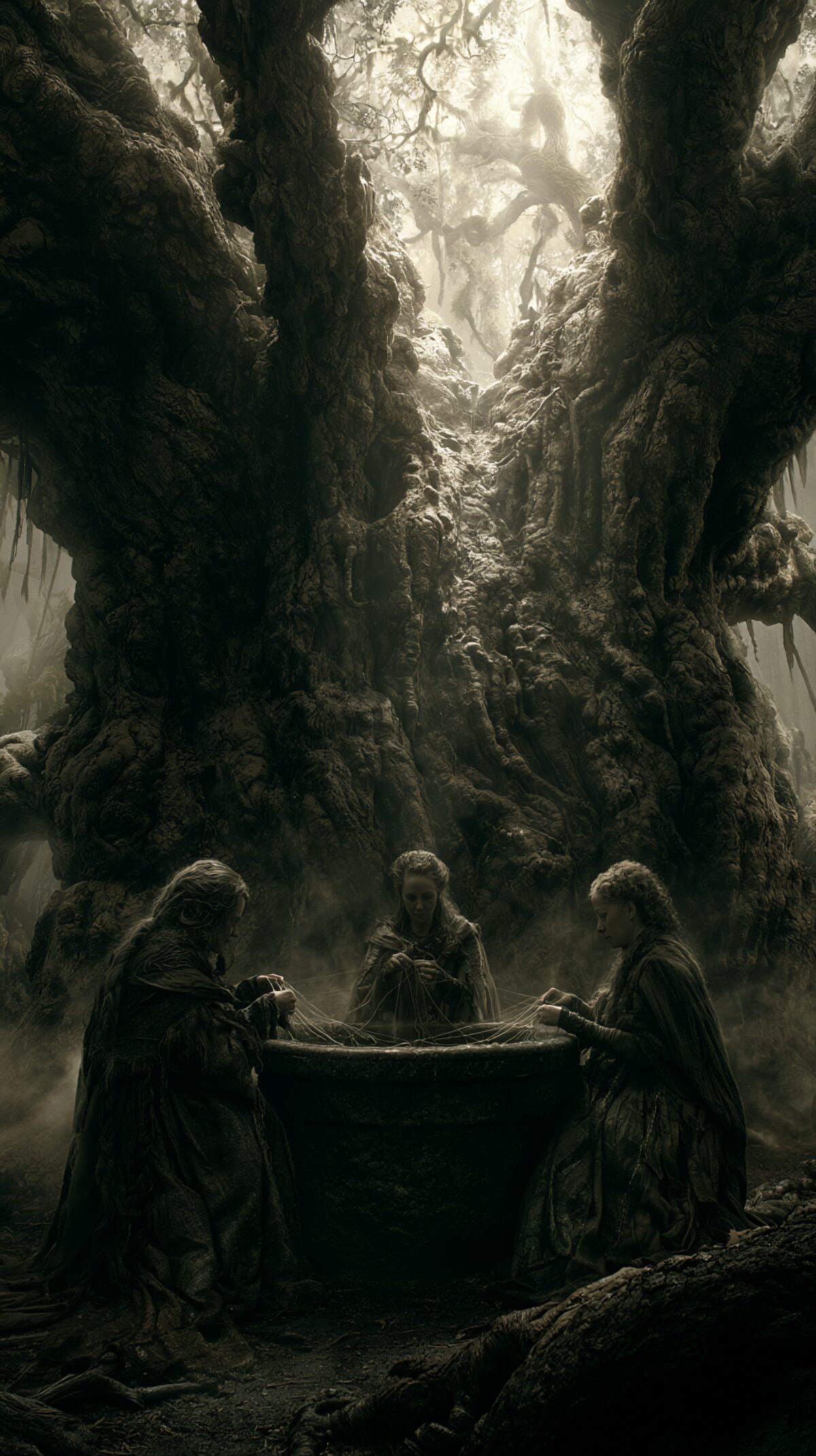
Above the gods stands fate – and it has many shapes. This large overview reaches far beyond the three famous Norns: to the many Norns of different descent, their work at the Well of Urðr, at the cradle and above the gods – with sources and an honest separation of evidence from later interpretation.
The Norns are the fate-women of Norse mythology. Three of them stand out: Urðr (that which has become), Verðandi (that which is becoming) and Skuld (that which shall be). They dwell at the Well of Urðr beneath the world-ash Yggdrasil and determine the fates of humans and gods alike.
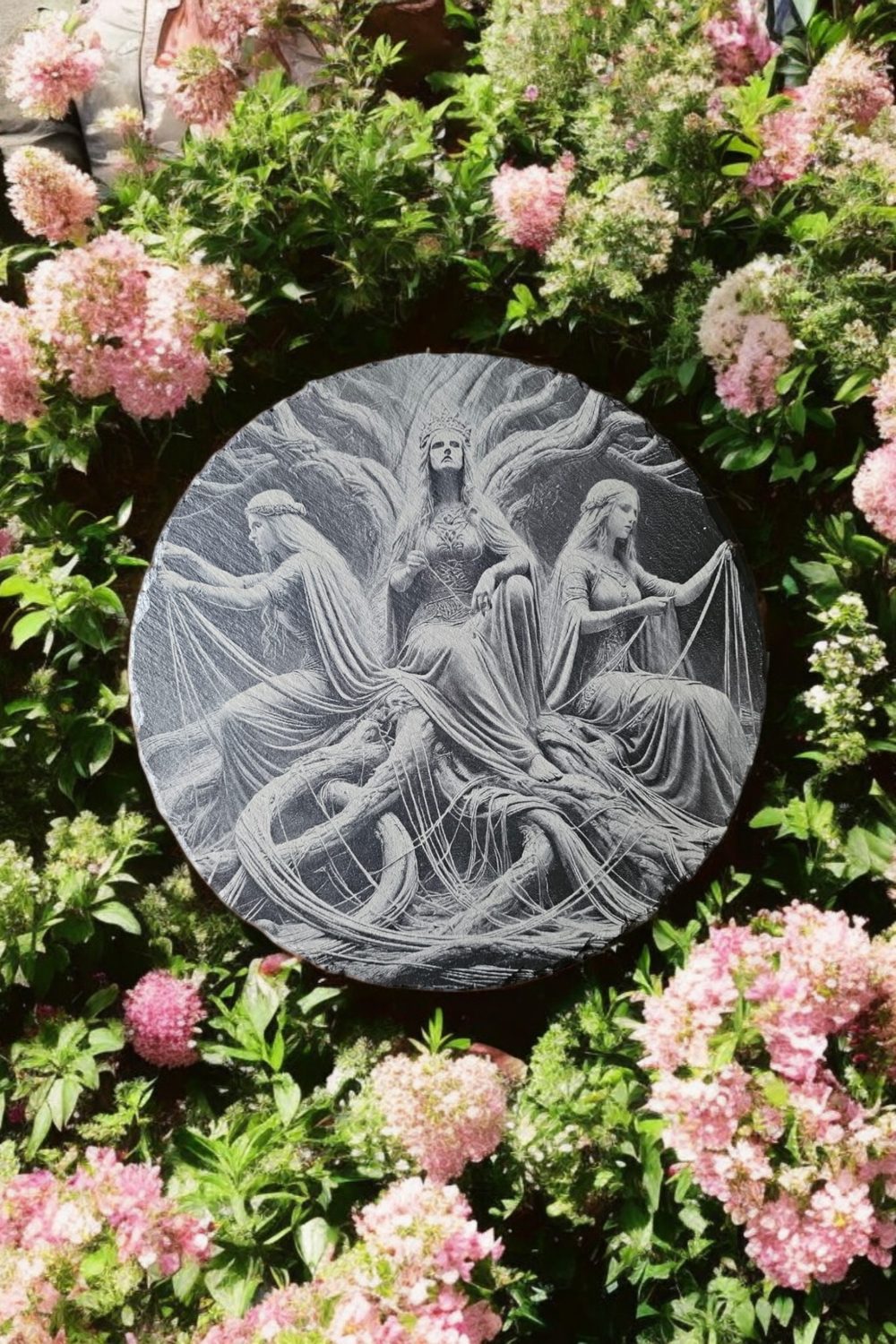
The Norns (Old Norse nornir, singular norn) are the female powers of fate in Norse mythology. In the surviving texts they appear as beings who set the course of a life — not as goddesses to whom one sacrifices, but as an authority standing above everything, even above the gods. Where Odin strives for knowledge and power, the Norns are the ones who have already decided what shall come to pass. The word that describes their work at its core is ørlǫg: literally the „primordially laid down", that which is „laid out from the beginning" — in other words, what has been allotted to a person. It can be rendered as „fate" or „lot", yet the literal sense is more concrete and more quiet: it is what holds true because it was laid down.
This is exactly where an honest framing is worth having from the outset. When people today think of the Norns, they usually picture something very tidy: three women who stand for past, present and future and together spin the thread of every life. The image is memorable — but it is an order that does not appear so clearly in the oldest sources. The medieval texts speak sometimes of three named Norns, sometimes of many nameless ones; sometimes they appear at the birth of a child, sometimes at the root of the World Tree. The sources never fixed a unified „system". Much of what we today take for settled knowledge was first ordered by Snorri Sturluson in the 13th century and later sharpened further by poets and scholars.
This does not diminish the Norns — on the contrary. It makes them more honestly tangible: as an old idea that every person is allotted a measure they did not set themselves, and which they can nonetheless bear with dignity. This thought runs through the whole of Old Norse poetry. And it begins with three names.
The three best-known Norns are called Urðr, Verðandi and Skuld. Their key passage is stanza 20 of the Völuspá, the great prophetic poem of the Poetic Edda. There we are told that three „maidens" (meyjar) come from the lake beneath the World Tree. They bear names, they cut marks into wood, and they determine the life of the children of men — the ørlǫg.
Thence come the maidens / mighty in wisdom, / three from the dwelling / down 'neath the tree; / Urth is one named, / Verthandi the next, — / on the wood they scored, — / and Skuld the third. / Laws they made there, / and life allotted / to the sons of men, / and set their fates.Völuspá 20, in the translation by Henry Adams Bellows (1923, public domain)
Two things stand out in this stanza. First: the Norns „scored on the wood" — Old Norse skáru á skíði, meaning they cut or carved marks onto a piece of wood. Their action is not described as spinning but as inscribing and fixing. Second: they „made laws" and „allotted life" — precisely the formula of ørlǫg. The stanza therefore shows the Norns as those who lay down the measure for every human being.
The names themselves are readily explained through language. Urðr belongs to the verb verða „to become, to happen" and means that which has become. The name is cognate with Old English wyrd, which likewise means „fate, that which has become". Verðandi is grammatically the present participle of the same verb — thus „that which is becoming". Skuld belongs to skulu „shall, to owe" and means that which is to be, what is still outstanding; the same root gives us English „should" and „shall". From this linguistic triad — the become, the becoming, the to-be — the familiar reading of past, present and future almost follows of its own accord.
Yet caution is needed here. Of the three, only Urðr is a truly old, independent figure attested outside this trio as well: the well beneath the World Tree is named after her (the Urðarbrunnr), and her name lives on in Old English wyrd. Verðandi, by contrast, appears virtually only in this one place in the Völuspá. Several scholars, among them Rudolf Simek in his Dictionary of Northern Mythology, consider it possible that Verðandi was coined for this very verse in the first place — as a linguistically fitting middle term between Urðr and Skuld, rather than as a figure handed down from cult.
What is attested: in Völuspá 20, three Norns are named — Urðr, Verðandi and Skuld — who come from the lake beneath the tree, cut marks into wood and lay down the ørlǫg of humankind. The etymology of the names (to „become" and „shall/owe" respectively) is well founded linguistically.
A note of caution: the neat equation „three Norns = past, present, future" is a plausible reading, but it is not the express concern of the source — the stanza itself assigns no tenses. Only Urðr is securely attested outside the triad; Verðandi occurs almost solely here and may be a learned coinage of the verse. The three names should therefore not be presented as a fixed, universally valid „model of time".

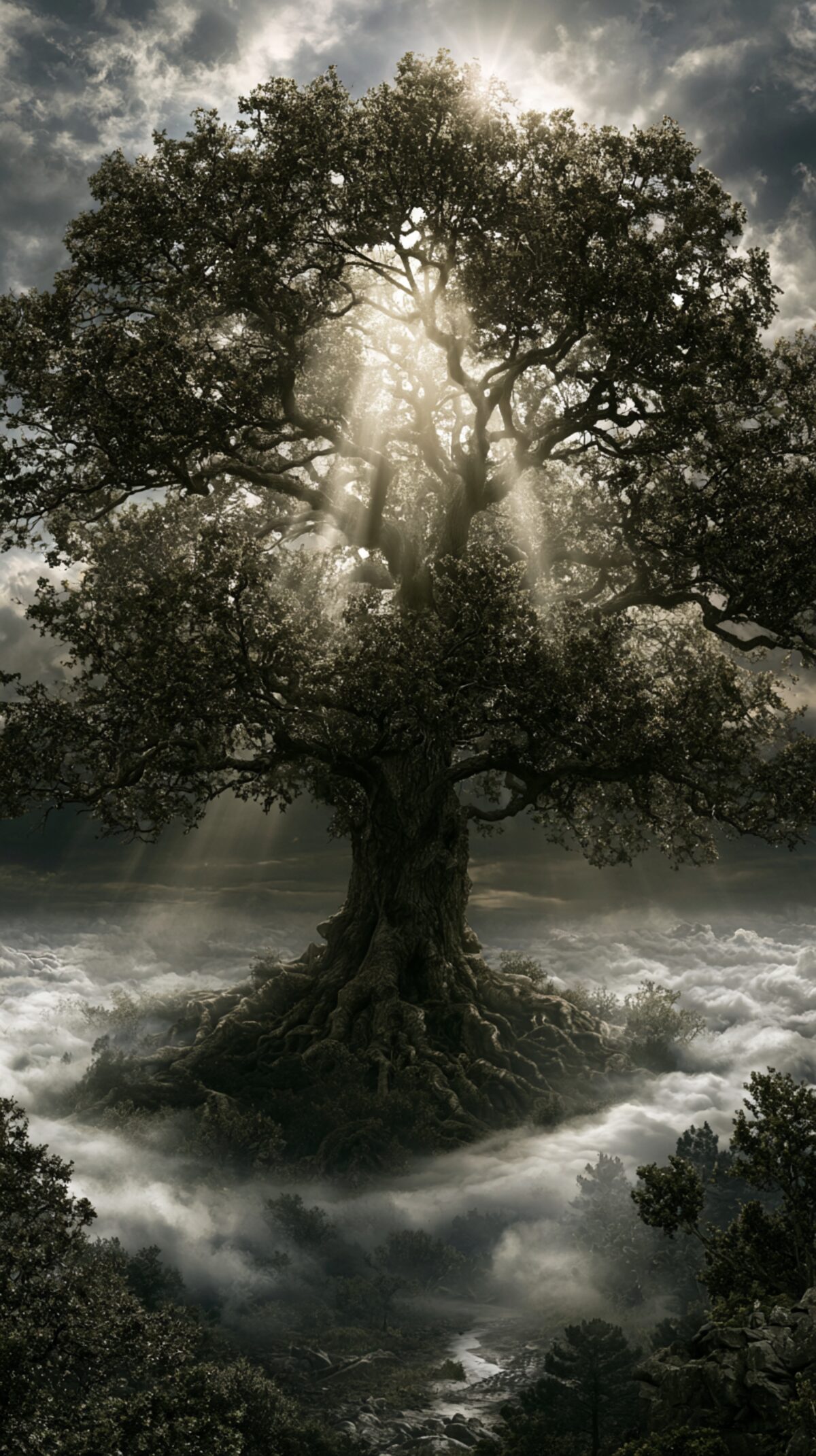
Where the Norns dwell is told most fully by Snorri Sturluson in the Prose Edda, in the section Gylfaginning (chapters 15 and 16). There he describes the three roots of the World Ash Yggdrasil. One of these roots reaches to humankind, and beneath it lies a sacred well: the Urðarbrunnr, the „Well of Urðr". At this place the gods hold their court each day; they ride down the bridge Bifröst to the well. And there, Snorri says, three maidens dwell — and he names them Urðr, Verðandi and Skuld.
Snorri adds a striking image: the water of the well is so holy that everything which enters it turns white — as white as the fine skin that lies within an eggshell. The Norns draw from this well and each day sprinkle the root of the tree with it, together with the white clay (Old Norse aur) that lies around the well. In this way they keep the branches from rotting or withering. The World Tree is thus kept alive not by magic but by steady, almost farmerly care — day after day, the way one waters a tree that has been entrusted to one's keeping.
An ash I know, / Yggdrasil its name, / with water white / is the great tree wet; / thence come the dews / that fall in the dales, / green by Urth's well / does it ever grow.Völuspá 19, in the translation by Henry Adams Bellows (1923, public domain)
This stanza of the Völuspá stands immediately before the Norn stanza and prepares it: first the evergreen tree above the Well of Urðr is shown, then the three women emerge from it. Snorri's prose description plainly builds on this older poem, but joins the individual images into one ordered scene: the court of the gods, the dwelling of the Norns, the daily tending of the tree, the whitening water. From this one can see clearly how Snorri works — he gathers scattered poetic images and assembles them into a coherent whole. That makes his account both valuable and something to read with care: much of it is the ordering synthesis of the 13th century, not the verbatim rendering of an ancient article of belief.
What is attested: Snorri, in Gylfaginning 15/16, places the Urðarbrunnr beneath one root of Yggdrasil, makes it the court-place of the gods and the dwelling of the three Norns, and describes how they sprinkle the tree daily with water and white clay so that it does not decay. Völuspá 19 already knows „Urth's well" beneath the evergreen tree.
The central action of the Norns is not spinning but fixing. Again and again we are told that they „lay down" fate (leggja ørlǫg), that they „cut" or „carve" it (skera, rísta), that they „determine" a life. In the Völuspá, as we saw, they cut marks into wood. This is a highly concrete idea: fate is set like an inscription — something written in that holds firm.
Alongside this stands a second image familiar to the poetry: the twisting or winding of threads of fate. The finest passage for this is found in the first Helgi lay (Helgakviða Hundingsbana I). When the hero Helgi is born, the Norns come in the night and twist for him mighty threads of fate. They draw out the golden threads and fasten them to all the quarters of the sky — an image of the wide, glorious lot allotted to this child.
In the dwelling then / was night, and the Norns / came, they who shaped / the life of the prince; / they bade him be / the most famous of chiefs, / and of leaders all / to be held the best. With all their might / the threads of fate / they twisted... / the golden threads / they fastened fast / amid the moon's great hall.Helgakviða Hundingsbana I, sts. 2–4, in the translation by Henry Adams Bellows (1923, public domain)
An important clarification is due here, because a particularly stubborn modern image has settled around the Norns. The popular motif of three women who spin and weave a person's life-thread and finally cut it through derives, in this closed form, rather from the Greco-Roman idea of the Moirai, or Parcae. In the oldest Norse sources, weaving is only weakly attested for the Norns themselves. Where the North actually works at the loom, it tends to be the Valkyries: in the Darraðarljóð, the grim weaving-song from Njáls saga, Valkyries weave the fabric of battle from entrails and human heads. With the Norns, by contrast, cutting, carving and laying predominate — and, as in the Helgi lay, the twisting of threads.
The distinction is no hair-splitting. It noticeably changes the picture: in the sources the Norns are less the quiet spinners at the wheel than beings who set the lot — inscribe it, twist it, fasten it. This fits a view of the human being that runs through the whole of Old Norse poetry: one cannot choose one's own lot. But one can decide how to carry it.
A note of caution: the common image „the Norns spin and weave the thread of life and cut it through at the end" is a later, strongly Moirai-/Parcae-influenced sharpening. In the oldest Norse sources the Norns above all cut/carve (marks into wood), lay down (the ørlǫg) and twist (threads of fate); the actual weaving there belongs rather to the Valkyries (Darraðarljóð). The two motifs should not be conflated, and spinning should not be presented as an Old Norse attestation.
When people hear „norns," they almost always picture exactly three: Urðr, Verðandi and Skuld at the well beneath the world-tree. Yet the sources themselves paint a far larger picture. The clearest passage comes not from a poem about the gods, but from the mouth of a dying dragon. In the Fáfnismál (stanzas 12–13) the young Sigurd sits beside the mortally wounded Fáfnir and seizes the chance to draw wisdom from the old creature. Of all things, he asks about the norns who help women in childbirth — and Fáfnir's answer is one of the most important lines in the whole tradition.
Tell me then, Fafnir, for wise thou art famed, / And much thou knowest now: / Who are the Norns who are helpful in need, / And free the child from the mother? Of many births the Norns must be, / Nor one in race they were; / Some to gods, others to elves are kin, / And Dvalin's daughters some.Fáfnismál 12–13, translation Henry Adams Bellows 1923 (public domain)
The key Old Norse phrase is sundrbornar mjǫk — „born very apart," of quite different descent. Fáfnir puts it plainly: the norns are not of one kindred. Some are of divine kind (of the Æsir), some of elvish kind (of the Álfar), and some are dvalins dœtr, the daughters of the dwarf Dvalinn. The three famous sisters at the well are therefore only the best known among many. „Norn" is not a fixed trio but a whole class of fate-beings — with members drawn from three different spheres of the Norse world: the gods, the elves and the dwarfs.
Evidence: The Fáfnismál belongs to the heroic lays of the Poetic Edda and states outright that the norns are many and „sundrbornar" — of differing descent (Æsir, Álfar, daughters of Dvalinn). That Fáfnir gives this answer to a question about childbirth ties the norns directly to the fate of the newborn.
Interpretation: The text does not say why a norn's descent should matter. The common reading — divine norns give good lots, elvish or dwarfish ones harsher fates — rests on Snorri's later system (see below), not on the Fáfnismál itself. Fáfnir's verse proves the plurality and the differing origins; the value judgement „good or ill according to descent" is a thirteenth-century addition.
The Icelandic scholar Snorri Sturluson takes up exactly this image and orders it. In the Gylfaginning (chapter 15) he explains that there are far more norns than the three at the Well of Urðr. To every human being who is born a norn comes, to shape that person's life. And because these norns are of such varied descent, the lots they assign turn out so varied too.
Snorri distinguishes three groups — entirely in Fáfnir's sense: divine norns, those of the kindred of the Álfar, and those of the kindred of the dwarfs. His conclusion is both comforting and hard: good norns, of good descent, shape a good life; but the people who fall into misfortune, that is brought about by ill norns. A hard fate, then, is not necessarily a punishment or a personal failing — it is simply the norn who fell to that person's lot.
Evidence: Gylfaginning 15 explicitly names many norns, their threefold descent (gods/Álfar/dwarfs), and the link between a norn's origin and the goodness of the life-lot. The text also ties the norn directly to birth: she comes „to every person who is born."
Interpretation: Snorri's neat division into „good" and „ill" norns is a systematisation of the early thirteenth century. He gathers the scattered older ideas — the many, differently natured beings of the Fáfnismál — into an ordered doctrine. It should be read as Snorri's interpretation, not as „the" heathen dogma. Explaining a hard life as the work of a particular norn is a wise and humane reading, but it is a reading.
The most vivid and popular idea is that of the norns at the bed of the woman in labour and at the cradle of the child. They appear at birth and settle what will become of the newborn. This connection runs right through the sources — and it explains why Fáfnir was asked about „need-going" norns in the first place.
The classic „many norns" story is the Nornagests þáttr, the tale of the „Norn-Guest." Here — as Nornagestr himself recounts, looking back at the court of King Óláfr — prophesying women travelled the land, vǫlur or norns, and were summoned to the cradle of a newborn child to set its fate. Two of the women spoke good things over the boy. The youngest, however, jostled from her seat in the crowd and offended, spoke a curse: the child should live no longer than the candle burning beside him. Then the eldest of the women stepped in, quenched the candle at once, and gave it to the mother with the instruction to keep it safe and never light it again. So the child escaped the curse — and bore ever after the name Norna-Gestr, „Guest of the Norns." He grew very old; only at the end of his long life, long since baptised, did he light the candle himself — and he died as it burned down.
That such helpful beings were called upon in the distress of childbirth is shown too by the Oddrúnargrátr. When Borgný is at last delivered after hard labour — Oddrún has stood by her with „bitter charms" — the labouring woman blesses her helper and calls upon the kindly powers:
So may the holy ones give thee help, / Frigg and Freyja and favouring gods, / as thou hast turned this danger from my hands.Oddrúnargrátr 9, after Henry Adams Bellows 1923 / rendering by Glanz & Gravur
Here gracious beings (hollar vættir) stand beside Frigg and Freyja — the female protective powers of birth form a whole field in which norns, dísir and goddesses interlock. The same domain is touched by the Sigrdrífumál. Among the rune-teachings the valkyrie Sigrdrífa gives to Sigurd are the bjargrúnar, the helping- or birth-runes:
Birth-runes learn, if help thou wilt lend, / The babe from the mother to bring; / On thy palms shalt write them, and round thy joints, / And ask the fates to aid.Sigrdrífumál 9, translation Henry Adams Bellows 1923 (public domain)
Evidence: Three independent texts link female fate- and protective powers with birth: the Nornagests þáttr (travelling norns at the cradle, the candle curse), the Oddrúnargrátr (invocation of hollar vættir, Frigg and Freyja at the delivery) and the Sigrdrífumál (the bjargrúnar/birth-runes with the plea to the dísir for help). Childbirth appears throughout as a field of female superhuman powers.
Interpretation: The Nornagests þáttr is a later, literarily embellished tale; the three women there are called partly vǫlur (seeresses), partly norns — the line between norn, seeress and guardian spirit is fluid. The motif of the life-candle has a fairy-tale character (a similar one is known from later European stories) and should not be read as a literal ritual report. Equating the „hollar vættir" of the Oddrúnargrátr with norns is likewise an interpretation; at that point the text names Frigg and Freyja, not the norns.
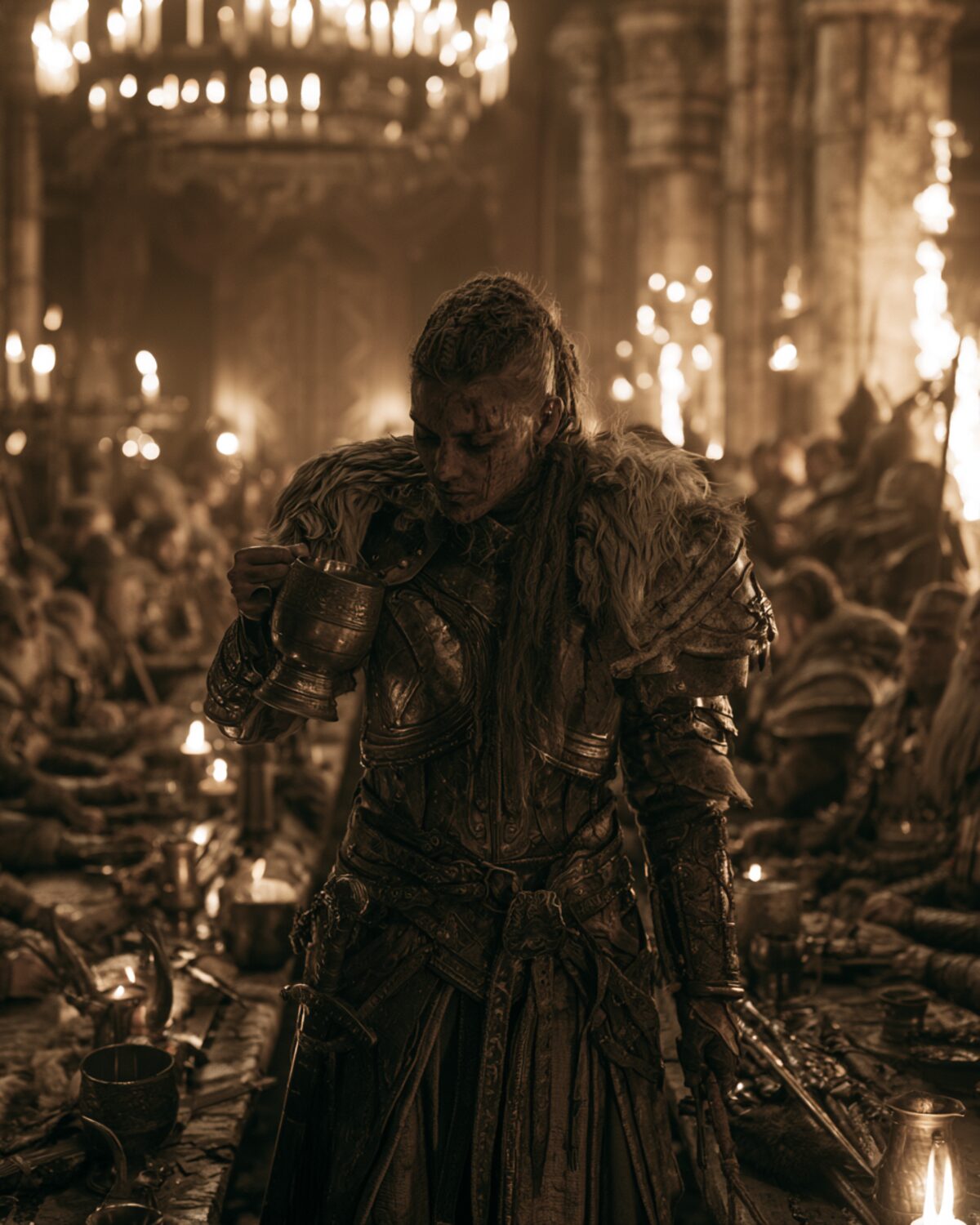
One especially telling case shows how permeable the boundary between the female fate-powers is: the name Skuld. From the Völuspá Skuld is known as one of the three great norns. Yet the same Völuspá (stanza 30) also names a Skuld among the valkyries who ride over the battlefield — beside Skǫgul, Gunnr, Hildr, Gǫndul and Geirskǫgul, the riders of Odin.
Snorri carries this doubling further in the Gylfaginning (chapter 36). Listing the valkyries whom Odin sends to every battle, he names among them expressly „the youngest norn, who is called Skuld." These valkyries, he writes, always ride out „to choose the slain and to govern the killings." Skuld is thus the one figure who appears in the sources at once as a norn and as a valkyrie.
Evidence: Völuspá 30 lists a Skuld among the valkyries; Gylfaginning 36 names „the youngest norn, who is called Skuld" expressly among the valkyries and credits them with choosing the fallen. The name Skuld thus demonstrably appears in both roles.
Interpretation: Whether the norn Skuld and the valkyrie Skuld are the same figure the sources do not say — it remains open. It may be that two traditions here converge under one name; it may also be that the tradition deliberately did not draw a sharp line between norns and valkyries. Scholars such as Rudolf Simek point out that norns, valkyries, dísir and fylgjur form one shared circle of female fate-beings whose edges blur. Skuld is the clearest proof of that permeability.
One of the most striking features of Norse tradition is that its highest powers are not the gods. Above the Æsir and Vanir lies ørlǫg — that which is „laid down" from the beginning, the appointed lot. And it is the Norns who lay down that lot. In the order of the world they therefore stand above the entire pantheon: even Odin, the knowing one, who pledges his eye at Mímir's well to learn what is coming, cannot turn that coming aside.
Nothing shows this more clearly than the end of the world. Odin knows that at Ragnarök the wolf Fenrir will devour him. He gathers fallen warriors in Valhalla, he questions the dead, he buys knowledge at any price — but he does not buy himself a different outcome. Wisdom does not change the lot; it only makes the one who bears it clear-eyed about it. In the wisdom poems of the Edda, in Vafþrúðnismál and in the Völuspá, Odin's search is therefore always also a search for his own end, which he knows and yet does not evade.
Evidence: In eddic poetry the doom of the gods is foretold and spoken by a seeress or in the contest of wisdom (Völuspá; Vafþrúðnismál). Odin acquires knowledge — the eye at Mímir's well, the runes, the counsel of the dead — yet no text lets him change his fate by it. Scholarship (among others Rudolf Simek) accordingly describes ørlǫg as a power that stands prior to the world of the gods.
„Fate" here should not be confused with the modern cliché of paralysing fatalism. The Norse stance is soberer and, in its way, more grown-up: you cannot choose the day of your death — but you can choose how you meet it. That is exactly the point of the best-known verse of the Hávamál: everything perishable perishes; only the judgement passed on a person, their renown, endures.
Cattle die, / and kinsmen die, / and so one dies one's self; / one thing I know / that never dies: / the fame of a dead man's deeds.Hávamál 77, translation Henry Adams Bellows 1923 (public domain)
Seen in this light, the Norns are not malevolent puppeteers but the quiet boundary of human power. They set the frame; how one fills it is left to each individual.
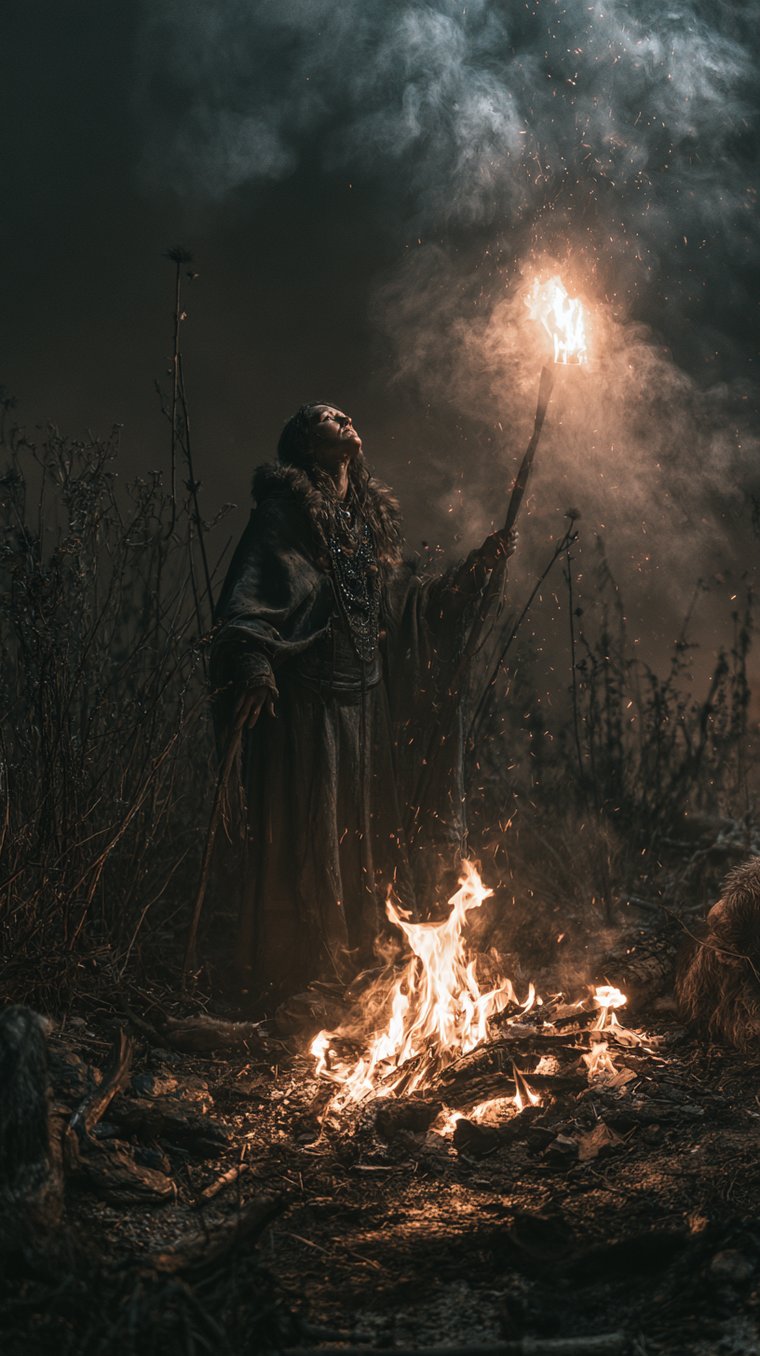
The Norns do not stand alone. The North knows a whole company of female powers of fate, and the boundaries between them are fluid — not because we cannot separate them cleanly today, but because the sources themselves do not separate them cleanly.
First there are the Dísir, female protective and ancestral spirits of a family, honoured in autumn with a sacrifice of their own, the Dísablót. They can protect, but they can also turn away and then herald misfortune. Then there is the Fylgja — literally „the follower", a personal attendant spirit who often appears in the shape of a woman or an animal, and whom, in the sagas, one not seldom glimpses shortly before death. And there is the Hamingja, the luck-and-fate force of a person or a whole family, which can even be inherited or pass over to others.
Evidence: Dísir, Fylgja and Hamingja are notions attested in sagas and eddic texts; the sources use the terms in partly overlapping ways. That a passage may mean a Norn, a Dís or a Fylgja without the assignment being decidable is a recognised finding in scholarship — the blur lies in the medieval testimony itself, not in a modern imprecision.
For our subject this means: in Norse thought „Norn" is not a sharply bounded office but a node in a web of fate-setting female figures. Anyone who wants to understand the Norns should keep this company in mind — without smoothing it into a tidy system that the sources never knew.
The belief that fate-setting women stand at the beginning of a life is not confined to the far North. It is more broadly Germanic and reaches into a shared European heritage. A particularly tangible piece of evidence even comes from the Rhineland.
Evidence: In his Corrector (composed around 1008–1023 in the Rhineland), Burchard of Worms rebukes a popular belief according to which, at certain times of the year, people set the table and laid places for „three sisters" — beings he himself equates with the Roman Parcae. This is an early, regionally tangible witness to the idea of three fate-determining women far outside Scandinavia.
The comparison leads further to the Roman Parcae and the Greek Moirai: Clotho, Lachesis and Atropos, who spin the thread of life, measure it out, and finally cut it. This clear, elegant threefold division — spin, measure, cut — has soaked deep into European imagination. Only: it belongs originally to the Moirai, not necessarily to the Norns.
To keep things straight: Parcae, Moirai and Norns are a comparison and probably expressions of a shared Indo-European motif — not an identification. The Norse Norns are a figure in their own right; the division of labour „spin / measure / cut" is at home with the Moirai and is often only later transferred onto the Norns. And the popular connection of the Norns with „Frau Holle" or Perchta is a scholarly interpretation of the 19th century (Jacob Grimm, „Deutsche Mythologie", 1835) — not a statement of the old sources.
This does not diminish the Norns. On the contrary: that so many peoples, independently of one another, placed women at the beginning and the end of a life does not make the Norse form smaller, but shows how deeply the image is rooted.
In the Viking Age and the high Middle Ages, „norn" appears not only as the name of the three at the well, but frequently as a word for fate and death as such. In skaldic verse „the Norn" is often simply a paraphrase — a kenning — for what has been measured out to a person, right up to their last breath. „Appointed by the Norn" then means little more than: unavoidable, decreed.
Evidence: In eddic and skaldic poetry norn appears several times in curse and fate contexts and is used up to the sense of „death, doom". The three named Norns (Urðr, Verðandi, Skuld) and this general use of the word stand side by side — both are attested.
Modern, and to be clearly set apart: the widely known „three Norns" who, in the 19th century, braid a rope of knowledge and tear it apart at the end come from Richard Wagner's stage work „Götterdämmerung" (1876). This is impressive 19th-century art and has strongly shaped our present image — but it is not a medieval source and must not be read as one.
1. „Urðr, Verðandi and Skuld are past, present and future." This is a pretty but partly modern reading, smoothed over from Snorri's systematising account. The older source, the Völuspá, stresses that the Norns together lay down the lot and set the laws of life — not that each is responsible for a separate zone of time.
2. „There are exactly three Norns." The famous three at the Well of Urðr are only part of the picture. The sources know many Norns of different descent — some of the Æsir, some of the elves, some of the dwarves — who measure out the lot to people at their birth. The number three is defining, but not the whole truth.
3. „The Norns weave the thread of fate." Weaving belongs rather to the Valkyries (as in the battle-magic of the sagas) and to the Greek Moirai. Of the Norns the sources say above all that they cut, carve, twist and lay down the lot. The fine image of the woven thread is therefore a transfer, not a core Norn motif.
4. The drawn „Web of Wyrd" — the pattern of nine crossing staves — is demonstrably modern. The term was popularised by Brian Bates' novel „The Way of Wyrd" (1983); the geometric symbol itself first appears in the 1990s. It is not a Viking-Age sign. We say this plainly, because it is often requested as a supposed „Norn symbol" for an engraving — you may find it beautiful, but you should not take it for old.
5. „Skuld is the evil Norn." That is a later exaggeration. Her name is connected with „skuld" in the sense of „that which is still outstanding"; in some texts she is also linked with the Valkyries. It is only a moralising reading — one the sources do not support — that turns her into the „wicked sister".
In the end there is no magic trick, but a stance. The Norns remind us of something sober and, at the same time, consoling: we did not choose our lot, and we will not talk it round. What remains to us is the way we meet it — with dignity, with loyalty to our own, with the courage to carry the unchangeable upright. That is exactly what the old verse about the renown that outlives us means.
If one engraves a Norn or fate motif into slate or wood, then as an emblem of this grown-up way of dealing with life — a quiet sign that recalls one's own bearing. To be honest: it is a symbol, not an amulet with an effect. But a good symbol, in the right place, can remind you of who you want to be when the day comes that you did not choose. It needs no more than that — and one should not credit it with less.
The Three Wells · Yggdrasil · Ragnarök · The Norse pantheon.
Völuspá, Fáfnismál, Grímnismál (Poetic Edda), English public domain: Henry Adams Bellows (1923). Snorri Sturluson, Gylfaginning. Scholarship: Rudolf Simek, Dictionary of Northern Mythology; Karen Bek-Pedersen, The Norns in Old Norse Mythology (2011).
It is perhaps the most famous bargain in all of mythology: the highest of the gods gives up an eye – willingly – for a …
Read more →Can a poem save a life? In the North, yes. The skald Óttarr svarti („the Black") had drawn the wrath of King Óláfr the …
Read more →Norse religion has no distant, all-powerful deity on a throne. It has a family – quarrelsome, cunning, loving, mortal …
Read more →Few names sound as thoroughly Viking as Ragnar Lodbrok. Television has made him the face of the entire North – the …
Read more →