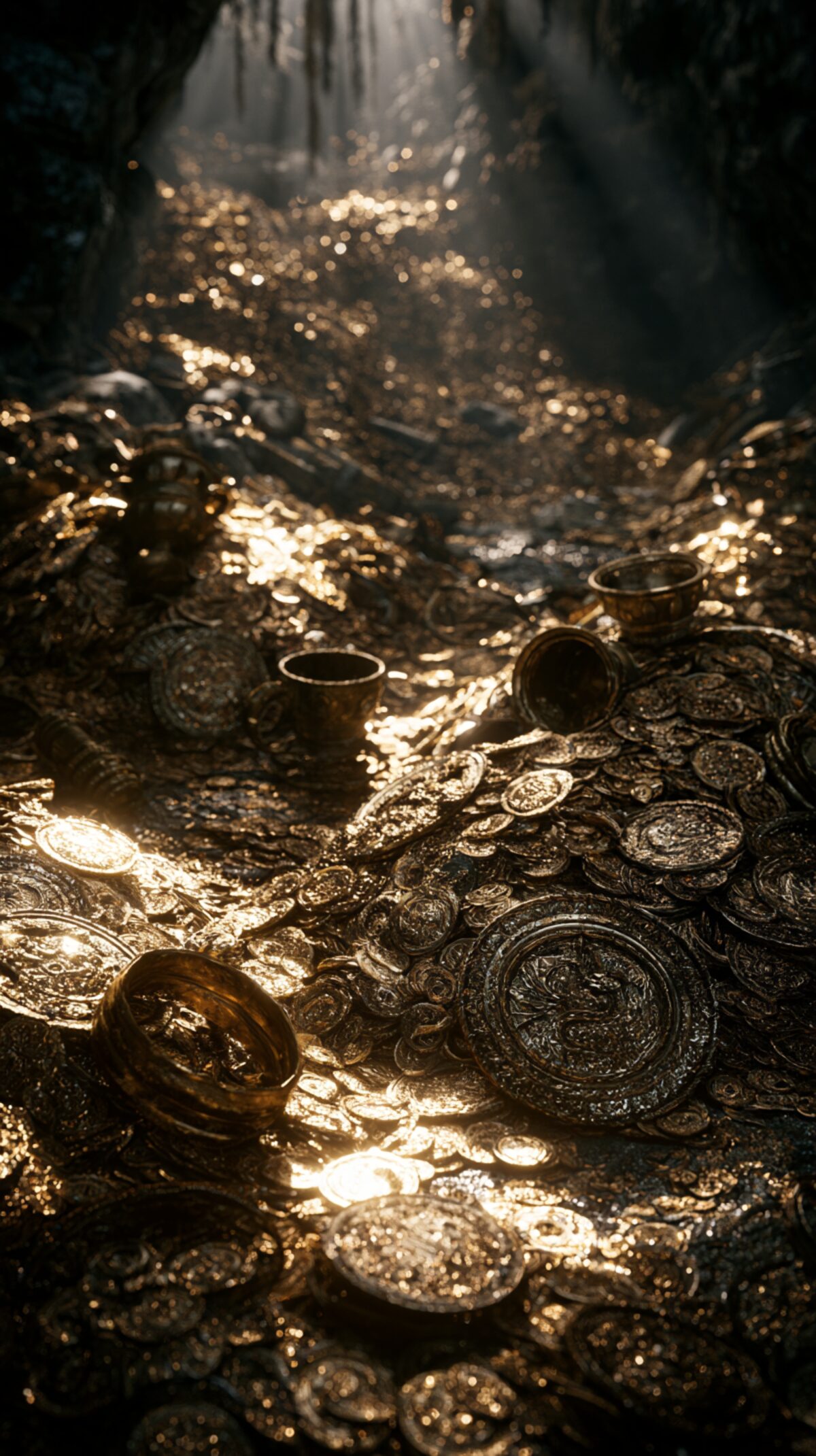
Sigurd is the greatest hero of the North: the Volsung who kills the dragon Fáfnir with the sword Gram, wakes Brynhild behind a wall of fire and is murdered by his own brothers-in-law. We know his story from the heroic poems of the Poetic Edda and the thirteenth-century Icelandic Völsunga saga; in Germany he is Siegfried, who dies at a spring in the Nibelungenlied. Here you will find what each source actually says, what rock carvings and church portals add, and how much real history hides in the legend.
A ring that carries a curse. A sword that a god himself shattered. A woman who has the man she loves killed and then joins him on the pyre. The Volsung legend does not do happy endings. Yet few medieval stories left so many traces: cut into bedrock in Sweden, carved into church doorways in Norway, chiselled onto crosses on the Isle of Man, and written on parchment in Iceland and Bavaria.
We will walk you through the whole cycle, from Sigurd's ancestors to the fall of the Gjukungs at Atli's court. The dragon only gets a cameo here, because he has a full article of his own: Fáfnir – from brother to dragon.
Our main source is the Poetic Edda, a collection of Old Norse poems about gods and heroes. Its chief manuscript, the Codex Regius (GKS 2365 4to), was written in Iceland around 1270, and most of its heroic poems revolve around Sigurd and the Gjukungs. For the manuscript itself, see The Edda – how we know the myths.
The poems run in story order: Grípisspá (a prophecy of Sigurd's life), Reginsmál, Fáfnismál, Sigrdrífumál – and then the text simply stops. A whole gathering of eight leaves is missing from the middle of the codex, the so-called "great lacuna". When the manuscript resumes, we are at the end of a poem scholars call Brot af Sigurðarkviðu, "Fragment of a Sigurd poem". After that come three Gudrun lays (Guðrúnarkviða I–III), the Sigurðarkviða in skamma ("Short Lay of Sigurd"), Helreið Brynhildar, Oddrúnargrátr, Atlakviða, Atlamál, Guðrúnarhvǫt and Hamðismál.
We have a fair idea what the lacuna contained thanks to the Völsunga saga. In the later thirteenth century an Icelandic author retold the whole cycle in prose, clearly drawing on Eddic poems, including some that are now lost. The saga survives in a single medieval manuscript of about 1400 (NKS 1824 b 4to, Royal Library, Copenhagen). There it runs straight into Ragnars saga loðbrókar, because Ragnar's wife Aslaug is presented as the daughter of Sigurd and Brynhild – more on that in Ragnar Lodbrok.
On top of that we have Snorri Sturluson's retelling in the Prose Edda, where the tale explains why poets could call gold "otter's ransom"; the Norwegian Þiðreks saga af Bern from the mid-thirteenth century; and on the Continent the Middle High German Nibelungenlied of around 1200.
The saga opens generations before Sigurd, with Odin, whose son Sigi founds the line. Sigi's great-grandson Volsung builds his hall around a huge tree called Barnstokkr. At a wedding feast a one-eyed old man in a cloak strides in, drives a sword up to the hilt into the trunk and announces that whoever pulls it out may keep it. Only Volsung's son Sigmund manages it. The guest, of course, is Odin.
What follows is a grim family chronicle of vengeance, wolf skins and incest. From Sigmund's later marriage comes Helgi, hero of the Helgi lays and Sigurd's half-brother; his story is told in Helgi and Sigrún. In old age Sigmund falls in battle against the sons of Hunding. The one-eyed stranger steps into his path, and Sigmund's sword breaks on his spear: the god who gave the luck takes it back. Dying, Sigmund tells his pregnant wife Hjördís to keep the fragments for their son.
Sigurd grows up at the court of King Hjalprek. His foster-father is the smith Regin – clever, skilled and anything but selfless.
First comes the horse. A bearded old man, Odin again, tells Sigurd to drive the horses into a river and pick the one that does not turn back to shore. That is how he finds Grani, descended, the saga says, from Sleipnir. Grani will carry the dragon's hoard and later decide who may ride through the fire.
Then the sword. Twice Regin forges a blade, and twice Sigurd smashes it on the anvil. Only from the pieces of Sigmund's sword does Gram emerge. The prose of Reginsmál says that Sigurd split the anvil with it. Völsunga saga adds a second test: a tuft of wool drifting downstream against the edge is cut clean in two. That was the dream of every warrior – a blade both unbreakable and razor-sharp. How real blades of the period were made is covered in The Viking sword.
Regin is not arming the boy out of kindness. He tells Sigurd an old family story, preserved in Reginsmál and by Snorri. Regin's father Hreidmar had three sons: Fáfnir, Regin and Otr, who spent his days fishing in the shape of an otter. Loki killed the otter with a stone, and the gods Odin, Loki and Hœnir then happened to ask Hreidmar for a bed for the night.
Hreidmar demanded wergild, the compensation owed for a slain kinsman: the otter's skin was to be filled and covered with gold. Using the net of the sea goddess Rán, Loki caught the dwarf Andvari, who lived as a pike in a waterfall, and took all his gold – including the one ring Andvari tried to keep back. The dwarf cursed ring and treasure alike: they would bring death to whoever owned them. When a single whisker of the otter still showed, Odin laid the ring on it. Read more in Andvari's cursed gold and Loki – helper and destroyer.
Fáfnir then killed his own father, took the hoard and withdrew to Gnitaheath, where he became a dragon. Regin got nothing. That is why he forges Gram: Sigurd is meant to kill his brother for him.
Völsunga saga calls the ring Andvaranaut, "Andvari's gift". It is the thread running through the whole legend, passing from Andvari through the gods, Hreidmar and Fáfnir to Sigurd, to Brynhild, back to Sigurd and finally to Gudrun. Nearly everyone who wears it dies by violence.
Sigurd digs a pit on the path the dragon takes to water and drives Gram up into its heart from below. Fáfnismál turns the killing into a conversation: the dying Fáfnir asks his killer's name, a wisdom contest about the Norns and the end of the world follows, and the dragon's last warning is that the gold will be Sigurd's death.
Then comes the moment almost every carving shows. Regin drinks his brother's blood, cuts out the heart and asks Sigurd to roast it. Sigurd tests it with his finger, burns himself and puts the finger in his mouth. With dragon's blood on his tongue he understands the birds, and they are discussing Regin's plan to betray him. Sigurd cuts off Regin's head, loads Grani with the gold and rides away. For the wider dragon lore, see Dragons and serpents in the Norse world.
The birds also mention a woman asleep on a mountain behind a wall of shields. In Sigrdrífumál Sigurd finds a figure in full armour there, slices open the mail shirt with Gram, and she wakes. Here she is called Sigrdrífa, "victory-driver". Odin pricked her with a sleep-thorn because she gave victory to a king against his will; she, in turn, swore to marry only a man who knew no fear.
She hands Sigurd a horn of mead and teaches him runes – victory runes, ale runes, surf runes, branch runes and more – along with rules for living that echo the Hávamál. You can read the stanzas side by side on our page Read the Sigrdrífumál.
Is Sigrdrífa the same person as Brynhild? Völsunga saga says yes. The Eddic poems are less clear, and scholars have argued since the nineteenth century over whether two originally separate figures merged. In Norse tradition Brynhild is valkyrie, shieldmaiden and princess at once – daughter of Budli and sister of Atli. Her own story is in Brynhild – valkyrie, queen, avenger, and the wider picture in The Valkyries. In the saga the two pledge themselves to each other, Sigurd gives her Andvaranaut, and a daughter, Aslaug, is born of the union. Then he rides on.
King Gjuki and his wife Grimhild have three sons, Gunnar, Högni and Guttorm, and a daughter: Gudrun. Grimhild, a woman skilled in magic, gives Sigurd a drink that makes him forget Brynhild. He marries Gudrun and swears blood-brotherhood with Gunnar and Högni. Guttorm does not swear – a detail that will matter.
Now Gunnar is to woo Brynhild. She lives behind the wavering flame (Old Norse vafrlogi) and will only marry the man who rides through it. Gunnar's horse balks, and Grani will not let him mount. So, through Grimhild's arts, Sigurd and Gunnar swap shapes. Sigurd rides through the fire as Gunnar and spends three nights with Brynhild, a naked sword laid between them. On leaving he takes Andvaranaut from her and gives her another ring from Fáfnir's hoard. The cursed ring later goes to Gudrun. Every man involved knows about the deception; the woman who was deceived does not.
Years later Brynhild and Gudrun bathe in a river. Brynhild wades further out so that water from Gudrun's hair will not touch her – her husband, after all, rode through the fire. Gudrun replies that it was Sigurd who rode, and shows her Andvaranaut as proof. In that moment Brynhild understands everything.
She demands Sigurd's death and claims that he broke his oath during those three nights. Gunnar and Högni are bound by blood-brotherhood, so they push Guttorm into the deed. Here the tradition splits, and the Edda does not hide it:
That marginal remark is priceless. The Icelandic scribe knew the continental version and preferred to leave the contradiction standing rather than smooth it over.
Brynhild laughs when Gudrun cries out. Then she admits that Sigurd never touched her, takes her own life and has herself burned with him on one pyre. In Helreið Brynhildar she drives towards the realm of Hel and defends herself before a giantess – as the one betrayed, not the one to blame.
The most moving part of the cycle belongs to Sigurd's widow. In the first Gudrun lay she sits silent over his body, unable to weep. Other women recount their own sorrows to loosen her tears. Only when her sister Gullrönd pulls the cloth from Sigurd's face does Gudrun break down.
Later she is married off to Atli, Brynhild's brother, who covets Sigurd's gold. In the third Gudrun lay she must prove at Atli's court that she has not slept with Thjodrek – Dietrich von Bern – and plunges her hand into boiling water. It comes out unharmed; her accuser Herkja is scalded. The ordeal points to a younger poem shaped by Christian legal custom.
Atlakviða is widely regarded as one of the oldest Eddic poems, often placed in the ninth century, though that cannot be proven. Its tone is hard and spare.
Atli invites Gunnar and Högni to his court, really for the sake of the treasure. Gudrun sends a warning: a ring with a wolf's hair wound around it. The brothers ride anyway, through the dark forest Myrkviðr, and are overpowered. Gunnar is ordered to reveal where the gold lies, but first demands to see Högni's heart. They bring him the trembling heart of a thrall; then Högni's own heart is cut out, and he laughs as it happens. Now only Gunnar knows the hiding place, and in essence he says: the Rhine shall rule the gold. He is thrown into a snake pit, where he plays the harp until an adder kills him.
Gudrun's revenge is the most savage scene in the Edda. She kills her sons by Atli, serves him their hearts, stabs him in his bed at night and burns the hall. Even then the cycle goes on: her daughter Svanhild – Sigurd's daughter – is trampled to death by horses on the orders of the Gothic king Jörmunrek, and her half-brothers Hamdir and Sörli die avenging her. With Hamðismál the heroic line comes to an end.
As engravers, this is the part that gets us most excited. No other Norse heroic legend appears so often in pictures, and so long before anyone in Iceland wrote it down.
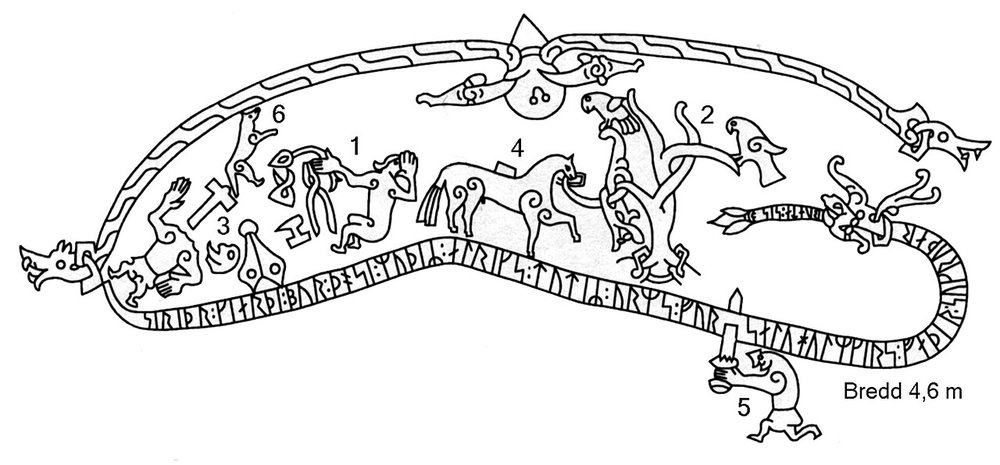
Ramsund, Sweden. At Ramsundsberget near Eskilstuna, a carving is cut into the living rock. It is catalogued as Sö 101 and usually dated to around 1030. The runic text has nothing to do with Sigurd: Sigrid, mother of Alrik and daughter of Orm, made this bridge for the soul of Holmgeir, father of her husband Sigröd. But the rune band is the dragon itself, and beneath it Sigurd drives his sword upwards. Next to it he roasts the heart and sucks his thumb; the birds sit in a tree with Grani tethered below; Regin lies beheaded beside his tools; and the otter appears at the edge. The nearby Gök stone repeats the same programme. For the art of the period, see The art styles of the Viking Age.
Isle of Man. Older still are the island's cross slabs of the late tenth century. On the Andreas cross (no. 121) you can see the dragon thrust, the heart roasting with finger in mouth, Grani and the birds; the reverse shows a figure among serpents, usually read as Gunnar. More Sigurd scenes appear on slabs at Jurby, Malew and Maughold. A pagan hero on a Christian cross – the settlers lived in two worlds at once, as The Norse on the Isle of Man explains. Stone fragments in northern England, for example from Halton and Kirby Hill, also show the thumb scene.
Hylestad, Norway. The stave church in Setesdal was pulled down in the seventeenth century, but its carved doorway jambs survive in the Museum of Cultural History in Oslo. Judging by the figures' clothing and gear, they date from the second half of the twelfth century. In seven panels they tell the story like a comic strip: Regin and Sigurd at the forge, the new sword, the dragon thrust, the roasting heart, Regin's killing, Grani with the hoard, and finally Gunnar in the snake pit, playing the harp with his feet. Why a heroic tale frames a church door is not settled. For the craft behind it, see Viking woodcarving.
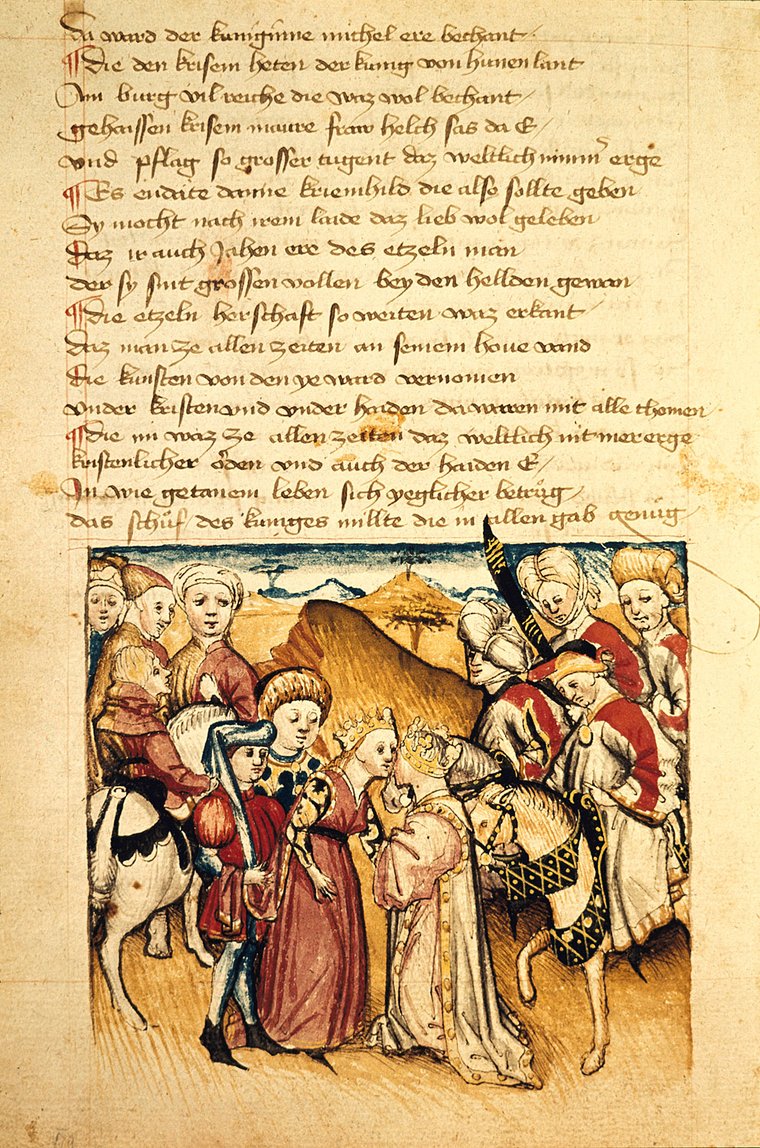
The Nibelungenlied was composed around 1200, probably in the Passau region, and survives in three main versions (manuscripts A, B and C). It tells essentially the same story – with a completely different heart.
Siegfried comes from Xanten on the Lower Rhine, son of Siegmund and Sieglinde – practically a neighbour of ours here near Aachen. He has killed the dragon before the poem even starts; bathing in its blood made him invulnerable except where a linden leaf stuck between his shoulders. Brünhild is no valkyrie but the queen of Isenstein, who tests her suitors in athletic contests, and Siegfried helps Gunther with a cloak of invisibility. The queens quarrel in front of Worms cathedral over who should enter first. Siegfried dies at a spring during a hunt, speared by Hagen.
The biggest difference lies in the second half. In the Edda, Gudrun avenges her brothers on Atli. In the Nibelungenlied, Kriemhild avenges her husband on her brothers, and Etzel is a rather good-natured king swept along by events. In the end nearly everyone is dead, and the hoard lies in the Rhine – the one thing both versions share.
The Thidreks saga sits between the two. It has Sigurd raised as a foundling by the smith Mimir and moves Atli's residence to Susat – Soest in Westphalia. So the legend is at home in North Rhine-Westphalia twice over.
| Motif | Edda / Völsunga saga | Nibelungenlied |
|---|---|---|
| Hero | Sigurd Fáfnisbani | Siegfried of Xanten |
| Sword | Gram | Balmung |
| Brynhild | valkyrie behind the flames | queen of Isenstein |
| Queens' quarrel | bathing in a river | outside Worms cathedral |
| Killer | Guttorm (in bed or in the forest) | Hagen (at a spring) |
| Revenge | Gudrun on Atli | Kriemhild on her brothers |
Here we deliberately separate what the sources say from what scholars debate.
Broadly accepted is the core around the Burgundians. Their kingdom on the Rhine under King Gundahar was destroyed around 436; the Western Roman general Aëtius used Hunnic auxiliaries to do it. Prosper of Aquitaine reports that Gundahar perished with his people, and a Gallic chronicle speaks of 20,000 dead. The Burgundian law code of around 500 names Gibica, Gundomar, Gislahar and Gundahar as earlier kings – in the North they become Gjuki and Gunnar, in the Nibelungenlied Gunther and Giselher. That the Burgundians sat at Worms, however, is first claimed by the poetry; their historical seat is not securely known.
Atli is Attila – that too is generally accepted. As far as we know, though, Attila was not personally involved in the Burgundian disaster. He died in 453 on the night after his wedding to a woman named Ildico; Jordanes, following Priscus, reports a haemorrhage, while later chroniclers claimed a woman killed him. Many scholars see this as the seed of Gudrun's murder of Atli. It is a hypothesis, not proof. In the same way, Jörmunrek stands for the Gothic king Ermanaric, who died around 375; Jordanes tells of a woman called Sunilda whom he had torn apart by horses.
For Sigurd himself there is no secure historical model. A frequent candidate is the Frankish king Sigibert I, murdered in 575 and married to the Visigothic princess Brunhild, whose feud with Fredegund recalls the quarrel of the queens. Other proposals, such as Arminius, are mostly regarded as speculation. Sigurd may simply be a hero who was attached to the historical fall of the Burgundians.
The Volsung legend celebrates no winner. It is about guilt passed down the generations, oaths that bind, and women who act more decisively than the men around them. Richard Wagner built his "Ring of the Nibelung" from it, first performed complete at Bayreuth in 1876 and with very free handling of the sources. J. R. R. Tolkien wrote poems on Sigurd and Gudrun in Old Norse metre that were only published in 2009 – more in Tolkien and the Edda.
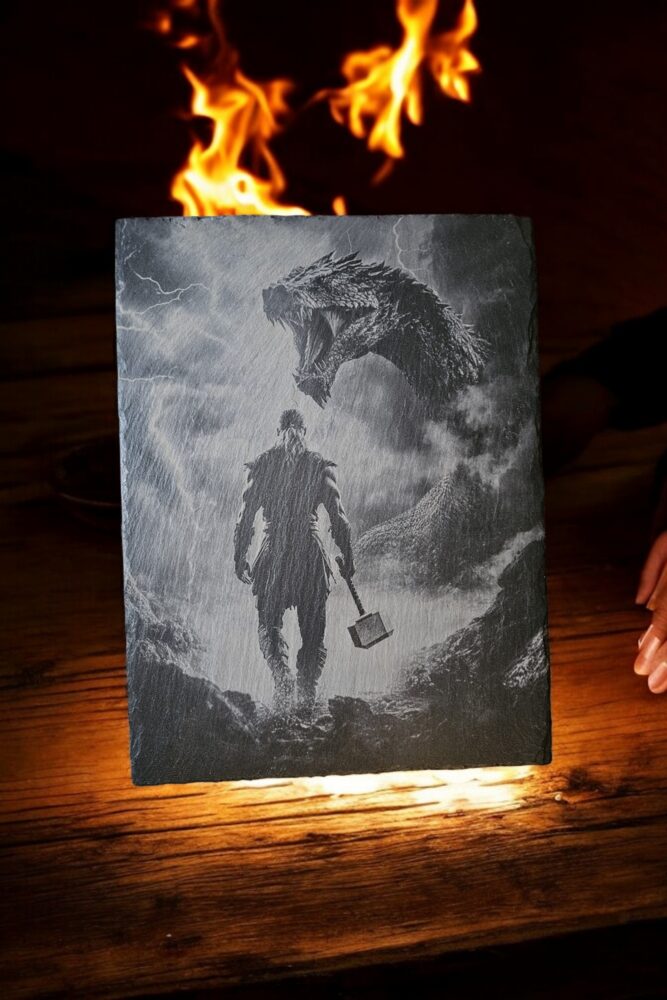
And the image chosen by the stone carvers of Man and the rock carvers of Södermanland is still the strongest one: the young hero beneath the dragon, sword thrust upwards. When we engrave it on slate, we work from those old models, not from fantasy dragons. More heroes of the North are gathered in our guide to Norse legends.
Is Sigurd the same as Siegfried? Yes. Sigurd is the Old Norse form and Siegfried the German form of the same legendary hero. The sword's name, Brynhild's role and the identity of the killer differ markedly.
What is the name of Sigurd's sword? Gram. Regin forges it from the fragments of the sword of Sigurd's father Sigmund. In the Nibelungenlied, Siegfried's sword is called Balmung.
What is Andvaranaut? A gold ring that Loki took from the dwarf Andvari, who cursed it. It passes via Fáfnir to Sigurd, Brynhild and Gudrun and brings death to almost everyone who owns it.
Who killed Sigurd? In the Edda and Völsunga saga it is Guttorm, the youngest of the Gjukungs, either in bed or in the forest. In the Nibelungenlied Hagen kills Siegfried at a spring.
Was Sigurd a real person? There is no evidence that he was. The Burgundians under Gundahar, destroyed around 436, and Attila are historical; for Sigurd there are only disputed theories.
Where can I see the Sigurd carvings today? The Ramsund carving is outdoors near Eskilstuna in Sweden, the Hylestad jambs are in the Museum of Cultural History in Oslo, and the Manx Sigurd crosses are at Andreas, Jurby, Malew and Maughold.
For courage. For remembrance. For legends that live on.
Fact/myth: image and text sources show the core and spread of the saga; invulnerability is a motif of the German, not the Norse, tradition.
It is the most famous smithing scene of the North: two dwarf brothers, a wager on Loki’s head, and a fly that stings at …
Read more →Some heroes set out with a sword. Svipdagr sets out with the protective charms of his dead mother – and with a task he …
Read more →Among all the gods, giants and dwarves there are two who are different: Thjálfi and Röskva, a pair of farmer's children …
Read more →This is the tale in which the immortal gods turn grey for the first and only time. An eagle on an ox, an extorted oath …
Read more →