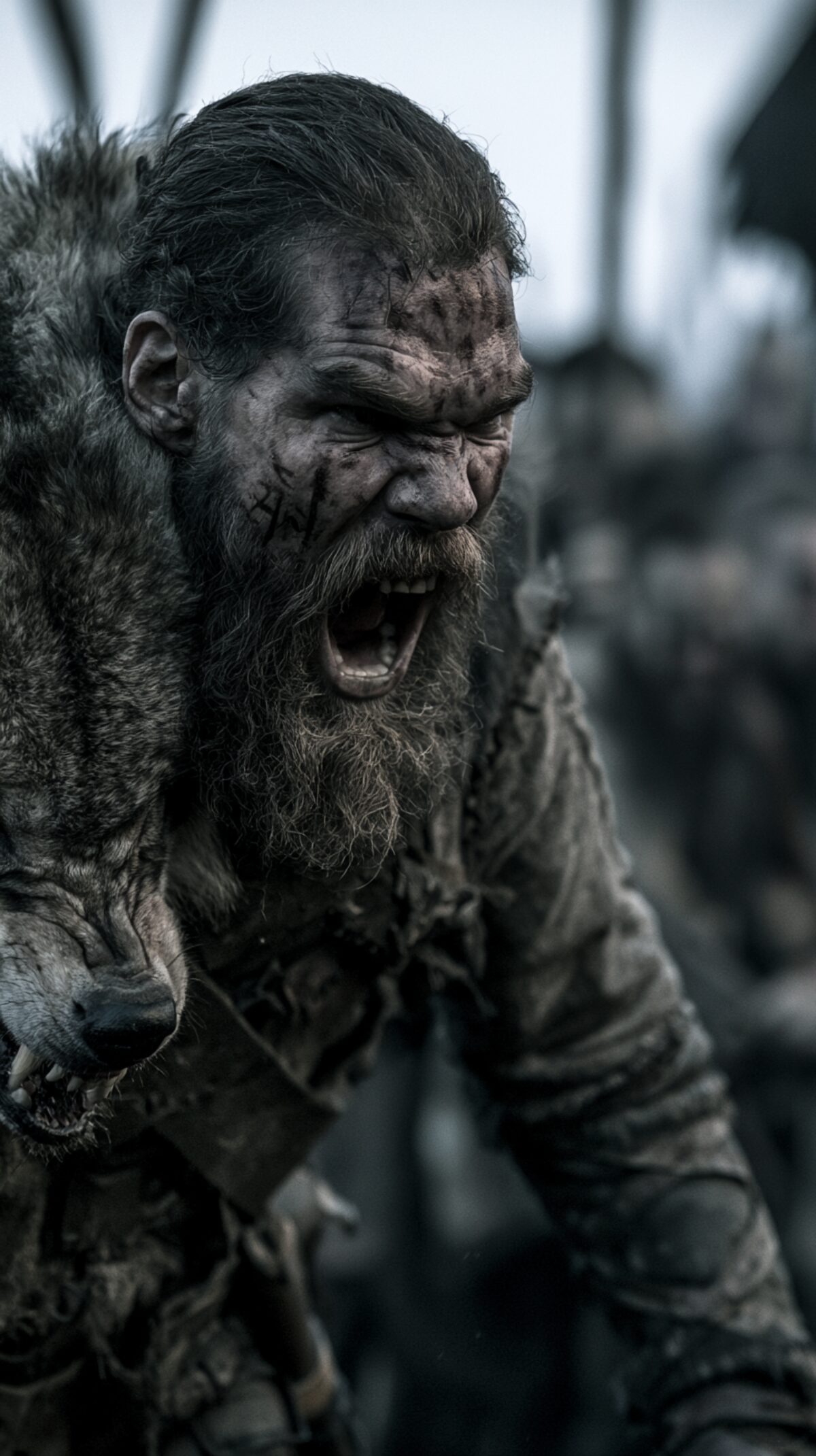
No animal stood closer to the people of the North and yet remained as alien to them as the bear. It shared their forests, carried their names and walked through their sagas. But between what the spade and the sources actually prove and what later stories made of it lies a wide gap. Let us look closely – at the real animal, the real pelt in the grave, and the warrior who wore its shirt.
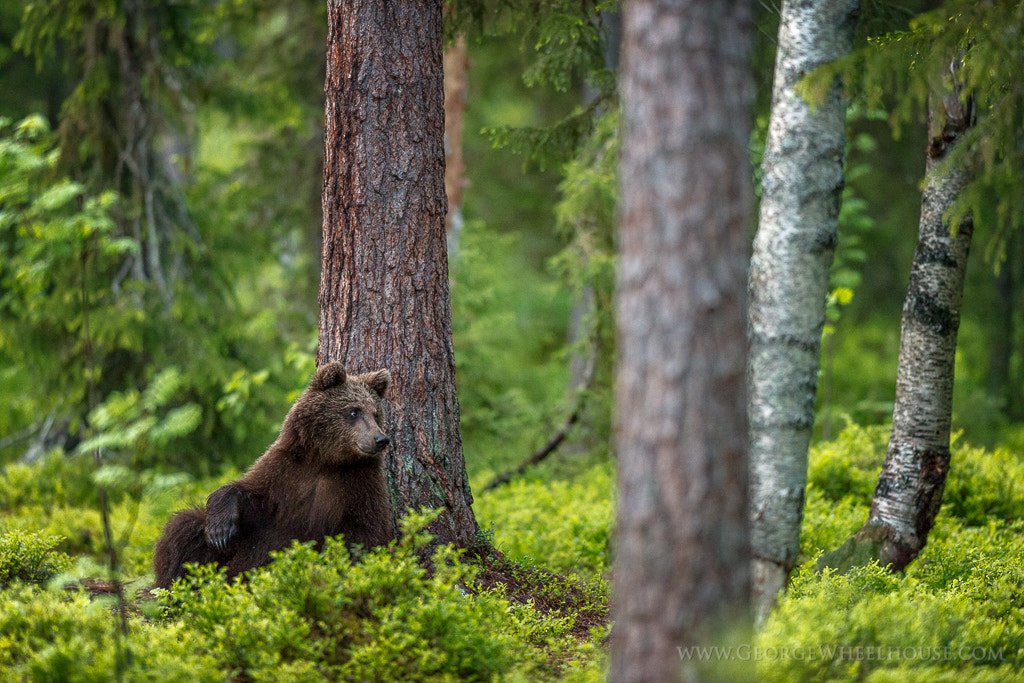
Picture the North of the Viking Age and you think of fjords, longhouses and ships. The brown bear belongs to that picture just as much. Ursus arctos was widespread across Scandinavia, from the forests of southern Sweden deep into the Norwegian and Finnish mountains. It was the largest land predator a farmer, hunter or traveller could meet – a creature that, reared up, towered over a grown man, that vanished in winter and rose from the earth in spring as if reborn. That mixture of raw power and mysterious behaviour turned the bear into far more than mere prey.
In the far north, along the coasts of Greenland and in the Arctic, a second bear appeared: the polar bear, white, enormous and, to most Norse people, a being from the very edge of the known world. Anyone who saw one alive, or even caught one, held something almost no one knew. Both bears – the brown forest bear and the white sea bear – shaped Norse tradition, but in very different ways.
First of all, the bear was an economic asset. Its pelt was one of the most sought-after commodities of the North: thick, warm, imposing. Bear pelts served as blankets, as seating and bedding, and as marks of rank. A pelt on the wall or across the bench said something about the master of the house, much as an expensive piece in the living room does today. Bear pelts travelled far south along the trade routes; they were among the luxury goods Scandinavia could offer the courts of the Continent.
Bear claws and teeth were worn too – as pendants, mounted or pierced. They were at once ornament and amulet: a piece of the animal's strength, carried on the body. But caution is needed where such finds are turned straight into "berserkers". We will come back to that.
The strongest archaeological evidence for the bear's importance lies in the graves. In numerous burials of the first millennium, especially in cremation graves of the Vendel Period and the early Viking Age, archaeologists find small bear bones – almost always the third, outermost toe bones, the terminal phalanges, the ones that carry the claws. The rest of the animal is missing.
That is no accident but a telling clue. When you skin an animal and leave the claws on the hide, exactly these end bones stay attached to the pelt. Find them in a grave – and nothing else of the bear – and a whole bear pelt once lay there, wrapping the dead or bedding them down. The pelt itself has perished in fire and earth; only the claws remain. Such bear-pelt burials are especially well known from the high-status boat and cremation graves of Swedish Uppland, such as Vendel and Valsgärde, and they run through wide parts of northern and central Europe.
Evidence: Bear claws as grave goods are a well-studied phenomenon. In studies of dozens of analysed graves, bear claws appear far less often than the bones of other animals – the bear was special equipment, not standard. Where claws lie without any other bear bones, specialists convincingly read them as the remnant of a vanished pelt that wrapped or underlaid the body. Such burials cluster in cremation graves of roughly the 4th to 10th centuries and in elite graves of the Vendel Period (Uppland).
The bear was so powerful that in several northern European languages people avoided its original name and paraphrased it instead – out of awe, lest naming it should summon it. The Germanic word from which our "bear" and the Old Norse bjǫrn derive probably means simply "the brown one". A cover name for an animal whose true name one had better not speak.
That very name became the North's favourite name of strength: Björn. To name a child "bear" was to wish it power and defiance. Related is the affectionate form Bjarki, "little bear". And many scholars even read the name of the Anglo-Saxon hero Beowulf as a paraphrase: "bee-wolf", the one who hunts the bees to get at their honey – a kenning for the bear. Whether that is right is uncertain, but the great forest fighter's closeness to the bear is unmistakable.
In the world of saga all this crystallises in a single figure: Bödvar Bjarki, the greatest fighter in Hrólfs saga kraka, the saga of the Danish king Hrolf Kraki. Bjarki is no ordinary warrior. In the saga's most famous scene he sits seemingly idle in the hall while the last battle rages outside – yet a mighty bear fights in the king's ranks and mows down the enemy. Only when Bjarki is torn from his trance and driven to fight does the bear vanish. Hero and beast are one: his hamr, his shape or "second body", fights as a bear while his own body rests.
As long as Bödvar sat motionless, a great bear fought before the king's men and killed more foes than five warriors together; no weapon would bite it. But when the hero was woken and called out into the battle, the bear was gone – and from that moment the tide turned.Retold after Hrólfs saga kraka, ch. 33; free translation: Glanz & Gravur
It is one of the most striking scenes in Old Norse literature. But it is literature – written down late, long after the Viking Age, as an artfully elaborated tale. It tells us how people imagined the bond between man and bear, not what happened on a battlefield.
This brings us to the most famous and most misunderstood term: the berserker. The Old Norse word berserkr is made of two parts, and scholars still argue over the first. The interpretation that dominates today reads ber- as "bear" and serkr as "shirt" or "coat": the berserker as the one "in the bear-shirt", the warrior in bear-skin. This fits the úlfheðnar, the "wolf-coats" – fighters in wolf-skin named alongside the berserkers in the same sources. Beast and warrior merge: whoever wears the pelt takes on the animal's wildness.
There is, however, a second, older reading. Snorri Sturluson himself took ber- as berr, "bare, naked" – the berserker as the one who went into battle "shirtless", that is, without armour. This reading is now considered less likely, but it is not entirely disproved. So we should say honestly: the "bear-shirt" reading is the better-founded one, but the name is not settled beyond all doubt.
The sources paint a contradictory picture. In poetry, berserkers are Odin's elite warriors who howl in battle-fury, bite their shields and are wounded by no iron. In the Icelandic family sagas, by contrast, they are often troublemakers, bullies and extortionists whom a hero brings down – almost a stock villain's role. Both are literary portraits, from different times and with different aims. What lay behind historical berserker practice – a warrior brotherhood, a cult, a fighting technique, a state of frenzy – cannot be safely reconstructed from the texts alone.
Only the idea behind it is certain: that a human could draw the strength of a predator into himself by wearing its pelt and taking on its nature. The bear was the mightiest model for that which the North knew.
The white bear plays a role all its own. It was so rare, so precious and so dangerous that a live polar bear ranked among the greatest gifts one could present to a king. This is told in Auðunar þáttr vestfirska, the short tale of Audun from the Westfjords. Audun, a poor Icelander, spends his whole fortune in Greenland on a polar bear and travels with it right across the Norse world to give the animal to King Sven Estridsson of Denmark. The tale is a song of praise to generosity and decency – and at the same time a testimony to the fabulous worth of a polar bear.
Greenland and Iceland were the lands from which such animals came. A polar bear was a walking status symbol, a gift with which a nobody could become a welcome guest at a royal court. No other animal of the North wore its value so visibly in its fur.
One trait of the bear struck the people of the North deeply: its vanishing and its return. In autumn the bear withdrew into the earth, into den or winter lair, and for months lay as if dead – no food, no drink, barely a breath. In spring it came forth again, lean but alive, and the she-bears with cubs that had been born in the dark of winter. For people who lived in a land of long nights and hard winters, this was a visible parable: descend into the dark, endure, return.
One should not build an elaborate "bear religion" of the Vikings out of this – the evidence is lacking. But that an animal which returns from the earth was linked with strength and endurance is a natural step and fits everything we know about the bear's standing. The bear was not merely strong; it was the animal that defeated winter.
Whoever owned a bear pelt had, as a rule, earned it the hard way. The bear hunt was among the most dangerous things a hunter could undertake. A brown bear is fast, clever and deadly at close quarters; to get near it with bow and spear without dying in the attempt demanded experience, nerve and often several men. That is exactly what made a slain bear and its pelt so valuable: it was not just a warm piece of goods but a proof of courage.
And so the circle closes back to the grave. A bear pelt in which a dead person was wrapped was no ordinary textile. It carried the story of its killing, the rank of the one who owned it, and the strength of the animal it had once belonged to. For some of the Norse, the bear went with them literally beyond death.
Unlike the serpent, the wolf or the bird, the bear is hard to pin down in Norse animal ornament. The interwoven animal styles of the Viking Age rarely show a creature unmistakably identifiable as a bear; the stylised gripping beasts usually cannot be named for certain. Where the bear appears, it is more in narrative scenes, in figural depictions and as a grave good – as pelt, as claw, as tooth – less as a clearly outlined heraldic beast. That suits an animal whose name was avoided: everywhere present, yet hard to grasp.
Myth-check: Three things are easily muddled. First: bear claws in a grave prove a pelt, not a berserker. They point to a dignified, prestigious burial with a precious animal skin – not to the dead being a fighter in bear-frenzy. Second: the origin of the word berserkr is disputed; "bear-shirt" is the better-founded reading, "bare shirt" (without armour, as Snorri had it) is now thought unlikely but not securely disproved. Third: Bödvar Bjarki's fighting bear-spirit is high-medieval saga literature, not a historical battle report. And fourth, importantly: the Sámi bear ceremony – the ritual hunt, burial and veneration of the bear among the Sámi – is a distinct, well-documented tradition with its own rules and rites. It does not belong in the same pot as "the Vikings", even though both lived in the same North.
The bear unites what the Norse valued and feared in themselves: raw strength, steadfastness, the retreat into darkness and the return into light. It was neighbour, trade good and symbol all at once. Looked at honestly – the pelt in the grave, the name Björn, the hero with the bear-spirit, the white bear as a royal gift – it needs no invented ingredient. The true story is impressive enough. And that is exactly where the quiet dignity of this animal lies: it was already great before the sagas made it greater.
Berserkers · Sköll & Hati · Everyday Viking life · Viking food & drink · Horses of the Vikings.
All Everyday Life & Craft articles →
It is glass-clear, harder than almost any other ornamental stone, and it hung around necks and lay in the graves of the …
Read more →A stone that is warm rather than cold, light as wood, honey-gold in the light – and sometimes carrying within it an …
Read more →Talk of Vikings and gemstones today, and you quickly hear about amethyst for stress and tiger's eye for courage. It …
Read more →Few plants mattered as much to the people of the far North, and are as thoroughly underrated today, as angelica. To us …
Read more →