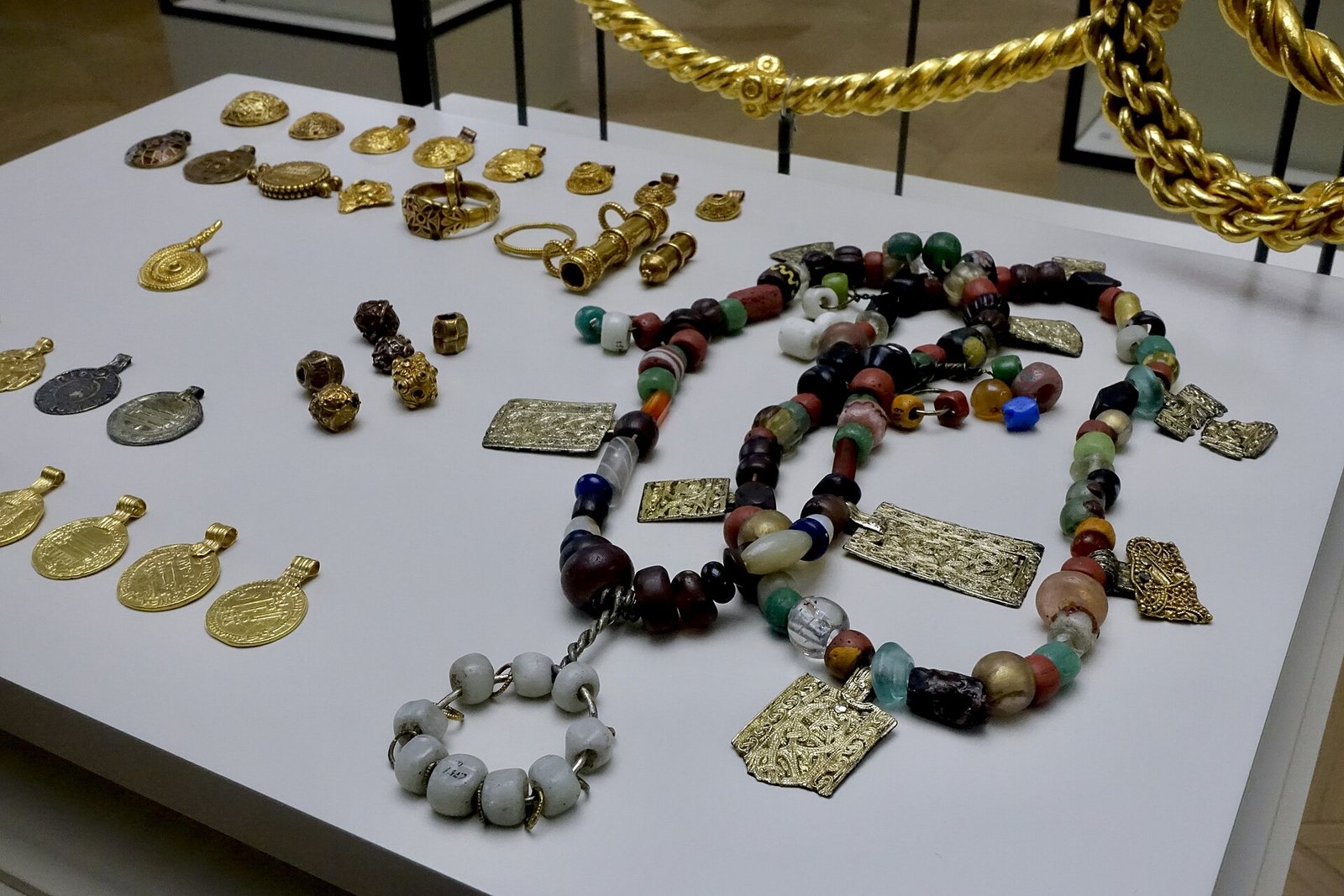
Talk of Vikings and gemstones today, and you quickly hear about amethyst for stress and tiger's eye for courage. It sounds nice, but it is modern esotericism - and it has little to do with what actually hung around necks and wrists between Hedeby and Birka. The real stones of the North have a far better story: they travelled by river and sea from half the known world, they were currency, status and adornment all at once - and, honestly, they need no invented healing promise to shine.
If one stone belongs to the Viking Age, it is this one. Amber is, strictly speaking, not a stone at all but fossilised tree resin that oozed from primeval pine forests many millions of years ago, sank into the ground and hardened over aeons. On the Baltic coast the sea still washes it ashore to this day - warm gold, honey-brown, sometimes milky, occasionally with a trapped midge older than any thought a human being has ever had. That very washing-ashore made amber both available and special in the North: you did not have to break it from the rock, you simply gathered it.
Long before the Vikings, the famous Amber Road ran across Europe all the way to Rome, where the material was polished, carved and paid for dearly. The Roman historian Tacitus devoted a passage to the amber gatherers of the Baltic coast - he calls them the Aestii - and, in a very Roman way, marvelled a little that these people only came to value the treasure on their own doorstep through long-distance trade:
They search the sea too, and alone of all peoples they gather amber, which they themselves call glesum, among the shallows and on the shore itself.Tacitus, Germania 45 (soli omnium sucinum, quod ipsi glesum vocant, inter vada atque in ipso litore legunt); translation: Glanz & Gravur
In the Viking Age amber was then worked on a huge scale - into beads, pendants, gaming pieces and small amulets, among them Thor's hammers. Whole workshop waste heaps have been found in the trading towns: lumps of amber, half-finished beads, drilling swarf. The material was soft enough to turn and drill with simple tools, warm to the touch and light - no wonder it became everything from a plain pendant to a showpiece. Amber is thus the most honest gemstone of the North: native, tangible, and, without any magic-marketing surcharge, a genuine piece of the Baltic.
Now it gets interesting, because here you can see just how far the world of the Norse reached. The glowing red carnelian beads and the clear rock-crystal beads known from the graves of Birka, Hedeby and other trading places are precisely not native. Carnelian - a red-orange variety of chalcedony - and cut rock crystal came to the North along the great eastern and Volga trade routes from the Orient, and partly as far away as India. The Varangians and Rus travelled down the Russian rivers, exchanging furs, amber and slaves for Arabic silver, silk and exactly these precious stone beads - and carried them, in the end, thousands of kilometres onward into Scandinavia.
These beads are little world maps. Anyone in the Viking Age who wore a string of faceted carnelian and rock crystal wore proof of a trading network that stretched from the icy northern sea to the bazaars of the Caliphate. It is important to keep this clean: the raw stone was not quarried in the North, often not even cut there. What the northern workshops themselves contributed was usually the mounting - and the beads were recombined, together with glass beads, silver and amber, into wholly local, often lavish neck arrangements. The value lay not in some alleged effect of the stone, but in the sheer distance it had travelled.
Not every colourful stone at the throat was a stone at all. A large part of what sparkled was glass - and that is no makeshift, but craft of a high order. In Ribe, the oldest town in Denmark, archaeology has excavated one of the earliest and most productive glass-bead workshops of the North. The bead makers re-melted imported lumps of glass and mosaic tesserae - some from the Mediterranean, some from the Near East - and drew from them, in astonishing quantity, beads in every colour. Thousands of beads and even more scraps of raw glass show that this was no occasional tinkering; here beads were made in series.
For us as an engraving and jewellery workshop, that is a rather sympathetic thought: even more than a thousand years ago, the finest piece was often not the most expensive raw material, but what skilled hands made of it. Glass beads were more affordable than true carnelian and yet colourful, gleaming and coveted - jewellery for many, not only for the richest. Anyone who today wants to know and value the difference between real natural stone and glass stands in a very old tradition.
A stone still underrated today is jet, or Gagat: not a mineral in the strict sense, but fossilised, extremely compacted wood - essentially a special form of coal, deep black, light, and polished so hard that it mirrors with a high gloss. The most famous deposit lies near Whitby on the English North Sea coast. From there jet was already traded in Roman times, and in the Viking Age it enjoyed a real heyday in the workshops of York and Dublin. It was turned and carved into rings, beads, pendants and small crosses as readily as into Thor's hammers.
Jet has one property that fascinated people even then: rub it, and it charges up electrostatically and attracts light fibres. It is easy to imagine that this apparently dead black stone, suddenly "coming alive", was credited with a special force. That, however, is not cleanly documented for the Viking Age - here we already enter the territory where one must honestly say: we know jet was worn, but what exactly people thought while doing so, no find tells us.
When people picture deep-red sparkling jewellery from the early North, they often think of the famous cloisonne technique: tiny plates of garnet set in gold cells, glowing in the sun. That splendour is real - but strictly speaking it belongs rather to the period BEFORE the Vikings, to the Migration Period and Merovingian era. The finest garnet cloisonne work dates from the 5th to 7th centuries, and the garnets themselves travelled in from far away, partly from India and Sri Lanka. By the time the Viking Age proper began, this fashion was past its peak; the Vikings preferred silver, amber and the imported trade beads mentioned above.
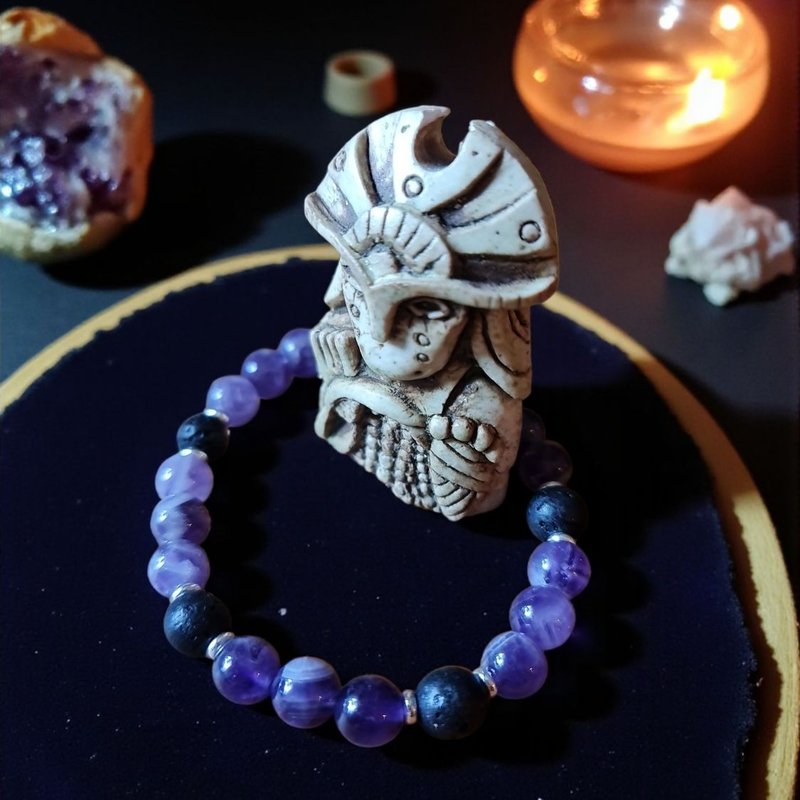
One must be equally honest about amethyst: the violet quartz was certainly known and prized in antiquity and the early Middle Ages, but it appears only rarely as a signature stone in the typical Viking-Age record. We mention this deliberately, because amethyst in particular tops every healing-stone list today - historically it was far less present in the North than one might assume.
One of the most astonishing groups of finds anywhere are the ground rock crystals from Gotland, known above all from Visby and the trading site of Fröjel. These are biconvex ground rock crystals - that is, lenses - whose optical quality is so high that they can actually magnify and focus light. Some researchers have suspected in them early reading aids or burning/collecting lenses. To be honest: whether the Norse deliberately used them as reading aids is not proven - most likely they were first and foremost mounted showpiece pendants, often set in silver. But the mere fact that rock crystal could be ground to optical precision on Gotland is an exclamation mark. This was high technology of the 11th century.
One detail worth knowing if you want to understand the northern jewellery picture: the leading metal of the Viking Age was silver, not gold. Amber, rock crystal and imported stone beads were set in silver wire, silver caps and silver loops; pendants were framed with fine filigree and granulation work. Silver was at once ornament and currency - hacksilver, that is chopped and weighed precious metal, circulated as a means of payment. A string of amber, glass beads, a few costly carnelians and a silver-mounted rock crystal was therefore not only decoration but portable wealth. You wore your capital around your neck - practical, if you were much on the move anyway.
Now to the trickiest question, and here we stay deliberately cautious: did the Vikings believe stones worked? The honest answer is: we only know in part. It is documented that there was a belief in amulets and protection - small Thor's hammers, pendants, occasionally formula words on metal. People wore things on their bodies to which they attributed protection or luck. That is thoroughly human and attested across all old cultures.
What is NOT documented, however, is an elaborate system in which a particular stone was responsible for a particular ailment. We have no Viking-Age source that says "take this stone against that trouble." The value of a carnelian lay in its origin and beauty, the value of amber in its availability, warmth and glow - not in a catalogued effect. So when we speak of protective belief, we mean it honestly and within the limits of what finds and texts allow, and no further.
We are a family workshop, and our hobbyhorse is the honest thing. In our gemstone world you will therefore find real stones - amethyst, peridot, malachite, tiger's eye, rock crystal and more - as laser-engraved jewellery and nature jewellery, cleanly worked and lovely to look at. What you will NOT find with us are healing promises. We will not sell you a stone "against" anything, because that would be neither honest nor provable. We sell you a beautiful, genuine stone - and the story that really lies behind it: the Baltic in the amber, the trade routes of the Rus in the carnelian, the skill of the bead makers of Ribe in the glass.
That fits everything we stand for: uncompromising quality from the raw product onward, German and local suppliers wherever possible, and the firm conviction that a piece only turns out well if you are honest with the material and honest with the customer. Good value, not cheap - and a true story rather than a hollow promise.
The Vikings were no grey, dirty barbarians - they liked colour, gleam and beautiful things, and their stones tell of a world far larger than the cliche allows. An amber from your own beach, a carnelian from the East, a glass bead from the workshop next door: three stones, three utterly different roads into one and the same necklace. It is precisely this honesty - what is real, where does it come from, what do we actually know - that is the shine we hold on to.
For courage. For remembrance. For legends that live on. Skål!
Carnelian – the Vikings' red beads · Amber – the gold of the North · Jet – the black gemstone · Viking jewellery.
All Everyday Life & Craft articles →
When we think of Vikings, we often see grey-brown figures in undyed wool. That is a mistake. Whoever could afford it …
Read more →The Viking of film and television wears grey, brown and grime. The real Norseman wore red, blue and yellow – and was …
Read more →They ran the farm, could inherit and divorce – and yet the truth about the Viking woman is more nuanced than modern …
Read more →A stone that burns like coal, charges electrically when rubbed like amber, and polishes to a deep black shine: jet is …
Read more →