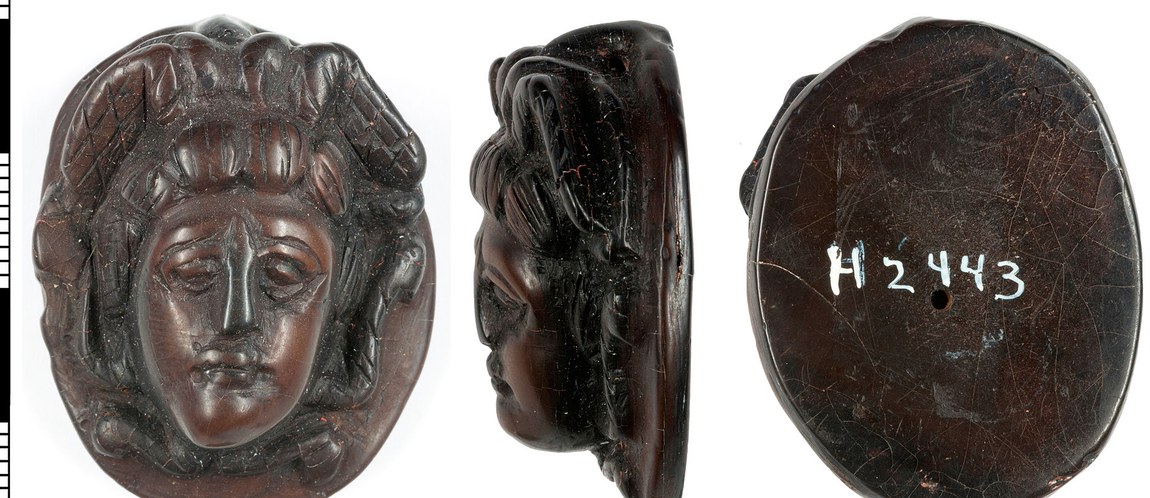
Jet is not a mineral but fossilised wood: an unusually dense, polishable coal formed some 180 million years ago from conifers, with its most famous deposit on the Yorkshire coast at Whitby. Romans carved it into Medusa pendants and little bears, Bede praised it in the eighth century as one of Britain's treasures, and craftsmen in Viking-Age York turned it into finger rings, gaming pieces and pendants. This article sets out what finds and laboratory work actually show, where researchers are still guessing, and why a great deal of shiny black “jet” is nothing of the sort.
Pick up a piece of jet and your hand tells you something is off. It is too light to be stone. It is too warm to be glass. Rub it on a wool sleeve and it lifts fluff the way amber does. Touch it with a red-hot needle and the smell is not mineral at all – it is the coal scuttle by your grandparents' fireplace. That is jet in a nutshell: coal that behaves like a gemstone.
In technical terms, jet is a mineraloid – a natural substance without a crystal lattice – and belongs to the coal family. It began as wood that was altered under pressure and without oxygen. Whitby jet comes from driftwood of trees related to the araucarias, the family that includes today's Chilean pine or monkey-puzzle tree. Those logs drifted into an oxygen-poor sea around 181 million years ago, in the Toarcian stage of the Early Jurassic, sank into the mud and became the jet that geologists find in the band known as the Jet Rock, part of the Whitby Mudstone Formation.
The physical properties explain why craftsmen prized it. Jet sits at roughly 2.5 to 4 on the Mohs hardness scale: soft enough to cut with a knife, file and lathe, hard enough to take and keep a mirror polish. Its density of about 1.3 grams per cubic centimetre makes even chunky beads astonishingly light. A jet necklace weighs a fraction of the same necklace in glass or stone.
Later jet workers at Whitby distinguished “hard” and “soft” jet. The two look alike, but soft jet is more prone to crack. That distinction belongs to the modern jewellery trade. Whether Viking-Age craftsmen knew it we cannot say; that some of their rings ended up cracked in the ground, we can.
Whitby sits on the North Yorkshire coast where the River Esk meets the North Sea. Its cliffs are dark shale, and the sea gnaws at them constantly. What breaks away ends up on the beach, jet included. For antiquity and the early Middle Ages that matters a great deal: people could collect what the waves exposed. Whether anyone was already digging into the cliff is an open question; large-scale mining with adits belongs to the nineteenth century, when the beach could no longer meet demand.
Above the town stand the ruins of an abbey. Its predecessor, the Anglo-Saxon double monastery of Streanæshalch, was founded in the seventh century under Abbess Hild, and in 664 it hosted the famous synod at which the Northumbrian church opted for the Roman way of calculating Easter. One small detail from the excavations matters here: English Heritage lists among the finds from the Anglian settlement a jet gaming piece, decorated with lines and disc shapes. The community on the clifftop did not just live above the black stone; they played with it.
English Heritage estimates that some 500 metres of cliff have been lost to the sea since the Anglian period, so much of the early settlement is simply gone. English Heritage itself lists the extent to which the early settlement was destroyed in the Danish invasions as an open research question. What is certain is that from the late ninth century the coast where jet washed up lay in the part of England under Scandinavian control. How that came about is told in our pieces on Lindisfarne 793 and the Vikings in England.
English jet came in via Old French jaiet; German Gagat stays closer to the Latin original, gagates. Pliny the Elder explains the name in Book 36 of his Natural History (sections 141–142): the stone, he says, takes its name from a place and river called Gages in Lycia, in what is now south-western Turkey. Then he describes it, here in our own rendering:
It is black, smooth, porous and light, not very different from wood, brittle, and when rubbed it has a strong smell. When burnt it gives off a sulphurous odour; and, remarkably, it is kindled by water and quenched by oil. Kindled in this way it drives off snakes.Pliny the Elder, Naturalis historia 36.141–142 (our own translation)
From there it gets stranger. The fumes are said to relieve women's complaints and to “detect” epilepsy and virginity; boiled in wine it is supposed to help toothache. The Magi, Pliny reports, used it in a form of divination called axinomantia: the stone would not burn up if what someone hoped for was going to happen. All of this is ancient natural lore and magic, not evidence that anything works – but it is the root of almost every later belief in jet as a protective stone.
There is a catch. Whether Pliny's gagates is the same material as Whitby jet is far from certain. “Kindled by water, quenched by oil” sounds more like a bituminous rock, or a muddle of several. Ancient stone names are umbrella terms, not mineralogical definitions. Only authors who write specifically about Britain tie the name securely to the material from the Yorkshire coast.
In Roman Britain jet became fashionable from the late second century and above all in the third and fourth. The workshops were not at Whitby but some 70 kilometres inland at Eboracum, modern York. The Royal Commission on Historical Monuments gathered the evidence: railway works in 1873 turned up rough blocks and half-finished pins, the trace of a workshop. Add bangle fragments, finger rings, beads, distaffs, a knife handle, a counter and a die.
The numbers are striking. The Commission lists at least 42 plain and 19 decorated bangles and eleven rings in the Yorkshire Museum alone. Among the pendants are four gorgon heads – Medusa, whose gaze turns people to stone and who therefore served as a charm against the evil eye – and three portrait medallions. And there is a small jet bear found at Bootham in 1845 in a grave group dated to around AD 320 and now in Sheffield.
Most of these pieces come from inhumation burials of the third and fourth centuries. Lindsay Allason-Jones later published the Yorkshire Museum's Roman jet in a catalogue of its own. With the end of Roman rule in Britain around 410, this first golden age of jet comes to a halt.
Black jewellery was worn in the Roman Rhineland too, and for a long time all of it was assumed to be Whitby jet. In 2001 Allason-Jones and Jones examined objects from Hadrian's Wall and the Rhineland using reflected-light microscopy, a technique borrowed from coal petrology. The result: craftsmen used a range of jets, shales and coals from several sources, and the Rhineland objects they examined were not Whitby jet but material from an unidentified source. Black does not automatically mean Whitby.
Some three centuries after the legions left, a monk at Jarrow – some 80 kilometres up the coast from Whitby – wrote his Ecclesiastical History of the English People. Bede finished the Historia ecclesiastica gentis Anglorum in 731. In the very first chapter he lists the riches of Britain: pearls, shellfish for scarlet dye, salt and hot springs, veins of copper, iron, lead and silver – and jet:
It also produces a great deal of jet of the finest kind. It is black like a gem and burns when put to the fire; when set alight it drives away serpents; and when warmed by rubbing it holds fast whatever is laid against it, just as amber does.Bede, Historia ecclesiastica I.1 (our own translation from the Latin)
It reads like first-hand observation, but only partly is. Bede is following, almost word for word, the Roman writer Solinus, probably of the third century, who wrote of Britain that jet was found there “in great quantity and of the best quality”, black as a gem. The snake motif comes from the tradition already in Pliny. Bede is copying ancient learning. Still, he thought it worth recording: to a scholarly Northumbrian, jet was one of the things that made his island special, right alongside pearls and silver.
The amber comparison is good physics, by the way. Both materials pick up a static charge when rubbed and attract light particles. The Greek word for amber, ēlektron, survives in our “electricity”. For jet's golden cousin, see our article on amber, the gold of the North.
In 866 the Scandinavian “Great Army” took York. Roman Eboracum and Anglian Eoforwic became Jórvík, for nearly a century one of the most important towns of the Scandinavian world west of the North Sea. And once again, jet was worked here.
The evidence comes above all from York Archaeological Trust's great excavation at Coppergate, 1976 to 1981. The waterlogged ground preserved wood, leather and textiles – and the craftsmen's waste. Ailsa Mainman and Nicola Rogers's finds volume, Craft, Industry and Everyday Life: Finds from Anglo-Scandinavian York (2000), explicitly lists jet and amber working among the town's crafts. For jet, that means the raw material was not just worn here but turned into jewellery on the spot.
York Museums Trust holds a lovely single piece: a small jet gaming piece with ring-and-dot ornament, reportedly found under the Coach and Horses inn on Nessgate and assigned by the museum to the Anglo-Scandinavian period (866–1066). It has been read as a chess piece, perhaps a rook. As early as 1959, though, the archaeologist Waterman warned against dating such chessmen before the Norman Conquest without good reason. For games on the board, read on at hnefatafl.
Not everything that gleamed black in Jórvík need have been jet, though – more on that below.
York was not alone. Viking-Age Dublin, the town of the Ostmen, has produced manufacturing debris from jet or lignite jewellery too. That points to something easily missed: the raw material was shipped and worked far from where it was found. Jet was a trade good, like amber, soapstone or the antler that fed the comb-makers.
Pull the scattered evidence together and a fairly clear picture emerges. In the Viking-Age North jet was never a bulk material like glass. It was an accent: a dark bead among bright ones, a ring, a bangle, a gaming piece, a small amulet.
Beads. In the grave of a settlement-period woman at Ketilsstaðir in eastern Iceland, a large black bead of jet or lignite lay among 42 beads and bead fragments. Michèle Hayeur Smith and colleagues, who re-examined the burial in 2019, stress that none of the bead materials occur naturally in Iceland and name the Whitby area (for jet) or southern Scotland (for lignite) as likely sources. They did not publish a chemical analysis of the bead itself. In a woman's grave in Sunnmøre in western Norway, Signe Horn Fuglesang reported jet beads together with a small jet snake, an amber bead in the shape of a woman and 66 glass beads, and suggested an amuletic purpose. How such strings were put together is the subject of our pieces on the bead-maker and on carnelian beads.
Rings and bangles. Jet finger rings are well attested at York. Bangles of jet, lignite or shale turn up across the Norse North Atlantic, in Scottish graves as well as at the farm of Toftanes in the Faroes, which has produced beads, bangles and rings of jet or lignite. The burial at Castletown in Caithness, northern Scotland, contained a lignite bangle. One can read this as Norwegian costume combined with British raw materials – an interpretation, not a measured result.
Gaming pieces. Attested in Roman and Anglo-Scandinavian York and at Anglian Whitby. A polished black piece stands out clearly on a pale board and sits nicely in the hand.
Snakes. This is where it gets interesting. In 2020 Leszek Gardeła studied a small, rare group of Viking-Age miniatures: coiled snakes made of silver, copper alloy, gold, wood – and jet. They come from graves, hoards, settlements and as stray finds. In graves they usually lie with women who were also given other ritual objects, which Gardeła reads as a sign of a special religious role. So jet snake figurines exist – the Sunnmøre grave is one example. The often-repeated claim that snakes were the main motif of Viking jet work, however, cannot be derived so sweepingly from the published literature. For the serpent as a motif in the North, read on in dragons and serpents in the Norse world.
Crosses. Christianisation brought a new form. In 2013 Elizabeth Pierce gathered a group of jet cross pendants with ring-and-dot ornament found across Britain, Ireland and Scandinavia – the same shape over a wide area. The National Museum of Ireland displays one such cross of the eleventh or twelfth century, excavated near Glendalough in 2018, and describes it as an import from Whitby. The black stone that Bede described as a snake-repeller had become devotional jewellery.
The obvious answer is Whitby. The deposit lay in Scandinavian-ruled Northumbria, Jórvík worked the material, so did Dublin, and merchant ships linked those towns with Norway, Denmark and the North Atlantic. For many finds this is plausible. It is proven less often than you might think.
The problem is a scientific one. Polished jet, lignite (brown coal), cannel coal and bituminous shale look almost identical. Even X-ray fluorescence struggles to separate jet from some lignites. Reflected-light microscopy on polished sections, and combining several methods, is more reliable but more invasive and expensive. For museum objects nobody wants to grind, analysis soon hits its limits.
Scotland shows how much this matters. As early as 1916 the archaeologist J. G. Callander argued that much Scottish “jet” was really local cannel coal, shale or lignite. A National Museums of Scotland project (Sheridan, Davis and colleagues, 2002) studied prehistoric black jewellery systematically and showed how often the label “jet” in old catalogues is wrong. For the Viking Age, Fraser Hunter discussed “jet and related materials in Viking Scotland” in 2008. The lesson for Scandinavia: where a catalogue says “jet”, it often means “black, coal-like material”, and a Whitby origin is a well-grounded assumption rather than a measured result for every single piece.
So that you look more closely next time you are in a museum, here are the four relatives in brief.
Jet is the aristocrat of the family: dense, even, easy to carve, takes a high polish. Drawn across unglazed porcelain it leaves a brown streak. It feels warm because it conducts heat poorly, and it burns with a coal smell and soot.
Lignite is brown coal, usually geologically younger than Whitby jet. Good hard pieces also polish and also leave a brown streak. This is where confusion is most likely, in the lab as well as in the display case.
Cannel coal – the name comes from “candle”, because it burns with a candle-like flame – is a fine-grained, dull-lustred bituminous coal. It occurs in Scotland and northern England and was also made into ornaments in prehistory.
Bituminous shale, such as Kimmeridge shale from Dorset, was turned into bangles in the Roman period. Victorian antiquaries often called such pieces jet. Shale is heavier and more brittle, and tends to crack as it dries out.
Then there are the modern imitations: black glass (“French jet”), vulcanite, later plastics. They have nothing to do with Vikings, but they turn up at flea markets as “antique jet” with depressing regularity.
The notion that jet wards off evil is old, but it has a traceable chain of sources. It starts with Pliny and other ancient authors – snakes, fumes, divination. Solinus and then Bede pass on the snake motif. Medieval lapidaries take over the ancient material and elaborate it. Into the early modern period jet was credited with power against poison, demons and misfortune.
For the Vikings themselves we have no such statement. We know of no Viking-Age or Old Norse text that credits jet with protective power; the Eddas and sagas are silent on the black stone. What we do have are find contexts: jet in women's graves, jet among snake miniatures, jet beside other objects interpreted as amulets. Archaeologists such as Hayeur Smith note that jet and lignite may have had amuletic significance, and point to Roberta Gilchrist's work tracing jet's protective associations from Roman times into the Middle Ages. That is a serious, well-argued interpretation. It is not proof that a Viking wore a jet ring as a charm.
Our honest take: it is entirely possible that people in the North credited this warm, light, “electric” black stone with something special, as they may have done with amber. But if someone tells you that “the Vikings wore jet against the evil eye”, they have moved ancient sources and modern esotericism into the Viking Age. For a sober look at how to test claims about protective symbols, see our piece on runes for protection, strength and courage.
Jet did not vanish after the Viking Age. In the high and late Middle Ages it was used mainly for religious objects: crosses, rosary beads, pilgrim souvenirs. Asturias in northern Spain has its own deposit – geologically younger than Whitby, from the Late Jurassic – and from this azabache workshops in Santiago de Compostela carved figures for pilgrims to the shrine of St James. Spanish jet thus travelled across Europe in pilgrims' bags.
Whitby jet's greatest fame, though, came in the nineteenth century. When Queen Victoria wore mourning, black jet jewellery became the fashion of the bereaved. According to Whitby Museum, around 1870 more than 200 workshops employed some 1,500 people; from the mid-1880s the trade collapsed, hit by changing fashion, Spanish jet and substitute materials. Many people now think of jet first as a Victorian mourning brooch. That brooch has nothing to do with the Viking Age.
In our workshop in Alsdorf we work a great deal with dark stone, slate above all. Anyone who has watched an engraving light up on a black surface understands the old fascination. Jet is the noblest member of the family: fossil wood from a Jurassic sea, freed by the surf, turned into rings at York and found again in graves from Scotland to Iceland.
If the jewellery of the North interests you, read on in Viking jewellery: worn, given – and chopped up, which deals with silver, glass and amber, and in hacksilver if you want to know how jewellery became money. For the wider picture of raw materials like jet, amber and soapstone, see our article on Viking trade.
What is jet stone made of? Strictly speaking jet is not a stone but a mineraloid of the coal family: fossilised wood. Whitby jet formed from araucaria-like conifers in the Early Jurassic, about 181 million years ago. It is light, black, takes a high polish and burns like coal.
Did Vikings wear jet? Yes. In Viking-Age York, finger rings, pendants, bracelets and gaming pieces were made of jet, and black beads and bangles of jet or lignite occur in Norse graves from Scotland via the Faroes to Iceland.
Where does Whitby jet come from? From the Jet Rock layer in the cliffs around Whitby on the North Yorkshire coast. In antiquity and the early Middle Ages it was mostly collected on the beach, where the sea washes it out of the cliff.
How can you tell if jet is real? Real jet is very light, feels warm, leaves a brown streak on unglazed porcelain and smells of coal when touched with a hot needle. Telling it apart from lignite is hard, though, even in a laboratory.
Is jet a protective stone? Ancient authors such as Pliny, and later Bede, credited it with power against snakes; medieval lapidaries added poison and demons. For the Vikings themselves there is no written evidence, only archaeological interpretations of find contexts.
What is the difference between jet and amber? Amber is fossil resin, jet is fossil wood. Both are light, feel warm and become electrically charged when rubbed – which is why jet was sometimes called “black amber”.
For courage. For remembrance. For legends that live on.
Hacksilver – silver as currency · Carnelian – the Vikings' red beads · Viking jewellery · Norse gifts for women · Rune magic – alu, laukaʀ and the formula words.
All Everyday Life & Craft articles →
How do you pay when there is no money of your own? The Vikings had a simple answer: with silver, weighed on the scales …
Read more →Long before chess came to the North, people sat on the long winter evening over a different board: Hnefatafl, the …
Read more →In the darkest time of the year the Norsemen celebrated Jól. Some customs of this winter feast live on in our Christmas …
Read more →When archaeologists open a Viking-age grave, one find is almost always there: a comb. The comb was the most personal …
Read more →