Say „Norse dragon" and most people picture the version from film and fantasy: winged monsters breathing fire. The sources tell a different story. The dragon of the North is first of all a huge serpent – an ormr that coils around the world, gnaws at the root of the world-tree, or lies on a hoard of gold. Let us look at the great serpents and dragons, keep what is attested cleanly apart from later embellishment, and glance at the serpent knots that still shape Norse art today.
The Old Norse word for the great monsters is ormr – and it simply means „worm" or „serpent". The same word survives in English worm, which in the Middle Ages could likewise mean a dragon. Alongside it stands dreki, a loanword from Latin draco that reached the North through Christianity and learned culture. The language itself already shows us something: the native idea was that of a huge serpent, while the finer, „draco"-like image came from outside.
This is more than word-play. It explains why the most famous Norse monsters are not winged lizards at all, but serpent beings: Jörmungandr, coiled around Midgard; Níðhöggr, lying at the root; and Fáfnir, crawling over his treasure. To understand these creatures, you first have to put down the movie image and picture a worm as big as a sea.
The Midgard Serpent is the largest monster in Norse tradition. It is one of the three children of Loki and the giantess Angrboða – sibling to the wolf Fenrir and to Hel, mistress of the dead. According to Snorri's Gylfaginning, Odin cast the serpent into the world-sea, where it grew so large that it encircled the whole earth and bit its own tail. Part of the serpent's power over the imagination comes from that image: a creature that encloses itself.
Its arch-enemy is Thor. The two meet twice in the tales: at Thor's fishing trip, when he has the serpent on his hook and it escapes at the last moment, and at Ragnarök, where they kill one another – Thor slays the serpent, but takes nine steps and falls to its venom. For the full duel, see our article on Jörmungandr, the Midgard Serpent.
A second great serpent-being lies deep below: Níðhöggr, whose name may be read as „malice-striker" or „grim biter". It dwells at one of the roots of the world-tree Yggdrasil and gnaws at it. The squirrel Ratatoskr carries insults between it and the eagle in the crown – a small, almost comic detail in a grim picture.
Níðhöggr is also a creature of the realm of the dead: in the Völuspá it sucks the blood of the slain and torments the corpses of oath-breakers and murderers. At the end of the prophecy it appears once more, flying over the world and carrying the dead in its feathers. More in our own piece on Níðhöggr at Yggdrasil's root.
The North's most famous „true" dragon was once no monster at all. Fáfnir is one of the sons of Hreiðmarr. When the gods hand the father a cursed hoard of gold, along with the ring Andvaranaut, as compensation, Fáfnir kills his own father out of greed, drives off his brother Regin, and lies down on the treasure in the wilderness. There greed itself transforms him: he becomes a dragon, poisoning everything with his venom and wearing the Ægishjálmr, the „helm of terror", to keep everyone away.
Sigurd, urged on by Regin, finally kills him by lying in a pit and driving his sword up into the crawling worm from below. In the Fáfnismál the dying dragon still speaks with his slayer. Of the helm of terror Fáfnir says:
Den Ägishelm trug ich / vor allem Volke, / weil ich den Hort behütete; / stärker als alle / wähnt' ich zu sein, / fand doch der Feinde nicht viele.Fáfnismál (Poetic Edda), German rendering by Karl Simrock, 1851, public domain
Fáfnir is therefore not a beast one simply defeats, but a warning: the dragon is greed, coiling around a person until he himself becomes the monster. We tell the whole tale of hero and worm in our article on Sigurd and Fáfnir.
Read the sources and you soon notice: the decisive weapon of the Norse monsters is rarely fire, but venom. Jörmungandr kills Thor not with a blast of flame but with its poisonous breath. Níðhöggr is a creature of decay. Fáfnir poisons the ground with his spittle. The fire-breathing dragon, as fantasy and film know it, belongs more to the Christian-influenced, later European idea of the dragon than to the world of the Edda serpents.
That does not mean there is no fire in the Norse cosmos – the fire-giant Surtr, for instance, carries the flaming sword that burns the world at the end. But Surtr is a giant, not a dragon. The distinction is worth keeping if you want to place the images honestly.
One of the oldest and most striking dragons in Germanic poetry is found not in the North but in England: in the Old English epic Beowulf. There a dragon guards a barrow-hoard for over three hundred winters, until a fugitive steals a single golden cup. In revenge the roused worm lays waste the land, and the aged king Beowulf goes out against it. He kills the dragon, but is mortally wounded in the fight.
This Beowulf dragon is much closer to the „classic" picture: it lies on gold, it can fly, and it breathes fire. It shows that even in the Germanic poetry of the early Middle Ages the Christian-learned image of the dragon and the native treasure-guarding serpent were already merging. The core – worm plus gold plus curse – is the same as with Fáfnir; the wings and flames are added from another tradition.
No image is bound so tightly to the Norse as the longship with a carved dragon head at the prow. And such heads are indeed attested – the ship type dreki („dragon") takes its name from them. The head was a sign of power and rank; not every ship carried one.
Important for an honest picture is a detail often overlooked: according to Icelandic tradition, the dragon heads were removable. An early Icelandic law, the Landvættir rule, required that the menacing heads be taken down before approaching one's own coast, so as not to frighten the guardian spirits of the land. The dragon head was thus not a fixed fitting but a sign one displayed and took down again – and by no means visible on every boat.
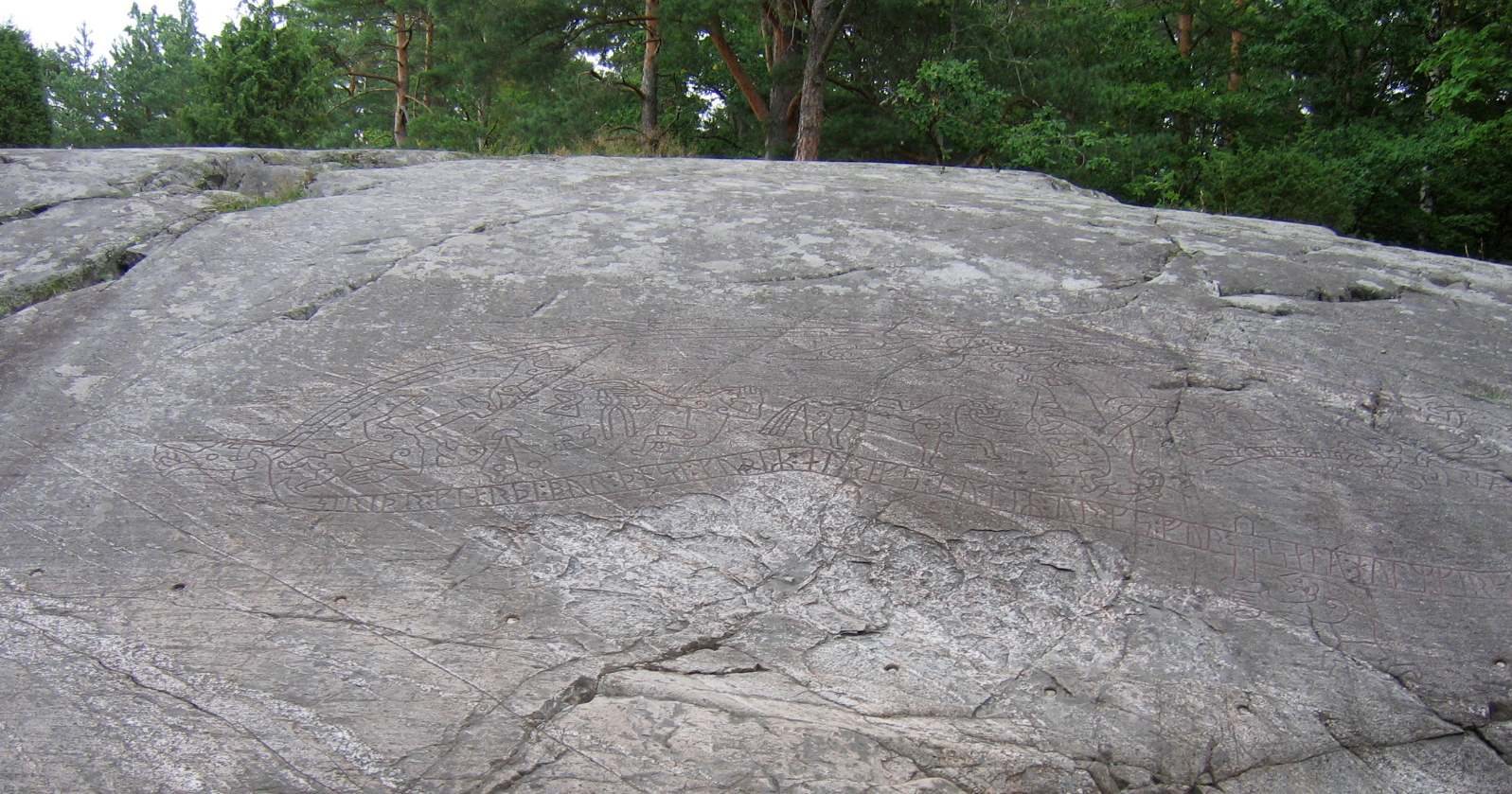
Where the written sources fall silent, the images speak. On rune-stones, on church doors and on carvings, serpents and dragons wind their way through the whole Viking Age and far beyond. The runic inscription itself often runs within the body of a stylised serpent – the text stands literally inside the dragon.
A common motif is the great beast in whose coils smaller animals are caught. Some of these images tell known stories – Sigurd's fight against Fáfnir, for example, can be recognised on several stones and carvings. Others are pure ornament, where the serpent becomes an endless, interlaced line.
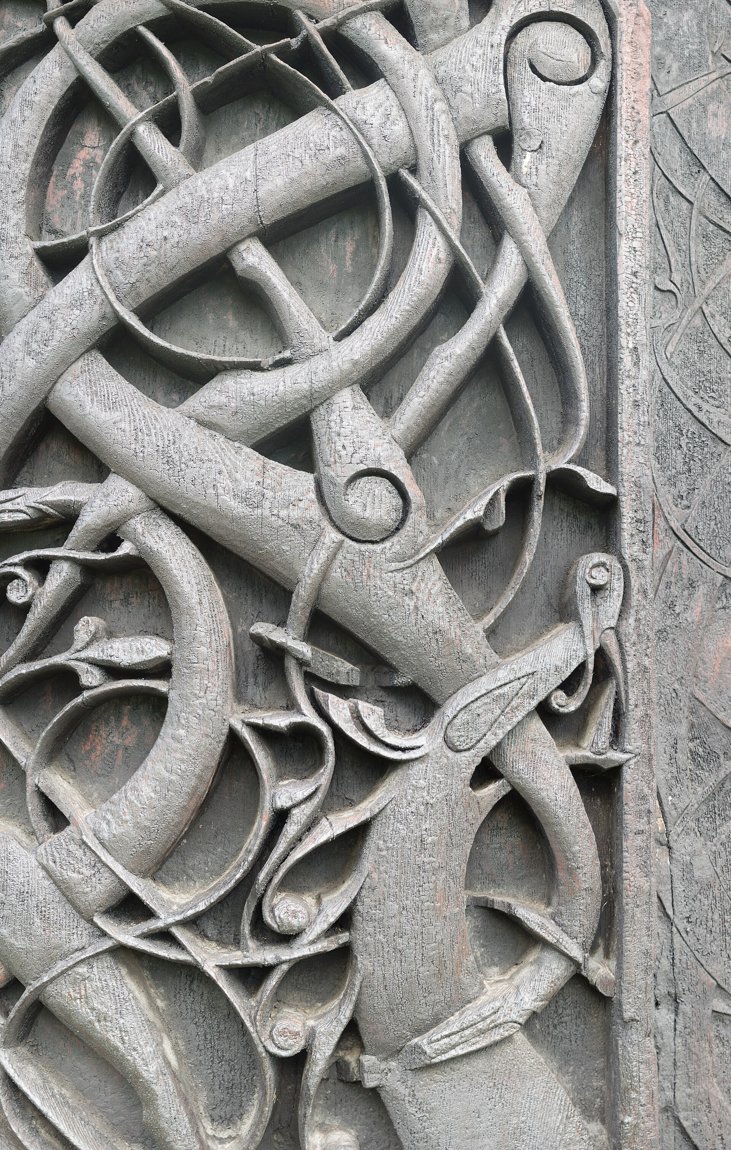
At the end of the Viking Age this art culminates in the Urnes style, named after the stave church of Urnes in Norway. Here animals and serpents have become an elegant web of narrow, crossing bands: slender quadrupeds and thin snakes grip and bite one another, all in wide, sweeping figure-of-eight loops. It is the most mature, most abstract of the Norse animal styles – the serpent knot as pure movement. More in our piece on the Urnes portal.
For us in the workshop these loops are a treasure: they are historically tangible, clearly datable, and can be engraved cleanly. Anyone who wants a serpent knot on slate or wood receives from us a motif from a genuine tradition – not from the fantasy kit.
The Midgard Serpent, biting its own tail, strongly recalls the Ouroboros, the circular symbol of eternity from the ancient and alchemical imagination. The resemblance is real and worth naming – but one should be careful about equating the two. According to the tale, Jörmungandr bit its tail simply because it grew so large that it enclosed the world; that is an image of world-encircling and of contained order, not primarily a philosophical sign of eternity. That later observers think of both together is understandable – but it is not evidence of a deliberate Ouroboros cult in the North.
Níðhöggr is not the only worm at the root. The Eddic poem Grímnismál lists a whole host of serpents lying beneath Yggdrasil and gnawing at its branches: Góinn and Móinn, Grábakr, Grafvölluðr, Ófnir and Sváfnir. They bear telling names – „the grey-hided one", „the field-digger" – and show that the tree is threatened not by a single enemy but by a whole nest of crawling forces, working ceaselessly at the foundation of the world.
This multiplicity is significant. Where Christianity later knows the one great dragon as adversary, the North thinks in serpents in the plural. The threat is not a single monster to be slain, but a constant gnawing from below – an image of transience far more uncanny than any single fire-breathing foe.
Scarcely any Norse motif binds serpent and fate so tightly as the cursed hoard. Fáfnir lies not on just any gold, but on the treasure of the dwarf Andvari, along with the ring Andvaranaut. When Loki wrings everything from the dwarf, Andvari lays a curse on the ring: it shall bring death to everyone who owns it. The curse takes effect at once – Fáfnir kills his father for it, becomes a dragon, and later Sigurd, Regin and the Nibelungs all fall victim to greed as well.
The dragon in the North is therefore never merely an animal, but always an emblem too. The worm on the gold shows what the treasure makes of its owner: it encloses him like the coils of a serpent, until nothing human is left. This motif – gold that petrifies and poisons – runs from Fáfnir through the Beowulf dragon into the later legendary world of Europe.
In the sagas the serpent meets us not only as a world-creature but very concretely as an instrument of death. In the tradition around Ragnar Loðbrók the hero dies in the snake pit of King Ælla: thrown down among a knot of adders, he still speaks his famous last words before the venom kills him. A related image stands in the Nibelung tradition, where Gunnar ends in the snake pit and there still plays the harp.
Whether such pits were ever historically used this way is disputed among scholars – the scenes clearly bear literary marks. But they show what rank the serpent holds in the Norse imagination: it is the creature that takes a hero in the hardest way, slowly and with venom, and at the same time gives him the stage for a dignified, fearless death.
The serpents and dragons of the North are more than monsters to be slain. They stand for forces that are never finally defeated: the world-serpent that holds the order together and shatters it at the end; the gnawer at the root, slowly wearing at the foundation; the worm on the gold, showing what greed makes of a person. Whoever engraves or wears them carries not a movie monster, but an old, honest image – and a piece of Norse form-art that coils a beast out of pure line.
Jörmungandr – the World Serpent · Niðhöggr – the gnawer at the root · Sigurd the dragon-slayer · The Urnes portal – the last animal style · The Wolf in the North.
All Beings & Creatures articles →
When you picture the roof of Valhöll, you probably think of shields and the golden gleam of Odin's hall. Yet above the …
Read more →At the feet of the father of the gods lie two wolves: Geri and Freki – both names mean „the greedy one". In the hall of …
Read more →The end of the world does not begin with thunder but with a rooster's crow — and it sounds three times over. Three …
Read more →On the roof of the hall of the slain stands a goat, and from her udder flows not a drop of milk but clear, bright mead …
Read more →