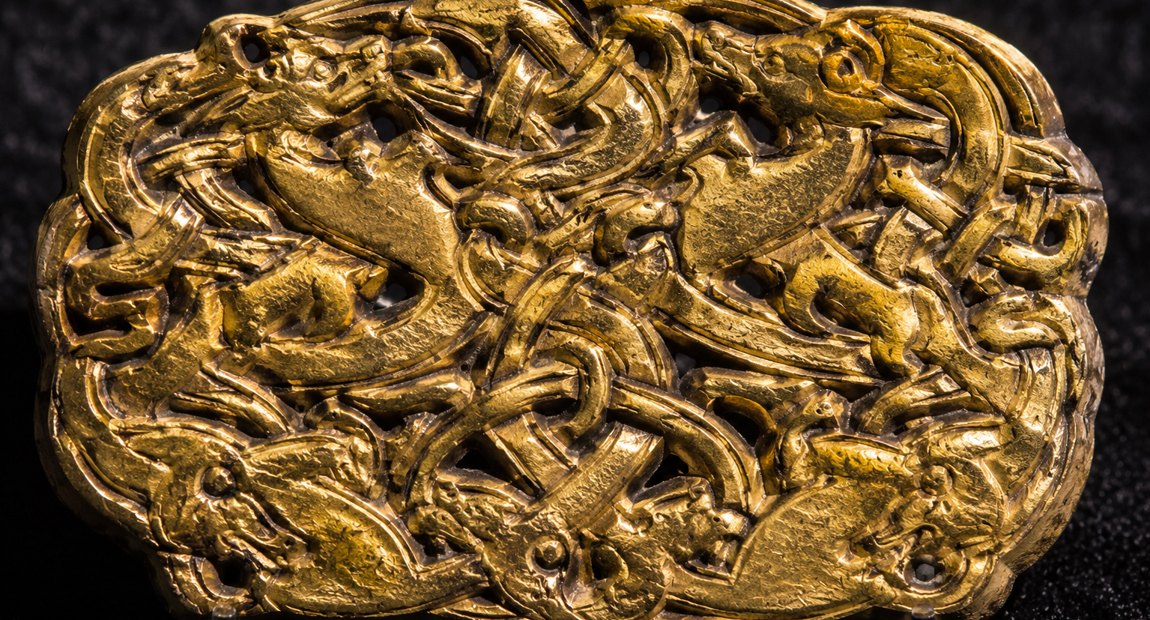
The Urnes portal is the carved north doorway of Urnes stave church on the Lustrafjord in western Norway: a pine relief made around 1070–1080 for an earlier church and reused when the present building went up in the 1130s. It gave its name to the Urnes style, the final phase of Viking animal art, with slender four-legged beasts, hair-thin serpents and open figure-of-eight loops. Here is what is firmly established, how scholars read the portal today, and why it looks more like a Christian sermon in wood than a pagan image of Ragnarök.
Picture a door that is older than the house it hangs in. That is the north portal at Urnes. The church you see today on the hillside above the Lustrafjord was raised in the 1130s. The portal, the wall planks beside it and parts of the gables are a good two generations older. Twelfth-century carpenters salvaged them from the building that stood here before and fitted them into the new one – evidently far too good to burn. Few pieces of medieval Scandinavian woodwork have been photographed, copied and argued over as much since.
The portal also lent its name to a whole phase of art. If you want the bigger picture of what came before, our overview of Viking art styles from Oseberg to Urnes walks through every stage. This article stays with the namesake itself: its date, the building phases, what is carved on it, how it has been read, and how far the style travelled.
Urnes, also spelled Ornes, lies in Luster municipality in Vestland county, on the eastern shore of the Lustrafjord, an inner arm of the Sognefjord. Directly across the water is the village of Solvorn, from which a small ferry crosses in summer. Urnes had its own parish until 1881, when it was abolished and merged into Solvorn. In the same year the church passed to Fortidsminneforeningen, the Norwegian society for the preservation of ancient monuments, which still owns it. Services are now held only for special occasions such as baptisms and weddings.
A stave church is a timber church whose load-bearing frame consists of upright posts – the "staves" – standing on a sill frame, with walls of vertical planks slotted between them. Because the timber does not sit in the ground, it does not rot the way the earth-fast posts of older buildings did. According to the figures UNESCO cites, around 1,300 medieval stave churches are recorded in Norway; 28 survive. Urnes is one of the oldest and is often called the oldest of all. In 1979 it was inscribed on the World Heritage List together with Bryggen in Bergen, the first two Norwegian sites to be listed, under criteria i, ii and iii.
Excavations beneath the church floor between 1955 and 1957, led by the building historian Håkon Christie, uncovered postholes from an earlier timber structure. Coin finds allowed him to place this first church roughly in the middle of the eleventh century. It was a post-built church, its supports dug straight into the soil.
How many churches followed is not fully agreed. The building researcher Kristian Bjerknes suggested a second church with a sill frame. The Danish archaeologist Knud J. Krogh reconstructed what he called "Urnesstilens kirke", the church of the Urnes style: a rectangular nave with a narrower chancel, richly carved, which on his reading was pulled down after less than sixty years. According to this view, the portal, the carved north-wall planks and the relief boards in the gables all come from that church.
The present church is dated by dendrochronology, the method of dating timber from its annual growth rings. As summarised in the Norwegian encyclopaedia Store norske leksikon, the building timber was felled between the winter of 1129/30 and the winter of 1131/32, so the church was probably finished early in the 1130s. It is no simple hall but a small timber basilica: a raised central nave rests on sixteen large staves linked by round arches and cushion capitals. Romanesque stone architecture, translated into pine – that is what UNESCO singles out as exceptional.
In 1601 the chancel was lengthened eastward and painted, and in 1704 the ridge turret was added. The font, pulpit and altarpiece date from the seventeenth century. During the restoration around 1900 the gables and south wall received protective cladding, behind which part of the old relief work is still hidden today.
The portal is carved from pine – not oak, as you sometimes read. The youngest tree ring identified on one of its planks belongs to the winter of 1069/70, so the carving most likely dates to around 1070–1080. That makes it the oldest dated carved portal in Norway. Older handbooks still put the Urnes carvings in the twelfth century in general terms; the tree rings have corrected that.
The whole ensemble is roughly three and a half metres tall. The carvers worked in deep relief, in places about ten centimetres into the wood, so the animal bodies seem to float above the background and light and shadow help draw the pattern. Planks, tympanum and door leaf are covered by a single continuous web of creatures.
There are good reasons to think the portal was originally the main west entrance of the older church. In the new building it was moved to the north wall, where it has been sheltered from the sun ever since. The new church received its own, plainer west doorway: a round-arched portal with cushion capitals and dragon motifs, whose door still carries medieval iron fittings with dragon-shaped tongues.
Standing in front of it, you first see nothing but motion. At the centre is a large, slender animal with four legs, an almond-shaped eye and a long, arching neck. It is locked in combat: narrow, snake-like creatures coil around its body and bite, and the animal bites back. There are also two-legged beasts, usually described in the literature as dragons. In the upper field, six animals in all face one another. In the door opening, two serpents twist around each other.
Everything is woven into figure-of-eight loops – lines that cross like a figure eight lying on its side and then double back. No body stays in its own panel; the creatures pass over and under each other, even across the boundaries between individual planks. One detail rewards a second look: on the right-hand side, about a third of the way up, a lily grows out of a serpent's mouth. That small motif turns out to matter a great deal in current interpretations.
We know only part of what the portal originally looked like. Traces of ultramarine and red have been found on the capitals inside the church; that the portal was painted too is plausible, but not securely documented for Urnes itself.
The Urnes style can be identified by a handful of features:
Plants barely feature any more – unlike the preceding Ringerike style with its long tendrils, from which Urnes developed around the middle of the eleventh century. Both share the motif of a great beast fighting serpents, which already appears in the Mammen style of the late tenth century. If you want to try the differences for yourself, our guide to drawing Norse animal ornament takes you through each style step by step.
Scholars usually date the Urnes style from around 1050 into the first decades of the twelfth century. The dating rests on dendrochronology, as at Urnes itself, and on coins buried together with jewellery in the style, including issues of the Norwegian kings Harald Hardrada and Olav Kyrre. The most influential framework comes from the Norwegian art historian Signe Horn Fuglesang, who distinguishes early, middle and late Urnes.
For a long time the obvious, romantic reading was this: pagan images on a Christian church. The great beast fighting serpents was linked with Ragnarök, the downfall of the gods, or with the world tree Yggdrasil, whose roots are gnawed by the dragon Níðhöggr. Some even suggested the older church was replaced so soon because its imagery was too pagan for the new order. You will still find this reading in many travel guides.
It cannot be proven. There is not a single scene on the portal that can be tied clearly to any text in the Edda: no tree with three roots, no stags, no eagle, no god. The Völuspá, the great poem of the seeress, does end with a dark dragon flying in, carrying corpses in its feathers, and that dragon is called Níðhöggr. But between a poem written down in the thirteenth century and a church doorway of around 1070 there is no direct link. For more on the creature itself, see our article on dragons and serpents in the Norse world.
In recent years an international research team led by the art historian Margrete Syrstad Andås of NTNU in Trondheim has studied the church in its European context. Results appeared in 2022 in the volume "Urnes Stave Church and Its Global Romanesque Connections", edited by Kirk Ambrose, Griffin Murray and Andås. Their core argument: Urnes is not the last gasp of a pagan art, but a building that responds to developments across Europe.
Andås identifies the great beast on the portal as a stylised lion. The lion was a widespread emblem of rulership, and in Christian imagery it could stand for Christ, "the Lion of the tribe of Judah". The serpents attacking it would then represent the evil he struggles against. The French art historian Nathalie Le Luel has drawn attention to the lily detail: several of the serpents attacking the lion turn into lilies – a symbol of salvation. Evil is not merely defeated; it is transformed.
The location fits. In the Middle Ages a portal was more than a door; it was the threshold between the world and the sanctuary. In medieval liturgy, for instance at the consecration of a church, Psalm 24 was sung at the doorway, with the question and answer that the King James Bible renders: "Who is this King of glory? The LORD of hosts, he is the King of glory." Andås took exactly this question as the title of her chapter on the portal and west gable. Anyone walking through this doorway walked, symbolically, through the struggle between good and evil towards Christ.
The Christian reading, too, remains an interpretation – no written explanation survives from the time the portal was made. It is also an open question whether every loop carries meaning or whether some of it is simply ornament. Of the roughly 120 surviving stave church portals, only a few show biblical scenes, while many show dragons – and on the Continent the dragon was an image of evil, whereas pre-Christian Scandinavian art tended to favour wingless serpents.
The portal is not the only treasure at Urnes. The capitals of the central nave carry 54 carved fields showing lions, dragons, a camel, centaurs, birds and a barefoot cleric with a crozier and a cross, whom some read as a pilgrim. The relief is flat and crisply cut, without modelling; foliage appears only on the corner capitals. These carvings belong to the new church of the 1130s and are clearly Romanesque.
On the chancel wall hangs a Crucifixion group: Christ wearing a royal crown, flanked by Mary and John. Its date varies in the literature between around 1150 and the late twelfth century; it was painted later, in the thirteenth century. Christ as a crowned king on the cross – here, too, the "King of glory". The furnishings also included two enamelled bronze candlesticks from Limoges in France, dating from the thirteenth century and no longer kept in the church, and a medieval wrought-iron altar candelabrum shaped like a boat, with weathervanes at the prow and stern.
The Limoges candlesticks show how connected this remote place was: the Sognefjord was a waterway to the open sea, to Bergen, to England and to the Continent. Norway had been converted only a few generations earlier under kings such as Olav Haraldsson, who fell at Stiklestad in 1030 and was soon venerated as a saint. How that change unfolded across the North is the subject of our article on the Christianisation of the Germanic peoples.
The portal gave the style its name, but most Urnes-style works are not in Norway at all. The largest group is found on runestones in Uppland, the region around Uppsala and Stockholm, which is why some scholars also call it the "runestone style". The Swedish archaeologist Anne-Sofie Gräslund divided the ornament on these stones into groups that can be used for dating. On her scheme, group Pr3, with transitional features, belongs to roughly 1050–1080, Pr4 to about 1060/70–1100, and Pr5 to about 1080/1100–1130. With Pr5 the runestone tradition in Uppland comes to an end.
The rune serpent, whose body carries the inscription, becomes ever slimmer through these phases. Its master was the rune carver Öpir, active in the late eleventh and early twelfth centuries, mainly in southern and eastern Uppland. He signed around fifty stones, and roughly as many again are attributed to him. His hallmark is a single rune serpent shaped like a figure eight, so fine and open that it almost floats. His works include the Vaksala stone (U 961), the Marma stone (U 485), on which he gives his full name, and a stone in Uppsala Cathedral. The middle Urnes phase, by contrast, is shaped by the rune masters Fot and Balli.
Many of these stones bear a cross and Christian prayer formulas such as "God help his soul". The same picture emerges as at Urnes: the style is not pagan but the visual language of a newly Christian elite that honoured its dead, recorded property and professed its faith all at once. For more on these monuments, see our honest introduction to the runes.
The style left its mark in Denmark too. The Hørning plank, discovered in 1887 reused as fill in the Romanesque church at Hørning near Randers, is the only surviving piece of a stave church built around 1070. Its outer face carries carved and painted dragons in the Urnes style; the inner face is painted with vines and grapes, an image of the Eucharist. It is now in the National Museum of Denmark in Copenhagen. Openwork animal brooches showing a great beast fighting serpents are another hallmark of the style, found across Scandinavia.
In England the Pitney brooch is the finest example. This gilded copper-alloy disc, just 39 millimetres across, was probably found in the 1870s in the churchyard at Pitney in Somerset and was acquired by the British Museum in 1979. In openwork it shows a ribbon-like animal fighting a snake. The archaeologist James Graham-Campbell has explicitly compared its combat motif with the compositions at Urnes.
The style lived longest in Ireland. Scandinavians had settled in towns such as Dublin, Waterford and Limerick, and it was through these Ostmen and their neighbours that ideas flowed. Irish metalworkers took up the Urnes style around 1100 and developed their own version, which scholars call "Hiberno-Urnes". Early examples include the shrine of St Patrick's Bell, dated by its inscriptions to around 1094–1105, and the Lismore crozier, made around 1100–1113 for Bishop Niall mac Meic Áeducáin. The art historian Máire de Paor called it "Irish-Urnes in its full development".
The most famous piece is the Cross of Cong. Tairrdelbach Ua Conchobair, king of Connacht and high king of Ireland, commissioned it to hold a relic of the True Cross that reached Ireland from Rome around 1123. The processional cross, about 76 centimetres tall, was first made for the church at Tuam and later moved to Cong Abbey, hence its name. Its surfaces are covered in Urnes-style interlace, and at its base animal heads grip the cross in their jaws. The inscriptions name the goldsmith Máel Ísu mac Bratáin Uí Echach. Today it is in the National Museum of Ireland in Dublin. Long after the style had given way to the Romanesque in Scandinavia, it was still decorating Irish reliquaries of the twelfth century. For the background, see our article on the Vikings in Ireland, Scotland and the islands.
In Scandinavia itself the Urnes style merged with the Romanesque in the twelfth century. This hybrid, often called "Urnes-Romanesque", appears mainly on Gotland and the Swedish mainland, but no longer on runestones. A well-known Danish example is the gilded altar frontal from Lisbjerg near Aarhus, from around 1135. The animals grow fuller, foliage returns, and compositions are arranged along axes. Urnes itself shows the transition in a single building: outside, the portal of around 1070; inside, the Romanesque capitals of around 1130.
The original cannot be touched and is fragile. That makes one project by Fortidsminneforeningen all the more remarkable. Under the title "Treets mester" (Master of the Wood), three Norwegian carving workshops have, since 2020, produced a replica of the portal – by hand, using tools forged after medieval models from bog iron ore. Their starting point was 3D scans by the Museum of Cultural History in Oslo, which revealed the tool marks of the original carvers. The timber came from a pine from Vik in Sogn. The replica was unveiled on 22 September 2024 and is intended for a planned World Heritage visitor centre.
What we like about it is that it treats the portal as craftsmanship, not just as a picture: the carvers learned first-hand how much time the deep, shadowed passages demand. For more on the techniques, read our article on Viking woodcarving.
When we transfer an Urnes-style motif onto slate or wood in our workshop in Alsdorf, it is a translation into another material and another technique. The goal is the same as 950 years ago: a line that never breaks, that dives over and under and still adds up to a whole. To find out which Norse signs are genuine and which are not, see our article on Viking symbols and their meaning.
How old is the Urnes portal? The youngest tree ring on a portal plank dates to the winter of 1069/70. The portal was therefore carved around 1070–1080, some sixty years before the present church was built.
Is Urnes the oldest stave church in Norway? It is one of the oldest surviving stave churches and is often called the oldest. Its timber was felled in 1129/30–1131/32, and parts such as the north portal were reused from an earlier church.
What are the features of the Urnes style? Slender quadrupeds and hair-thin serpents intertwined in open figure-of-eight loops, usually only two line widths, and an open design with no axis of symmetry.
What do the animals on the Urnes portal mean? Recent research reads the great beast as a lion, an image of Christ fighting evil, and the serpents turning into lilies as evil defeated and transformed. The older Ragnarök or Níðhöggr reading has no supporting evidence.
Where else can you see Urnes-style art? Above all on runestones in Uppland, Sweden, on openwork brooches across Scandinavia, on the Pitney brooch in England, and on Irish church treasures such as the Cross of Cong.
For courage. For remembrance. For legends that live on.
Runes & their meaning · Thor's Hammer · Norse symbols: real or invented? · The Golden Horns of Gallehus · Guldgubber – the tiny gold gods.
