Harald Hardrada (Old Norse Haraldr harðráði, "hard ruler", properly Harald Sigurðarson) was a Norwegian prince who fled the Battle of Stiklestad as a teenager in 1030, served in Kievan Rus and in the Byzantine Varangian Guard, became king of Norway from 1046 and was killed at Stamford Bridge in England on 25 September 1066. Here is what contemporary Greek and English sources say about him, what only the Icelandic sagas tell – and why the "last Viking" label is more myth than evidence.
Summer 1030, a battlefield in central Norway. A wounded fifteen-year-old hides while the peasants who have just killed his half-brother, the king, comb the field for survivors. Thirty-six years later the same man stands outside York with an army, having seen Kiev, Constantinople and Sicily, wearing the crown of Norway and reaching for England. Within days he is dead. In between lies one of the most improbable careers of the eleventh century – and one of the most lavishly told.
That is exactly the catch. Harald Sigurðarson reaches us largely as a saga hero. The fullest accounts were written in Iceland around 150 years after his death: Morkinskinna (c. 1220), Fagrskinna and, above all, Haralds saga Sigurðarsonar in the Heimskringla of Snorri Sturluson (c. 1230). Their backbone is skaldic verse, some of it composed in Harald's own lifetime. But a handful of outsiders also saw him – a Byzantine officer named Kekaumenos, the Anglo-Saxon Chronicle, Adam of Bremen. We set the two kinds of evidence side by side. The story survives the test; it simply becomes more honest.
Harald was born around 1015, probably in Ringerike in south-eastern Norway. His father was Sigurd Syr ("the Sow"), a petty king of Ringerike. His mother, Åsta Gudbrandsdatter, had earlier been married to Harald Grenske, and from that marriage came Olaf Haraldsson – the future Saint Olaf. Harald was therefore Olaf's younger half-brother, a family tie he would exploit politically for the rest of his life.
Olaf became king of Norway in 1015 but was driven out in 1028 by Cnut the Great and the Norwegian magnates who sided with him; we tell that story in our article on Cnut the Great. In 1030 Olaf returned from exile in Rus to win back his kingdom. On 29 July 1030 he met a peasant army at Stiklestad – and fell. According to the sagas Harald fought at his side, aged fifteen, and was badly wounded. A farmer is said to have hidden him and nursed him until he could slip across the mountains into Sweden.
Around 1031 Harald reached Kievan Rus, probably arriving first at Staraya Ladoga, the Aldeigjuborg of the sagas. The ruler there was Grand Prince Yaroslav the Wise, whose wife Ingegerd was a Swedish king's daughter. The court at Novgorod and Kiev was a natural refuge for Scandinavian warriors: Olaf had sheltered there, and Olaf's young son Magnus was being raised there too.
The sagas have Harald serve for several years as a commander in Yaroslav's retinue. Modern writers often link him to Yaroslav's Polish campaign of 1031 – plausible, but no source names him there. The sagas are more interested in romance: Harald supposedly asked for the hand of Yaroslav's daughter Elisabeth – in Old Norse Ellisif or Elisiv – and was turned down because he had neither land nor treasure. Whether that first courtship really happened is unknowable. The ending, however, is real: after his years in Byzantium, around 1043/44, Harald did marry Ellisif.
He even made poetry of it. In the Gamanvísur ("verses of amusement") attributed to him, Harald boasts of his deeds at sea and in battle – and each stanza ends, roughly speaking, with the complaint that a woman in Garðaríki, the land of the Rus, still will not have him. It is self-mockery of a high order: the hard warrior whom every weapon obeys, except where a prince's daughter is concerned.
After a few years Harald moved on south with his followers, down the Dnieper along the route from the Varangians to the Greeks, towards Constantinople. That was probably in 1034, perhaps a little earlier.
In Constantinople – Miklagarðr, "the great city", to the Norse – Harald joined the Varangian Guard. Since the late tenth century this imperial bodyguard had been recruited from warriors of Rus and Scandinavia; many Englishmen joined after 1066. The word Varangian (Greek Varangoi, Old Norse Væringjar) probably means something like "men bound by a pledge". How Varangians, Rus and Normans relate to one another is the subject of our explainer Vikings, Normans, Varangians.
Here is what makes Harald unusual: for his Byzantine years we have more than sagas. The officer Kekaumenos, writing in the 1070s, compiled a book of advice and anecdotes – often called the Strategikon in English and German scholarship, also known as Consilia et narrationes or Advice and Anecdotes. In it he tells of Araltes – Harald – son of a king of "Varangia", whose brother Julavos (Olaf) had been king there.
In outline, Kekaumenos says this: Harald came to Constantinople under Emperor Michael IV (r. 1034–1041) with about 500 brave men. The emperor sent him to Sicily, where the Roman – that is, Byzantine – army was at war. When the island had been subdued, Harald returned and was given the rank of manglabites, one of the palace guards who cleared the emperor's path with batons. He then fought in Bulgaria against the rising led by Delyan and was rewarded with the title spatharokandidatos. Under Constantine IX Monomachos he asked to go home, was refused, and slipped away secretly. Back in his own country he ruled in place of his brother – and, Kekaumenos adds, remained loyal and friendly towards the Romans.
From 1038 Byzantium tried, under the general George Maniakes, to wrest Sicily from Arab rule. The army included Varangians, Lombard contingents and Norman mercenaries – among them men who would go on to build Norman southern Italy (see our article on the Normans in southern Italy). Messina and Syracuse fell, but the campaign unravelled once Maniakes was recalled to Constantinople.
The sagas recount several sieges that Harald won by cunning. The most famous: he caught birds that nested in a besieged town, tied slivers of tarred wood to their backs, set them alight and let them fly home, where they set the roofs ablaze. Snorri does not name the town. The same trick is told of Princess Olga of Kiev in the Rus Primary Chronicle and turns up elsewhere too. This is a migrating story motif, not a field report.
Bulgaria stands on firmer ground. In 1040/41 Peter Delyan rose against Byzantine rule, and Michael IV took the field against him in person in 1041. Kekaumenos confirms Harald's part in the campaign. Harald's skald Þjóðólfr Arnórsson calls him the "Bulgar-burner" (Bolgara brennir) – a clear echo of Emperor Basil II's celebrated nickname, "the Bulgar-slayer".
Michael IV died in December 1041. His nephew Michael V succeeded him and in April 1042 banished the popular Empress Zoe to a convent, sparking a popular uprising in the capital. The emperor fled to a monastery, was dragged out and blinded. The eyewitness Michael Psellos describes the scene vividly in his Chronographia.
Snorri tells it very differently. Harald, he says, had been thrown into prison on Zoe's orders – either for embezzling plunder or because he had sought the hand of a young relative of the empress. A noblewoman freed him with Saint Olaf's help, whereupon Harald and his Varangians seized the emperor and put out his eyes. Snorri cites the skalds Þórarinn Skeggjason and Þjóðólfr, who do indeed say that Harald had the emperor blinded.
In 1042 or 1043 Harald left Constantinople without permission. According to the sagas he ran two ships over the chain that closed the Bosporus at night, his rowers rushing first to the stern to lift the bows, then forward so the hull tipped over the chain; one of the ships broke its back. Kekaumenos at least confirms the secret flight. Harald had already sent his wealth ahead to Yaroslav in Kiev – and it must have been a great deal of wealth.
Back in Rus, Harald married Ellisif, Yaroslav's daughter, around 1043/44. They had two daughters, Maria and Ingegerd. In the winter of 1045/46 he moved on to Sweden, where he allied himself with Sweyn Estridsen, another man with a claim – in his case to Denmark.
Norway was now ruled by Magnus the Good, Olaf's son, who had been brought home from Rus in 1035 and had also been king of Denmark since 1042. Harald and Sweyn first raided the Danish coasts together. Then Harald switched sides: in 1046 he came to terms with his nephew Magnus and became co-king. Harald received half of Norway and in return handed over half of his Byzantine treasure, while Magnus kept precedence. The arrangement lasted barely a year. In 1047 Magnus died in Denmark without an heir, leaving Harald sole king of Norway – and Sweyn king of Denmark.
According to the sagas Harald took a second wife around 1048, Tora Torbergsdatter, from a powerful Norwegian family. Whether Ellisif was still alive at the time is debated. Tora's sons Magnus and Olaf both became kings, and Olaf Kyrre ("the Quiet") ruled long and peacefully after his father's death.
The by-name harðráði means something like "hard ruler" or "stern in counsel". It is rare in the earliest sources; in Norway he is usually just Harald Sigurðarson, and "Hardrada" owes its fame mainly to English usage. He probably earned it all the same, enforcing royal power with considerable brutality.
Around 1050 he had the powerful Trønder magnate Einar Thambarskelfir and his son murdered in Nidaros (Trondheim) after Einar had appeared in the town with his own armed following. The killing almost triggered civil war, and it finally broke the old networks of aristocratic power we describe in our piece on the Earls of Lade. In 1064/65 Harald crushed a revolt in the Uplands, burning farms and having farmers killed or maimed for withholding taxes.
At the same time Harald was, in some ways, a thoroughly modern ruler. He enforced a royal monopoly on coinage, so that only the king's money was to circulate. The fact that his pennies lost much of their silver content over the course of his reign brought him revenue and shows that he understood coinage as an instrument of power. The sagas also credit him with founding Oslo. Archaeologically the site is older; Harald developed it into a royal base rather than founding it. Adam of Bremen, writing in the 1070s, paints him as a greedy and cruel tyrant and complains that he had bishops consecrated without reference to the archbishop of Hamburg-Bremen.
From 1048 to 1064 Harald fought Sweyn Estridsen of Denmark almost every year. It was a grinding war of coastal raids with no decisive outcome. Around 1049/50 – the dating varies – the greatest trading town of the North fell to his fleet: Hedeby on the Schlei.
Snorri reports that Harald's army went all the way south to Hedeby, took the merchant town and burnt it. As proof he quotes a stanza by one of Harald's men saying that Hedeby burned from end to end in anger; the skald Þorleikr fagri ("the Fair") also alludes to the fire in a poem about Sweyn. Another contemporary stanza, by the Icelander Valgarðr á Velli, describes one of Harald's Danish raids in which women were led bound to the ships – an unvarnished picture of what "Viking warfare" meant for those on the receiving end.
The climax of the war was the sea battle at the Nissan (Niså) off the coast of Halland on 9 August 1062. Harald won; Sweyn escaped. Nothing was settled. In 1064 the two kings made peace, each keeping his own realm, and Harald was free to look elsewhere.
Harald was not only a patron of skalds – Þjóðólfr Arnórsson, Arnórr jarlaskáld, Stúfr the Blind and Valgarðr á Velli all worked for him – but a poet in his own right. Several lausavísur (single stanzas) and the Gamanvísur are attributed to him. In one well-known stanza he lists his accomplishments, among them poetry, riding, swimming, skiing, shooting, rowing and harp-playing. A very similar catalogue was composed a century later by Earl Rögnvaldr Kali of Orkney; what we see here is an ideal of the complete nobleman, not a CV.
Harald's claim to England was thin, but not invented. He pointed to an agreement between Magnus the Good and Harthacnut, Cnut's son, that whichever outlived the other would inherit his kingdom. When Edward the Confessor died in January 1066 and Harold Godwinson was crowned, Harald saw his chance. He was egged on by Tostig, Harold's exiled brother and former earl of Northumbria.
In late summer 1066 Harald sailed by way of Orkney to England with a large fleet. Two versions of the Anglo-Saxon Chronicle give 300 ships; modern estimates of perhaps 10,000 to 15,000 men are no more than an order of magnitude. Tostig joined with ships of his own. The fleet went up the Humber and the Ouse and landed at Riccall, south of York.
On 20 September the northern earls Edwin and Morcar confronted the Norwegians at Fulford and were defeated. York submitted and agreed to hand over hostages. Harald pulled his army back to wait for them at Stamford Bridge, a crossing of the River Derwent some twelve kilometres east of York, leaving part of his force with the ships at Riccall.
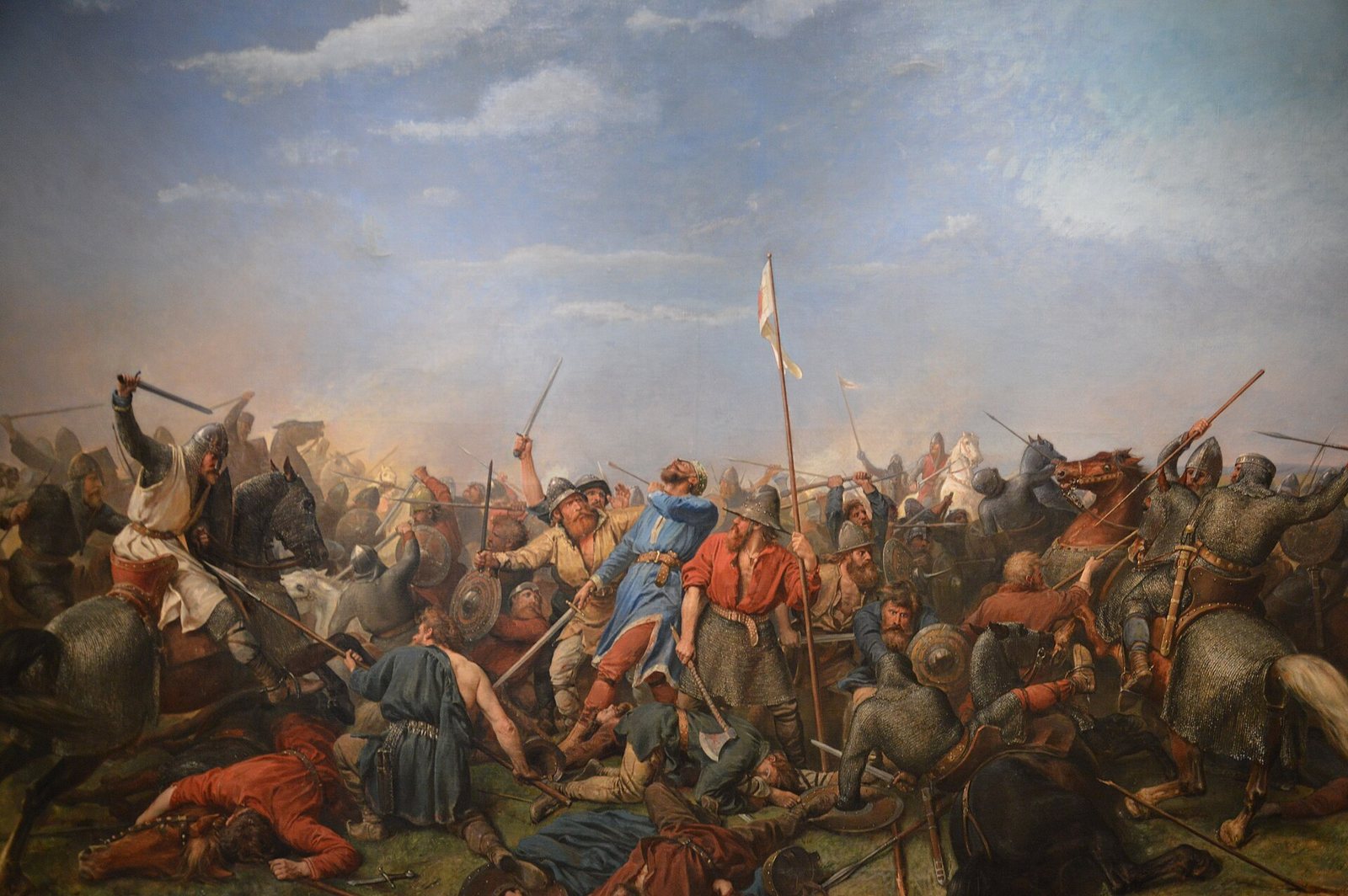
What followed is the most famous surprise attack of the English Middle Ages. Harold Godwinson had marched north at astonishing speed, mustered his army at Tadcaster on 24 September, passed through York the next morning and fell on the unsuspecting Norwegians on 25 September. The Anglo-Saxon Chronicle stresses exactly that surprise, and says the fighting went on until late in the day with countless men killed on both sides. Harald and Tostig were among the dead. Our article on the Battle of Stamford Bridge covers the course of the fighting in detail.
Snorri's version is more colourful. On that warm day, he says, the Norwegians had left their mail shirts at the ships. Before the battle a rider came over from the English line and offered Tostig his earldom back. And what would Harald of Norway get? Snorri gives the envoy the famous reply that he would be granted seven feet of English ground – or as much more as he was taller than other men. Only afterwards did Harald learn that the rider had been King Harold himself. A magnificent scene – and almost certainly a literary one.
According to Snorri, Harald composed a stanza before the fighting, judged it poor and immediately made a better one, whose gist is that we do not creep behind our shields, however loudly the weapons ring. Soon afterwards an arrow struck him in the throat. A relief force under Eystein Orri, which had run from the ships without armour and arrived exhausted, was cut down in turn – the sagas call that last charge "Orri's storm".
The losses were enormous. Harold let Harald's son Olaf and the Orkney earls Paul and Erlend leave on oath; according to the Chronicle, about two dozen ships were enough to carry the survivors home. The Anglo-Norman monk Orderic Vitalis wrote some two generations later that a great heap of bones still lay on the battlefield. Harald's body was taken back to Norway and buried in St Mary's Church in Nidaros, later moved to Helgeseter Priory, which was demolished in the seventeenth century. His grave is lost.
Nineteen days after Stamford Bridge, on 14 October 1066, Harold Godwinson fell at Hastings fighting William of Normandy – a descendant of Rollo and so another man with Norse roots.
Hardly a book or documentary resists the label: Harald Hardrada, the last Viking, whose death closes the Viking Age. It is a modern convention, not a medieval one; no source of the eleventh or thirteenth century calls him that. The year 1066 is convenient for textbooks because it coincides with the Norman Conquest of England, and we use it ourselves as a rule of thumb.
But the rule has holes. In 1069/70 Sweyn Estridsen sent a Danish fleet to England that plundered York, and another followed in 1075. Cnut the Holy planned a great invasion in 1085 that never sailed. The Norwegian king Magnus Barefoot campaigned in the Irish Sea in 1098 and 1102/03 and was killed in Ulster in 1103. The Hebrides and the Isle of Man stayed under Norwegian rule until 1266. And Harald himself was already a Christian king with a coinage, bishops and administration – more a high-medieval monarch than an old-style sea-king. "Last Viking" describes a feeling: with Harald ends the age in which a Scandinavian army seriously fought for the crown of England. No more than that.
In the Arsenal of Venice stands a marble lion about three metres tall, carved in the fourth century BC. It originally stood in the harbour of Piraeus near Athens; the Venetian commander Francesco Morosini carried it off as war booty in 1687. On its flanks, inside serpent bands like those on Swedish runestones, are carved runes – graffiti left by Scandinavians, probably Varangians, in the eleventh century.
When the Danish scholar Carl Christian Rafn interpreted the inscriptions in the 1850s, he found the name Harald among them, and the romantic idea was born that Harald Hardrada had left his mark there. The runes, however, are badly weathered, and every reading is largely reconstruction. Erik Brate (1914) arrived at a quite different reading that names Swedes as the carvers. Today Harald's involvement is considered unlikely: the style and dating of the ornament point to the second half of the eleventh century, after Harald had left Byzantium, and his name cannot be read with any confidence.
In the end we are left with a figure who bridges two ages. Harald began as a fugitive in a world where a bold man with a sword and a few hundred followers could make his fortune between Kiev and Constantinople. He ended as a king who struck coins, appointed bishops and brought his own subjects to heel with fire. Kekaumenos saw a loyal mercenary, Adam of Bremen a tyrant, Snorri a hero with flaws, the Anglo-Saxon Chronicle a dangerous invader. Each was partly right – and it is precisely the seams between the contemporary core and the later gloss that make his story so compelling.
What does Hardrada mean? Old Norse harðráði means roughly "hard ruler" or "stern in counsel". The by-name is especially common in English; in Norway he is usually called Harald Sigurðarson or Harald Hardråde.
How did Harald Hardrada die? He was killed on 25 September 1066 at the Battle of Stamford Bridge near York, fighting King Harold Godwinson. According to Snorri, an arrow struck him in the throat.
Did Harald Hardrada serve in the Varangian Guard? Yes. Besides the sagas, the Byzantine writer Kekaumenos confirms it, naming his service in Sicily and Bulgaria and his court ranks of manglabites and spatharokandidatos.
Did Harald Hardrada blind Emperor Michael V? His skalds and Snorri say so. Byzantine sources such as Psellos do not mention him; he may have been involved as an officer of the guard, but there is no proof.
Why is Harald Hardrada called the last Viking? Because his death in 1066 ended the last great Scandinavian attempt to conquer England. The label is modern; raids and Norwegian rule in the west continued long afterwards.
Who was Harald Hardrada's wife? Ellisif (Elisabeth), daughter of Yaroslav the Wise of Kiev. According to the sagas he also took Tora Torbergsdatter around 1048, mother of the kings Magnus and Olaf Kyrre.
For courage. For remembrance. For legends that live on.
Stamford Bridge 1066 · Cnut the Great · Leif Erikson · Rollo of Normandy · Ragnar's sons.
All History & Finds articles →
Long before the Vikings, a Roman writer describes a Germanic tribe that defeats its enemies not by number or strength …
Read more →The most famous eyewitness account of the Vikings comes not from the North, but from Baghdad. In 921 the Caliph sent …
Read more →Carved in stone over 1,000 years ago, a king proclaims the unification and baptism of Denmark – the same king whose …
Read more →Long before the Vikings they settled between the Eifel and the Danube, leaving behind gold hoards and princely graves …
Read more →