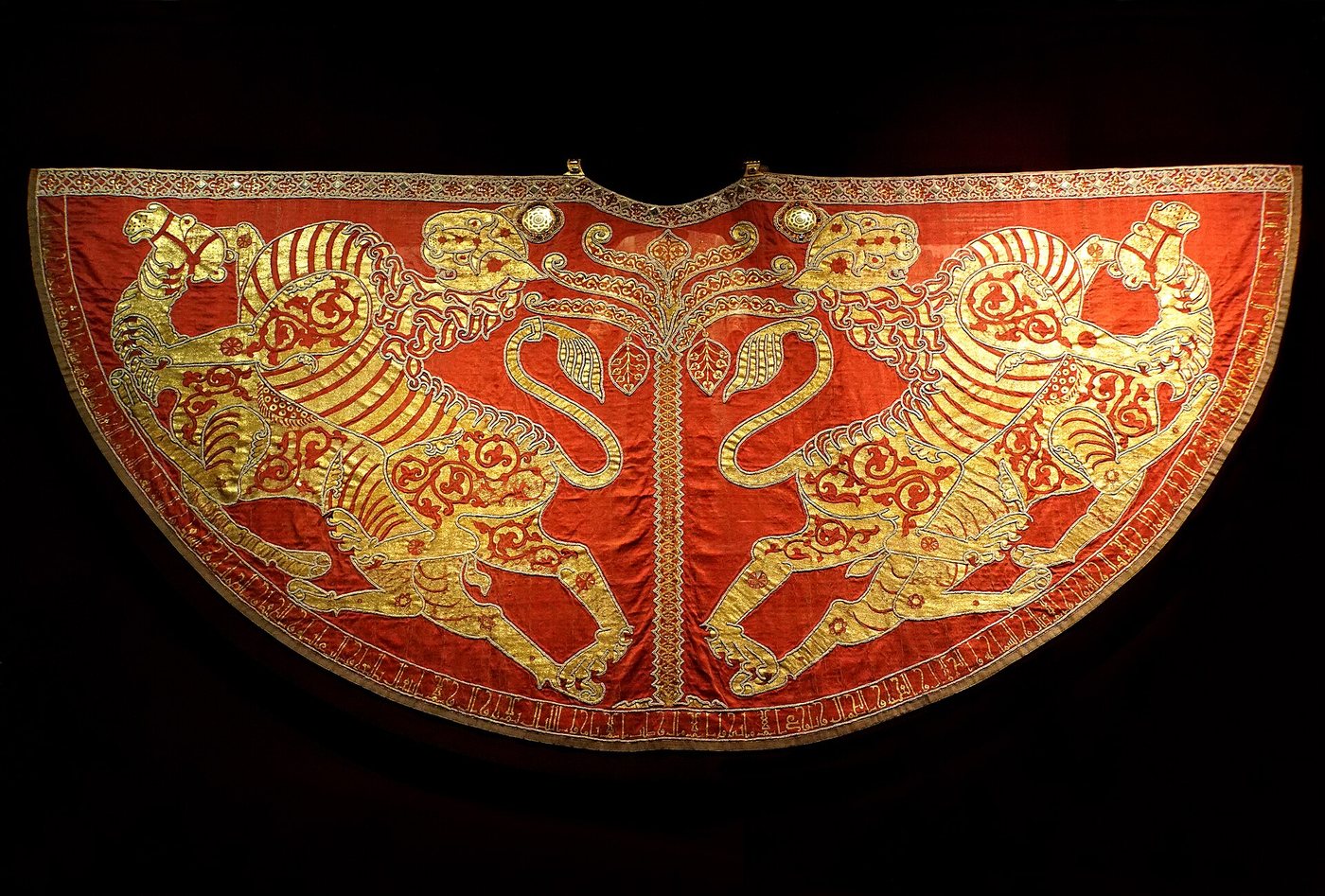
On Christmas Day 1130, in the cathedral of Palermo, a man was crowned king whose great-grandfather had been a minor knight in the Cotentin. Roger II ruled over Greeks, Arabs, Lombards and Jews; his charters were written in Latin, Greek and Arabic; his coronation mantle bears an Arabic inscription. A hundred and twenty years earlier his people had crossed the Alps as mercenaries and pilgrims. By then they had long ceased to be Vikings. How French-speaking knights from Normandy conquered the south of Italy – and why the North survives in this story almost only in a name.
The name is misleading. Normanni, Northmen, was originally what the Franks called the Scandinavian raiders. After Rollo received land on the lower Seine in 911, it became the name of the inhabitants of the new principality, Normandy. How that came about is told in our article on the Vikings in France.
The men who went to southern Italy in the early eleventh century were the great-grandsons and great-great-grandsons of those settlers. They spoke French, they were baptised, they fought as armoured horsemen with the lance, and they had about as much in common with the sea-raiders of the ninth century as a crusader has with a Viking: a distant ancestry and a name. Calling them "Vikings in Italy" skips three generations.
The sources tell two versions of how the first Normans came south. Amatus of Montecassino reports that some forty Norman pilgrims on their way home from Jerusalem defended Salerno against Saracen raiders around the year 1000 and were then invited to come back. William of Apulia says that Norman pilgrims met a man called Melus at the shrine of the Archangel Michael on Monte Gargano.
Melus is firmly historical. He was a Lombard nobleman from Bari who had risen against Byzantine rule in Apulia in 1009 and failed. From about 1017 he fought again, this time with Norman warriors at his side. After early successes his army was crushed in 1018 at Cannae, the very place where Hannibal had once defeated the Romans. Melus fled to Emperor Henry II and died in Bamberg in 1020.
The Normans stayed. In the years that followed they hired themselves out to anyone who paid: to the Lombard princes of Capua and Salerno, to abbots, to Byzantium. Southern Italy at the time was a patchwork of Byzantine provinces, Lombard principalities, free coastal cities such as Naples and Amalfi, and Arab-ruled Sicily. For mercenaries it was ideal ground.
The first permanent holding went to a Norman called Rainulf Drengot. Duke Sergius IV of Naples, who needed help against the prince of Capua, gave him Aversa, between Naples and Capua, around 1030 – and his sister in marriage. The mercenary captain became a count with land of his own.
Amatus describes what happened next: Aversa became a rallying point. New men came from Normandy, drawn by the word that in the south a sword could win you land. Rainulf's nephew Richard became prince of Capua in 1058 and so displaced the old Lombard dynasty.
The most famous family, though, came from Hauteville in the Cotentin, the peninsula in the west of Normandy; which of the places of that name is meant is not entirely certain. According to Malaterra, Tancred of Hauteville had twelve sons by two marriages. Several of them went south.
The eldest, William and Drogo, fought in 1038 in the Byzantine army of the general George Maniakes, which was to wrest Sicily from the Arabs. William is said to have killed an emir in single combat before Syracuse and so earned the byname "Iron Arm" – so Malaterra tells it. According to Snorri's kings' sagas, Harald Sigurdsson and his Varangians served in the same army. If that is true, then for a moment real Scandinavians and the descendants of Scandinavians stood side by side – and had hardly more to say to each other than two bands of mercenaries of different origin.
In 1042 the Normans of Apulia chose William Iron Arm as their count at Melfi. After him his brothers Drogo and Humphrey led them. How much of a plague the Normans had become by then is shown by the year 1053: Pope Leo IX marched against them with an army and was defeated and captured at Civitate.
The ablest of the brothers came to Italy around 1047: Robert, called Guiscard, the cunning or wily one. He started out as the leader of a robber band in Calabria and became count of Apulia after Humphrey's death in 1057. In 1059 Pope Nicholas II, having learned from Leo's defeat, made peace with the Normans at Melfi. He invested Robert as duke of Apulia and Calabria and, in the future, of Sicily – an island then still entirely in Arab hands.
Robert kept his word. Bari, the last Byzantine city in Italy, fell in 1071, Salerno in 1076. In 1081 he crossed the Adriatic and attacked the Byzantine Empire itself. At Dyrrhachium in present-day Albania his army met the imperial Varangian Guard, in which many Englishmen now served who had fled after 1066 from the Normans of William the Conqueror. The Guard was cut to pieces. Anna Komnene, the emperor's daughter, left Robert an unfriendly but respectful monument in her Alexiad. He died on Kefalonia in 1085.
Sicily was the task of the youngest brother, Roger. In 1061 he and Robert crossed the strait and took Messina. The rest took thirty years. In 1063 Roger defeated a much larger army at Cerami, in 1072 Palermo fell after a siege of several months, and in 1091, with Noto, the last Arab town surrendered.
Roger styled himself count of Sicily. He ruled a land in which Muslims were the majority, with Greek Christians in Messina and the north-east. He let them keep their religion, used Arab officials and Greek scribes, and at the same time built up a Latin church. If you are looking for a culture shock anywhere in this story, it is here – but it is the culture shock of Frenchmen in the Mediterranean, not of Norsemen.
Roger's son and namesake united what the family had conquered. Roger II took over Apulia as well in 1127, and on Christmas Day 1130 he was crowned king in Palermo. The crown came from the antipope Anacletus II, whom Roger backed in the papal schism; the other pope, Innocent II, recognised the kingship only in 1139, after Roger's son had taken him prisoner.
How little "North" there was in this kingdom is shown by an object now in the Imperial Treasury in Vienna: Roger's coronation mantle, made in the royal workshop in Palermo, with lions bringing down camels and an Arabic inscription dating it to the year 528 of the Hijra, that is 1133/34. It later became the coronation mantle of the Holy Roman emperors. A Norman king in silk with Arabic lettering – that is the end of the line that began with Rollo.
What we know about the conquest comes mainly from three works, all from the late eleventh century and all from the victors' circle. Amatus, a monk at Montecassino, wrote a history of the Normans around 1080; the Latin original is lost and it survives only in a fourteenth-century Old French translation, the Ystoire de li Normant. William of Apulia composed a Latin verse epic on Robert Guiscard in the 1090s, the Gesta Roberti Wiscardi. And Geoffrey Malaterra, a monk who himself came from northern France, wrote the history of Roger I and his brother at Roger's request.
Malaterra left the most famous description of the Normans:
Est quippe gens astutissima, injuriarum ultrix, spe alias plus lucrandi patrios agros vilipendens, quaestus et dominationis avida …
"For they are a most cunning people, avengers of wrongs done to them, who despise their fathers' fields in the hope of gaining more elsewhere, greedy for profit and for power …"Geoffrey Malaterra, De rebus gestis Rogerii, I, 3; our translation
That is praise and warning at once, written by a man in these people's service. There is no word in it about ships, gods or the North.
The honest answer: little, and what little there is remains disputed. The language of the Normans in Italy was French; Old Norse had largely disappeared in Normandy itself by around 1000. What survived were mainly personal names. Some Norman names attested in southern Italy go back to Norse names, such as Asclettin, the name of a brother of Rainulf, which comes from Old Norse Ásketill. Whether that reflected any awareness of Nordic descent cannot be said.
People have tried to find more: the mobility, the way of fighting, the knack of conquering great lordships with small groups. Those are interpretations. The Normans fought as Frankish cavalry, and men emigrating to get rich elsewhere was no Nordic peculiarity in the eleventh century. The chroniclers of the south saw them as Frenchmen from Normandy – not as descendants of Vikings.
Contemporary written sources are Amatus, William of Apulia and Malaterra, together with Byzantine voices such as Anna Komnene and charters from the Norman chanceries. All three chroniclers wrote for or about the victors.
Materially tangible are the Normans' buildings in Sicily and Apulia and the coronation mantle of Roger II.
Later tradition is Harald's service in Sicily, which we know mainly from Snorri's kings' sagas.
Modern interpretation is every claim that a "Viking spirit" lived on in the Normans of Italy.
It remains one of the most astonishing stories of the Middle Ages all the same: the sons of a minor knight from the Cotentin, who within a century created a kingdom between Europe, Byzantium and the Arab world. For courage. For memory. For legends that live on.
Rollo of Normandy · The Vikings in France & Normandy · Miklagard and the Varangians · Harald Hardrada · The Madjus in al-Andalus · Stamford Bridge 1066.
.jpg)