The sacrificial bog of Oberdorla in Thuringia is the largest known Iron Age cult site in Central Europe: at a small lake near Niederdorla, people made offerings from the 6th century BC into the High Middle Ages, set up idols carved from forked branches and sank animals, tools and probably humans in the water. Günter Behm-Blancke excavated the sanctuary between 1957 and 1964. Here is what is certain, where the old interpretations wobble, and why the place stayed sacred even after Christianisation.
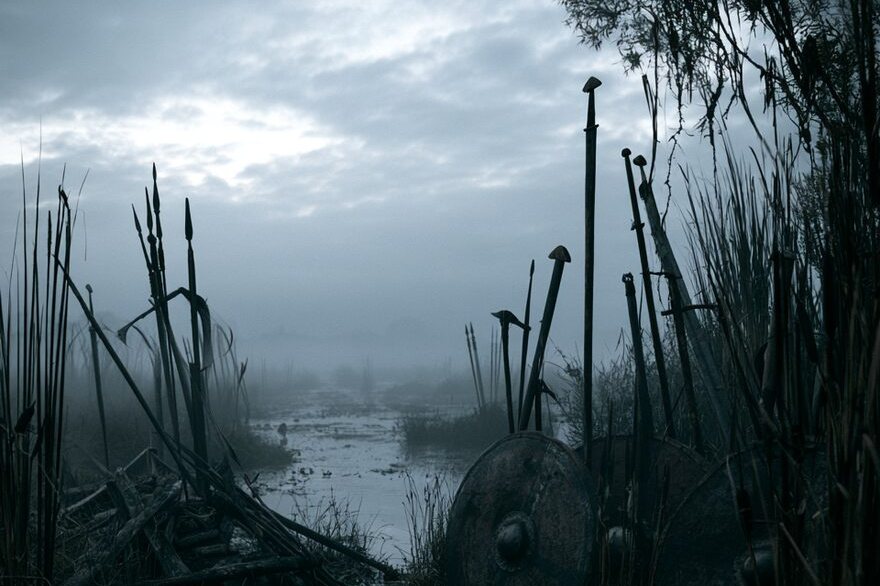
Picture a shallow hollow in the farmland of Thuringia, just north of the village of Niederdorla and west of the town of Mühlhausen. Today a small lake glints there between reeds and willows. Next to it stand round fences woven from hazel rods, a handful of roughly carved wooden figures and a thatched longhouse. It looks peaceful, almost ordinary. But for something like one and a half thousand years, this was a place where people came to bargain with their gods.
The lake itself is a gift of geology. Beneath it lies Middle Muschelkalk, a limestone sequence with soluble layers. Where groundwater dissolves those layers, the surface slumps, and water collects in the hollow. The original lake measured roughly 700 by 200 metres; over time it silted up and turned to bog, a process researchers date to around 100 BC. For Iron Age people this was not a mere pond but a seam where water, earth and the underworld touched. That is exactly the kind of place they chose for offerings, as we explain in our overview of sacrificial bogs and bog finds.
A quick word on names, because the internet happily mixes them up. The site lies within the boundaries of Oberdorla, only about 200 metres from the edge of Niederdorla. Specialists usually call it the cult site of Oberdorla, many travel guides say "the sacrificial bog of Niederdorla", and the museum today goes by "Opfermoor Vogtei", after the municipality of Vogtei to which the local villages now belong. All three names mean the same place.
Nobody went looking for this sanctuary. It was found because people needed fuel. From 1947, in the hungry years after the war, peat was cut from the hollow. Sherds, bones and worked timbers began to surface, and the digging also gave the lake its present shape. What lay in the peat was strange enough to catch the attention of the state archaeologists.
Between 1957 and 1964 a team led by Günter Behm-Blancke (1912–1994) excavated the site systematically. Behm-Blancke was director of the Museum of Pre- and Early History of Thuringia in Weimar and was already known for his work on Bronze Age cult caves in the Kyffhäuser hills. At Oberdorla he exposed, over a large area, something that almost never survives: the wooden fittings of cult places, preserved in waterlogged ground as if in an archive.
The harvest was enormous. At least 86 distinct cult places could be told apart, along with thousands of animal bones, human bones, pottery, wooden tools and idols. The zoologist Manfred Teichert published the animal remains in two volumes in 1974. The full publication of the excavation, however, appeared only after Behm-Blancke's death: in 2002 and 2003 Sigrid Dušek, assisted by Barbara Lettmann, brought out his two-volume work "Heiligtümer der Germanen und ihrer Vorgänger in Thüringen. Die Kultstätte Oberdorla" (Sanctuaries of the Germani and their predecessors in Thuringia). Keep that timeline in mind for everything that follows. Many of the interpretations date from the 1960s and 70s and carry the handwriting of a single, very imaginative excavator.
What makes Oberdorla so remarkable is not one spectacular object but the sequence. The site tells a long story in layers, and that story starts well before anyone spoke of "Germanic" peoples.
The oldest phase belongs to the Hallstatt period, the early Iron Age of Central Europe, in the 6th century BC. At the edge of the hollow stood a rectangular altar of limestone slabs with a semicircular wall. Fires burned on it, and food was offered. Behm-Blancke suggested spring rituals for a vegetation deity. That is an interpretation, not a finding. In the late Hallstatt period small oval offering places were added, marked with stones or branches; some already held simple wooden idols, one of them wearing a decorated neck-ring.
In the La Tène period, the later pre-Roman Iron Age, the small lake became the real focus of cult. Celtic influence now shows: apse-shaped enclosures and altars built of turf sods. For a short time Behm-Blancke assigned one cult place to immigrants from the Oder–Warta region in today's Poland, recognisable by unfamiliar pottery. Again, a caveat: pottery styles do not always travel with people, and ethnic labels are interpretation.
Towards the end of the 1st century BC the Hermunduri, the tribe Roman writers place in this region, built a large circular sanctuary with a rectangular wooden altar. Animal bones and human skulls were found here, the skulls concentrated on the western edge of the precinct. From this point on we are firmly in the world that classical authors called Germanic.
In the Roman Iron Age (roughly 1st to 4th centuries AD) several circular shrines appeared: rings of hazel fencing with altars, cult poles and post idols in the middle. Behm-Blancke read them as shared sanctuaries for several deities. In the 3rd century a single, separate shrine apparently replaced this group. It held a wooden image of a goddess that looks influenced by Gallo-Roman models. The excavator linked offerings of deer and pigs to this goddess and compared her with the Roman Diana. A sign on a pot, read as the sowilo rune, was even supposed to hint at her name. That reading walks a very thin line, and we pass it on only as a hypothesis.
In the 4th century a shrine containing a grave was destroyed. In the grave lay the skeleton of a young female in a wooden coffin. Behm-Blancke tied the destruction to unrest at the time the Thuringians were emerging, which is again a historical guess, not an inscription.
The most unusual features are the two ship sanctuaries of the 5th century, enclosures built in the shape of a boat. In one stood a tall post ending in a horse's head; Behm-Blancke thought of a male deity. In the other, cattle offerings suggested a female deity. Ships and horses as cult symbols are known all over northern Europe, from Bronze Age rock carvings to the picture stones of Gotland, and we have a separate piece on sacred horses. Whether a deity was really worshipped "in a ship" at Oberdorla, as Tacitus hints for an Isis-like goddess among the Suebi, remains open.
In the late Migration Period the bog was a major offering place until one enclosure was destroyed by fire. And then? The story keeps going.
What made Oberdorla famous among specialists are its wooden idols. In wet, oxygen-poor peat, timber survived that would long since have rotted on dry land. The finds were numerous enough for Behm-Blancke to build a typology that is still cited today. Broadly, he distinguished four forms:
The forked-branch idol is the site's real signature. People took what the tree offered: a fork that already resembled a human body, and helped it along with a knife. Nobody carved a portrait here. Someone recognised a figure in the wood. A phallus idol set beside a female forked figure led Behm-Blancke to think of a divine couple and a fertility cult. Good comparisons are the famous pair from the Braak bog in Schleswig-Holstein and the figure from Broddenbjerg in Jutland, which has been dated to the 6th century BC. You can read more about these figures in our article on Germanic idols.
Two human-shaped idols from Oberdorla, 124 and 150 centimetres tall, were shown in the major Berlin exhibition "Germanen. Eine archäologische Bestandsaufnahme" at the Museum of Prehistory and Early History, where the curator named them her personal highlight. The accompanying material pointed out, in essence, that these figures look nothing like what people expect of gods such as Thor or Odin. That is exactly the lesson. The gods of Oberdorla carried no hammers and kept no ravens. They were forked branches with faces.
Domestic animals make up the bulk of the bone material, cattle above all, followed by horses, sheep, goats, pigs and dogs. Even a domestic cat is recorded. Wild species add to the list: red deer, European bison, wolf, wild boar, otter, fox and a pond turtle. Manfred Teichert counted at least 27 pike and some tench, plus remains of 35 bird species. A mirror of what an Iron Age farming community owned and hunted.
How the animals ended up in the ground matters. At many north European offering sites, the meat was apparently eaten and only certain parts were handed to the gods: skulls, jaws, foot bones, sometimes hides with head and hooves still attached. The exact distribution at Oberdorla is laid out in Teichert's specialist volumes; for the big picture it is enough to say that the sacrifice was usually also a feast. The community ate, the deity received its share. How such sacrificial meals look in later written sources is the subject of our piece on Germanic sacrifice and sanctuaries.
Besides animals, the excavators found food offerings in pots, bundles of flax, weapons, everyday tools, a cult boat, fish traps, hand nets, harpoons and fish hooks. Among the finds are one of the earliest known Germanic bows and a five-hole weaving tablet. A large loom weight was read by Behm-Blancke as a gift to a female deity. Cult sticks interpreted as lot sticks recall the casting of lots that Tacitus describes; more on that in our article on Germanic oracles.
This is where things get delicate, so we will go slowly. At Oberdorla, human bones from at least 40 individuals were recovered. That number is solid. The harder questions are how these people died and why they ended up in the bog.
Behm-Blancke was convinced he could demonstrate human sacrifice. He described traces of dismemberment: in one case, he reported, the head and limbs had been removed, and the trunk weighted down with branches and sunk in the bog together with broken tools. Human skulls clustered on the western edge of the Hermunduran round sanctuary. For these reasons Oberdorla is often cited as the best-known archaeological evidence for Germanic human sacrifice.
Still, a second look is worthwhile. First, many of the bones are isolated fragments rather than complete bodies. Second, cut and chop marks can also result from funerary rites, from handling the dead, or from violence that has nothing to do with sacrifice. Third, the interpretations come from a time when osteology and taphonomy, the study of what happens to bones after death, were far less developed than they are now. And fourth, not every body in a bog is an offering. Tacitus himself notes in Germania 12 that certain condemned people were sunk in swamp and mire. That would be punishment rather than a gift.
Our honest assessment: it is certain that human remains entered the cult area at Oberdorla over a long period. It is quite possible, and many specialists agree, that at least some of them reflect ritual killing. How many, who these people were and what exactly was intended, we do not know. Anything beyond that is fiction.
A site like Oberdorla tempts you to fuse it with the classical texts. That is precisely why it pays to keep apart what the written sources say and what the ground shows.
Tacitus wrote his "Germania" around AD 98. In chapter 9 he reports that the Germani worshipped Mercury above all, usually identified with Woden by modern scholars, and offered him human victims on certain days. In chapter 39 he describes the sacred grove of the Semnones, where a human being is killed. In chapter 40 he tells of the procession of the goddess Nerthus, whose wagon is washed in a secluded lake after her return; the slaves who serve her are then swallowed by the same lake. Nerthus, however, belongs to tribes in the north, probably near the Baltic, not to Thuringia. So Oberdorla is not a Nerthus sanctuary. It is evidence that cult at lakes and in bogs was widespread across the Germanic world.
For the Hermunduri themselves there is an even more dramatic passage. In the Annals (13.57) Tacitus reports a war in AD 58 between the Hermunduri and the Chatti over a salt-rich border river. The victors had vowed the enemy army to Mars and Mercury beforehand, a vow that meant the destruction of men, horses and every possession. The Hermunduri won. Where the river lay is debated; the Werra and the Franconian Saale are often suggested. The episode cannot be tied to Oberdorla directly, but it shows that the very tribe that built a round sanctuary here is linked in Roman tradition with sacrificial warfare. What such army offerings look like in the ground can be seen at Illerup Ådal in Denmark.
And who led the rituals? The bones do not say. Tacitus mentions priests who keep order at the assembly and carry out punishments; there is background on this in our article on Germanic priests and seeresses. Whether Oberdorla had a permanent priesthood, or whether heads of households and village communities made the offerings themselves, cannot be read from the evidence.
Many sanctuaries simply stop at some point. Oberdorla does not. The site stayed in use after the Migration Period. Pottery of the 10th and 11th centuries together with dog bones shows that offerings were still being made here long after Thuringia had officially become Christian. Isolated traces reach into the 11th or 12th century.
That is striking, because the mission in Thuringia had begun in earnest in the 8th century with Boniface, the same man who had Donar's Oak at Geismar felled in Hesse. Church decrees of that era forbid offerings at springs, trees and stones again and again. At Oberdorla we see how stubborn such habits were. You went to church on Sunday and still left something at the old lake, perhaps simply out of habit.
According to the usual account, the cult only came to an end when an archdeaconry was established at Oberdorla, an ecclesiastical seat supervising the parishes of the area. Researchers suspect that the church did not choose this location by chance: it lay close to a place that still clearly mattered to local people. When exactly the archdeaconry was founded is not securely dated in the sources available to us. For the wider story of how the old faith gave way to the new, see our article on the Christianisation of the Germanic peoples.
After German reunification, the local municipalities joined in 1990 to form the "Mittelpunkt Deutschlands" association, a name that refers to the fact that, by one common calculation, Niederdorla lies closest to the geographical centre of Germany. In July 1992 the open-air museum at the sacrificial bog opened its gates.
On the lakeshore there are now around ten reconstructed sanctuaries from different periods: rings of hazel fencing, altars, post and forked-branch idols, a ship sanctuary. On the western edge of the bog lies a reconstructed 3rd-century village with a longhouse, three sunken-floor huts and a storehouse. Craft demonstrations, cooking over an open fire, archery and spear throwing take place there, and in alternating years the museum hosts a Germanic festival and a Roman market. A memorial stone for Günter Behm-Blancke was set up in 2012, marking the museum's twentieth anniversary and the hundredth anniversary of his birth.
Original finds are not only on show at the bog. The Opfermoor Museum on the edge of Niederdorla displays finds, including a woman's skeleton. The Museum am Lindenbühl in Mühlhausen has an archaeological section on the site, and part of the finds, together with the excavator's papers, is held by the Museum of Pre- and Early History of Thuringia in Weimar. For more destinations, see our guide museums and sites from Hedeby to Lofoten.
A fair warning about the reconstructions: every rebuild is an interpretation. The height of the fences and the faces of the idols are partly assumptions. Treat them as a thinking aid, not as a photograph from the year 200.
So what holds true some sixty years after the dig? Beyond dispute: Oberdorla is the largest known Iron Age cult site in Central Europe and one of the very few where the development of a sanctuary can be followed over such a long span.
Researchers are more cautious about the interpretations. Behm-Blancke leaned heavily on folklore parallels and on much later written sources. He identified fertility goddesses, vegetation gods, a Diana-like goddess and divine couples. Some of these attributions are easy to follow; others rest on very few finds. Today scholars draw a sharper line between what was excavated and the stories told about it. The ethnic labels, too, Celts here, Hermunduri there, immigrants from the east, are viewed more sceptically, because pottery and building styles do not carry passports. And for the earliest phases the word "Germanic" simply does not fit.
At the same time, work continues. The full publication of 2002/2003 made the evidence widely accessible for the first time. Sigrid Dušek's entry in the Reallexikon der Germanischen Altertumskunde (vol. 21, 2002) gives the concise specialist overview. More recent contributions, for instance in the journal "Blickpunkt Archäologie" (2024), look at the bog in the context of the surrounding settlement landscape. New scientific analyses, such as radiocarbon dates on the timbers, isotope studies on bones or ancient DNA, could one day answer open questions, for example where the dead came from. So far little of this has been published, and we will not promise what is not yet on the table.
In the bigger picture, Oberdorla is a counterweight to the late texts. The Eddas and sagas of the 13th century tell of Odin, Thor and Freyja. Oberdorla shows the layer underneath: local powers sought out by the water, honoured with forked branches, cattle skulls and bowls of porridge. If you want to understand Germanic religion, you need both: the stories and the peat.
In our workshop in Alsdorf we spend a lot of time with wood and slate. When we engrave a design into a slice of a tree trunk, we sometimes think of the people of Oberdorla, who looked at a forked branch, saw a figure and only had to help it a little. That may be the loveliest lesson of this place. The gods of the early Iron Age were not marble statues. They grew out of whatever material was at hand, and they stood where water and land met.
Oberdorla also shows how long memory can last. Through Celtic influence, the Roman era, the Migration Period and the Christian mission, this unremarkable lake remained a place where people left something behind. They kept coming back.
What is the Oberdorla sacrificial bog? A prehistoric cult site at a small lake near Niederdorla in the Unstrut-Hainich district of Thuringia, Germany. Offerings were made and wooden idols set up there from about the 6th century BC into the High Middle Ages.
Who excavated the sacrificial bog of Oberdorla? Günter Behm-Blancke, director of the Museum of Pre- and Early History of Thuringia in Weimar, led the excavations from 1957 to 1964. The full publication appeared only in 2002/2003, after his death.
Were there human sacrifices at Oberdorla? Bones of at least 40 people were found, some with signs of dismemberment. Many specialists consider human sacrifice likely, but the numbers, circumstances and motives remain uncertain.
What is a forked-branch idol? A cult figure made from a naturally grown forked branch, with a head carved at the top and the two limbs forming the legs. At Oberdorla these figures are regarded as female.
Can you visit the Oberdorla sacrificial bog? Yes. Since 1992 the Opfermoor Vogtei open-air museum near Niederdorla has shown reconstructed sanctuaries and a 3rd-century Germanic village. Original finds can also be seen in Mühlhausen and Weimar.
Is Oberdorla a Viking sanctuary? No. The site is mainly Iron Age to Migration Period and lies in central Germany. It reflects Germanic and pre-Germanic religion, much older than the Viking Age.
For courage. For remembrance. For legends that live on.
Nerthus · Donar’s Oak · The Old Germanic Feasts · The Norse pantheon.
All History & Finds articles →
Long before there were Germanic peoples – some 4,300 years ago – people in today’s Saxony-Anhalt raised a vast ring of …
Read more →King Hákon the Good, a son of Harald Fairhair, fought all his life against the sons of his brother Eric Bloodaxe. Two …
Read more →Long before there were Vikings in the sense of the sagas, there was already a town in south-west Jutland: Ribe, founded …
Read more →The Viking battle was no wild scramble but a hard struggle shield to shield. A look at tactics and weapons beyond the …
Read more →