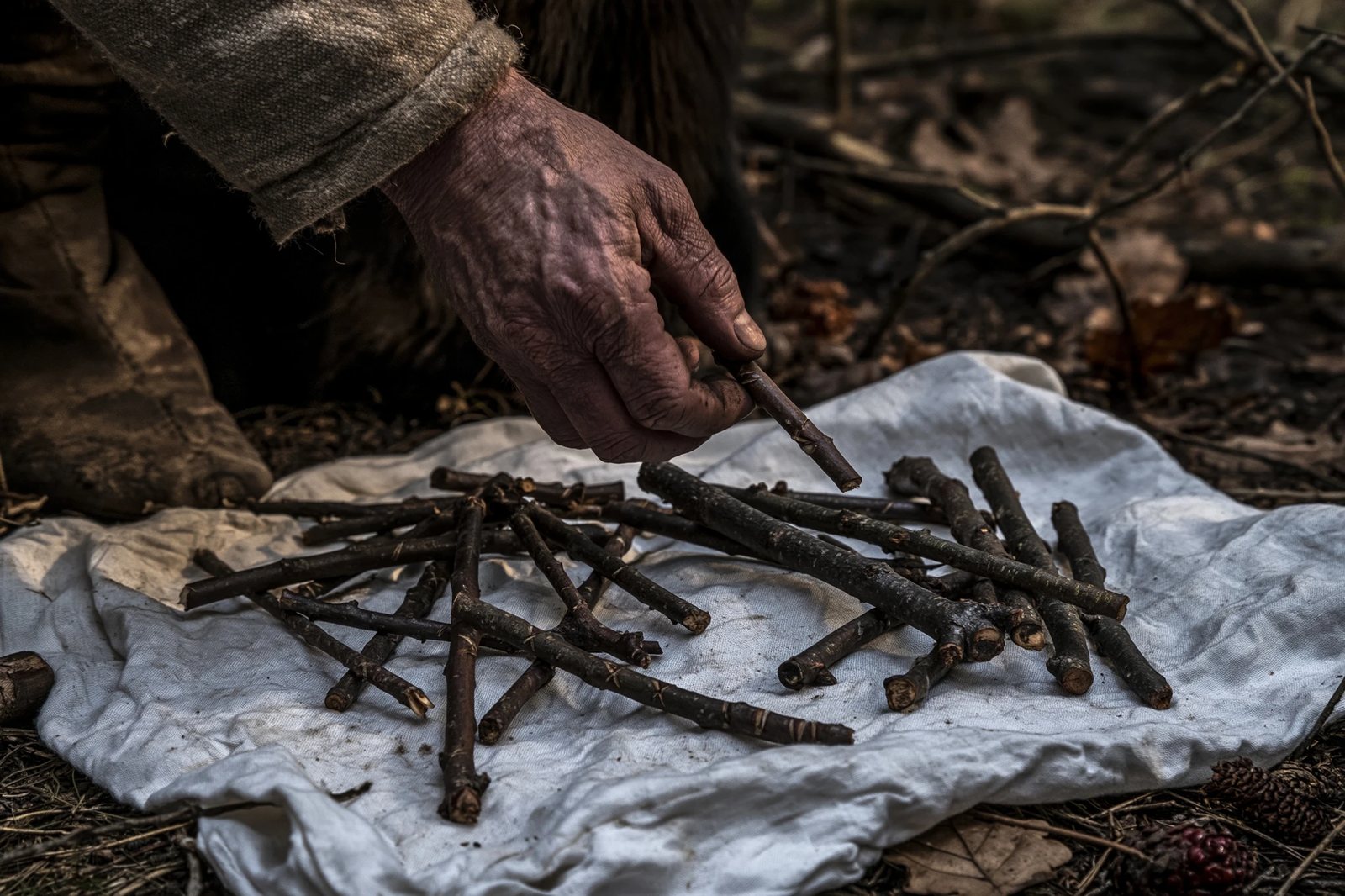
The ancient Germanic peoples consulted the future mainly by casting marked sticks onto a white cloth, by listening to the neighing of sacred white horses, by watching birds, and by heeding wise women – that is how Tacitus describes it around AD 98 in his Germania. Caesar adds mothers who cast lots before battle, the Norse sagas speak of lot-chips at the sacrifice and of the völva with her staff. Here we sort what is attested from what is interpretation – and explain why today's "rune oracle" dates from the 1980s.
Picture a clearing somewhere between the Rhine and the Elbe in the first century. A man cuts a branch from a fruit tree, chops it into small pieces and cuts a sign into each. He spreads a white cloth on the ground, scatters the sticks across it, prays, looks up at the sky – and picks up three of them, one at a time. What he says next may decide between war and peace.
This is not a fantasy scene. A Roman senator described it almost exactly like that. And it is only one of several ways in which the Germanic peoples, and later the Norse, tried to learn the will of their gods. Let us walk through them one by one – sources in hand, and with a clear eye for where knowledge ends and imagination takes over.
An oracle is any method of getting an answer from higher powers: by lot, by animal sign, by dream, or through a person through whom a deity speaks. The Romans drew neat distinctions between sortes (lots), auspicia (signs from birds) and vaticinationes (the prophecies of inspired people). Caesar and Tacitus use exactly these terms when writing about the Germani – and that matters, because we see Germanic divination almost entirely through Roman eyes.
The Germanic peoples of the Roman era left no texts of their own. The earliest runic inscriptions are short – usually names or formula words – and say nothing about casting lots. What we know therefore comes from three layers: Roman and Greek reports (1st–3rd centuries), early medieval Christian writings (8th–9th centuries), and Old Norse literature, which was only written down in Iceland in the 12th and 13th centuries. Blend these layers and you quickly end up with an "ancient tradition" that never existed in that form. For the wider picture, see our article on Germanic religion.
The most famous passage is in chapter 10 of the Germania, written around AD 98. Tacitus opens with a line that is quoted endlessly: no people pay more attention to omens and lots than the Germani. Then he describes the procedure in surprising detail.
"Their method of casting lots is simple. They cut a branch from a fruit-bearing tree into slips, mark them with certain signs and scatter them at random over a white cloth. Then, if the question is a public one, the priest of the community – if private, the father of the household himself – prays to the gods, looks up to the sky, picks up three slips one at a time and interprets them according to the sign cut into each."Tacitus, Germania 10 (our own translation)
Several details reward a second look. First, there are two levels. For the community, the sacerdos civitatis, the priest of the tribe, acts; for the family, the pater familiae, the head of the household. So this was no secret art of a few initiates – it could happen at home. To learn more about the people who led such rites, read our piece on Germanic priests and seeresses.
Second, the wood. "Fruit-bearing tree" – arbor frugifera – probably means a tree bearing edible fruit or nuts: apple, hazel, beech perhaps. Tacitus does not say which. For trees in Germanic cult more broadly, see sacred trees and groves.
Third, the white cloth and the three picks. The sticks are thrown "at random" – chance is the point, because chance is how the gods speak. And the interpreter does not grab three at once but picks one, three times over: ter singulos tollit. The number three recurs in Germanic and Norse ritual – but beware, it is just as beloved in Roman and countless other rites.
Fourth – and this is often overlooked – there were rules about the outcome. If the answer was negative, the same matter could not be put to the lots again that day. If it was positive, further confirmation from omens, such as the birds, was required. So much for the idea that people simply kept throwing until they got the answer they wanted.
This is where it gets interesting – and where most popular accounts start to cheat. Tacitus writes notis quibusdam, "with certain signs". He says nothing about letters or writing.
The equation "signs = runes" is tempting but unprovable. The earliest securely readable runic inscriptions date from the 2nd century AD, such as the comb from Vimose in Denmark. An older brooch from Meldorf (1st century) bears marks whose reading as runes or as Latin letters is disputed. Whether a runic alphabet existed by AD 98 that lot-casters across Germania could use is therefore an open question, and not a likely one.
Scholars accordingly discuss other options: simple symbols, owner's or house marks, notches, or signs whose meaning the interpreters knew without their being writing at all. Some runologists consider it possible that lot-casting later became one of the uses of runes. That is a hypothesis, not a finding. And remember: Tacitus never set foot in Germania. He wrote from the reports of traders and soldiers and described the procedure in terms his Roman readers would recognise – Rome had lot oracles too, for instance at the sanctuary of Fortuna at Praeneste.
To dig into when and why runes arose, read the runes – an honest introduction and our longer scholarly treatise on runology.
Bird augury, Tacitus writes, is "known here too" – that is, as in Rome. What is peculiar to the Germani is something else: they sought omens and warnings from horses. These horses were kept at public expense in the same sacred woods and groves; they were white and untouched by any mortal work. They were yoked to a sacred chariot, and the priest together with the king or chief of the community walked alongside, watching their neighing and snorting.
Then comes the sentence that shows how seriously this was taken: no omen was trusted more – not only by the common people, but by the nobles and by the priests. The priests regarded themselves as servants of the gods, but the horses as the gods' confidants. The animal stood closer to the gods than the human who read it. A lovely detail: the priest is not the intermediary here, merely the interpreter.
Why white, and why unworked? White is the colour of purity and the sacred in many cultures; a horse that has never laboured belongs, in a sense, to no one but the gods. For more on horses in cult, see sacred horses and, for the Viking Age, the horses of the Vikings.
There is a striking parallel from the Baltic, but file it clearly under "not Germanic": around 1200, Saxo Grammaticus describes the Slavic sanctuary of Svantevit at Arkona on the island of Rügen. Before a campaign, a white horse sacred to the god was led across rows of crossed spears; which leg it lifted over them first decided whether the venture would succeed. That is Slavic, more than a thousand years after Tacitus, and told by a Christian author – yet it shows that horse oracles in northern Europe were not a one-off.
On Germanic bird augury, Tacitus offers half a sentence: they consult the calls and flight of birds. Which birds, which direction meant luck – he does not say. He may simply have assumed what every Roman knew.
In the North we have a little more, though from late sources. In Heimskringla, Snorri Sturluson tells how Earl Hákon held a great sacrifice in Götaland; two ravens came flying and croaked loudly, and the earl took this as a sign that Odin had accepted the offering. This comes from a 13th-century book of kings, more than two centuries after the events, and Hákon is deliberately portrayed there as the last great heathen. As evidence for actual ritual it needs care; as evidence for how omens were imagined in the North, it is valuable.
Even more famous is the raven banner. The so-called Annals of St Neots, an English chronicle of the early 12th century, report under the year 878 a Danish banner called "Raven". Before a victory, it is said, the raven on it seemed to flutter as if alive; before a defeat it hung still. That is legend, but it shows how tightly raven, Odin and fortune in war were bound together. More in the raven in the Norse world and Hugin and Munin.
The fourth method in Germania 10 sounds like the arena, but it is meant as ritual. Before a serious war, a captive was taken by whatever means from the people about to be fought. He was matched against a chosen champion of their own – each with the weapons of his own nation. The victory of one or the other was taken as a praeiudicium, a preliminary verdict, on the whole war.
The logic is compelling: two men stand in for two peoples, and the gods show in miniature how things will go at full scale. Whether this was regular practice, or whether Tacitus heard of one or two cases, we cannot say. No other evidence from the Germanic period survives. But the idea that a duel reveals divine judgement lives on in the North in hólmganga, the regulated duel of the sagas, and in the judicial duel of the Middle Ages. More on warfare in Germanic and Viking warfare, and on the legal framework in law and the Thing.
A good 150 years before Tacitus, Julius Caesar recorded an oracle that shaped a real battle. In 58 BC he faced the Suebian king Ariovistus in Alsace. For days Caesar offered battle; Ariovistus held back. Caesar questioned prisoners and learned – as he writes in the first book of his Gallic War – that among the Germani it was the custom for the matres familiae, the mothers of families, to declare by lots and prophecies whether it was advantageous to fight. And these women had proclaimed that the Germani were not destined to win if they fought before the new moon.
"It was not fas for the Germani to win if they joined battle before the new moon."Caesar, De bello Gallico I.50 (our own translation)
Caesar exploited this coolly: he forced Ariovistus into battle before the moon was "right" and won. A rare case where we can watch an oracle actually shape politics and war – and an enemy turn it to his advantage.
Two points stand out. First, it is women who cast lots and prophesy, not priests. Second, the moon matters. Tacitus too notes in Germania 11 that the Germani held their assemblies at new or full moon, as these times were thought auspicious. For how the Germanic and Norse peoples reckoned time by the moon, try our moon calendar.
The Greek writer Plutarch adds, around AD 100 in his Life of Caesar, that the holy women drew their predictions from the eddies of rivers and the sound of rushing streams. Whether he had a separate source or was embellishing cannot be decided.
There is one more small story in Caesar (I.53). After the battle he freed his envoy Gaius Valerius Procillus, who had been dragged along in chains. Procillus said the lots had been consulted three times in his presence to decide whether he should be burned at once or kept for later – and that he owed his life to the lots. Not politics this time, but a single human life. And again the threefold question.
Besides lots and animals, there were people through whom the future spoke. Tacitus writes in Germania 8 that the Germani believe there is something holy and prophetic in women, so they neither scorn their advice nor ignore their answers. He names Veleda, who under the emperor Vespasian was long regarded by many as a divinity, and an earlier seeress whose name the manuscripts give as Aurinia, which many scholars emend to Albruna.
Veleda is the best known. She lived among the Bructeri on the river Lippe and wielded great influence during the Batavian revolt of AD 69–70; Tacitus reports in the Histories that she had foretold German success and the destruction of the legions. She lived in a tower; no one could approach her directly, and a relative carried questions and answers "like the messenger of a god". We tell her full story in Veleda, and the revolt in the Batavians.
Ganna is known from the Greek historian Cassius Dio (early 3rd century). She was a virgin who served as seeress after Veleda, and she travelled with Masyos, king of the Semnones, to the emperor Domitian, who received them both with honour and sent them home. A seeress as part of a diplomatic mission – that says a great deal about her standing.
Waluburg is the most surprising. Her name appears on a potsherd (an ostracon) from the Nile island of Elephantine in Upper Egypt, now in the Berlin Papyrus Collection (P. 12682, published as SB III 6221). Written in Greek in the 2nd century, it is a list of names, probably from the household of a Roman governor, and among them is a woman with a Germanic name described as a Semnonian and a sibyl – a prophetess. How she got to Egypt – as a prisoner of war, as part of a household? – we do not know. But it is a rare original document, showing that Germanic seeresses had a reputation even within the Roman world.
For the wider position of women in these societies, see women among Germanic peoples and Vikings.
Between Tacitus and the sagas lie centuries from which a handful of Christian texts mention lot-casting. The monk Rimbert, in his Life of the missionary Ansgar (c. 870), writes that the Swedes consulted lots on important matters. When an exiled Swedish king with Danish support planned to attack Birka, lots were cast to see whether the gods wanted the town destroyed – the answer was no, and the force moved on. Later King Olof had the lot decide whether the Christian mission should be admitted. Rimbert, of course, tells this as a missionary eager to show that God worked even through heathen lots.
Alcuin reports in his Life of Willibrord (c. 800) that the Frisian king Radbod, on a holy island, cast lots three times a day for three days to decide which of the missionaries should die for violating the sanctuary; one of them was chosen. And the Frisian law code, the Lex Frisionum (c. 800), describes a procedure with two wooden slips, one marked with a cross, to identify the culprit in an unclear killing – by then framed in Christian terms, on the altar or on relics. The old practice survived by acquiring a new god. We have a separate article on the Frisians.
Old Norse literature contains words that echo Tacitus directly. Hlaut was the sacrificial blood; the hlautteinn, the "blood-twig", was used to sprinkle it. At the opening of the Eddic poem Hymiskviða, the gods "shook twigs and looked at the blood" (paraphrased) – evidently a divination rite in which twigs and sacrificial blood work together. And in Völuspá, after the end of the world, the god Hœnir chooses the hlautviðr, the "lot-wood": even in the renewed world, lots are cast again.
The second key word is blótspánn, literally "sacrifice-chip". The phrase fella blótspán, "to let the sacrifice-chip fall", appears – according to Cleasby and Vigfússon's great Icelandic-English Dictionary – in Hervarar saga, in Fagrskinna and in Landnámabók, each time where someone consults the gods before a decision. What these chips looked like, and whether they bore signs, the texts do not say. How a blót, a sacrifice, worked and where it took place is covered in blót sites and Germanic sacrifice and sanctuaries.
The most detailed oracle scene in all of Norse literature is in the Saga of Erik the Red, preserved in two manuscripts – one of them Hauksbók from the early 14th century. Greenland is in the grip of famine. The farmer Þorkell invites a seeress, Þorbjörg, the "little völva". The saga describes her down to the last stitch: a blue cloak set with stones, a hood of black lambskin lined with white catskin, a staff with a brass knob, a pouch at her belt, gloves of catskin. She is given a high seat with a cushion of hen's feathers and a meal of goat's-milk porridge and the hearts of every kind of animal on the farm.
The next day she needs women who can sing the necessary spell-songs, the varðlokkur. Only the young Christian Guðríðr knows them – learned from her foster-mother in Iceland – and after some hesitation she sings them so beautifully that many spirits gather. Then Þorbjörg prophesies: the famine will end with the spring, and Guðríðr has a brilliant future ahead. The saga has both come true.
This scene is no record from the 10th century. It was written by Christian Icelanders in the 13th, and many details may be literary embroidery. Even so, archaeologists have found metal staffs in Viking-Age women's graves that some interpret as seeresses' staffs – an interpretation that is well argued, though not certain in every case. Neil Price has studied these finds in depth. The völva is thus the Norse heir of Veleda: a woman through whom the future speaks. A direct, unbroken line between the two, however, cannot be proven.
Other sagas know similar figures. In Vatnsdæla saga, a seeress tells the Norwegian Ingimundr he will settle in Iceland – a land he has never seen. How seeresses worked and how Freyja and Odin fit in, we cover in depth in the völva and seiðr. And if you want to read the North's most famous prophecy itself, find it in our Völuspá.
Now for the chapter some people would rather skip. The rune oracle as you find it today in bookshops and apps – a bag of 24 stones, each rune with a fixed meaning, spreads like tarot – is a modern creation. Its big breakthrough came with The Book of Runes by the American Ralph Blum in 1982. Blum even added a blank rune associated with fate – it appears in no historical rune row. For how this "web of fate" thinking emerged, see the Web of Wyrd.
Esoteric rune interpretations existed in the decades before. The meanings now given to individual runes draw partly on the medieval rune poems from Norway, Iceland and England; but those only explain the rune names in short verses and say nothing about divination. The modern drawing system itself – one stone, three stones, a cross spread – has no historical basis.
Does that mean you should not use it? Of course not. Many people draw a rune as a prompt for reflection, and that is perfectly fine – as long as you know what you are doing. That is exactly how we see our rune of the day: a modern prompt using genuine historical signs, not the revival of a lost ritual. If you are looking for a rune to accompany you, our guide which rune should you get engraved? helps – with an honest look at what the finds actually support.
Here in Alsdorf we do not find this honesty disappointing; we find it thrilling. The real oracles of the Germani are stranger, rougher and more impressive than any card deck: a white cloth on the forest floor, a horse snorting before the sacred chariot, a woman in a tower on the Lippe whose word the legions feared.

How did the Germanic tribes predict the future? According to Tacitus (Germania 10), with marked sticks cast on a white cloth, the neighing of sacred white horses, the flight and calls of birds, and a single combat before wars. Seeresses such as Veleda were consulted too.
Did the ancient Germans use runes for divination? That is not attested. Tacitus only mentions "certain signs" on the sticks, and the earliest secure runic inscriptions are later than the Germania.
What is a blótspánn? An Old Norse "sacrifice-chip", a piece of lot-wood dropped during a sacrifice to learn the gods' will. The sagas use the phrase but do not describe what it looked like.
Who was the most famous Germanic seeress? Veleda of the Bructeri, who held great influence during the Batavian revolt of AD 69–70 and is described by Tacitus.
How old is rune divination? The modern rune oracle with fixed meanings and spreads was popularised mainly by Ralph Blum's "The Book of Runes" (1982). It is a modern creation using historical signs.
Why did Ariovistus refuse to fight before the new moon? According to Caesar, the mothers of families had declared by lots and prophecy that the Germani could not win if they fought before the new moon.
For courage. For remembrance. For legends that live on.
Germanic Priests & Seeresses · Germanic Sacrifice & Sanctuaries · Germanic Religion · The grove of the Semnones · Nerthus – the earth goddess.
All Festivals & Belief articles →
While elsewhere a round man with a reindeer sleigh rolls in, in Iceland thirteen troll boys come down from the …
Read more →