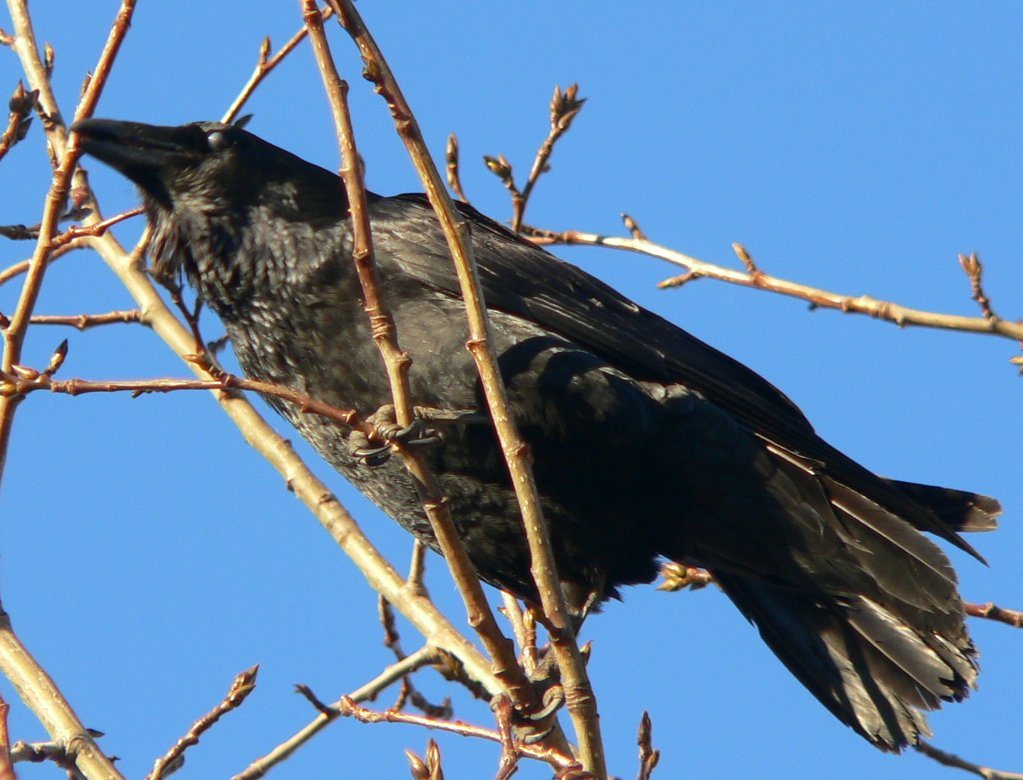
Few animals are as closely bound to the North as the raven. It perches on Odin's shoulders, circles above the battlefield, flutters on the banners of sea-kings, and even guides a settler toward an unknown island. The raven is at once clever and eerie, divine messenger and carrion-eater. Let us look at what the sources actually say – and where later storytellers embellished with a generous hand.
The common raven is the largest songbird in the world, a strikingly intelligent creature with a deep, far-carrying call and plumage that shimmers blue-black and metallic in the light. Anyone who has watched a raven at the carcass of a fallen animal understands why the people of the North linked it to two things at once: keen intellect and death. Both sides come together in the Old Norse tradition, and both belong to the same bird.
The raven was no accidental symbol. It lived at the edge of the human world, followed hunters and armies, found every kill, and seemed to read the signs of the landscape. Exactly these qualities made it one of the most significant animals of the Viking Age – in poetry, in ritual, and in everyday life alike. Myth and hard reality wind around it together.
The common raven is, moreover, an unusually long-lived and territory-loyal bird, one that knows a range over years and can recognise individual human faces. It caches food, remembers where it hid things, and sometimes cooperates with other animals during a hunt. People who lived daily with nature did not miss this behaviour. A bird that seemed to plan and remember fitted a god of wisdom perfectly – and a bird that found the dead fitted a god of battle just as well.
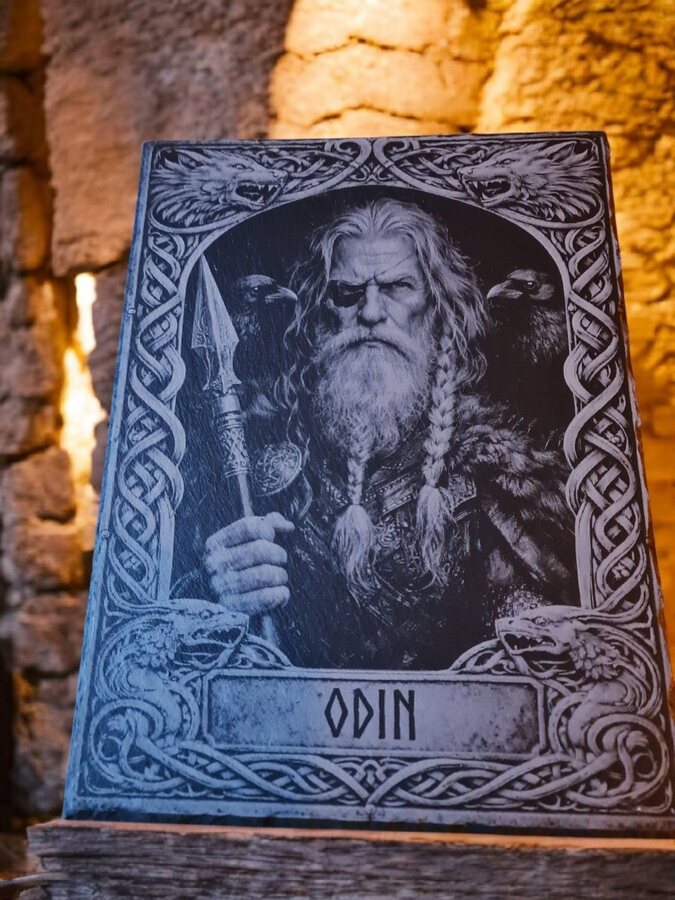
Best known are Odin's two ravens, Hugin and Munin. Their names speak plainly: Hugin belongs to Old Norse hugr, "thought, mind, desire," and Munin to munr or muna, "memory, remembrance." Odin's ravens are therefore not merely pets but embodied faculties of the god himself – his roaming mind and his memory, flying out into the world each day and returning home.
The central passage stands in the Poetic Edda, in Grímnismál, where Odin speaks as Grímnir:
Hugin and Munin fly each day over the wide earth; I fear for Hugin, that he may not return, yet I fear still more for Munin.Grímnismál 20, rendered after the translation of Karl Simrock (1851, public domain)
This stanza is remarkably layered. Odin, the god of wisdom, worries that thought and memory might slip away from him – a quiet, almost human trait in an otherwise overwhelming figure. Scholars such as Rudolf Simek have noted that the ravens here can be understood less as acting animals than as images of Odin's mental reach: through them the god sees what happens in the world. This is why Odin also bears the byname Hrafnaguð, "raven-god."
Snorri Sturluson expanded this image into a fixed scene in his Prose Edda (around 1220): two ravens sit on Odin's shoulders and whisper into his ear everything they have seen and heard; at daybreak he sends them out, and by breakfast time they return. Readers who want to go deeper into this pair will find a dedicated deep-dive on Hugin and Munin and on Odin's role as the All-Father and seeker of knowledge.
As wise as the raven is in mythology, its second role is sober: it is a carrion-eater. After a battle it was ravens, eagles and wolves that descended on the fallen. For the people of the Viking Age this was no metaphor but a daily observation – and precisely for that reason the raven became a fixed companion of battle and death.
Skaldic poetry, the elaborate court verse of the North, mirrors this in countless circumlocutions. "To sate the ravens," "to give the ravens food," "to redden the raven's blood" – all of these are kennings, coded phrases for slaying in combat. A warrior who cut down many enemies "fed the ravens." The bird thus becomes both witness and beneficiary of the fight, and its presence in verse ennobles the victorious fighter.
The raven shares this role with the wolf; together they form the classic pairing of "beasts of battle" that appears over the dead. This connection is not Norse alone – in Anglo-Saxon poetry, too, such as "Beowulf" or "The Battle of Brunanburh," raven, eagle and wolf appear together as the grim chorus of war. The raven is therefore no pure creature of fable but a bird tightly bound to the harsh reality of combat and dying.
From this union of raven, war and Odin grew one of the most famous war standards of the North: the raven banner, Old Norse hrafnsmerki. Several sources mention a banner bearing a raven, carried into battle by Danish and Norwegian leaders.
The Anglo-Saxon Chronicle reports for the year 878 that the Anglo-Saxons captured a banner called "Raven" from a Danish army. Later sources link raven banners with the jarls of Orkney and with Cnut the Great. The raven was ideally suited as a war standard: it stood for Odin, god of warriors and the slain, and by its very presence it promised victory – or at least rich pickings for the birds of the battlefield. You can read more about this standard and its history in our article on the Viking raven banner.
Beside war and wisdom, the raven had a third, very practical meaning: it counted as a bird of omens. Its appearance, its call, the direction of its flight – all of this was interpreted. In the sagas ravens often announce disaster or death, but sometimes also favourable turns. Because the raven is clever and flies far, people credited it with knowing more than a human could.
The best-known story tells of a settler who used ravens in a thoroughly practical way, as a navigation aid. According to the Landnámabók and the tradition surrounding Flóki Vilgerðarson – later called Hrafna-Flóki, "Raven-Floki" – he took three ravens with him on his voyage into the unknown North Atlantic. Along the way he released them one after another: the first flew back toward the route already travelled; the second rose and returned to the ship because there was only sea all around; but the third flew ahead – and in its direction Floki finally found land. Thus, it is said, he reached Iceland.
The method, incidentally, is not far-fetched: from a ship, land birds head straight for the nearest coast if any is within reach. Similar "bird voyages" are known from various seafaring cultures. Here, then, the raven was not only a mythic sign but a real helper on the open sea.
How much the raven belonged to the North shows also in the fact that people named their children after it. The Old Norse word for the raven, hrafn, appears in numerous personal names: Hrafn on its own as a given name, and compounds such as Hrafnkell or Hrafnhildr. To name a son "raven" was to wish him cleverness, sharpness and nearness to Odin's power – a name with intent, not merely a pretty word.
The raven also left traces in place-names and in vocabulary. In poetry it serves, as noted, as the building block of countless kennings; a warrior could be praised as "raven-feeder" or "friend of the raven" because his deeds provided the bird with plentiful food. Such phrases were no mere wordplay: they set the human being within a larger picture in which battle, death and the hungry birds of the field belonged together. The raven was thus firmly anchored in the thinking and speech of the Viking Age – not only in myth, but in everyday life and self-image.
In Norse and in wider Germanic poetry the raven almost never appears alone where war is concerned. Its constant companion is the wolf, often joined by the eagle. Together these "beasts of battle" form a fixed motif: where they appear, death is near, and their coming either announces the slaughter or follows it.
In Odin this image condenses with particular force. For to him belong not only the ravens Hugin and Munin but also the two wolves Geri and Freki. The god is thus surrounded by exactly those animals that appear over the fallen – a fitting image for the lord of battle and the dead, who takes half of the slain to Valhalla. Raven and wolf are his animals because they embody his reality: the hard, final side of war.
One may ask why this bird of all birds gained such importance, and not the eagle or the falcon, which are also at home in the North. The answer lies in its particular mixture of nearness and strangeness. The raven does not fear humans as much as other wild animals; it follows them, watches them, uses their refuse and their battlefields. At the same time it stays uncanny – black, loud, unpredictable, and always present where something has died.
This dual nature made it the ideal border-crosser between worlds. A bird that shuttles between the human realm and the wilderness, between life and death, is suited like almost no other creature to be the messenger of a god who likewise crosses boundaries – between wisdom and war, between the living and the fallen. The raven is therefore not only a beautiful motif but a considered emblem that the people of the North drew from close observation of nature.
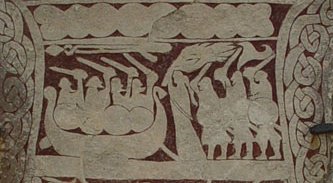
That the raven was so deeply bound to Odin shows in his bynames and in visual art. In poetry Odin is called, among other things, Hrafnaguð and Hrafnáss, "raven-god" and "raven-god (Ase)." On Viking-Age picture stones, pendants and metalwork, birds appear again and again beside warrior figures, and these are cautiously interpreted as the ravens of Odin.
Caution is the right word here: not every carved bird is necessarily Hugin or Munin. The interpretation often rests on context – a rider with a spear, plus two birds, points toward Odin. But the imagery of the Viking Age is rarely captioned unambiguously, and honest scholarship keeps open the point where interpretation begins. What is certain: the raven ranks among the most beloved animal motifs of the North and carries its double meaning – wisdom and death – effortlessly in a single, elegant image.
For an engraving motif the raven is ideal, precisely because it glosses over nothing. It stands for the alert mind and for memory, for the gaze that reaches further than one's own horizon – and at the same time for finitude, for the seriousness of battle and the nearness of death. Anyone who has a raven engraved is not choosing mere "Viking décor" but an image with genuine depth, drawn from the sources themselves.
What matters to us is keeping the line between evidence and legend visible. Hugin and Munin, the kennings of battle, the raven banners and Floki's clever birds – all of this is anchored in the texts. The prophesied magic of the fluttering banner, on the other hand, is later storytelling. Both may be told, but one should know which is which. It is exactly in this honesty that the appeal of the Norse heritage lies for us.
Hugin & Munin – Odin's ravens · Odin · The Wolf in the North.
All Beings & Creatures articles →
Between crown and root of the World Ash Yggdrasil scurries a small, restless creature: Ratatoskr, the squirrel. It …
Read more →Without the giants there would be no Norse world – in the most literal sense. Out of a giant it arose, against the …
Read more →In Valhalla an eternal feast holds sway – provided by a single animal that never runs out: the boar Sæhrimnir.
Read more →When people picture Yggdrasil, they usually think of the mighty trunk, of the crown where the eagle sits, and of the …
Read more →