When people picture Yggdrasil, they usually think of the mighty trunk, of the crown where the eagle sits, and of the hart that feeds on its branches. Yet the world tree does not merely live from the top down – it is also besieged from below. Deep among the roots, in the damp dark beneath the ash, a whole host of serpents coils and writhes. They gnaw and feed without pause, and the Poetic Edda even knows them by name.
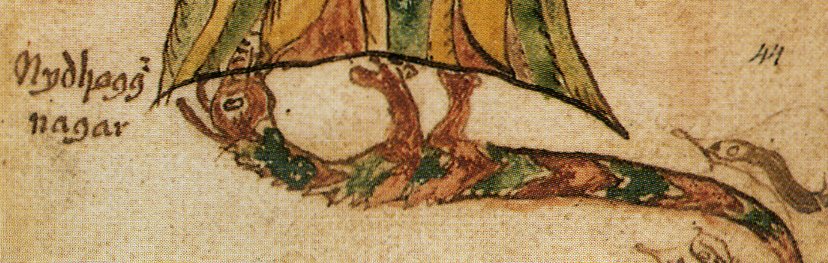
The key passage stands in Grímnismál, the lay in which the bound Odin reveals the gods' cosmology to young Agnar. There it is said that beneath the ash lie more serpents than the ignorant could dream – and then they are named.
More serpents there be beneath the ash
than an unwise ape would think;
Góinn and Móinn, Grafvitnir's sons,
Grábakr and Grafvölluðr,
Ófnir and Sváfnir shall ever, methinks,
gnaw at the twigs of the tree.Grímnismál 34, translation Henry Adams Bellows 1923
Six names, then: Góinn and Móinn, said to be the sons of one Grafvitnir, together with Grábakr, Grafvölluðr, Ófnir and Sváfnir. They gnaw at the branches and roots of the tree – day and night, without end. It is an image of quiet, stubborn destruction: while life blossoms above, decay labours below.
The following stanza sums up what this means for the world tree. Yggdrasil bears more hardship than people realise – it is worn at from every side.
Yggdrasil's ash great evil suffers,
far more than men do know;
the hart bites its top, its trunk is rotting,
and Niðhöggr gnaws beneath.Grímnismál 35, translation Henry Adams Bellows 1923
With this the whole play of forces is named: above, the hart (in other stanzas there are four of them); in the middle, the rotting flank; below, Niðhöggr and his serpent folk. The tree does not stand in eternal, undisturbed splendour – it endures, even as it is worn away. That is precisely what makes it a symbol of a world both upheld and threatened.
In his Prose Edda, Snorri Sturluson assigns Yggdrasil's three roots to three places. Beneath the third root lies Hvergelmir, the „bubbling cauldron" – an ancient spring in cold Niflheimr. From it, Snorri says, flow the primal rivers, the Élivágar, and thus ultimately all running water. Hvergelmir is the source of the streams.
Yet the same cauldron is also the darkest corner of the world order. Here dwells Niðhöggr, and here, it is said, are gathered more serpents than words can hold – so many that no tongue could count them. The place from which all rivers spring is at the same time the place where the root of the world is gnawed. Niðhöggr himself, the great gnawer, has his own article on our site; here we look at the creeping folk that surrounds him.
The names of the root serpents can hardly be pinned down with certainty – they ring of darkness, earth and concealment, yet the sources do not explain them. Góinn and Móinn appear to be plain serpent names, as does Grábakr, which suggests something like „grey-back". It grows interesting with Ófnir and Sváfnir: these two names appear elsewhere in the tradition as well, namely in the lists of Odin's by-names. The All-Father bears dozens of names, and „Ófnir" and „Sváfnir" are among them. Whether this is a deliberate play on double meaning, or simply shows how freely the skalds drew on a shared stock of names, cannot be decided. It is a fine example of how, in the North, a name was not firmly bound to a single being.
Attested: The serpents at the root are listed by name in Grímnismál 34, and the tree's suffering appears in Grímnismál 35. Hvergelmir as the source of the rivers and the dwelling of Niðhöggr and countless serpents is described in Snorri's Gylfaginning. The names Ófnir and Sváfnir also appear in the surviving lists of Odin's by-names.
Myth check: A common misunderstanding: the serpents at the root are not the Midgard Serpent Jörmungandr. Jörmungandr lies in the world ocean, encircling Midgard – he has nothing to do with the root folk beneath Yggdrasil. And the list of six names is exactly that: an enumeration. The old sources give the individual serpents no stories, no roles, no „secret meaning". Anyone who assigns them a fixed symbolism is reading beyond what the Edda actually provides.
It is striking how familiar the underlying pattern feels: the bird in the crown above, the serpent at the root below. Similar ideas are found far beyond the North. In Indian tradition the Nāgas, serpent-shaped beings, dwell at the root or foot of the cosmic tree or mountain, in the depths of the underworld. And in the Garden of Eden the serpent coils around the tree of knowledge. The bird in the crown as a creature of the sky, and the serpent in the deep as a creature of the underworld and of chaos – this pair of opposites appears in many cultures. This expressly does not mean that one culture influenced another; there is no evidence of any such contact. It only shows how natural the image of the tree is that joins sky, earth and underworld – and how often something creeping waits at its root.
Grímnismál names six serpents, and a seventh, Grafvitnir, as the father of two of them. It is worth looking at each of these names on its own – not because the Edda gives them stories, for it pointedly does not, but because the names themselves speak. They are built from Old Norse, and anyone who knows the building blocks can hear what the poets had in mind when they described the crawling folk beneath the root: grey, earth, and the ceaseless digging in the damp dark. One must stay honest here. Some of these names can be read well, others remain obscure despite every effort of the philologists, and no reading is a story. In what follows we always say how firm the ground is beneath our feet.
Góinn and Móinn always appear together, as „Grafvitnir's sons“, and they are the two most difficult names on the whole list. Unlike „grey-back“ or the digging-names, there is no transparent word here that translates itself. Scholarship feels its way forward with guesses – a link to a word for „land, earth“ has been proposed, as has a mere sound-play that binds the two into a catchy pair of the kind Norse poetry loves. Only this is reliable: they are serpent-names, they sound like a matched set, and they mean beings of the deep. Whoever reads more into them is adding poetry. This honest not-knowing belongs to the subject itself: the Edda handed down the names, but not their meaning.
One should not be misled by the sparseness: serpent-names were a small stock of their own in the North, from which the poets drew. Besides the list in Grímnismál, the so-called Þulur – versified name-lists appended to the Prose Edda – hand down whole rows of terms for serpent and dragon. Góinn and Móinn therefore do not stand alone; they are part of a tradition that named the crawling thing again and again, sometimes descriptively, sometimes merely for the sound. This explains why a name like Grábakr is immediately understandable, while Góinn and Móinn stay mute: the one is made from a clear word, the other from the bare sound of poetic speech.
Here the ground grows firm. Grábakr is built from grár, „grey“, and bakr, „back“ – „grey-back“. It is so clear that one can picture the creature: an earth-coloured, unremarkable serpent whose back carries the colour of the damp soil it lives in. Grey is no idle colour in the North. It is the colour of the uncertain, the weathered, the namelessly old – and it suits a being that does not stand out but consumes in secret. Grábakr is thus one of the few names we can render with confidence, and it means exactly what carries the whole image: quiet, inconspicuous, ceaseless work at the root.
It is notable that grár in Old Norse does not mean only the colour. In set phrases the word carries a hostile undertone – „to do someone something grey“ means roughly „to treat them ill, to harm them“. Whether the poets consciously heard this secondary sense cannot be proven; certain is only that „grey-back“, for a being that secretly consumes at the root of the world, is a doubly fitting name – the colour of concealment and the ring of malice in one.
Two names share the same first element, and it may be the most telling on the list: graf-, from the verb grafa, „to dig“, cognate with the English word „grave“. Wherever this element stands, it is about burrowing in the earth, undermining in the most literal sense. Grafvitnir, the father of Góinn and Móinn, joins this digging to vitnir, a poetic word for „wolf“. Literally that yields something like „grave-wolf“ or „the digging wolf“ – a strong, double-edged image that fuses the serpent with the beast of prey and grants both the habit of burrowing in the dark. Grafvölluðr carries the same graf- and a second element related to vǫllr, „field, plain, ground“: „the one who digs up the ground“, „who churns the earth“. Both names therefore point to the same activity – not a feeding from above like the hart, but an undermining from below. This is no accident of word-choice: the poets deliberately cast the root-serpents as the force that works from beneath at the tree's very footing.
That a serpent's name should contain the very word for „wolf“ may at first surprise. Yet Norse poetic speech did not think in neat compartments: vitnir is one of many circumlocutions for the wolf, and the poets reached freely for such images where robbing, teeth and consuming in secret were concerned. Serpent and wolf share, in this conception, the same role – that of the silent devourer who takes what others cannot protect. In Grafvitnir the two images meet in a single name.
The last two names point to movement and effect. Ófnir is usually set beside a root that means „to weave, wind, entangle“ – „the winder“, „the coiling one“, the very motion of a serpent's body as it wraps itself around root and branch. Sváfnir most likely belongs with svefn, „sleep“, and svefja, „to lull, to soothe“: „the luller“, „the one who brings sleep“. Whether this refers to the deadly effect of the bite or rather to the silent, numbing nearness of the creature, the source does not say. That these two names also appear in the handed-down lists of Odin's by-names we have already touched on; here only the meaning drawn from the word itself matters – and that gives us two images of movement: the coiling and the lulling.
Taken together, the two give a fine picture of the serpent's nature as the North saw it: a creature that coils in silence and whose nearness numbs. Nothing about it is loud – no fire, no roaring like the dragon of the later sagas. The root-serpents work not through terror but through endurance. That is exactly what makes them the fitting force at the foot of the world-tree: they overwhelm nothing, they merely consume – patient, endless, hidden.
To understand where this serpent folk is at home, one must descend to the oldest place in the world-order. In the Prose Edda Snorri Sturluson assigns a spring to each of Yggdrasil's three roots: beneath the root reaching to the Æsir lies the Well of Urd; beneath the root to the frost-giants the Well of Mímir, the well of wisdom; and beneath the third root, which points toward Niflheimr, lies Hvergelmir. The name means something like „seething cauldron“ or „roaring spring-kettle“, and it carries its character in the word: no still mirror like the Well of Urd, but a boiling, steaming primal water in the cold, misty north of the world.
The location alone says much. Niflheimr, the „mist-world“, is the counter-pole to fiery Muspellsheim; its very name carries mist and cold. While the Well of Mímir stands for wisdom and the Well of Urd for fate and law, Hvergelmir stands for the raw, untamed primal water from which everything comes and to which the coldest and oldest of the world belongs. It is telling that the tradition peoples precisely this spring with the densest serpent folk: the origin is at the same time the most untamed place, no gentle well but a seething cauldron at the edge of the ordered world.
Hvergelmir is more than a dark corner. According to Snorri it is the origin of all streams. From it well the Élivágar, the ancient „ice-waves“ or „storm-waves“, and with them, ultimately, all flowing water in the world. This sets the spring-kettle at the very beginning of creation. For the tradition tells that the waters of the Élivágar, the farther they ran from their source, carried a venom that hardened in the cold – first to slag, then to rime and ice, piling up layer upon layer. Where this ice later met the heat from Muspellsheim it thawed, and from the dripping, quickened drops came the first giant. Vafþrúðnismál captures this beginning in a spare stanza:
Out of Elivagar / did venom drops spring, / and waxed till a giant was born; / thence comes our race, / and so fierce are we all.Vafþrúðnismál 31, translation Henry Adams Bellows 1923
From Hvergelmir, according to Snorri, flows a wealth of rivers, and in Grímnismál the Poetic Edda names a long row of them. Most are today only sound – Svöl, Gunnþró, Fjörm, Fimbulþul and many more. One, however, stands out: Slíðr, the „fearsome“. The Völuspá describes it as a stream that flows from the east through poison-dales, and in which swords and knives drift. With that the spring-kettle reaches into the imagery of the death-rivers through which – as on the shore of corpses – the guilty must wade. The place beneath the third root is therefore not only origin, but also the beginning of those dark waters that run along the edges of the world.
Thus a remarkable circle closes: the same cauldron from which all rivers – and indirectly even the life of the first giant – arise is at once the darkest place in the world. Here, in cold Niflheimr, dwells Níðhöggr, and here, as Snorri says outright, more serpents are gathered than any tongue could count. The source of the water and the place of the gnawing fall together. This is no contradiction, but the Norse order in a single image: becoming and passing away spring from the same depth.
On Níðhöggr, the great gnawer, we have a separate article; here he shall be only the leader of a collective. For Grímnismál does not place him alone at the root, but in company: the six named serpents and the uncounted folk of Hvergelmir form, as it were, his retinue. The image matters, because it gives the destruction at the root its weight. It is not a single monster that works at Yggdrasil, but a whole nameless multitude, from which only a few are singled out by name.
The role of this folk is clearest at a grim place the Völuspá describes: Náströnd, the „shore of corpses“. There stands a hall whose walls and roof are made not of wood but of woven serpent-bodies; venom drips steadily in from above. It is the place where perjurers and murderers must wade – and where Níðhöggr feeds on the bodies of the dead.
A hall I saw / far from the sun, / on Nastrond it stands, / and the doors face north; / venom drops / through the smoke-hole down, / for around the walls / do serpents wind.Völuspá, translation Henry Adams Bellows 1923
Here it becomes clear that the serpents of the deep not only gnaw at the tree but also belong to the image of the world of the dead. At the end of the Völuspá Níðhöggr even rises up and bears the fallen away on his wings – the gnawer of the root becomes a herald of the end. Yet one should not stir the two images together: the six Grímnismál serpents are a list of beings at Yggdrasil's root, while Náströnd is a place of punishment for the dead. What links them is the same motif – the crawling, consuming thing that waits at the border between life and decay.
It helps to bring some order into the Norse serpent-world, for in Old Norse serpent and dragon flow together in one word: ormr. The same word means the small adder, the vast world-serpent, and the gold-hoarding dragon. Whoever hears „serpent“ must therefore ask which one is meant – and the answers differ greatly.
The word ormr, incidentally, is ancient and related to the English „worm“; in older usage „worm“ likewise denoted serpents and dragons – think of the German Lindwurm. This breadth of the word is no flaw, but the expression of a view that drew no sharp line between the crawling adder and the winged dragon. For the Norse mind both were the same being in different size and power – from the finger-long creature in the moss to the one that spans the world.
There are, first, the root-serpents of Grímnismál that concern us here: a folk of the deep, without a story of their own. To be distinguished from them is Níðhöggr, the great gnawer at the root, who in the Völuspá takes on almost dragon-like traits. Yet another being is Jörmungandr, the Midgard Serpent: it lies not at the root but in the world-sea, encircling the world of men, and is the deadly foe of Thor – it has nothing to do with the root-folk. And finally Fáfnir: not a being of the world-order, but a dwarf or giant who out of greed turned into an ormr, a dragon, to guard his gold, until Sigurd slew him. Four wholly different roles, one shared word.
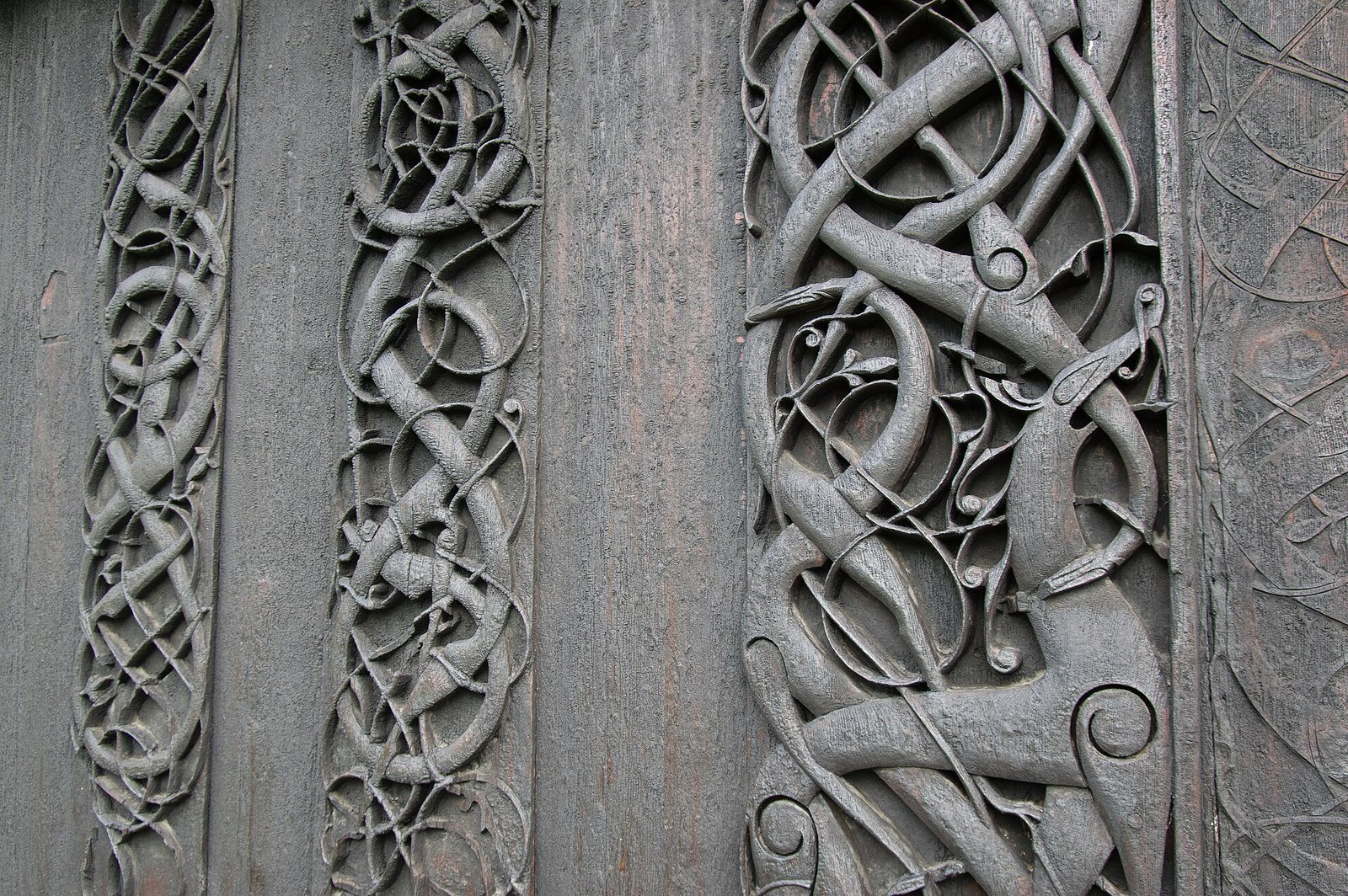
For our workshop a fifth appearance matters, because carved in stone it still stands before our eyes: the serpent as bearer of writing. On countless Viking-age runestones the inscription runs not in straight lines but within the body of a serpent or dragon-like beast. The rune-band is the creature's body; head and tail form beginning and end, often artfully interlaced. In the later animal styles of the Viking Age – think of the flowing Ringerike style and the slender, self-entwined Urnes style – this band grows ever more elegant. The famous great Jelling stone shows a mighty beast entwined by a serpent. The honest classification is important: this serpent on the stones is an ornament and a frame for the text, not a depiction of one of the six Grímnismál serpents. But it shows how naturally the serpent's body served the North as a form – beautiful, dangerous and load-bearing at once.
How deeply the serpent's body shaped the Norse eye shows in yet another place: in the ships. The greatest warships of the Viking Age carried a carved animal- or dragon-head at the prow and were therefore called drekar, „dragons“. Olaf Tryggvason's famous ship was simply named Ormr inn langi, „the Long Serpent“. The same word ormr that names the beings beneath the root thus also named the proudest thing a man could own. Serpent and dragon were in the North not merely terrors of the deep, but a form in which power, beauty and danger could be expressed at once – on the gravestone as on the prow.
The basic pattern – a bird above in the tree, a serpent below at the root – feels strangely familiar, and it is worth pursuing this more closely without falling into rapture. In Indian traditions it is the Nāgas, serpent-shaped beings who dwell in the depths, guarding water and treasure and bound up with roots, with mountains and with the underworld; great world-serpents there bear or encircle the order of the world. In the biblical Garden of Eden the serpent coils at the tree of knowledge. Especially striking is an image from ancient Mesopotamia: in a Sumerian tale a sacred tree grows, but in its roots there settles a „serpent that knows no charm“, not to be driven out, until the tree must be felled. And in the Epic of Gilgamesh it is a serpent that robs the hero of the plant of rejuvenation and sheds its skin in doing so – renewal is lost to the crawling creature. From the Greek world one knows Ladon, the dragon coiled around the tree with the golden apples of the Hesperides, and Python, the earth-serpent at the navel of the world in Delphi.
A second trait links these images across the cultures: the serpent at the root is often a guardian. The Nāgas watch over water and hidden treasure; Ladon guards the golden apples; and in the North Fáfnir the dragon guards his gold, while beneath Yggdrasil lies the most precious thing of all – the springs of wisdom and of life. Where something valuable rests in the hidden deep, in many traditions a serpent-being lies before it, half warden, half threat. This too is less a proof of kinship than a sign of how closely the human mind binds together depth, treasure and danger.
This clustering is impressive – but it must be handled with care. The idea of the „world-tree“ or the „world-axis“ that joins heaven, earth and underworld, and at whose foot something chthonic lurks, is to a large extent an ordering category of modern religious studies. It is a useful tool for setting like beside like, but it is no proof that one culture influenced another. There is no evidence of such contact between the North, India, the Near East and Greece in this matter. What the parallels really show is something more modest and at the same time more beautiful: the image of the tree as an axis between the worlds evidently lies close to human thought – and so does the feeling that at its root, in the dark, something crawling waits and consumes the order.
There remains the question of why the Norse tradition sets a consuming serpent-folk at the root of the world-tree at all. A tree that bears the world – why may it not stand in undisturbed splendour? The answer lies in Grímnismál itself, which soberly states that Yggdrasil endures more than people know: the hart consumes above, the flank rots, Níðhöggr and his folk gnaw below. The tree suffers – and yet it holds.
Precisely in this lies the greatness of the image. Yggdrasil is no backdrop of eternal perfection, but a living being under strain. That it stands nonetheless is not a given, but labour: Snorri tells that the Norns draw water daily from the Well of Urd and pour it, together with the white clay lying around the well, over the ash, so that its branches will not rot. The dew that falls from it to the earth is the honeydew on which the bees feed. So the gnawing from below is met by a tending from above – the world is not simply borne, it is held, day by day, against decay.
In this tension lies also the reason the image still moves us today. A tree at which the hart consumes from above and the serpents dig from below is no symbol of cheap comfort. It says neither that all will be well nor that all is lost. It says: life carries its own decay with it – and holds its ground all the same. Whoever fixes such a motif in wood or stone holds fast not a pretty ornament, but a whole attitude: the readiness not to hush up the dark and not to give up the bearing. In just this the Norse world-picture differs from a mere idyll.
This is a grown-up view of the world. It knows no static paradise, but a balance that must be won again and again. Even the end, Ragnarök, is in Norse thought no mere extinction: the tree survives it, and in its shelter, in Hoddmímir's wood, two humans hide, from whom a new race springs. The serpents at the root are therefore not merely a picture of horror. They are the honest part of the world-order: the testimony that all that lives is at the same time threatened – and that what is borne holds its ground nonetheless.
The folk of the root-serpents is a quiet theme of the Edda: a few names in Grímnismál, a seething cauldron in Snorri, a shore of corpses in the Völuspá. Yet precisely in this sparseness lies its power. The names speak of grey and digging, the place speaks of origin and decay at once, and the image of the serpent at the root meets us far beyond the North. One need not invent a secret teaching for the six serpents to find them striking. It is enough to take them as the old lays give them: as the crawling, tenacious counterpart of the bearing tree – and as a reminder that in an honest world-picture the consuming thing, too, has its place.
Yggdrasil – the world tree · Niðhöggr – the gnawer at the root · The nine worlds · The Norns · Heiðrún – the mead-goat.
All Beings & Creatures articles →
Without the giants there would be no Norse world – in the most literal sense. Out of a giant it arose, against the …
Read more →In Valhalla an eternal feast holds sway – provided by a single animal that never runs out: the boar Sæhrimnir.
Read more →Two wolves race across the firmament – one after the sun, the other after the moon. It is the oldest chase in the …
Read more →Eight legs, a one-eyed rider and a road that leads all the way down into the realm of the dead: Sleipnir is no ordinary …
Read more →