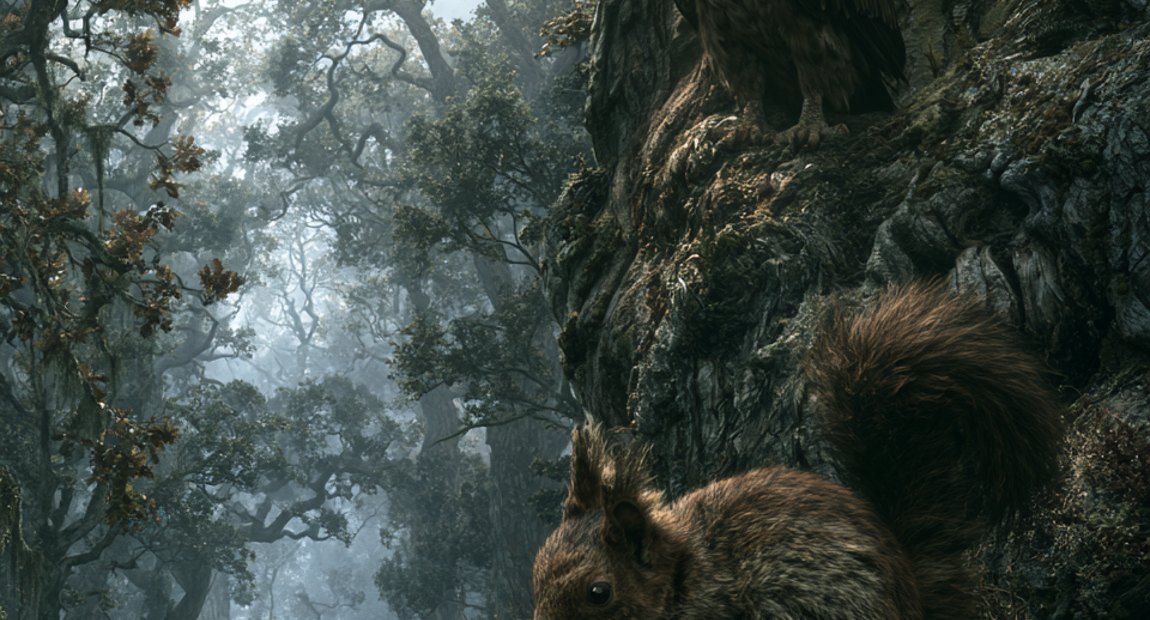
Ratatoskr is the squirrel of Norse mythology who runs along the trunk of the world ash Yggdrasil, carrying words between the eagle in its crown and the dragon Níðhöggr at its roots. He appears in exactly two medieval sources: a single stanza of the Eddic poem Grímnismál and one sentence in Snorri Sturluson's Prose Edda. Here is what those texts really say, what the name "Drill-Tooth" reveals, who else lives in the tree, and how a small rodent became the patron saint of gossip.
Picture the largest tree that ever grew. Its roots reach down to the dead, to the giants and to humankind; its crown spreads across the sky. At the top sits an eagle who knows many things. At the bottom a dragon gnaws the roots. And in between? Not a hero, not a god, not a valkyrie. A squirrel.
That is exactly why we love Ratatoskr. One of the strangest roles in the whole mythology goes to the most unassuming animal imaginable. No weapon, no power, just quick paws and a single task: moving words around. Anyone who has watched one passed-along remark blow up a family dinner or derail a club meeting knows that this is not a harmless profession.
Ratatoskr is also a textbook case of how very little text can turn into a very big picture. The entire medieval record for this animal fits on an index card. The sly personality, the role as messenger between the nine worlds, the cute mascot of video games: all of that is interpretation, embellishment or modern invention. So let us look closely, starting with the sources word for word.
Ratatoskr first turns up in Grímnismál, "The Sayings of Grímnir". The poem belongs to the Poetic Edda, a collection of Old Norse mythological and heroic poetry preserved mainly in the Codex Regius, an Icelandic manuscript written around 1270. The poems themselves are older, but how much older is impossible to say with confidence for Grímnismál. Some scholars consider parts of it pre-Christian, others expect later additions. There is no fixed date.
The frame story is grim. Odin, disguised as Grímnir ("the masked one"), arrives at the court of King Geirrøðr, is seized and set between two fires for eight nights. Tormented and starving, he begins to speak, and what pours out is a panorama of the divine world: halls, rivers, beasts, names. In the middle of his description of the world ash stands stanza 32. In Old Norse (normalised) it reads:
Ratatoskr heitir íkorni, er renna skal at aski Yggdrasils; arnar orð hann skal ofan bera ok segja Niðhǫggvi niðr.Grímnismál 32, Old Norse text after the normalised edition of Guðni Jónsson
Henry Adams Bellows translated it in 1923 like this:
Ratatosk is the squirrel who there shall run / On the ash-tree Yggdrasil; / From above the words of the eagle he bears, / And tells them to Nithhogg beneath.Grímnismál 32, translation Henry Adams Bellows, 1923 (public domain)
Bellows stays close to the original here, and it pays to be pedantic. The stanza names the squirrel, places it on the ash, and gives it one job: to carry the eagle's words ofan, "from above", and deliver them to Níðhöggr niðr, "below". The direction is one-way, top to bottom. There is no reply from the dragon, no back-and-forth, no lying and no malice. Some later translations, such as Karl Simrock's German version of 1851, already have the squirrel running "up and down". That is a natural assumption, since a squirrel that runs down must come back up, but it is the translator speaking, not the poem.
Something else is odd. Stanza 32 speaks of "the eagle" as if we had already met him, yet Grímnismál introduces no eagle in the tree beforehand. Several scholars have therefore suggested that a stanza about the eagle may have been lost. It is a reasonable guess, nothing more.
Some fifty years before the Codex Regius was written down, around 1220, the Icelandic scholar and chieftain Snorri Sturluson composed his Prose Edda. Its first major part, Gylfaginning ("The Tricking of Gylfi"), is a teaching dialogue: the Swedish king Gylfi, disguised as a wanderer called Gangleri, questions three mysterious figures about the order of the world. Snorri clearly knew Grímnismál well and quotes it repeatedly. In chapter 16, headed "Enn frá askinum" ("More about the ash"), he assembles the whole cast of the tree. Two sentences matter to us:
Örn einn sitr í limum asksins, ok er hann margs vitandi, en í milli augna honum sitr haukr, sá er heitir Veðrfölnir. Íkorni sá, er heitir Ratatoskr, renn upp ok niðr eftir askinum ok berr öfundarorð milli arnarins ok Níðhöggs.Snorri Sturluson, Gylfaginning 16, Old Norse text
In our own rendering: "An eagle sits in the branches of the ash, and he knows a great many things; and between his eyes sits a hawk called Veðrfölnir. The squirrel called Ratatoskr runs up and down the ash and carries words of envy between the eagle and Níðhöggr."
Only now do we have the image everyone knows. Snorri does three things. First, he explicitly gives the squirrel both directions: upp ok niðr, up and down, with the words travelling milli, between the two. Second, he defines the content of the messages: öfundarorð, literally "envy-words", words of spite and ill will. Third, he adds a second bird, the hawk Veðrfölnir, perched between the eagle's eyes.
Snorri does not tell us where he got this. He may have known a stanza now lost, he may have drawn on oral tradition, or he may simply have drawn the logical conclusion from the terse Eddic verse: whoever carries words down and comes back up probably brings answers too. Snorri liked to fill gaps so that everything fitted together. That makes him indispensable, but not every detail he offers is ancient.
The name Ratatoskr (also normalised as Ratatǫskr, anglicised as Ratatosk) has two parts: rata- and -toskr. Both are trickier than fantasy encyclopaedias suggest.
For the second element, -toskr, almost everyone thinks of "tooth" or "tusk", and the English word is indeed usually compared. The catch is that the word appears nowhere else in Old Norse. It is a hapax, a word attested only once. The Norwegian philologist Sophus Bugge concluded that the whole name might be borrowed from Old English and originally mean something like "rat-tooth". The American Scandinavianist Albert Morey Sturtevant disagreed in a 1956 article in Scandinavian Studies: a single attestation is no proof of borrowing, and there are Norse names such as Tunne that also describe a person by a peculiar sort of tooth.
The first element is where it gets interesting. There are two main lines for rata-:
We find the "Drill-Tooth" reading more convincing, because the pairing of Rata and gnaga ("gnaw") in Hávamál fits a squirrel so strikingly well. But honestly, the debate is not settled. And note this: the name says nothing about gossip, lies or errands. If it describes anything, it describes an animal with strong teeth.
A side note: the German word Eichhörnchen owes its "oak" and "horn" only to later reinterpretation. Old High German had eihhurno, Old Norse íkorni, Old English ācweorna; Pfeifer's etymological dictionary considers a root meaning "to move violently".
Ratatoskr does not live alone. In the sources, Yggdrasil is a full ecosystem, and only the whole cast explains why a messenger is needed at all. Grímnismál describes the tree in stanzas 31 to 35, Snorri in chapter 16. Meet the neighbours:
The eagle in the crown. Nameless, but margs vitandi, "knowing many things". No source tells us more. Some modern readers connect him with Hræsvelgr, the giant in eagle shape who, according to Vafþrúðnismál, sits at the end of heaven and makes the wind with his wings. That is a modern combination, though, not something the texts say.
Veðrfölnir. The hawk between the eagle's eyes appears only in Snorri. The name is usually interpreted as "the one bleached by the weather", but this translation is not entirely certain either. Why one bird should sit between the eyes of another, no source explains.
Níðhöggr at the root. The dragon or great serpent gnaws at the tree from below, according to Grímnismál 35. In Völuspá he sucks the corpses of the dead. The first element of his name is usually connected with níð, a word for slander, defamation and hatred. So it is to him, of all creatures, that Ratatoskr delivers the eagle's words: a being whose very name contains malicious talk. More in Níðhöggr, the dragon at the root.
The serpents. Stanza 34 claims that more serpents lie beneath the ash than any foolish ape imagines, and names several of them, including Góinn, Móinn, Grábakr, Ófnir and Sváfnir. Snorri places them with Níðhöggr in the spring Hvergelmir. See the serpents at Yggdrasil's roots.
The four harts. Dáinn, Dvalinn, Duneyrr and Duraþrór nibble the shoots in stanza 33; in Snorri they run through the branches and bite off the leaves. In his 1923 edition Bellows suspected they were a late multiplication of the single hart of stanza 26. More in The four harts of Yggdrasil.
Heiðrún and Eikþyrnir. In stanzas 25 and 26, the goat Heiðrún and the hart Eikþyrnir stand on the roof of Valhalla and feed on a tree called Læraðr. Heiðrún gives mead for the fallen warriors, and water drips from Eikþyrnir's antlers into Hvergelmir. Whether Læraðr is the same tree as Yggdrasil is debated. See Heiðrún and Eikþyrnir.
And then there is the stanza that sums it all up. Grímnismál 35 begins: Askr Yggdrasils drýgir erfiði meira en menn um viti, "The ash Yggdrasil suffers more hardship than men know." The hart bites from above, the side is rotting, Níðhöggr gnaws from below. The World Tree is no flawless emblem of harmony. It is chewed, wounded and besieged, and still it stands. Snorri adds that the Norns pour water and clay from the well of Urðr over it every day so that its branches do not wither. More in The three wells beneath Yggdrasil.
From here on we leave the firm ground of the sources. Everything that follows is interpretation, some of it well founded, some of it bold. We will tell you who argues what.
A decorative detail. Rudolf Simek regards the squirrel as probably a later, embellishing feature in the picture of the world ash. The world tree as an idea may be very old; the individual animals in it need not be. The animal stanzas of Grímnismál do read like a list that could easily have grown over time.
A cycle of destruction and renewal. Hilda Ellis Davidson stresses that the tree is constantly being gnawed and eaten, by the dragon, by the harts and presumably by the squirrel, whose very name means something like "Drill-Tooth", while the Norns tend and heal it. The result is a picture of a world that is always under threat and always renewing itself.
The lowly carrier of feud. John Lindow makes an observation from the sagas: the people who carry malicious words between feuding parties there are rarely of high status. That a small animal plays this role in the myth fits the same pattern.
The scolding squirrel. The zoologists Richard W. Thorington Jr. and Katie Ferrell, in their book Squirrels: The Animal Answer Guide (2006), offer a down-to-earth explanation: squirrels chatter and scold loudly when they spot a predator, birds of prey included. It cannot be proven, but it is a charming idea.
Gods against giants? Older interpretations saw in the quarrel between eagle and dragon the struggle of constructive against destructive powers, gods against giants, with Ratatoskr as its courier. Bellows already called this "a trifle far-fetched" in 1923, and most scholars today agree.
Linking the worlds. Modern books often call Ratatoskr "the messenger between the nine worlds". That is a free extension. The sources know only crown and root, eagle and dragon. What is true is that Ratatoskr is the only creature in the tree that moves vertically and connects top and bottom. In that sense he really is a link, just one that carries nothing good. For the wider cosmology see The nine worlds.
Did someone in the North invent this, or is the story older? In 1937 the historian of religion Jan de Vries pointed, in his Altgermanische Religionsgeschichte, to a remarkable parallel that you can read for yourself: a fable by the Roman poet Phaedrus from the first century AD (Book II, Fable 4).
In it, an eagle nests at the top of an oak, a cat raises her kittens in a hollow halfway up the trunk, and a wild sow farrows at the foot of the tree. The cat climbs up and tells the eagle that the sow is digging at the roots every day to topple the tree and devour his young. Then she runs down and warns the sow that the eagle is only waiting to snatch her piglets. Neither dares to leave its nest; both families starve, and the cat and her kittens feast on them. Phaedrus' moral: see how much harm a double-tongued person can do.
An eagle above, a digger at the root, a small animal in between carrying lies: the resemblance to Snorri is striking. Whether learned Icelanders knew the fable or both go back to an older storytelling pattern cannot be decided. What is clear is that the strife-carrying role, which Snorri emphasises more than the Edda does, has a very old model in European storytelling. Scholars also point to the widespread enmity between eagle and serpent, for example in India between the bird Garuḍa and the serpent beings. As Simek and de Vries stress, though, such parallels do not allow the Norse motif to be dated securely.
To people of the Viking Age the squirrel was no fable creature but a familiar animal, and a commodity. Scandinavia is home to the Eurasian red squirrel (Sciurus vulgaris), which in the North often grows a dense, greyish winter coat. That winter fur was in demand for centuries.
Already around 551, the historian Jordanes reports in his Getica that the Suehans in the North supplied precious dark furs through many intermediaries to the Roman market. Which animal is meant remains unclear, probably not the squirrel. But fur from the North was obviously an export long before the Vikings.
In the Viking Age this became big business. Arab geographers describe the Rus, the Scandinavian-led traders of the East, as fur merchants. Ibn Rusta writes in the early tenth century that their only business was trading in sable, squirrel and other furs. Payment came in Arab silver dirhams, which lie by the tens of thousands in Swedish and Gotlandic hoards. Alongside slaves, furs were among the most important goods heading south. Read more in our articles on Viking trade and the Rus in the East.
Fur is hard to catch archaeologically because it usually decays in the ground. A 2022 study in PLOS ONE showed how much modern methods can still recover: a team led by Luise Ørsted Brandt used protein analysis to identify the species behind fur remains from Danish high-status graves, including Hvilehøj and Bjerringhøj at Mammen, and found beaver among them, an animal not native to Denmark at the time. Squirrel was not identified there. That does not mean it was absent; it shows how thin the direct evidence is.
In the high and late Middle Ages squirrel fur became a mass product. Grey winter pelts, known in German as Grauwerk, travelled in enormous quantities from Russia and the Baltic via the Hanseatic League to Western Europe. The alternating grey back and white belly fur even became a heraldic pattern: vair. When you see rows of blue and white bell shapes on a medieval coat of arms, you are looking at stylised squirrel skins.
So people knew this animal at very close range, as a forest dweller, as quarry and as trade goods. That they credited it with gossip of all things betrays a sharp eye for its loud, indignant temperament.
Few figures of Norse mythology have made such a steep career leap in recent years. Ratatoskr has arrived in pop culture, usually far friendlier than in the original.
The best-known appearance is probably in God of War Ragnarök (2022), where Ratatoskr is a prominent side character; a spectral version had already appeared in the 2018 predecessor. How much real mythology is in that series we examine in God of War fact-checked. In the online game Smite Ratatoskr is playable, and Fire Emblem Heroes has its own character of that name. At Marvel, Ryan North's comic series The Unbeatable Squirrel Girl features a Ratatoskr as a shapeshifting agent of discord, which at least keeps the strife angle alive.
Nearly always, the cute animal wins out and the dark side shrinks. In the myth Ratatoskr is no mascot; he is part of the hardship the World Tree endures.
Here in Alsdorf, Ratatoskr is a favourite because he does something many Norse motifs cannot: he tells a story with a wink. An eagle above, a dragon below, a squirrel mid-dash in between. It is a motif you do not need to explain for people to like it, and it still has depth for anyone who knows the Edda.
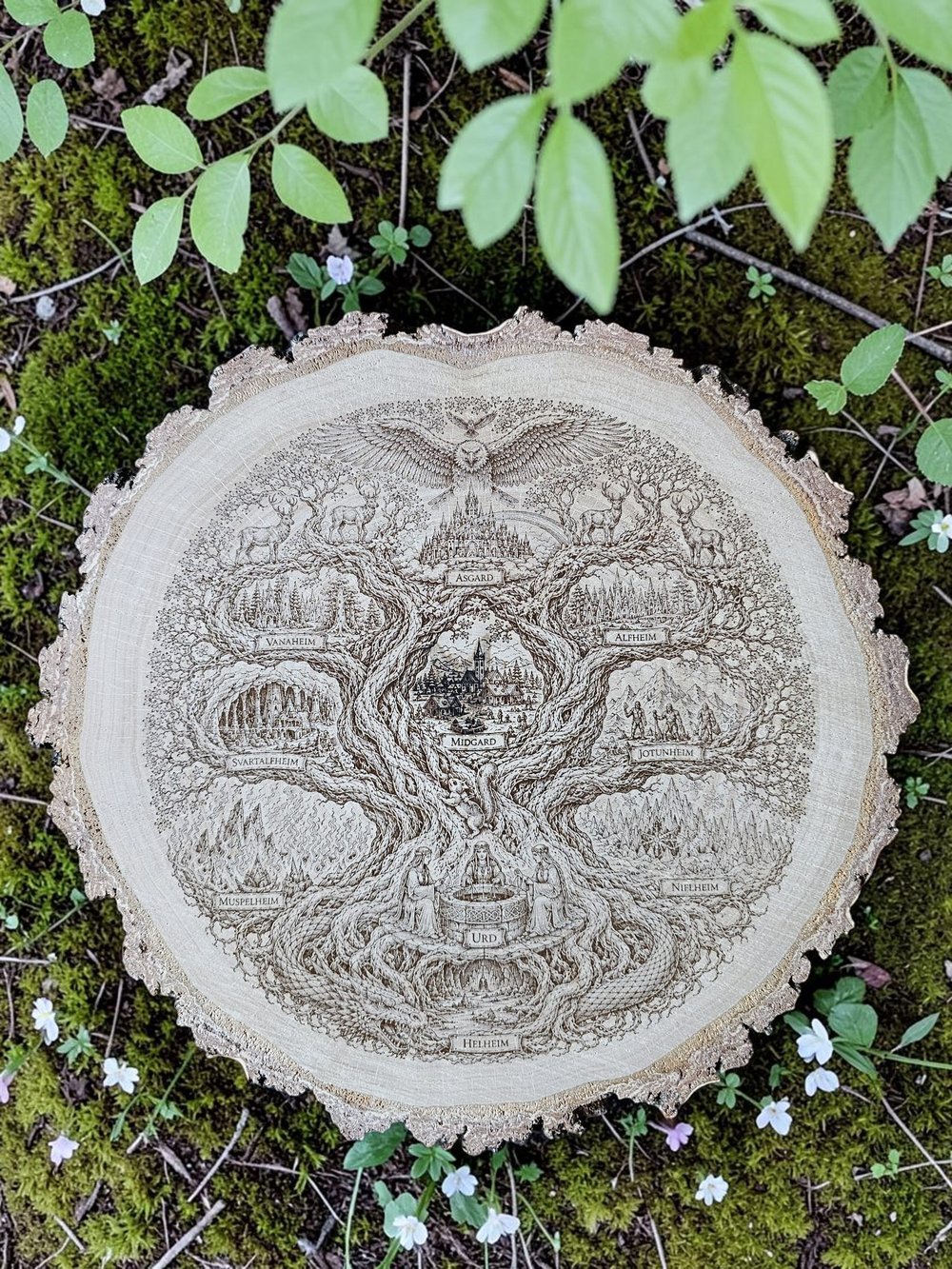
It works especially well on a birch wood slice, where the growth rings already supply the trunk. On natural slate the scene feels darker and more serious, more like a glimpse into the mythic world. We care about honesty in style: we know of no Viking Age depiction that is securely identified as a squirrel. If you want Ratatoskr in Viking style, you get a new design inspired by genuine animal ornament, such as the interlaced Urnes style, not a copy of a historical original. How those styles are built up we show in Drawing Norse animal ornament.
Our favourite idea for families and friends: Ratatoskr with a tongue-in-cheek line on a wooden slice for the hallway, as a reminder that not every word needs passing on.
What does the name Ratatoskr mean? The most common reading is "Drill-Tooth" or "Gnaw-Tooth", from Rati, the auger in Hávamál, and -toskr, probably "tooth" or "tusk". Another reading links rata to "roam", giving something like "Wandering Tooth". Neither is certain.
What does the squirrel do in Yggdrasil? According to Grímnismál 32 it runs on the world ash and carries the eagle's words down to Níðhöggr. Snorri adds that it runs up and down, carrying envious words between the two.
Is Ratatoskr evil? The sources do not judge the squirrel morally. Snorri only says it carries hostile words; the idea that it lies or deliberately stirs up trouble is a modern sharpening.
Where is Ratatoskr mentioned in Norse mythology? In only two places: stanza 32 of Grímnismál in the Poetic Edda, and chapter 16 of Gylfaginning in Snorri's Prose Edda.
What is the name of the eagle in Yggdrasil? The eagle remains nameless in the sources. Only the hawk Veðrfölnir, who according to Snorri sits between the eagle's eyes, has a name.
For courage. For remembrance. For legends that live on.
Yggdrasil – the world tree · Niðhöggr – the gnawer at the root · The nine worlds · The Norns · Heiðrún – the mead-goat.
All Beings & Creatures articles →
Without the giants there would be no Norse world – in the most literal sense. Out of a giant it arose, against the …
Read more →In Valhalla an eternal feast holds sway – provided by a single animal that never runs out: the boar Sæhrimnir.
Read more →Two wolves race across the firmament – one after the sun, the other after the moon. It is the oldest chase in the …
Read more →Eight legs, a one-eyed rider and a road that leads all the way down into the realm of the dead: Sleipnir is no ordinary …
Read more →