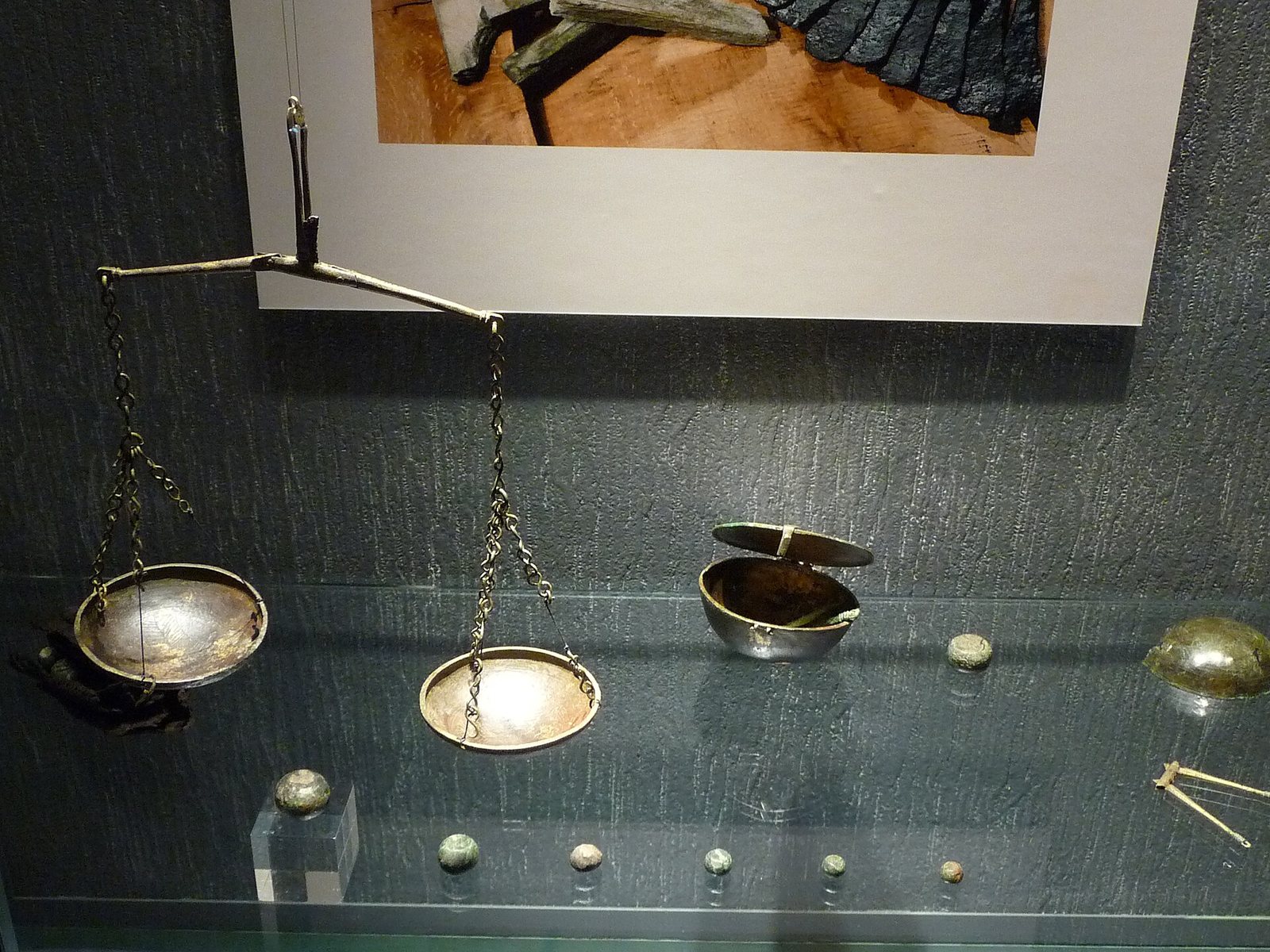
The image of the Viking as a mere raider hides what really held the Norse world together: a far-reaching trade network that linked the North Atlantic with Baghdad. To understand the Viking Age, follow the silver – from the furs of the far north, through the merchant's balance scale, to the dirhams from the Caliphate.
The Viking Age (roughly 793 to 1066) is often reduced to raiding. Yet the overwhelming majority of people in Scandinavia lived by farming, craft and trade. Even the same men who went raiding in summer were farmers or merchants again by autumn. The Old Norse word "kaupmaðr" (merchant) appears in the sagas as often as "víkingr", and the great trading places of the North are far better attested archaeologically than any single battle.
Trade and plunder were not opposites but two sides of the same mobility. Anyone with a seaworthy ship, weapons and capital could barter where he was allowed and take where he judged others too weak. Both brought silver – and silver was the currency of the North.
The Viking trade network ran along two main axes. The western route crossed the North Sea and the Atlantic: to England, Ireland, the Frankish realm, on to al-Andalus and the Mediterranean, and to the new settlements in the Faroes, Iceland and Greenland. Along it flowed Frankish weapons, Anglo-Saxon silver, Irish slaves and Rhenish pottery.
The eastern route ("austrvegr") crossed the Baltic to the river systems of Eastern Europe – the Volkhov, Dnieper and Volga. Along it the Norse, known as the "Rus", reached the Khazar realm, the Byzantine Empire and, via the Volga Bulgars, the Abbasid Caliphate. From there came the single most important import: silver in the form of dirham coins. Without the eastern route, the silver wealth of the Viking Age cannot be explained.
Long-distance trade concentrated in a few great hubs, the emporia. Hedeby (Haithabu) on the Schlei was the largest: a planned trading town with harbour jetties, workshops, its own coinage and a semicircular rampart. The Arab traveller at-Tartushi described it in the 10th century – with some bewilderment at its singing and customs. Hedeby and the Danevirke have been a UNESCO World Heritage Site since 2018; only a small part has been excavated to date.
Birka on the island of Björkö in Lake Mälaren was the Swedish counterpart, a pivot between the Baltic world and the eastern route; here Ansgar preached, and here lie more than a thousand graves. Ribe on Jutland's west coast is the oldest town in Scandinavia – recent excavations (Northern Emporium) show dense long-distance trade from around 790. Kaupang on the Oslofjord (whose name simply means "marketplace") was Norway's node. All these places share the same pattern: they sit on sheltered waterways, were seasonally or permanently busy, and lived by exchange rather than by their own production alone.
Dorestad in the Rhine-Meuse delta was the largest emporium of north-western Europe in the 8th and early 9th centuries – a Frisian-Frankish market through which Rhenish wine, cloth and pottery flowed north. Its decline was multi-causal (a shifting river, Frankish power struggles, repeated raids), not simply "destroyed by the Vikings".
On the southern Baltic coast, Wolin at the mouth of the Oder was a major trading town where Slavs, Scandinavians and merchants from the East met; Adam of Bremen praised it as one of the greatest cities in Europe. Smaller places such as Reric, Ralswiek and Menzlin filled out the network. Trade here was multi-ethnic from the start – the "Viking" was one among many.
At the start of the eastern route lay Staraya Ladoga (Old Norse Aldeigjuborg) on the Volkhov – dated by dendrochronology back to around 753, and thus older than the classic Viking Age. From here the Norse pushed on to Novgorod/Holmgard and the rivers beyond. Where the currents became impassable they carried their goods overland (the portages) and traded furs and slaves for silver with the Volga Bulgars at the market town of Bulgar.
It is precisely this Volga trade that the Arab envoy Ibn Fadlan describes, having met the Bulgars in 922 and depicted the Rus as merchants offering their wares by the river. Whether these "Rus" were consistently Scandinavians is debated to this day – probably a mixed group that arose out of the trade itself.
Anyone who followed the Dnieper down to the Black Sea reached Miklagard – Constantinople, the "great city". Constantine VII Porphyrogenitus even records, in his work "De administrando imperio", the names of the Dnieper rapids in both Norse and Slavonic – a rare direct witness to the bilingualism of the trading crews. In Byzantium Norsemen served in the emperor's Varangian Guard; runestones in Sweden commemorate the men who stayed "in Greece" (Grikkland). Trade, mercenary service and diplomacy ran into one another here.
What did the North have to offer the South? Above all the raw materials of the wilderness. Furs were the most important export: squirrel winter pelt (grey-work) as a bulk commodity, together with marten, sable, fox, beaver and bear. The Norwegian chieftain Ohthere told at the court of King Alfred of the tribute he collected from the Sami in furs, feathers and walrus ivory.
He was a very rich man in those possessions in which their wealth consists, that is, in wild beasts. And the tribute that the Finns (Sami) pay consists of the skins of beasts, of birds' feathers, whalebone, and ship-ropes made of walrus and seal hide. Each pays according to his rank.Ohthere's report to King Alfred, Old English Orosius, late 9th c. (public domain; rendering by Glanz & Gravur)
Amber from the Baltic had been traded for millennia and was worked into beads and amulets in the emporia's workshops. Iron from Norwegian and Swedish bloomeries was a trade good, as was walrus ivory and walrus-hide rope from the far north and from Greenland – the latter became, for a time, the "white gold" of the North Atlantic settlements.
Alongside the luxury goods ran a brisk trade in everyday wares. Whetstones from Eidsborg in Telemark were exported in bulk even before the great raiding voyages and are found from Hedeby to England. Soapstone vessels from Norway replaced pottery, which was scarce in the North, and were traded via Kaupang. Antler combs were a mass product of the towns; protein analysis (ZooMS) has shown that many Hedeby combs were made from Norwegian reindeer antler – evidence of long-distance trade in the raw material itself.
Honey (for mead), salt, stockfish and above all wool formed the staple. In Iceland coarse woollen cloth, "vaðmál", even became a fixed unit of account: prices and dues were reckoned in ells of cloth. Anyone who reduces the Viking Age to swords overlooks that the North was, above all, an exporter of fur, fish, stone and cloth.
An honest account must include the trade in people. The unfree – Old Norse "þrælar" (thralls) – were a fixed commodity of the North. They were seized on raids, taken as prisoners of war or sold in hardship, and passed on along the eastern and western routes – a considerable share via the Volga and through intermediaries into the markets of the Caliphate. The trade was lucrative for the sellers and bitter for those it touched. We show this soberly and without embellishment: the wealth that settled into hacksilver and dirhams rested partly on this foundation too.
In return, what the North lacked flowed in. First and foremost silver – mostly as Arab dirhams, which came to Scandinavia in vast quantity along the Volga route; Gotlandic hoards such as the Spillings treasure contain thousands of them. Then silk from Byzantium and the Orient (attested, for instance, in the Oseberg burial), glass as raw material and as funnel beakers, spices in small quantities (dill, coriander and mustard are attested; pepper and cinnamon are not certain for the Viking Age), and wine from the Rhine and France – an upper-class drink that reached the North via Dorestad and Hedeby.
The remarkable thing about Viking-Age trade is that silver mostly counted not as coin but as weight. People chopped up ingots, rings and foreign coins into pieces – the hacksilver – and weighed them on fine folding balances with standardised weights. A piece was worth exactly what it weighed, regardless of which ruler had struck it.
Because forgeries circulated, the merchant tested his goods: small nicks cut into the surface and knife-point pecks revealed whether the silver was solid throughout or merely a silvered core. Many surviving pieces are covered in such test-marks. Together with folding balances and lead weights, this yields the picture of a pragmatic, cross-regional cash system without a fixed state – trust came from the scale and the knife, not from a king's head.
Over time the coin prevailed. In Hedeby, its own coins were struck as early as the 9th century (modelled on Dorestad), and in the 10th century Danish, Norwegian and Swedish kings minted their own money – a sign of consolidating power. From the Empire, the Otto-Adelheid penny, struck from Harz silver, streamed into the North in the late 10th century and gradually replaced the drying stream of dirhams. The transition was fluid: for a long time weighed hacksilver and counted coin circulated side by side.
The supply of Arab silver did not stop suddenly, but it noticeably eased around 960 to 980 – the Caliphate's silver mines were becoming exhausted and the fineness of the dirhams fell. This "silver crisis" reordered trade: the North turned more strongly to Western European silver (the Harz, England, the Rhineland), and the growing coinage of native rulers filled the gap. Lead-isotope analysis of the silver confirms this shift of sources over the course of the Viking Age.
Long-distance trade depended on the right ship. The slim, fast longship was a machine of war; trade, by contrast, sailed on the knörr – a broader, deeper cargo ship with high freeboard, a small crew and a large hold, driven mainly by sail. The Skuldelev finds from the Roskilde fjord show both types side by side: Skuldelev 1, for example, was an ocean-going knörr of the kind that supplied Greenland and Iceland. Without these sturdy freighters, trade across the open Atlantic or the Baltic would have been unthinkable. On the rivers of the East, by contrast, one needed small, light boats that could be carried overland at the rapids.
Navigation relied on experience, coastal landmarks and the height of the sun. The sailing directions preserved in the Landnámabók describe latitude sailing by the sighting height of land – sober seamanship, not sorcery. This too corrects the cliché: the trading skipper was an expert in weather, current and cargo.
Trade needs trust and rules. Merchants joined together in a félag – a trading partnership in which capital, ship and risk were shared; the word survives to this day in the English "fellow". A special market peace applied at the fairs: whoever broke the peace put himself outside the law. Towns such as Hedeby and Birka stood at times under the protection of a king or a reeve who levied tolls and kept order – an early step from the free place of barter to the administered town.
How deeply trade pervaded daily life is shown by the equipment of a merchant's grave: a folding balance, a set of weights, hacksilver, a knife for the test-nicks, and the wares themselves. The merchant carried his "bank" literally on his belt. Trade was not a sideline of the Viking Age but one of its load-bearing frames.
Hedeby · Hacksilver – silver as currency · The silver hoards · Amber – the gold of the North · Dorestad – the great trading place.
All History & Finds articles →
Anyone sailing west out of Norway carried no compass and yet had a remarkably clear destination: the arc of islands …
Read more →The Vikings came, raided – and stayed. Over the winter, at least. Instead of sailing home after every raid, they …
Read more →When we picture Vikings, we see mist, fjords and the grey North Sea. Yet the same men who plundered monasteries on the …
Read more →We remember the Vikings as raiders and coastal plunderers – yet their greatest feat was a quiet one: they crossed the …
Read more →