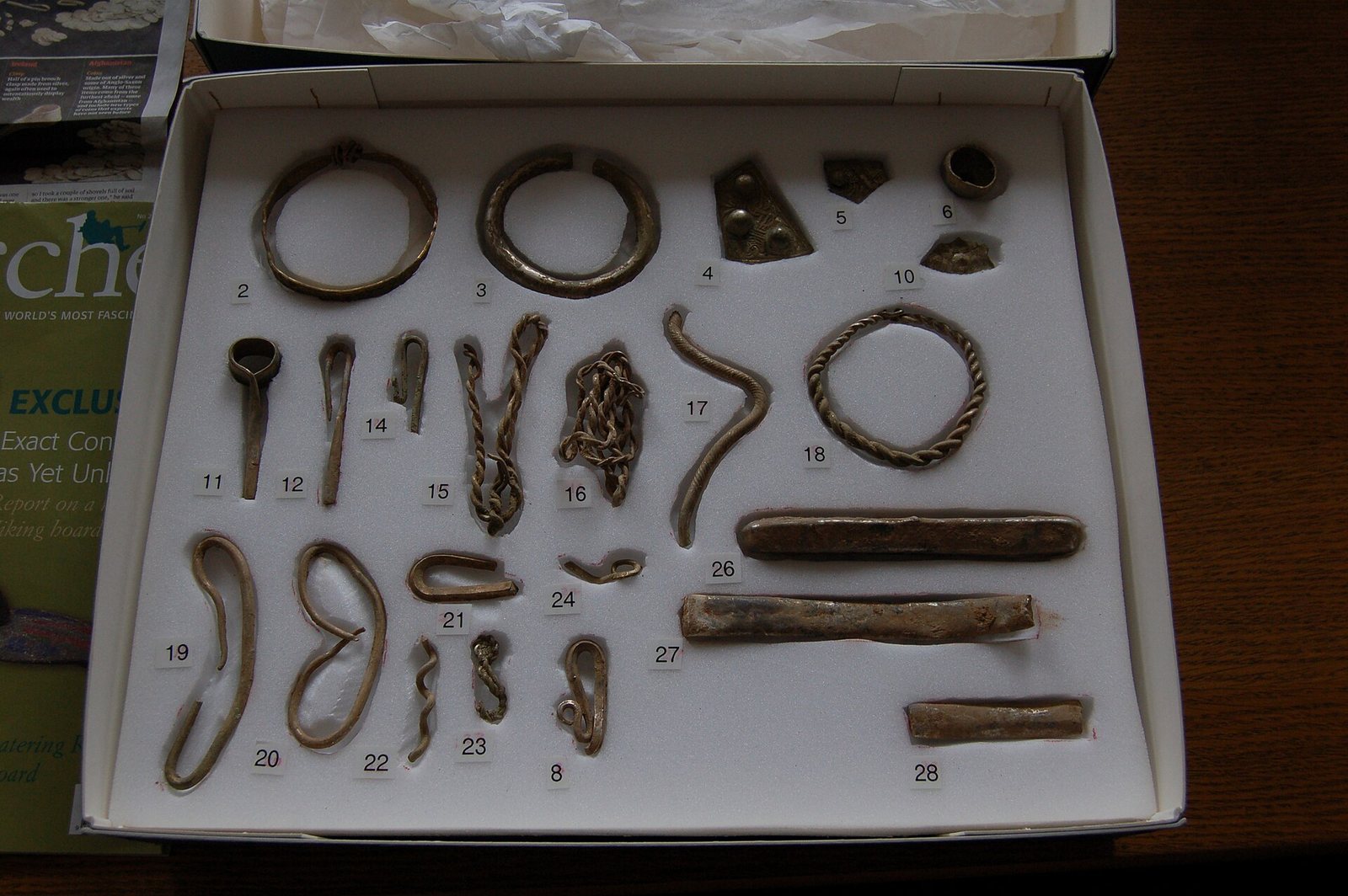
Image credit (header image): “Harrogate Hoard items”, Portable Antiquities Scheme from London, England, CC BY 2.0 (Wikimedia Commons).
Silver was the lifeblood of Viking trade – weighed, chopped up, buried. Three of the greatest hoards show how far the networks reached: from Gotland via the Caliphate to England.
When we hear “Viking”, we picture longships and axes. But the real engine of that world was humbler and only dully gleaming: silver. It was currency, status symbol and savings account in one – and it knew no borders. A dirham struck in Samarkand or Baghdad could travel the Russian rivers to the Baltic, be weighed there, chopped up, and finally buried under the floor of a Gotlandic farm. The great silver hoards are therefore far more than treasure finds: they are frozen snapshots of a world-spanning network, centuries before anyone knew the word “globalisation”.
One detail is easily missed: for the Viking, what counted was not the coin but the weight. People trusted no foreign ruler’s portrait; they trusted the scales. That is why the hoards contain so much hacksilver – cut coins, bent arm-rings, pieces of ingot. A trader carried a small folding balance and a set of standard weights; payment was by the gram, not by the piece. Silver was a language understood from Ireland to the Volga.
The Spillings hoard, found on Gotland in 1999, is the largest known Viking silver hoard of all: about 67 kilograms of silver, including some 14,295 coins – almost all Islamic dirhams. They come from around 69 mints in 15 present-day countries and were hidden in the late 9th century under the floorboards of an outbuilding. For comparison: that is so much silver a single man could barely carry it.
In the Viking Age Gotland was the hub of Baltic trade, and the amount of eastern silver in its soil is breathtaking. Spillings brings the Dirham Road to life: the great artery along which Scandinavian merchants – the “Rus” – carried furs, amber, weapons and slaves south, and received streams of Caliphate silver in return. Every one of these coins bears an Arabic inscription; together they form a map of medieval long-distance trade, written in precious metal.
No other spot in Europe holds as much Viking-Age silver as Gotland. Over a thousand hoards are known from this single Baltic island alone – a density found nowhere else. The reason lies in its position: Gotland was the perfect waystation between the trading places of the East and the markets of the West, a neutral hub full of farmer-merchants who sailed the sea in summer and came home with silver in autumn.
Strikingly, many of these hoards seem to have been laid down not in panic but by design – a kind of reserve, buried near the farm, sometimes emptied, sometimes topped up. Spillings, with its floorboards laid over it, looks almost like a strongbox. Gotland thus shows a side of the Vikings that the image of the wild raider tends to bury: the sober, calculating trader who managed his wealth like a modern saver – only without a bank.
Further west, the Cuerdale hoard (Lancashire, found on a riverbank in 1840) tells a different story. At about 40 kilograms of silver and some 8,600 objects, it is the largest silver hoard in Western Europe. It was buried around 903–905 – and much suggests it was a war-chest: the wealth of Vikings expelled from Dublin in 902, now regrouping in north-west England. The mix in the hoard – Irish-Norse jewellery, Anglo-Saxon and Frankish coins, dirhams, masses of hacksilver – fits a force on the move that deposited all its portable wealth in one safe place, never to return for it.
On 6 January 2007, two metal-detectorists near Harrogate lifted perhaps the finest of these hoards from the field: the Vale of York hoard. It held 617 silver coins and 65 further objects – but the showpiece is the vessel that contained them: a gilded, animal-decorated cup of Carolingian make, crafted in mid-9th-century northern France, probably an altar vessel. A Frankish church vessel, repurposed as a Viking’s handy silver container – few objects capture the meeting of cultures so sharply.
The coins are political, too. They date to around 927, precisely the year the Wessex king Æthelstan conquered the Norse kingdom of Jórvík (York) and first united England under one crown. The hoard looks like the emergency baggage of a loser of that upheaval: buried in haste, in hope of better times that never came for its owner. The British Museum called it the most important find of its kind in Britain in over 150 years.
The obvious answer is: for safekeeping. Someone with no strongroom entrusts his silver to the earth – and retrieves it once the danger has passed. That so many hoards were never recovered has a sadly simple explanation: the owner fell, was carried off or driven away, and took the knowledge of the hiding place to the grave.
But there is a second, deeper reading. In the Norse imagination, gold and silver given to the earth could also be a gift to the powers. Snorri Sturluson writes in the Ynglinga saga that Odin decreed each man would take with him into the other world whatever he himself had put into the ground. Where exactly the line runs between piggy-bank and offering can rarely be decided from a single hoard – and it is precisely this blur that makes the finds so fascinating.
“Cattle die, kinsmen die, you yourself die likewise; but one thing never dies: the fair fame of one who has earned it.” — Hávamál 76, after Bellows (public domain)
It is one of the wisest lines in the Edda – and it stands in strange contrast to the mountains of silver in the ground. The Vikings piled up wealth, yet knew perfectly well that it is fleeting. What remains is not the metal but the name, the story, the good piece passed on. In our workshop this is more than poetry: at lines like these we think of what we do ourselves – giving a person, a name, a memory a form that outlasts generations.
Hedeby & Trade · The Great Army · Everyday Viking Life · Longships.
Gotlands Museum (Spillings); British Museum (Cuerdale, Vale of York); Yorkshire Museum. Rudolf Simek, Dictionary of Northern Mythology. Image credit (title): silver from the Spillings hoard, photo W. Carter, CC BY-SA 4.0 (Wikimedia Commons).
All History & Finds articles →
A horse, a golden disc, six little spoked wheels: the Trundholm Sun Chariot is one of the most beautiful images the …
Read more →One late-summer day in 1066, a Norwegian army marched through northern England certain of victory – and a few hours …
Read more →Some lose a battle and thereby win everything. On 29 July 1030 the Norwegian king Olav Haraldsson fell at Stiklestad …
Read more →A whole royal ship, buried beneath a mound, full of gold and weapons – and a helmet that became the face of an entire …
Read more →