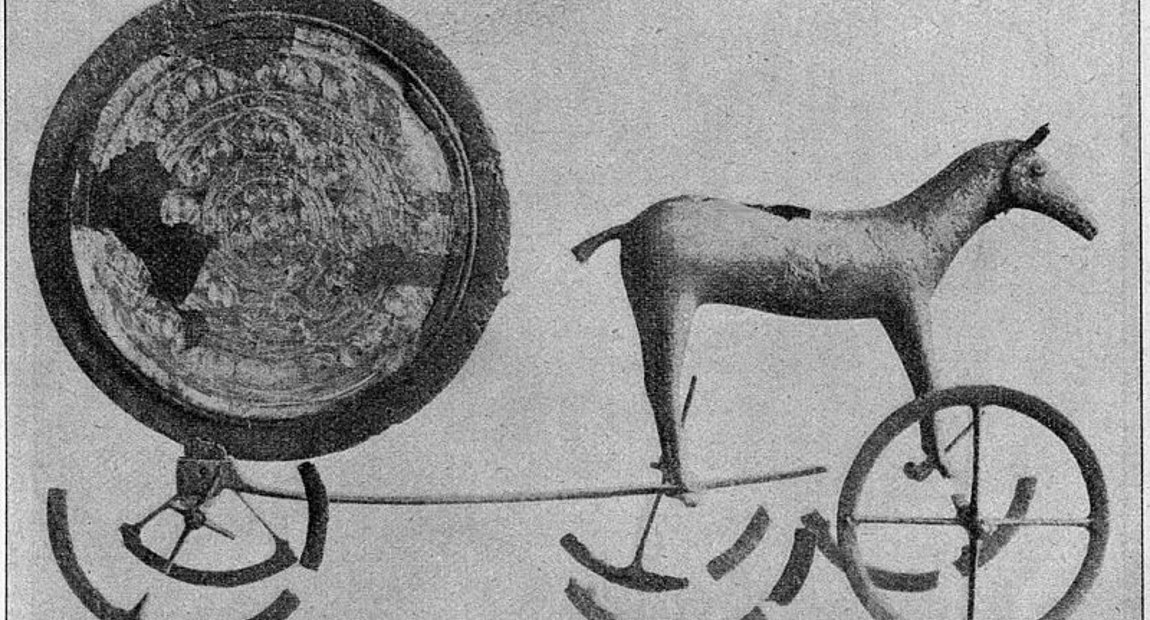
A horse, a golden disc, six little spoked wheels: the Trundholm Sun Chariot is one of the most beautiful images the Bronze Age has left us. It shows the sun being drawn across the sky – an idea that proved remarkably tenacious in the North. For this very motif resurfaces some two thousand years later in the Edda.
In September 1902 a farmer ploughed the Trundholm bog in north-western Zealand for the first time – and struck a small bronze sculpture: a horse pulling a large disc on a frame with spoked wheels. In 1998 archaeologists returned to the site and recovered 21 further parts, including wheels and spokes. The chariot is dated to about 1400 BC. It stands today in the National Museum in Copenhagen and features on the Danish 1000-krone banknote.
The most artful part is the disc. It is about 25 cm across and gilded on one side only – the right side when you view the horse from behind. Both faces are decorated with punches and gravers in zones of concentric circles. The common reading: by day the sun is drawn from east to west, showing the Earth its bright, golden side; by night it returns from west to east, turning its dark side to us. The whole chariot was probably wheeled about in rituals to re-enact the sun's course across the sky.
The National Museum puts it plainly: three things stood at the centre of Nordic Bronze Age religion – the sun, the horse and the ship. The horse, only newly at home in the North, became the bearer of the sun. Related ideas are known far and wide: the Celtic sky god Taranis carries a spoked wheel, in the Indian Rigveda the sun goddess rides a chariot, and the Greek Helios drives his sun-team across the sky. The sun drawn by horses is an ancient Indo-European image.
This is where it gets interesting for us. Some two thousand years after the Sun Chariot, in the Christian-era but far older poems of the Edda, the sun still crosses the sky as a team of horses. The Grímnismál says:
„Árvakr and Alsviðr, they must draw the weary sun up from here; and beneath their shoulders the kindly powers, the Æsir, hid iron-coolness." Grímnismál 37, after Karl Simrock (1851); rendering, public domain source
Árvakr („Early-awake") and Alsviðr („All-swift") are the two horses that draw Sól, the sun; a shield called Svalinn („the Cool one") protects them from the heat. And because nothing is without an adversary, the wolf Sköll chases the sun – until he swallows it at the world's end. We tell this in full in our pieces on Sköll and Hati and the sacred horses.
We should stay honest: more than two millennia separate the Sun Chariot (c. 1400 BC) from the Edda (written down from the 13th century). No one can draw an unbroken line. John Lindow cautiously reads the Trundholm horse as a Bronze Age forerunner of Skinfaxi, the horse that pulls the day across the sky. That is not certain – but that the people of the North imagined the sun, across two thousand years, as something drawn by a horse is a remarkably long-lived image.
Bronze sculpture of a horse, disc and spoked wheels, found in 1902 in the Trundholm bog (Odsherred, NW Zealand), supplemented in 1998 by 21 further parts. Cast by the lost-wax method, c. 54×35×29 cm; disc ~25 cm, gilded on one side only. Dated ~1400 BC (Montelius period II). Now in the Nationalmuseet Copenhagen. Interpretation: ritual depiction of the sun's course (bright/dark side). Sun, horse, ship = core motifs of Nordic Bronze Age religion.
The Sun Chariot is no „proof" of the Viking-Age Norse gods – more than two thousand years lie between, and the connections are interpretation, not evidence. The popular idea that the disc encodes an exact calendar (such as the 19-year Metonic cycle) is an appealing but disputed thesis. What is certain is the image itself: the sun drawn by a horse – a motif that echoes in the North from the Bronze Age to the Edda.
Sköll & Hati · Sacred horses · Horned helmets – yes, but not among the Vikings · Norse symbols: real or invented?.
All History & Finds articles →
One late-summer day in 1066, a Norwegian army marched through northern England certain of victory – and a few hours …
Read more →Some lose a battle and thereby win everything. On 29 July 1030 the Norwegian king Olav Haraldsson fell at Stiklestad …
Read more →A whole royal ship, buried beneath a mound, full of gold and weapons – and a helmet that became the face of an entire …
Read more →Some Vikings raided, others had Danegeld paid to them – Sweyn Forkbeard did both and then reached for the crown itself …
Read more →