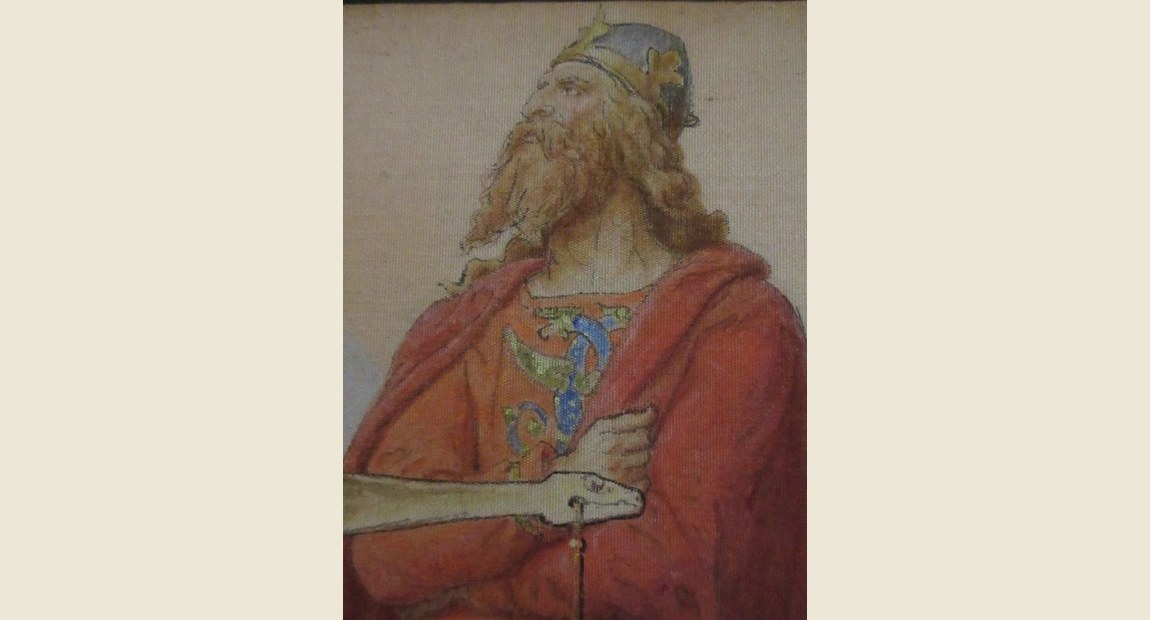
Sweyn Forkbeard (Old Norse Sveinn tjúguskegg) was the Danish king who conquered England in 1013: by the end of that year the English accepted him as king and Æthelred II fled to Normandy. On 3 February 1014 Sweyn died at Gainsborough. The son of Harald Bluetooth and father of Cnut the Great overthrew his own father around 986/87, won at Svolder and turned Danegeld into conquest. Here is what the sources actually show, and where Adam of Bremen, William of Malmesbury and monastic legend exaggerate.
Christmas 1013. On the Isle of Wight, a king celebrates the feast with no kingdom left to rule. Æthelred II of England, later nicknamed "the Unready", is sitting on an island off his own coast while almost the entire realm has bowed to a Dane. Within days he crosses the Channel to his brother-in-law in Normandy. The man who drove him out is Sweyn Forkbeard: son of Harald Bluetooth, king of the Danes, overlord of much of Norway and now accepted as king of the English. Six weeks later he is dead.
It sounds like a saga, yet most of it comes from a remarkably sober source, the Anglo-Saxon Chronicle, which recorded England's misfortunes year by year. Add two hostile German bishops, a Flemish monk writing for Sweyn's daughter-in-law, and Icelanders telling stories two centuries later, and you have a historical puzzle. Let's sort the solid pieces from the legends.
In Old Norse he was Sveinn. The byname tjúguskegg means "fork-beard": tjúga is a fork, the kind you would use for hay or dung, and skegg is a beard. The Danes still call him Svend Tveskæg, "two-beard". In English he appears as Sweyn, Swein or Svein. The nickname is first recorded around 1140 in the Roskilde Chronicle, well over a century after his death. Whether he really wore a split chin beard or a two-pronged moustache, nobody can say.
His father was Harald Bluetooth, who boasted on the great Jelling stone that he had "made the Danes Christian". His grandparents were Gorm the Old and Thyra. Sweyn's mother is uncertain. Danish reference works often name Tove, daughter of the Obodrite prince Mistivoj, who is attested as Harald's wife on the Sønder Vissing runestone, but nothing explicitly makes her Sweyn's mother. His year of birth is unknown; figures like "c. 960" or "963" are estimates.
His own household is easier to trace. Thietmar of Merseburg, a contemporary, says Sweyn married a sister of the Polish duke Bolesław the Brave. Their sons were Harald, who succeeded in Denmark, and Cnut, later Cnut the Great. A daughter, Estrid, became the mother of Sweyn Estridsen, king of Denmark from 1047. Another daughter, Gytha, married Eiríkr Hákonarson, jarl of Lade. The Icelandic sagas give Sweyn a Swedish queen, Sigrid the Haughty, a literary figure whose existence historians strongly doubt.
Sweyn's first secure appearance in history is a family war. Around 986 or 987, backed by part of the Danish nobility, he rose against his father. Harald was wounded and fled south to the Slavs on the Baltic coast. Adam of Bremen names his refuge as Jumne, usually identified with Wolin at the mouth of the Oder. There the old king died of his wounds, and his body was taken back to Roskilde for burial in the church he had built.
Why Sweyn rebelled is not reliably recorded. Adam frames it as a religious clash: a pious father overthrown by a pagan son and a pagan faction. Modern historians prefer more practical explanations. Harald's grand projects, the Trelleborg-type ring fortresses, the bridge at Ravning Enge and the strengthening of the Danevirke, demanded labour, tribute and obedience on an unprecedented scale. There were setbacks too: in 974 Emperor Otto II broke through the Danevirke, and although Harald recovered the border region in 983, Norway slipped out of his control when Jarl Hákon of Lade threw off Danish overlordship. An ambitious prince with followers hungry for land and loot did not lack supporters.
Thirteenth-century Icelandic tradition later decorated these years with the legendary Jomsvikings, who capture Sweyn and marry him off. Wonderful storytelling, but not a reliable source for the 980s.
Much of what we hear about Sweyn's Danish reign comes from men who disliked him. The most influential is Adam of Bremen, who wrote his history of the archbishops of Hamburg-Bremen around 1075. In Adam's version Sweyn is an apostate who persecuted Christians, was driven out by the Swedish king Erik the Victorious as divine punishment, and spent fourteen years in exile, finally with a Scottish king, before repenting.
The trouble is that those fourteen years do not fit the timeline. Sweyn was raiding England by 994 at the latest, fought at Svolder around 1000 and minted coins in his own name around 995. Kings in long exile do not do that. The Danish historian Niels Lund concluded that Adam was writing a sermon on sin and punishment rather than a factual account. Adam himself, rather awkwardly, mentions an English bishop named Gotebald working in Scania under Sweyn, which hardly suits a persecutor of the Church.
The second witness is Thietmar of Merseburg, a Saxon bishop who wrote until 1018 and was therefore Sweyn's contemporary. He too is hostile, paints the Danish attacks on England in dark colours and tells the story of how Sweyn's body was taken to Denmark, which we will come back to.
Beyond the chronicles, Sweyn left his own traces. Around 995 pennies were struck on an English model with a legend naming him king of the Danes. They are regarded as the oldest Danish coins to carry both a king's name and the country's name. The model was Æthelred's own coinage, and much of the silver probably came from English payments.
Even more direct are two runestones from Hedeby, now displayed at the Viking Museum Haithabu near Schleswig. One (DR 3) states that King Sweyn raised the stone in memory of Skarði, his retainer, who had "gone west" and now met his death at Hedeby. A second stone (DR 1) names a man called Thorulf as Sweyn's retainer. "West" in runic inscriptions often means England, and both stones probably remember fighting around Hedeby around the year 1000. Retainers like these, the king's heimþegi and members of his hirð, were the backbone of royal power: men who lived on their lord's food and silver and followed him to war in return.
That is the core problem for every Viking-age king. A war band needs a constant supply of silver, weapons and glory. Denmark alone could not provide enough. England could.
In 991 a large Scandinavian army defeated Ealdorman Byrhtnoth at Maldon in Essex, after which England paid 10,000 pounds to make the raiders leave. Whether Sweyn was there is disputed; some manuscripts of the Chronicle name Olaf (Tryggvason) as leader, while Sweyn is not explicitly mentioned for that year. We explain how this system of extortion and payment worked in our article on Danegeld and the Battle of Maldon.
The year 994 is certain. The Chronicle reports that Olaf and Sweyn arrived before London with 94 ships and attacked the city on the feast of the Nativity of the Virgin, 8 September. They meant to burn it, but the citizens fought back so fiercely that the attackers suffered more harm than they inflicted. Frustrated, the raiders turned on Essex, Kent, Sussex and Hampshire, seized horses and rode wherever they pleased. In the end Æthelred paid 16,000 pounds and fed the army through the winter at Southampton.
For Olaf Tryggvason, the campaign ended in a deal. He was confirmed at Andover with Æthelred as his sponsor and promised never to come to England again in hostility, a promise he kept. Instead he sailed to Norway and made himself king there, turning Sweyn's comrade at London into his most dangerous rival. Read more in our portrait of Olaf Tryggvason.
Olaf Tryggvason ruled Norway from 995 and pushed Christianity hard. For Sweyn this was doubly threatening. Norway had been within the Danish sphere under Harald Bluetooth, and a strong neighbour could control the sea lanes through the Skagerrak and Kattegat. Around 1000 Sweyn therefore formed an alliance with the Swedish king Olof Skötkonung and with Eiríkr Hákonarson, son of the jarl of Lade whom Olaf had displaced. Eiríkr was also Sweyn's son-in-law.
The allies caught Olaf on his way back from a Baltic expedition. The battle is known as Svolder (Old Norse Svǫlð or Svǫlðr), but even its location is disputed. Adam of Bremen places it in the Øresund; the Icelandic sagas put it near an island called Svǫlðr off the Wendish coast, possibly near Rügen. Icelandic tradition dates it to 9 September 1000, and some scholars consider 999 possible. The outcome is not in doubt: Olaf's fleet was defeated, his famous ship the Long Serpent was boarded, and according to tradition the king leapt overboard in full armour.
The most colourful details, such as Einarr Þambarskelfir's bow snapping in his hands, come from Snorri Sturluson's Heimskringla and earlier Olaf sagas of the twelfth and thirteenth centuries. Older and more valuable are verses by skalds like Halldórr ókristni, whose Eiríksflokkr praises the jarl's victory. In the poetry, the real hero of Svolder is Eiríkr, not Sweyn.
Politically, though, Sweyn won. Norway was divided: Eiríkr and his brother Sveinn Hákonarson governed large parts of it as jarls under Danish overlordship, some eastern districts went to Sweden, and Sweyn kept the area around the Oslo fjord, the Vík, for himself.
In England, matters grew worse. In 1002 Æthelred paid 24,000 pounds to a fleet. Shortly afterwards, on 13 November, St Brice's Day, he ordered, as the Chronicle tersely puts it, all the Danish men who were in England to be killed, because he had been told they planned to murder him and his councillors. This probably meant not the long-settled descendants of Danish colonists in the Danelaw, but mercenaries and newcomers, especially in southern towns.
A rare near-contemporary witness is a charter Æthelred issued in 1004 for St Frideswide's in Oxford. In it the king explains why the church had to be rebuilt: the Danes in Oxford had taken refuge inside, and the townspeople had burned them together with the building.
The massacre is best known for a story that turns Sweyn's campaigns into personal vengeance. Among the dead, it says, was Sweyn's sister Gunnhild, married to Pallig, a jarl in English service. Sweyn supposedly swore to return.
In 1003 Sweyn was back. The Chronicle names him as leader of the army that took and plundered Exeter, reportedly betrayed by a reeve whom Queen Emma had appointed. The Danes then marched through Wiltshire, burned Wilton and returned to their ships via Salisbury. An English force under Ealdorman Ælfric melted away before fighting because its leader feigned illness, and the Chronicle quotes a bitter old proverb: when the leader falters, the whole army is hindered.
In 1004 it was the turn of Norwich and Thetford in East Anglia. Here Sweyn met an opponent who really hurt him: Ulfcytel, an East Anglian nobleman, attacked the Danes near Thetford. The Chronicle says the Danes themselves admitted they had never met harder fighting in England. In 1005 famine struck, and the Danish fleet went home.
From 1009 another name dominates the Chronicle: Thorkell the Tall, a Danish commander whom later tradition links with the Jomsvikings. His army ravaged southern England for three years, took Canterbury in 1011 and captured Archbishop Ælfheah, who was killed at Greenwich in April 1012 by drunken warriors because he refused to let a ransom be paid for him. The army then received 48,000 pounds, and Thorkell entered Æthelred's service with 45 ships.
That switch of sides may well have alarmed Sweyn. A Danish commander with his own fleet, rich in English silver and serving the enemy, was a power the king in Denmark could not ignore. Cnut's biographer Timothy Bolton has also suggested that Sweyn's English wars helped stop his own magnates from growing too powerful. Whatever the mix of fear, greed and calculation, in 1013 Sweyn stopped bargaining for silver and went for the kingdom.
In summer 1013, before August according to the Chronicle, Sweyn sailed for England with a great fleet. His younger son Cnut was with him; the elder, Harald, governed Denmark. Sweyn first put in at Sandwich in Kent, the classic Viking landing place. Then he did something unexpected: instead of striking at Wessex, he sailed round East Anglia into the Humber and up the Trent to Gainsborough in Lincolnshire.
It was a shrewd choice. This was the region where Danish settlers had lived since the ninth century and Scandinavian custom prevailed. Almost at once Earl Uhtred and the Northumbrians submitted, followed by the people of Lindsey, the Five Boroughs (Derby, Leicester, Lincoln, Nottingham and Stamford) and finally the whole army north of Watling Street, the old Roman road that marked the edge of the Danelaw. Sweyn took hostages, demanded horses and provisions, and left the ships and hostages with Cnut.
Only when his army crossed Watling Street did he allow plundering and burning. Oxford submitted at once and gave hostages, and so did Winchester. London held out: Æthelred and Thorkell were inside, and many Danes drowned in the Thames because they did not look for a bridge. Sweyn turned west. At Bath, Ealdorman Æthelmær and the western thegns submitted. Then London gave in too, fearing that Sweyn would destroy it.
And all the nation then regarded him as full king. Anglo-Saxon Chronicle, entry for 1013 (own translation)
Æthelred's queen Emma had already gone to her brother, Duke Richard II of Normandy, and the princes followed. The king stayed with Thorkell's fleet, spent Christmas on the Isle of Wight and then crossed over himself. Sweyn demanded full payment and provisions for his army through the winter.
Sweyn returned to his base on the Trent, and there his story ended abruptly. The Chronicle for 1014 simply says that he ended his days at Candlemas, on 3 February, and that the fleet then chose Cnut as king. Contemporary sources say nothing about the cause of death. A fall from his horse is sometimes mentioned in popular accounts, but no contemporary source supports it.
The monks of Bury St Edmunds had their own explanation. In the Miracula sancti Eadmundi, written by Herman the Archdeacon towards the end of the eleventh century, St Edmund, the East Anglian king killed by Vikings in 869, appears to the Danish king at Gainsborough. Sweyn, according to the story, had demanded tribute even from the saint's lands, and Edmund ran him through with a spear. The Morgan Library in New York holds a Bury manuscript from around 1130 that paints the scene: Edmund, crowned and holding a money bag, thrusts his spear into the breast of Sweyn as he lies in bed.
Sweyn's achievement soon unravelled. The English magnates invited Æthelred back, on condition that he rule more justly than before. In spring 1014 Æthelred marched on Lindsey, where Cnut was still waiting for horses and support. Cnut sailed away, put his father's hostages ashore at Sandwich with their hands, ears and noses cut off, and returned to Denmark. For a moment it looked as if the Danish adventure was over.
According to the Encomium Emmae Reginae, a work of praise written by a Flemish monk around 1041/42 for Queen Emma, Sweyn was first buried in England, probably at York. Thietmar of Merseburg reports that an English woman had the body dug up and sent to Denmark. Some historians suspect she was Ælfgifu of Northampton, Cnut's first partner, from a family of the English north.
The Encomium names his final resting place as a Holy Trinity church that Sweyn himself had founded, without naming the town. Most scholars think of Roskilde, where Harald Bluetooth was already buried. The Swedish archaeologist Maria Cinthio argued instead for Holy Trinity in Lund, in then-Danish Scania, whose beginnings date to Sweyn's time. The question is unresolved, and no grave can be securely assigned to him.
Sweyn's elder son Harald II succeeded in Denmark. Cnut returned to England in 1015 with a large fleet, backed by Eiríkr Jarl and, once again, Thorkell the Tall. After Æthelred's death in April 1016 and the battle of Assandun that October, Cnut became king of all England when Edmund Ironside died soon afterwards. In 1017 he married Emma, widow of the man his father had driven out. Denmark followed around 1018/19 and Norway in 1028: the son completed what the father had begun. Read more in our article on Cnut the Great.
Modern historians such as Peter Sawyer and Niels Lund have thoroughly revised Adam's picture of a godless rebel. Sweyn now appears as a hard-headed, adaptable ruler who invested his father's resources not in fortresses but in fleets and followers. He exploited the weakness of the English leadership with real political instinct, relied on the loyalty of the Danelaw and won the richest kingdom in north-western Europe almost without a pitched battle. He was no saint: his campaigns cost countless people their lives, freedom or property. In him you can see the shift from Viking raids on England to the age of Christian kingdoms, a road that only ended in 1066, when Harald Hardrada fell at Stamford Bridge.
Who was Sweyn Forkbeard? Sweyn Forkbeard (Old Norse Sveinn tjúguskegg, Danish Svend Tveskæg) was king of Denmark from about 986/87 to 1014, son of Harald Bluetooth and father of Cnut the Great. In late 1013 the English accepted him as their king.
When was Sweyn Forkbeard king of England? From London's submission in late 1013 until his death on 3 February 1014, only a matter of weeks. No formal coronation is recorded.
How did Sweyn Forkbeard die? Contemporary sources give no cause of death. He died at Gainsborough in Lincolnshire. The story that St Edmund killed him with a spear is a monastic legend from Bury St Edmunds.
Why was he called Forkbeard? The Old Norse byname tjúguskegg means "fork-beard". It is first recorded around 1140, and we do not know what his beard actually looked like.
Where is Sweyn Forkbeard buried? First in England, then his body was taken to Denmark and buried in a Holy Trinity church he had founded. Whether that was in Roskilde or Lund is disputed.
Was Sweyn Forkbeard a pagan or a Christian? He was baptised and issued coins bearing a cross. The image of a pagan apostate comes from Adam of Bremen and is regarded by historians as partisan.
For courage. For remembrance. For legends that live on.
Danegeld & the Battle of Maldon · Ragnar's sons · Gorm the Old · Thyra Danebod – Denmark's mightiest woman · Stiklestad – the fall of Saint Olav.
All History & Finds articles →
The Vikings had no central state power. Law and politics arose at the assembly of free people – the Thing.
Read more →A handle that turned out too short, a fly at the bellows and over a thousand silver amulets in the earth: Thor's hammer …
Read more →A king raises a stone for his wife and calls her on it “Denmark's adornment.” A son sets both parents an even greater …
Read more →A lake named after a god. A lord’s hall the size of a church. Weapons sunk in the water, and a gold ring heavier than …
Read more →